
contentEffort Google Leak: What the Field Actually Confirms
The contentEffort Google leak is real but narrow. See what the primary documents actually confirm, what's inference, and one vendor's unverified claim.

On this page
The contentEffort Google leak exposed a real field in Google's Content Warehouse documentation. Google wrote the field's description; no vendor invented it. That description runs two lines, buried one level deeper in Google's schema than the fields it usually gets grouped with, and says nothing about how the score is produced or weighted.
Somewhere between the March 2024 leak and today, contentEffort turned into a pitch. Paid tools now sell a 0-100 "Content Effort Score" that supposedly mirrors Google's internal number, and one of them claims contentEffort synthesizes a second leaked field, originalContentScore, a real field elsewhere in the leak that the documentation never ties to contentEffort.
This guide keeps the two apart. Every google content effort claim here is checked against a primary document and quoted with its exact location; everything else is marked as inference.
In this guide:
- What the leaked field's own text says, and how to read it yourself
- Where it actually sits in Google's schema, not where it usually gets grouped
- Google's Search Quality Rater Guidelines definition of effort, turned into a checklist
- Whether Google's field and the rater guidelines' criterion are confirmed to be the same thing
- Why three public content effort scoring tools produce three numbers that don't convert into each other
The contentEffort Google leak: what the field actually says
contentEffort is a field in Google's leaked Content Warehouse documentation, described as "LLM-based effort estimation for article pages" and stored as a list of scores rather than one fixed number. The description names one page type only: articles.
It says nothing about how the LLM's score gets produced, what counts as high or low, or whether it factors into ranking at all.
The data type backs up that narrowness. contentEffort is a list of QualityNsrVersionedFloatSignal entries, each one a {value, versionId} pair. That structure lets Google keep more than one effort score around, tagged to whichever model version produced it, instead of overwriting a single number every time the model changes.
You don't have to trust a summary of any of this. The leak's public mirror is browsable directly: open the QualityNsrPQData module and search for contentEffort.
Google's own generated field comment is right there, unfiltered by any SEO blog's summary, ours included.
That field sits inside a much larger structure. Google's public documentation on google ranking factors never names contentEffort; it belongs to a separate class of internal signals the leak exposed, distinct from anything Google has published as a ranking factor.
Where contentEffort actually sits in Google's documentation
The leaked contentEffort attribute isn't a direct field of CompressedQualitySignals, the structure most explanations group it under. It sits one level deeper, inside QualityNsrPQData, reached only through CompressedQualitySignals' own pqDataProto field.
Several explainers list contentEffort alongside ugcDiscussionEffortScore, lowQuality and siteAuthority as though all four sit at the same level. The leak's own field documentation draws a different picture. CompressedQualitySignals reaches quality data through one field:
pqDataProto: "Stripped page-level signals, not present in the encoded field 'pq_data'," type QualityNsrPQData.t
Only inside QualityNsrPQData does contentEffort show up. Three other fields skip that extra step and sit directly on CompressedQualitySignals: ugcDiscussionEffortScore, described as "UGC page quality signals. (Times 1000 and floored)" and used for pages like forums; lowQuality, converted from quality_nsr.NsrData; and siteAuthority, converted from quality_nsr.SiteAuthority. siteAuthority is its own leaked, site level signal with a mechanism worth its own explanation; see siteAuthority for that.
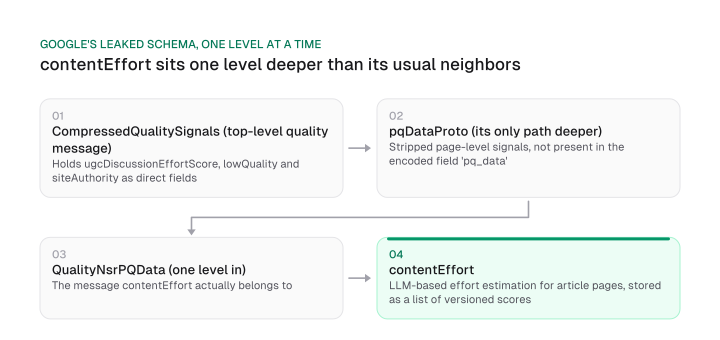
The distinction is easy to miss because two levels of schema nesting read like one in a quick summary. It matters here because the fields that sit directly on CompressedQualitySignals (ugcDiscussionEffortScore, lowQuality, siteAuthority) are a different tier of signal than a field Google can only reach by first stepping into pqDataProto and then into QualityNsrPQData.
How Google's quality raters define effort, and how to check your pages against it
The google quality rater effort criterion is the extent to which a person actively worked to create satisfying content, one of four inputs Google's guidelines weigh for Main Content quality alongside originality, talent or skill, and accuracy. Google's own Search Quality Rater Guidelines spell out what does and doesn't count, in section 3.2:
"Effort: Consider the extent to which a human being actively worked to create satisfying content. Effort may be direct, such as a person translating a poem from one language to another... the automatic creation of thousands of pages by running existing freely available content through existing translation software without any oversight, manual curation, etc., would not be considered to have effort."
That definition centers on what the page itself shows: sourcing, structure, original analysis, demonstrated firsthand experience. Hours logged and which tool drafted the page don't enter into it.
The same section extends the idea to community content: "For pages like social media posts or forum discussions, the level of participation and depth of conversation is an important part of effort. Contributions from multiple individuals on such pages can add up to a significant amount of total human effort."
Here's a checklist that ties every line to that source sentence, instead of a proprietary scoring vocabulary layered on top of it:
- Original information, reporting, research or analysis of its own, beyond assembled facts (Google's helpful content guidance).
- Insight or analysis beyond the obvious, not a restatement of what's already out there (same guidance).
- First-hand expertise and depth of knowledge visible on the page itself, the kind that comes from having actually used something or visited somewhere (same guidance).
- Direct human work behind the page: original reporting, hands-on testing, a person's own translation or analysis (QRG section 3.2).
- Not the output of running existing, freely available content through translation or generation software with no oversight or manual curation (QRG section 3.2).
- Depth that actually matches the topic; a thin answer to a technical question reads as low effort no matter who or what produced it (QRG section 3.2).
- On UGC pages, forums, comment sections, social posts, real participation and depth of conversation from more than one contributor (QRG's UGC clause).
- Contributions that add up across a thread; many thin replies can clear the bar collectively where one unexplained post can't (QRG's UGC clause).
This checklist belongs inside a repeating ai content production process, run before every publish rather than once.
Where the effort criterion meets generative AI content
Google's Search Central publishes one page on generative AI content, and it names exactly two Quality Rater Guidelines sections to read: 4.6.5 on scaled content abuse and 4.6.6 on little-to-no-effort content. Google's guidance on using generative AI content puts them side by side directly:
"You might find value in looking at the Search Quality Raters guidelines on how to evaluate both scaled content abuse (section 4.6.5) and main content created with little to no effort, little to no originality, and little to no added value (section 4.6.6)."
Section 4.6.5, on scaled content abuse, is covered in depth elsewhere: see is ai content bad for seo for the current policy and examples.
What belongs here is the effort-specific line. Google's guidelines state it plainly: "the use of Generative AI tools alone does not determine the level of effort or Page Quality rating."
Section 4.6.6's own heading names the failure condition directly:
"MC Created with Little to No Effort, Little to No Originality, and Little to No Added Value for Website Visitors."
The tool used to write a page and the effort a page shows are two separate questions. Google's own reading list keeps them that way.
Is the leaked contentEffort attribute the same as QRG effort?
Confirmed and inferred aren't the same claim. Google's documents confirm that a rater criterion called Effort and a field called contentEffort both exist, but they never say the field measures the criterion.
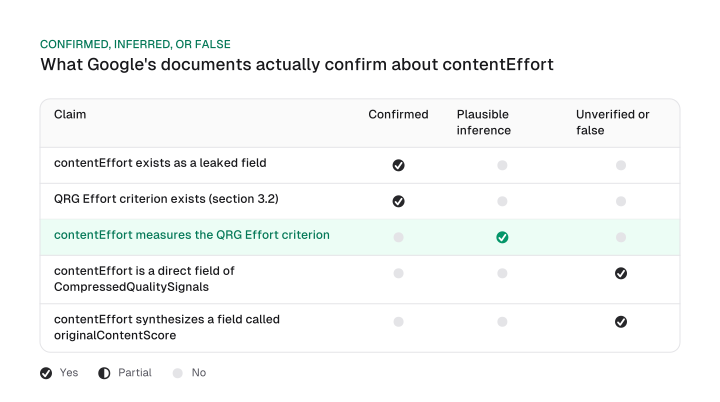
Written out, the same five rows read like this. The field exists in the leak: confirmed. The QRG Effort criterion exists in section 3.2: confirmed. The field measuring that criterion is a plausible inference. Nothing in either document confirms it outright.
One more row lands on false: contentEffort isn't a direct field of CompressedQualitySignals, for the reasons in the previous section. A second claim, that contentEffort synthesizes a field called originalContentScore, is unverifiable: that field is real but sits in an unrelated part of the leak's documentation, and nothing ties the two together.
That last row is checkable, and the claim doesn't hold as written. A field called OriginalContentScore does exist, inside a different module (PerDocData), and its own description limits it: "Only pages with little content have this field." Nothing in the documentation ties it to contentEffort.
One vendor, Searchable.com, describes its own scoring method by claiming contentEffort "is not a single signal but a system of competing philosophies that likely synthesizes several attributes, including: contentEffort, originalContentScore, ugcDiscussionEffortScore." All three items in that list are real fields in the leak, but the leak's own documentation never states that contentEffort synthesizes the other two; the synthesis claim itself stays unverified against the primary source it implies.
Treating contentEffort as "the QRG's Effort criterion, automated" is a reasonable hypothesis. It has zero direct confirmation behind it, and at least one vendor has already built past that hypothesis into a fabricated field name.
Why public content effort scoring tools don't agree with each other
Three public content effort scoring systems carve up the same idea three different ways, and none of their scales convert into each other.
| Tool | Scale | What it covers |
|---|---|---|
| Metaflow's Content Effort checklist | 0 to 12 | Six visible-evidence signals |
| WordStream's Content Effort Scorecard | Capped at 92 of 100 from text alone | Text input can't earn the last 8 points; those need visible proof, like interactive elements, custom visuals and demonstrated expertise |
| Carlos Redondo's Rubric 2.0.0 | 32-point intrinsic score | Kept separate from its own 0-4 information-gain dimension, scored against the live top 10 |
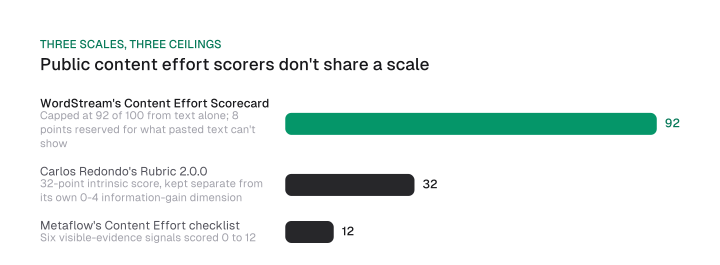
Lined up side by side with no recalculation, the three scales don't share a common ceiling. Metaflow tops out at 12. WordStream tops out at 100 but reaches only 92 from pasted text alone, reserving the last 8 points for what plain text can't show it.
Carlos Redondo's Rubric 2.0.0 keeps its 32-point intrinsic score deliberately separate from its own 0 to 4 information-gain dimension. The stated reasoning: combining the two "would mix two different contracts."
None of the three claims to read Google's internal number, and none of them could: Google has never published contentEffort's scale or its weight in ranking. A score from any one of these tools is a checklist proxy for that tool's own rubric. It isn't a readout of Google's field, and the three rubrics don't even agree on how many points to award or what to keep separate.
That's the real shape of the content effort google leak: a two-line field description. It has no scoring system attached. contentEffort stays scoped, narrow and unweighted in the documents, and every public tool measuring "effort" measures its own checklist instead of Google's field.
Run the checklist above against a page before you publish it. It won't hand you a number, but neither does Google's own field.
Frequently asked questions
Is contentEffort a confirmed Google ranking factor?
No. It's a stored, LLM-produced signal named in leaked documentation, described only as "LLM-based effort estimation for article pages." It has never appeared on a public Google ranking-factor page, and the documentation itself says nothing about how or whether it affects ranking.
Can I see the leaked contentEffort field myself?
Yes. A public mirror of the leaked Content Warehouse client library publishes the field's exact one-line description and data type. Search its module index for QualityNsrPQData and you'll find contentEffort's entry exactly as Google's own generated comment states it.
Does using AI to write content automatically lower my effort score?
No. Google's guidelines state directly that "the use of Generative AI tools alone does not determine the level of effort or Page Quality rating." What lowers it is the absence of oversight, curation or original work, whether or not AI was involved in drafting.
What's the difference between contentEffort and ugcDiscussionEffortScore?
contentEffort scores article pages and sits inside a different message, QualityNsrPQData, than ugcDiscussionEffortScore, which is a direct field of CompressedQualitySignals and scores UGC pages like forums and comment threads.
Do third-party Content Effort Score tools match Google's real number?
No tool can, since Google has never published the field's scale or weight. Each public tool, Metaflow's, WordStream's and Carlos Redondo's included, scores its own rubric against its own ceiling instead of Google's field.
Figures and images in this post are free to reuse under CC BY 4.0 with credit to Mission Growth.
Get Mission Growth highlighted in your Google results.