
AI Content Strategy: The 6-Stage AI Content Workflow
Build an AI content strategy on a 6-stage workflow, not a tool list. See what AI drafts, what a human checks, and the failure each check is built to catch.

On this page
An AI content strategy is a six-stage production workflow, not a planning document. AI drafts the work at two defined points. Four named human gates check it before it moves forward, and each gate is built to catch one specific failure.
Most teams still treat "AI content strategy" as something you write once: brand voice guidelines, a content calendar, a list of pillar topics. That definition stops being useful once a team publishes daily. The real question becomes operational: which stage does AI own, which stage does a human check, and what is that check actually built to catch?
This guide answers it with the AI content production process that turns a plan into published pages, stage by stage and gate by gate.
In this guide:
- The six stages, what AI does at each one, and which four carry a named human gate
- The specific, sourced failure each gate is built to catch, including a real AUD 439,142 incident
- A decision rule for turning a gate into a checklist instead of a vibe check
- A volume threshold for when a shared doc stops working and dedicated tooling starts paying for itself
What an AI content strategy actually is
An AI content strategy is the sequence of production stages where AI drafts and a named human gate checks the work before it moves to the next stage. It is not the strategy document that sits above it.
As a document, that usually means pillars, a calendar, a tone guide: useful for direction, silent on execution. It doesn't say which stage AI owns, which stage a human checks, or what that check is built to catch. That missing piece is a vendor-neutral AI content strategy framework built around the checkpoint rather than the artifact.
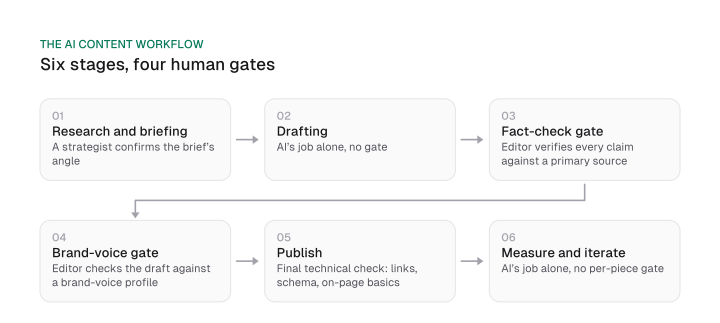
| Stage | AI's job | Human gate | What it catches |
|---|---|---|---|
| 1. Research and briefing | Pulls a first-pass topic and competitor scan and drafts a brief from existing performance data | Strategist confirms the brief's angle | An AI-suggested topic that duplicates a live page's intent (cannibalization) |
| 2. Drafting | Writes the full first draft from the confirmed brief | None. AI's job alone | Not applicable |
| 3. Fact-check gate | None. Human-only stage | Editor verifies every checkable claim against a primary source | A wrong fact stated in the same confident tone as a correct one |
| 4. Brand-voice gate | None. Human-only stage | Editor checks the draft against a written brand-voice profile | Generic, unsupported claims that read like every other AI draft |
| 5. Publish | Formats and schedules once both editorial gates pass | Final technical check: links, schema, on-page basics | A piece that passed editorial review but breaks a technical requirement |
| 6. Measure and iterate | Surfaces performance data back to the team | None. AI's job alone; gate performance gets reviewed separately | Not applicable |
Most results for an AI content strategy template hand you a spreadsheet tab full of columns to fill in. The table above is the template that matters, because its four columns are the ones a piece can fail on. Fill in your own tools and owners underneath it.
This table is a production workflow, not an AI SEO optimization checklist: it decides whether a piece is fit to publish at all, and Stage 5 below shows exactly where the two jobs meet.
The 6-stage AI content workflow, stage by stage
Each of the six stages has one job for AI. Four of them pair that job with a named human gate built to catch one specific failure, and two are AI's work alone.
Stage 1: Research and briefing
AI pulls a first-pass topic and competitor scan and drafts a brief from existing performance data. A strategist reviews that brief before anyone drafts a word.
- AI's job: Pull a first-pass topic and competitor scan, then draft a brief from existing performance data.
- The gate: A strategist confirms the brief's angle and disqualifies any AI-suggested topic that duplicates a live page's intent.
- What it catches: Cannibalization. An AI research pass has no way to know a sibling page is already in production for the same intent; a strategist does.
- Who owns it: The strategist.
Stage 2: Drafting
AI writes the full first draft from the confirmed brief. There's no gate at Stage 2, and that's by design: this stage is AI's alone, and the next two stages exist specifically to check its output.
Stage 3: Fact-check gate
An editor verifies every specific, checkable claim against a primary source before the piece moves forward: a number, a date, a named source, a quote. Nothing here is AI's job; Stage 3 is human-only by design.
Here's why that gate has to exist. OpenAI's Kalai, Nachum, Vempala and Zhang published a paper in September 2025 arguing that language models hallucinate because training and evaluation procedures reward a confident guess over an admission of uncertainty.
So a wrong fact comes out of the model in the same fluent, assured tone as a correct one. Nothing in the sentence itself flags the risk. That's the specific failure Stage 3 exists to catch, and the check has to run against a primary source, not against how confident the draft sounds.
The stakes aren't hypothetical. Deloitte Australia delivered a government report worth AUD 439,142 to the Department of Employment and Workplace Relations, and it shipped with a fabricated legal quote and invented references.
An outside researcher found them and the report had to be reissued. In October 2025 Deloitte was not paid AUD 97,587.11 of that contract: 22.2% of its value, or 97,587.11 divided by 439,142.
That scale is not a one-off. The EBU and BBC's October 2025 study of AI-assistant answers from ChatGPT, Copilot, Gemini and Perplexity found that 45% had at least one significant issue, 20% had a major accuracy issue such as hallucinated or outdated information, and 31% had a sourcing problem.
A wrong fact isn't the only stake at this gate, either. Unchecked AI content carries ranking risk on top of factual risk, and that's a separate mechanism our guide on is ai content bad for seo answers in full.
Stage 4: Brand-voice and originality gate
An editor checks the draft against a written brand-voice profile and flags generic, unsupported claims. Like Stage 3, this is a human-only stage: nothing here is AI's job.
What it catches is different from Stage 3, though. A draft can pass fact-check clean and still read like every other AI draft on the internet: vague claims, no specific numbers, no position taken. Here's what that looks like caught, side by side.
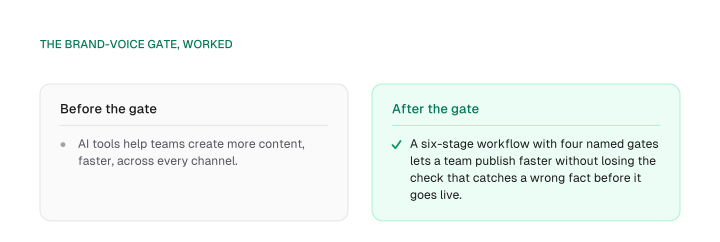
Before the gate: "AI tools help teams create more content, faster, across every channel." After it: "A six-stage workflow with four named gates lets a team publish faster without losing the check that catches a wrong fact before it goes live."
The first sentence is true of every AI tool ever built and commits to nothing. The second names a number, a mechanism and a claim a reader could disagree with. That's the brand-voice gate doing its job.
Stage 5: Publish
AI formats and schedules the piece once both editorial gates pass. A final technical check runs before anything goes live: links, schema, on-page basics. That check is Stage 5's gate, and it is technical rather than editorial, which makes it a different job from an AI SEO checklist, the one that covers on-page and technical optimization once a piece is already live.
What it catches: a piece that cleared both editorial gates but breaks a technical requirement, a dead internal link, a missing schema field, a broken figure directive.
Stage 6: Measure and iterate
AI surfaces performance data back to the team: traffic, engagement, whatever the stack already reports. There's no gate here either; Stage 6 is AI's job alone, same as Stage 2.
What the team does with that data is separate from a per-piece gate. The team reviews gate performance itself: how many drafts each gate rejected, and why.
That's a different measure than time-to-publish or hours saved, and it catches a failure those speed metrics can't see: a workflow that looks efficient, fast, high-volume, while its gates quietly stop catching anything.
Mission Growth's platform tracks AI citations and visibility for customers. That's worth separating clearly from what this section measures: production-quality metrics (did the gates catch anything) and AI-answer visibility metrics (does the published piece get cited) are two different questions, and conflating them is how a team ends up measuring the wrong one.
Turn each gate into a checklist, not a vibe check
A gate written as an explicit, named checklist catches more real errors than an editor's unstructured read-through. It removes the case-by-case inconsistency that unaided judgment introduces, and that's not a content-marketing hunch.
A 2000 meta-analysis by Grove and colleagues compared structured, mechanical prediction against unaided clinical judgment across studies in health and behavior. It found mechanical prediction was about 10% more accurate on average, and substantially better in 33%-47% of the studies it covered, against clinical judgment being substantially better in only 6%-16%.
The mechanism is the same one your gates run on: a decision procedure applied the same way every time beats a skilled person's unaided read, because the procedure doesn't have good days and bad days.
So write each gate as a named, specific list instead of trusting a skilled editor's unaided pass. For the fact-check gate, that might read: every number has a primary source, every named entity's claim traces to a source, no unattributed superlative survives. For the brand-voice gate: no sentence could run unedited on a competitor's blog, every claim names a number or a position, no banned term made the cut.
This transfer has a limit, and it's worth stating. Grove's finding is about predictive judgments with quantifiable cues, closer to clinical diagnosis than to open-ended tone or creative judgment. It supports one recommendation: make the fact-checkable, rule-based part of your gates an explicit list. It doesn't extend to a broader claim about AI versus human judgment.
Small team vs. enterprise: when the workflow needs dedicated tooling
A shared document with the same six gates works until a team is producing content daily across more than one channel. Past that volume, the coordination cost of a shared doc exceeds what workflow software costs.
Coordination cost is what decides this, and it is the real question in AI content operations at volume. A five-person team publishing twice a week can run all six stages off a shared doc and a Slack thread, where a gate is a checklist someone opens before hitting publish.
The document starts to break down once multiple writers, multiple channels and multiple gate-owners are all touching the same piece in the same day. A shared doc has no way to enforce that a gate ran before the next stage started.
That's a different decision than the one ai agent seo answers: this is about who checks content production, not which agent architecture runs an SEO workflow end to end. Once you're past the threshold, the comparison that matters is tooling, not headcount; see best ai seo tools for what dedicated platforms actually cover.
Why an AI content workflow fails even with a human "reviewing" it
An AI content workflow fails when the human step is a skim for tone instead of a named gate checking a specific failure mode. "We have a human in the loop" and "the workflow actually catches errors" are not the same claim.
Three patterns show up most often:
- The fact-check gate exists on paper, but nobody runs it against a primary source. The editor checks how confident the sentence sounds instead, which is exactly the signal Stage 3 exists to distrust.
- The brand-voice gate collapses into a five-minute typo skim. A generic sentence like the "before" example in Stage 4 ships unchanged because nobody checked it against the brand-voice profile at all.
- No one owns the gate by name. "Someone will catch it" quietly becomes nobody's job on a busy publishing week.
Most "this reads generic" complaints trace back to Stage 4 being skipped or rushed, not to the AI draft itself. Unchecked, generic AI content carries ranking risk on top of the credibility problem; see does google penalize ai content for that mechanism.
An AI content strategy is the six-stage workflow itself, not the plan that sits above it: four named gates catch a specific, sourced failure before a piece publishes. Start this week: pick your riskiest gate, fact-check or brand-voice, write its checklist down, and run your next AI draft through it before it goes out.
Frequently asked questions
No. In this workflow, AI owns Stages 1 and 2, the research pass and the first draft, by design. Stages 3, 4 and 6 stay human because they're judgment calls: verifying a claim, checking brand voice, and deciding whether gates are catching real errors. That's different from asking will ai replace seo more broadly.
Every specific, checkable claim gets checked against a primary source: a number, a date, a named source, a quote. The target is the individual claim rather than the whole draft's "accuracy" in the abstract. That's the gate that would have caught Deloitte's fabricated legal quote before its government report shipped.
Yes. The same six stages and four gates apply per language. The fact-check and brand-voice gates need a reviewer fluent in that language; a plain translation of the English checklist won't catch what native fluency would.
The exposure sits at Stage 1: whatever you feed a research or briefing tool, customer data, unpublished performance numbers, is what leaves your systems. That input deserves the same scrutiny you give the published page.
The six stages and their gates are format-agnostic. What changes per format is how much weight Stage 4 carries: off-brand risk runs higher in short, public-facing formats like social captions than in long-form blog posts.
Figures and images in this post are free to reuse under CC BY 4.0 with credit to Mission Growth.
Get Mission Growth highlighted in your Google results.