
Is AI Content Bad for SEO? The Scaled Content Abuse Test
Is AI content bad for SEO? No: Google penalizes low-value scale, whatever tool made it. See the scaled content abuse rule and a 4-question test.

On this page
Is AI content bad for SEO? No. Google's ranking systems don't check how a page was written. They check whether it's original, helpful, and demonstrates real expertise.
Its spam policies target manipulative scale. The tool that typed the words was never the target.
The harder question is that the sources people cite to prove it disagree with each other. One source says AI assistance is already common among top-ranking pages. Another says nearly half of publishers saw AI help their rankings. A third, built to measure a winner between the two, says pages written by people currently outrank AI ones most of the time.
None of those numbers are wrong. They measure different things. Once you separate them, the policy question stops being a vibe and becomes something you can check against a page you already published.
In this guide:
- Google's current scaled content abuse policy, quoted directly, past the 2023 blog post alone
- Why no AI text detector, including anything Google itself could build, can be made reliable
- The replicability test: one question that predicts whether an AI-assisted page will lose rankings
- What three widely cited studies actually measured, reconciled into one calibrated answer
- A decision matrix for what to do with AI content you've already published
Is AI content bad for SEO? What Google actually penalizes
Google does not penalize a page for being written by AI. Its ranking systems check whether a page is original, helpful, and demonstrates real expertise.
None of those checks reads the byline to see whether a human or a model typed the sentence.
Google said as much directly in a February 2023 blog post. Using automation, including AI, to generate content is a problem only when the primary purpose is manipulating rankings rather than helping users.
What Google has said directly:
- Production method: automation and AI are allowed; the violation is using them to manipulate rankings primarily.
- Evaluation criteria: helpfulness, originality, and E-E-A-T apply the same way regardless of who or what wrote the page.
- Detection: Google doesn't rely on a tool that flags "AI-written" text as such, which the next section explains.
So does google penalize ai content the way people fear? No. It penalizes a behavior pattern that predates AI by years and simply now includes it.
That line is still the operating principle today. What's changed since 2023 is that Google folded the same intent test into a named, current spam policy that goes further than the original post ever did. The 2023 language alone doesn't cover what the policy says now.
If your real worry is whether AI replaces the SEO role rather than whether this specific page ranks, that's a related but separate question. See will ai replace seo for the job question. This post stays on whether the content itself gets penalized.
What Google's spam policy flags today
Google's current scaled content abuse policy defines the violation the same way no matter who or what produced the page: many pages generated to manipulate rankings without helping users.
Google says the policy applies "no matter how it's created." It names three ways pages get generated in volume to break it: generative AI, scraping paired with automated transformation, and content stitched together from multiple sources.
This policy sits inside the wider discipline of generative engine optimization, which covers how pages earn a place in AI answers generally, beyond classic search results.
What counts, and what doesn't:
- Counts as abuse: a template swapped across hundreds of near-identical pages with no original data, expertise, or reason to exist beyond ranking for a keyword.
- Doesn't count: a page built with AI assistance that adds original data, a tested procedure, or first-hand expertise a reader can't get from scrolling a search results page.
The dividing line the policy actually draws is whether a page would exist without the ranking incentive behind it. Who or what typed it is beside the point.
Can Google detect AI-written text?
Google doesn't rely on an AI text detector, because no detector, however well built, can be made reliable enough to trust.
SpamBrain, Google's spam-fighting system, doesn't try to guess who or what wrote a page. It analyzes patterns and signals to identify spam content "however it is produced."
Here's the mechanism, in plain terms first: as language models write more and more like humans, no detector can perfectly separate the two, no matter how good the detector gets. The boundary it's trying to draw keeps getting thinner.
The specific finding:
- Sadasivan and coauthors' 2025 paper found a mathematical ceiling on detection accuracy, tied to how close text written by AI and text written by people actually are.
- Recursive paraphrasing, rewriting AI text through another model, pushes that ceiling toward random guessing by washing out the fingerprints a detector looks for.
That's why a low score from a third-party AI detector like Originality.ai or GPTZero doesn't move your Google rankings on its own. Google's ranking systems don't take detector output as an input.
So can Google detect AI content the way those tools claim to? No: the accuracy ceiling is mathematical, and it holds by design.
For the fuller technical rundown of what to check page by page, see the ai seo optimization checklist.
What triggers a ranking drop
Pages built with AI help lose rankings when they're easy to reproduce: a competitor, or another AI, could generate the same page from the same public information with nothing added.
That's the actual mechanism behind every symptom people blame on AI, whether they call it hallucination, no brand voice, or low engagement. It's a page that offers nothing a reader couldn't get by asking any model the same prompt.
The test below comes from a pattern Google's own leaked ranking documentation and its public guidance both point to, distilled into four questions you can run on any page in a few minutes:
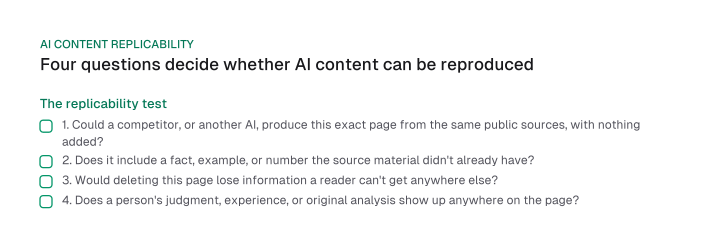
- Could a competitor, or another AI, produce this exact page from the same public sources, with nothing added?
- Does it include a fact, example or number the source material didn't already have?
- Would deleting this page lose information a reader can't get anywhere else?
- Does a person's judgment, experience or original analysis show up anywhere on the page?
The same leaked documentation names an attribute called contentEffort, reportedly used to estimate how much genuine effort and originality a page required. Google has never confirmed exactly how it's used.
The direction still lines up with the test above: effort that shows up as something added to the page, separate from effort spent generating volume.
Everything else people flag as an AI content risk is a visible symptom of failing that test, and rarely a separate problem.
Where each symptom actually comes from:
- Hallucinated facts: careless generation, not verified information, that adds nothing true.
- Generic-sounding writing: no voice, example, or judgment a competitor's model couldn't also produce.
- Weak engagement and short dwell time: what that failure looks like in the data, since a page with nothing new gets skimmed and abandoned.
Algorithmic bias in AI output sits outside that pattern. It's a brand-safety risk worth catching in review, separate from ranking.
Does AI content actually rank? What three studies measured
Three widely cited numbers about ai content and seo rankings disagree with each other because they measure three different things: perception, presence, and head-to-head performance.
Only one of them actually answers "will my AI content outrank a page written by a person."
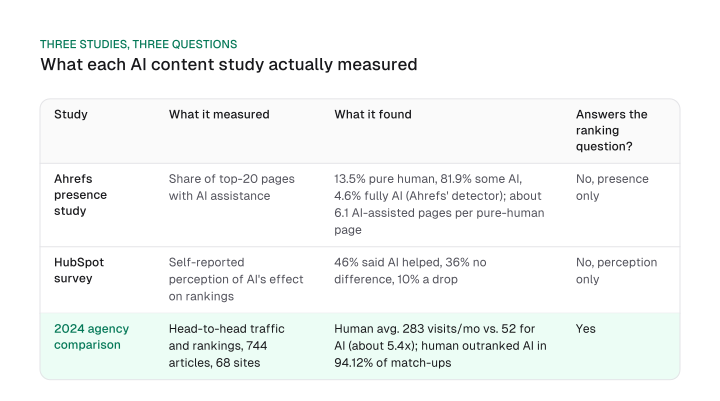
Ahrefs' study of 100,000 keywords found that, as classified by Ahrefs' AI detector, 13.5% of top-20 pages were "pure human," AI played some role in 81.9% of them, and 4.6% were fully AI-generated. That's a pattern-based estimate from one company's own detector rather than a manual count.
Do the math: roughly six pages with some AI help rank for every fully human page (81.9 divided by 13.5, about 6.1). That's a presence signal: it shows how common AI assistance already is. Performance is a separate question.
HubSpot's survey of 300-plus web strategists found 46% said AI helped their pages rank higher, 36% saw no difference, and 10% saw a drop. That's a perception check, filtered through however each person defines "helped."
The number that actually answers the SEO question: in one 2024 agency comparison of 744 articles across 68 sites, human-written pieces averaged 283 monthly visits against 52 for AI, about 5.4x the traffic, and outranked AI content in 94.12% of the match-ups.
Presence and perception both say content built with AI help is common and feels fine to publish. The one study built to measure a winner says pages written by people currently win most of the time.
"Does AI content rank" and "does AI content rank as well as human-written content" turn out to be different questions.
For the wider set of AI-SEO numbers beyond content quality, AI Overview prevalence, click-through rates, and citation counts, see ai seo impact ranking statistics.
E-E-A-T and AI content: what the framework requires
E-E-A-T is not a single ranking signal AI content has to pass. Google's own Search Quality Product Management lead, Elizabeth Tucker, said as much directly on the Search Off the Record podcast in June 2024.
"There's no ranking signal that's a one-to-one match with E-E-A-T."
The closest analogue, PageRank, only lines up with the authoritativeness part of the framework. The other three letters have no equivalent.
Treating e-e-a-t ai content questions as a checklist a page has to clear misreads what the framework is for.
What Google's own quality raters use E-E-A-T for is closer to a mindset than a gate. It's the lens raters apply when judging whether a page seems useful, and not a score the algorithm reads off directly.
That reframes the byline question specifically. Google's Search Off the Record team addressed a common misreading directly in an August 2023 episode: needing a named, credentialed author in the byline to satisfy E-E-A-T isn't the requirement.
"It's about whether or not you are demonstrating expertise generally across content."
That's also more useful for readers than a credential line alone. Google's separate guidance on disclosure only asks that you identify who or what created a page when readers would reasonably expect to know, short of a blanket credential requirement.
The same logic applies to misinformation and YMYL topics. Google's guidance singles out medical, financial, and safety content for extra scrutiny regardless of production method, because the cost of being wrong is higher there. AI isn't specifically suspect.
If you're weighing whether any of this changes once you're optimizing for AI answer engines rather than classic search, that's the geo vs seo distinction, a separate question from this post's.
How to avoid AI content penalties in SEO
There's no published safe ratio or weekly cap on AI-assisted content, because Google's policy tests each page's value on its own, independent of volume.
That means your workflow question isn't "how many can we publish this month." It's "does this specific page pass the replicability test," asked one page at a time. If an AI SEO agent drafts the pages, the same test applies to every draft it hands back.
Here's how to avoid ai content penalties in seo in practice, not in theory:
- Research and outline with AI. It's fast at pulling together what's already public, which is exactly the part that doesn't need a person's time, and exactly the part that, left alone, produces a replicable page.
- A person adds what AI can't. A number from your own data, an opinion backed by a reason, a specific example you've actually seen. This step decides whether the page passes the replicability test, so skipping it defeats the workflow.
- Fact-check every claim against a source you can name, especially anything generated with confidence and no citation. This is where hallucinated facts get caught before they cost the page its credibility.
- Publish, then retest. Six months later, run the same test again on your page: if a competitor or another AI could now produce it from public information alone, it has drifted back toward the replicable pile and needs another pass.
Cadence was never your lever here. The lever is a mandatory human pass that adds something a model couldn't already produce.
For how this changes the rest of the SEO workflow beyond content production, see ai search optimization vs traditional seo.
What to do with AI content you've already published
An AI-assisted page that's already underperforming should be deleted and redirected, consolidated, rewritten, or left alone, based on its traffic and how easily it could be reproduced.
That's a two-factor decision, and never a blanket delete-everything reflex.
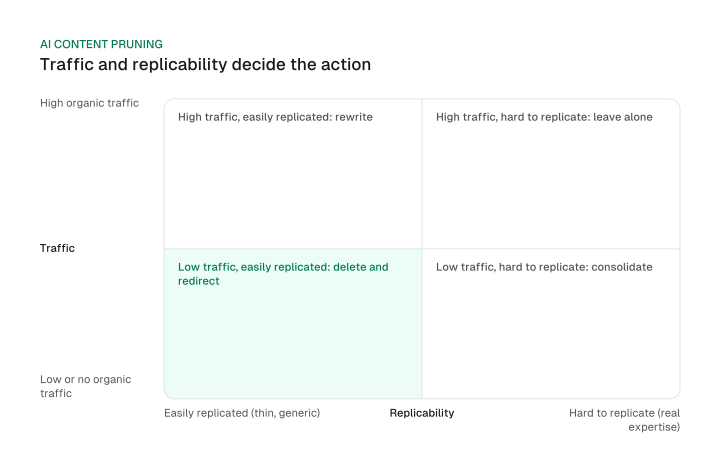
Cross your page's traffic against how easily it's replicated, and one of four actions falls out.
What each quadrant means:
- Low traffic, easily replicated: delete and redirect. Nothing is lost, and the redirect passes authority to a page doing real work.
- Low traffic, hard to replicate: consolidate. Real substance, a specific example, a genuine opinion, or data nobody else has, folded into a stronger page instead of lost.
- High traffic, easily replicated: rewrite. It's working today on borrowed momentum, so add what a competitor's model couldn't before that gap closes.
- High traffic, hard to replicate: leave it alone. It already has real substance, and it's already working.
The traffic side of that matrix has evidence behind it. In the same 2024 agency comparison cited above, pruning underperforming posts produced an 11-12% traffic lift. Cutting what wasn't working freed up whatever was holding the rest of the site back, the same logic the matrix applies at the page level.
The matrix runs the same way regardless of who wrote the page first. A page with little traffic but real effort behind it gets consolidated or kept, whether AI helped write it or a person wrote it by hand. The decision was never about authorship in the first place.
Google's ranking systems check whether a page is original, helpful, and hard to reproduce. The studies that seem to disagree are measuring perception, presence, and performance, not different realities, and E-E-A-T was never a checklist a page can fail on its own.
The actionable move is narrower than "is AI content bad for SEO": open your five lowest-traffic AI-assisted pages this week and run the replicability test on each before deciding what to do with them.
Frequently asked questions
No. Google doesn't use third-party AI detectors as a ranking input, and Sadasivan and coauthors' 2025 research shows those detectors can't be made reliable enough to trust as one. Their accuracy has a mathematical ceiling that paraphrasing pushes down further, and no amount of engineering raises it back up.
No. Google has never published a ratio or a cap, because the scaled content abuse policy tests each page's value on its own, independent of volume. Publishing ten pages a week is fine if each one passes the replicability test; one a month isn't safe if it doesn't.
Only when readers would reasonably expect to know who or what created it, per Google's own guidance. There's no blanket disclosure requirement. What matters more for E-E-A-T is demonstrating real expertise in the content itself.
Yes, when it's original, helpful, and shows real expertise; production method alone doesn't disqualify a page. But in the one 2024 agency comparison built to measure a head-to-head winner, unedited AI content was the weaker performer, so "can rank" and "outranks a human-written page" aren't the same claim.
Google's spam policy for pages generated for the primary purpose of manipulating search rankings and not helping users, no matter how they're created. Generative AI, scraping with automated transformation, and content stitching all qualify the same way, and so does the same pattern run by people.
No. Audit each one against the traffic-and-replicability matrix first. Many will just need a rewrite or a consolidation; few need deleting. Deleting a low-traffic page with real substance loses more than it saves.
Figures and images in this post are free to reuse under CC BY 4.0 with credit to Mission Growth.
Get Mission Growth highlighted in your Google results.