
The AI SEO Optimization Checklist (35 Steps)
An AI SEO optimization checklist: 35 pass/fail checks in 4 phases that make your pages reachable, extractable, and citable by AI search engines.
By Furkan AktaşPublished Updated
On this page
An AI SEO optimization checklist is a sequenced set of checks that make a page reachable, extractable, and citable by AI systems, on top of ranking well in classic search. That covers Google AI Overviews, ChatGPT, Perplexity, Gemini among them.
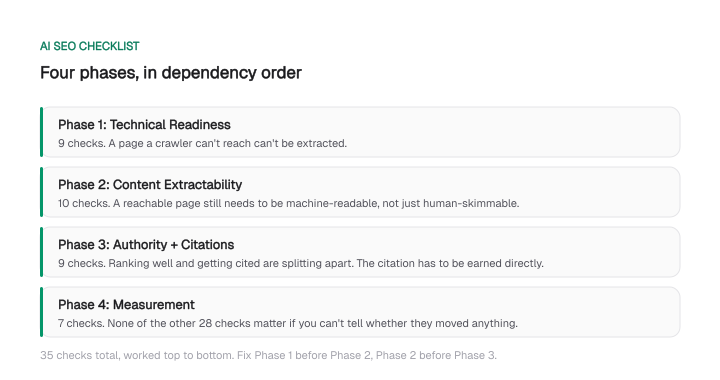
This one runs 35 checks across four phases in dependency order: technical readiness, then content extractability, then authority and citations, then measurement.
Every item states why it matters and gives a literal pass test you can tick.
Scan it in five minutes, or save it as a working checklist and run one phase at a time.
Key takeaways
Work through 35 pass/fail checks in four dependency-ordered phases: technical readiness, content extractability, authority and citations, then measurement. Fix each phase before the next one; a page a crawler can't reach never gets extracted, and a page nobody cites won't surface in an AI answer.
Here's how the four phases build on each other:
How to use this AI SEO optimization checklist
The AI SEO optimization checklist runs top to bottom. Its four phases are ordered by dependency, not by topic, and that order is the whole point. A classic SEO audit process follows the same logic: measurement, crawling, content, then authority. If you reach for a scanner instead, read what ai llm seo audits actually verify before you trust the score it gives back.
A page a crawler can't reach can't be extracted, no matter how well it's written.
A page nothing cites won't surface in an AI answer, no matter how fast it loads. Fix Phase 1 before Phase 2, then Phase 2 before Phase 3. If you'd rather hand the work off, here's what to expect when buying AI SEO services instead of running this checklist yourself.
Some people call this an ai search optimization checklist or an llm seo checklist. The label matters less than the sequence.
If you're new to the underlying definitions, read our GEO vs SEO hub first. This is the geo checklist that follows from it.
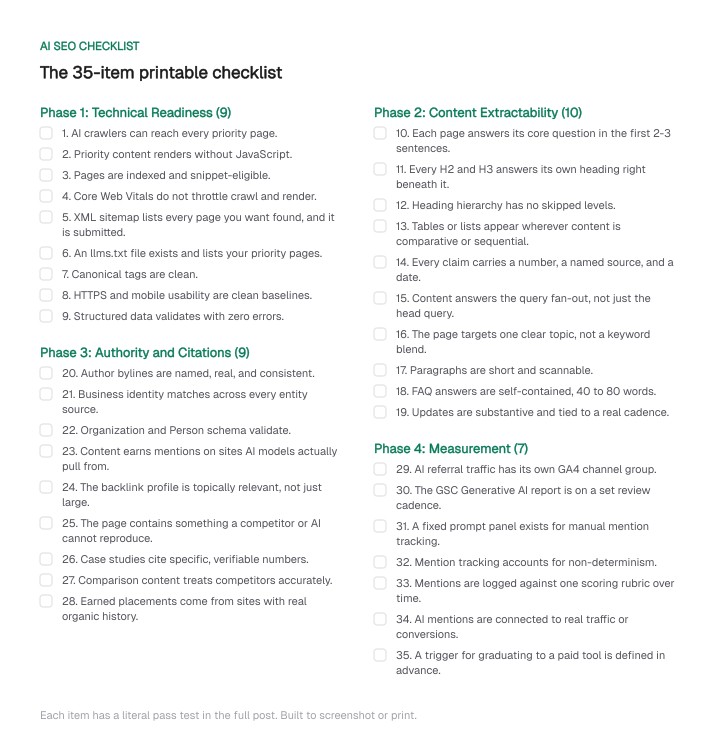
Every item here carries a literal pass test you can tick.
"Build topical authority" isn't a check, because you can't tick it. "Your top 10 referring domains overlap with your subject matter" is a check, because you either can confirm it or you can't.
Screenshot the graphic below, or save the page. Run each phase, tick what passes, and fix what fails before moving down.
Checklists like this range from about 10 to 130+ items and 2,300 to 9,000 words, and few pair each item with a pass/fail test. This one holds to 35 items, each with a literal test.
Phase 1: technical readiness (9 checks)
Phase 1 technical readiness gates the other three phases: nothing below it matters if an AI crawler can't reach, render, or index the page.
Think of it as the technical SEO checklist for AI search: everything downstream depends on it passing first.
Google's own May 2025 guidance names crawlable, indexable content with minimal JavaScript dependency as a factor in how well a page performs in its AI experiences.
Crawl and render access
Crawl and render access decides whether an AI crawler ever sees your page before anything else on this list matters. Which of GPTBot and other AI crawlers to let in is a separate policy call; this check confirms the ones you chose can reach you.
1. AI crawlers can reach every priority page. If robots.txt blocks the bots that build AI answers, no other check matters: your page never enters their index.
Pass: robots.txt must not disallow any of these on a URL you want cited:
- GPTBot and OAI-SearchBot (OpenAI)
- ChatGPT-User (OpenAI's user-triggered fetcher)
- ClaudeBot and Claude-SearchBot (Anthropic)
- PerplexityBot (Perplexity)
These names get revised occasionally, so recheck each vendor's live docs.
2. Priority content renders without JavaScript. Most AI crawlers read raw HTML and skip anything injected client-side. Pass: View Source, not the rendered DOM, shows your full target text. We moved our own React app to static HTML for 20 pages for this exact reason.
3. Pages are indexed and snippet-eligible. A page has to sit in Google's index before it can feed an AI Overview. Pass: URL Inspection in Search Console returns "URL is on Google" with no manual action on every priority URL.
4. Core Web Vitals don't throttle crawl and render. Slow pages get crawled less often and rendered later, delaying their place in AI answers. Pass: Largest Contentful Paint sits at or under 2.5 seconds, Google's threshold for a "good" score.
For the full crawler and rendering audit, see how AI crawlers read and render a page.
Discovery and markup hygiene
Discovery and markup hygiene make sure the pages you've already made reachable actually get found and parsed correctly.
5. Your XML sitemap lists every page you want found, and it's submitted. AI systems and search crawlers both use the sitemap as a discovery map. Pass: the sitemap coverage report in Search Console shows zero "not found" priority URLs.
6. An llms.txt file exists and lists your priority pages. This plain-text file hands AI crawlers a curated map of what matters on your site. Before you add an llms.txt file to your site, check which crawlers actually fetch it.
Pass: /llms.txt resolves to a real, current page list instead of a stub or a 404.
We publish our own llms.txt and llms-full.txt at missiongrowth.io as a live example. Check yours the same way with our llms.txt checker.
7. Canonical tags are clean. Contradictory canonicals split ranking signals and can drop a page out of eligibility. Pass: each priority URL points to itself as the canonical, and Search Console reports no "duplicate, Google chose different canonical" on those URLs.
8. HTTPS and mobile usability are clean baselines. These are table stakes, and failing them quietly undercuts everything above. Pass: zero mixed-content warnings and zero mobile usability errors in Search Console.
9. Structured data validates with zero errors. Valid schema helps machines parse your author, date, and content type. It's necessary, not sufficient, so treat a clean validation as a floor. Pass: the Rich Results Test shows zero errors and zero warnings on each priority page type.
Phase 2: content extractability (10 checks)
Phase 2 content extractability decides whether a machine can lift one clean answer out of a page a human would happily skim.
Google's May 2025 guidance points the same direction here: original, clearly structured, dated content is what performs in its AI experiences.
Paste your first 100 words into a blank document and read them on their own. If they don't answer the page's core question without the rest of the article, item 10 fails.
Structure pages so machines can extract them
Structure decides whether an AI system can quote your page cleanly or has to skip it for a competitor's tighter answer.
10. Each page answers its core question in the first 2-3 sentences. AI systems quote complete answer units near the top, so a buried answer gets skipped. Pass: the first 100 words contain a direct, quotable answer with no scene-setting.
11. Every H2 and H3 answers its own heading right beneath it. Machines extract by heading, so a section that wanders before answering loses the extract. Pass: the sentence right under each heading answers it directly.
12. Heading hierarchy has no skipped levels. Broken nesting confuses parsers about what belongs where. Pass: every step goes H1 to H2 to H3, never straight to H4.
13. Tables or lists appear wherever content is comparative or sequential. A machine lifts a clean table more reliably than the same facts smeared across a paragraph. It matters most on the comparison pages at the center of SaaS SEO, which lead with a verdict and a feature table.
Pass:
- At least one table or list sits in every how-to or comparison section.
17. Paragraphs are short and scannable. Dense blocks hide the answer unit a machine is hunting for. Pass: no paragraph runs past roughly four sentences, and sentence length varies inside each section.
Make claims and coverage worth citing
Claims and coverage decide whether a model trusts what your page says enough to repeat it.
14. Every claim carries a number, a named source, and a date. Vague claims don't get cited; specific, sourced ones do. Pass: no "studies show" or "experts say" appears anywhere without a name and date attached.
15. Content answers the questions a search expands into. AI systems split one query into several related sub-questions and reward pages that cover them. Pass: the page answers three or more real follow-up questions a searcher would ask next.
16. The page targets one clear topic, not a keyword blend. A blended page dilutes the entity signal and matches nothing sharply.
Pass:
- Title, H1, and first paragraph all name the same specific topic.
18. FAQ answers stand alone, 40 to 80 words. An answer that needs the rest of the page for context can't be quoted on its own. Pass: no FAQ answer says "see above" or leans on surrounding text.
19. Updates are substantive and tied to a real cadence. A silent date bump with no content change is a signal both AI systems and search discount. Pass: each last-modified date maps to an actual edit you can point to. Deep dive: freshness cadence.
Phase 3: authority and citations (9 checks)
Phase 3 authority and citations exists because ranking and getting cited are pulling apart: a top-10 spot no longer carries the citation with it.
Ahrefs' March 2026 re-analysis of 863K keyword result pages and 4M AI Overview URLs found the overlap between organic top-10 rankings and AI Overview citations had fallen to 37.9%, down from 76.10% in its July 21, 2025 study of 1.9M citations.
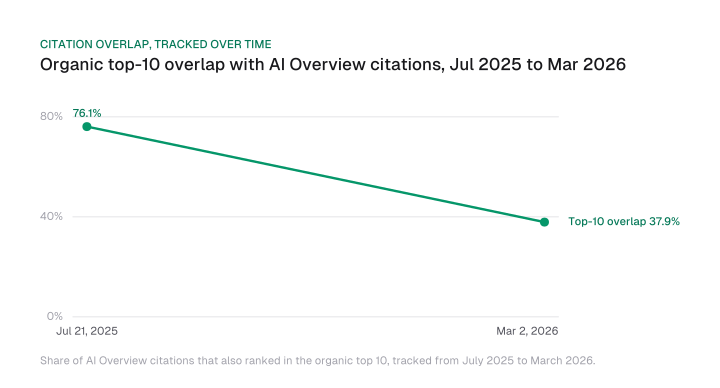
You have to earn the citation directly.
Make your identity unambiguous
Your identity has to read the same way everywhere a model or a crawler might encounter your brand.
20. Author bylines are named, real, and consistent. AI systems weigh named expertise, and an "editorial team" byline gives them nothing to attribute. Pass: every article has a named author with a bio page and Person schema.
21. Business identity matches across every entity source. Conflicting names and descriptions weaken the entity a model builds of your brand. Pass: your name, description, and category match exactly across your own site, LinkedIn, and top directories.
22. Organization and Person schema validate. These tell machines who published the page and who wrote it, cleanly. Pass: zero errors in the Rich Results Test on both markup types.
Earn citations you don't control
Citations you don't control matter more now: a model samples what other sites say about you, and that carries more weight than your own claims about yourself.
23. Content earns mentions on sites AI models actually pull from. Models sample citations from third-party pages as well as your own. Pass: at least one new, URL-verifiable earned mention this quarter.
24. The backlink profile is topically relevant. Relevance to your subject beats raw domain count for entity authority. Pass: your top 10 referring domains publish on your actual subject matter; generic directories fail the check.
25. The page contains something a competitor or AI can't reproduce. A page that only restates public knowledge gives a model no reason to prefer it. Pass: original data, a tested result, or a named firsthand claim exists somewhere on the page.
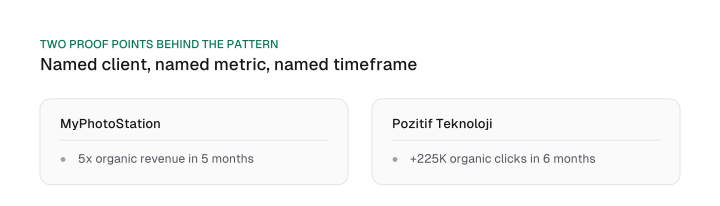
26. Case studies cite specific, verifiable numbers. "Significant growth" isn't citable; a named client with a named metric is. Pass: named client, named metric, named timeframe. Our own case studies set the format to match: MyPhotoStation (5x organic revenue in 5 months) and Pozitif Teknoloji (+225K organic clicks in 6 months).
27. Comparison content treats competitors accurately. A model that catches a factual error about a rival discounts the whole page. Pass: every competitor claim is fact-checked against that competitor's own public materials.
28. Earned placements come from sites with real organic history. A high domain rating on a link farm buys nothing an AI model trusts. Pass: a manual spot-check confirms each new placement's own search visibility instead of trusting its domain score.
Phase 4: measurement (7 checks)
None of the first 28 checks earn their keep if you can't tell whether they moved anything.
This phase hands off almost entirely to the two siblings that own measurement depth, and it doubles as an ai visibility checklist you run on a fixed cadence rather than one-off. For the classic organic side of that cadence, an SEO dashboard built in Data Studio keeps Search Console and GA4 in one view.
Wire AI traffic into analytics
Analytics has to separate AI referral traffic from everything else before you can measure any of this.
29. AI referral traffic has its own GA4 channel group. GA4's default channel group now includes an AI Assistant channel for sources like ChatGPT, Gemini, DeepSeek, Copilot, and Grok; Perplexity is not on that list and still files under Referral.
Pass: perplexity.ai and any other AI referrer outside GA4's AI Assistant list route to a channel group you built yourself. Audit your current setup first with our tracker audit, then wire the channel per AI search analytics.
30. The GSC Generative AI report is on a set review cadence. Google's report is the only view of AI Overviews and AI Mode that comes straight from Google, and it has real limits worth knowing before you rely on it.
Pass: a monthly review is scheduled, and you go in knowing v1 reports impressions only, with no clicks, CTR, position, or query data, and no history before May 18, 2026. Deep dive: the GSC report and analytics stack.
Run a manual mention-tracking loop
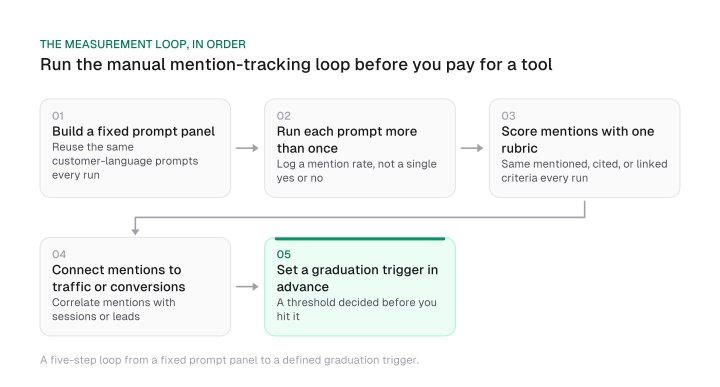
A manual mention-tracking loop is what most teams run before they justify a paid tool.
31. A fixed prompt panel exists for manual mention tracking. Improvising prompts each run makes results impossible to compare over time. Pass: 10 to 30 real customer-language prompts are saved and reused every run. Deep dive: the prompt panel.
32. Mention tracking accounts for answers that shift between runs. AI assistants answer the same prompt differently each time, so a single shot is noise. Pass: each prompt runs three or more times per check, and you log a mention rate rather than a yes or no.
33. Mentions are logged against one scoring rubric over time. A rubric that drifts run to run makes the trend meaningless. Pass: the same mentioned, cited, or linked criteria apply every run, in one sheet or tool. Deep dive: scoring and metric definitions.
Prove it's working and know when to graduate
Proof and a graduation trigger keep manual tracking from running forever past the point it still makes sense.
34. AI mentions are connected to real traffic or conversions. A mention count tracked on its own can't tell you whether it earned anything. Pass: you've attempted at least one correlation between AI mentions and sessions or leads. Deep dive: tying mentions to sessions and attribution.
35. A trigger for graduating to a paid tool is defined in advance. Manual tracking has a ceiling, and "whenever we get around to it" means never. Pass: a specific threshold, prompt count, platform count, or team hours, is decided in advance, before you hit it. Deep dive: the measurement maturity model, then compare vendors once you graduate.
Frequently asked questions
What is an AI SEO checklist?
An AI SEO checklist is a sequenced set of checks, distinct from a generic SEO checklist, that make a page reachable, extractable, and citable by AI crawlers and chat assistants on top of ranking in classic search. This one runs 35 items across four phases in dependency order: technical readiness, content extractability, authority and citations, then measurement. Each item comes with a reason it matters and a literal pass test you can tick.
How is this different from a normal technical SEO checklist?
A classic technical SEO checklist gets you crawled and indexed; it doesn't replace that work. This one keeps Phase 1 overlapping with standard technical SEO (indexation, Core Web Vitals, canonicals), then adds what a normal checklist skips in Phases 2 through 4: crawler access built for AI systems, an answer a machine can extract, and citations earned off your own site.
Do I need schema markup to show up in AI Overviews or get cited by ChatGPT?
No. Schema helps machines parse your author, date, and page type, but it isn't a ranking or citation requirement by itself. Valid structured data helps with rich results and entity clarity. Yet a page with perfect schema and a buried answer still won't get cited. Treat it as one signal, not the lever, as covered in our Google AI Overviews guide.
How often should I re-run this checklist?
Run Phase 4 measurement monthly, matching the cadence for the GSC Generative AI report and your prompt panel checks. Re-run Phases 1 to 3 whenever you ship or substantially update a priority page, and tie content refreshes to a real change rather than a silent date bump (Phase 2, item 19). There's no single universal interval beyond those triggers.
Does this work the same for Google AI Overviews, ChatGPT, and Perplexity, or do I need a separate checklist per platform?
Phases 1 and 2 apply across all of them: every platform needs a reachable page with an answer near the top. Phases 3 and 4 diverge by platform. Google AI Overviews depends on indexation and surfaces in Search Console; ChatGPT samples prompts with no ranking signal and no first-party report at all. Use the linked guides inside those phases where the mechanics split.
What is the single highest-impact item if I can only do one thing today?
Confirm an AI crawler can reach the page (item 1) and that the page answers its own question in the first 2 to 3 sentences (item 10). Nothing downstream matters if a bot is blocked or the answer is buried below the fold. Fix crawler access first, then the opening answer unit; authority and measurement come after those two are true.
Cite this page
Aktaş, F. (2026, September 17). The AI SEO Optimization Checklist (35 Steps). Mission Growth. https://missiongrowth.io/blog/ai-seo-checklist
Figures we made for this post are free to reuse under CC BY 4.0 with credit to Mission Growth.
Get Mission Growth highlighted in your Google results.