AI SEO Trends 2026: What's Real, What to Do, What to Skip
AI SEO trends 2026 sorted by evidence: which shifts held up, what Google changed for site owners and what its guide says to skip, plus one action for each.
By Furkan AktaşPublished Updated

On this page
AI SEO trends 2026 claims fall into three different kinds: real shifts, single readings from one vendor and advice Google's own guide says to skip. You can't plan a quarter on a pile of all three.
So this page scores each of the AI search trends 2026 claims with one test, then gives you an action, a watch signal or a reason to ignore it. The short version: reach keeps growing, AI Overview presence has flattened, the click gap is a direction and not a rate, and the zero-click and overlap headlines fail.
In this guide:
- The four-part test that separates a trend from a statistic
- What the passing trends change in your plan
- Two popular claims that fail the test
- Google's dated changes since May 2026
- The tactics Google's guide says to skip
- A query audit, then a triage of what to act on, watch and ignore
AI SEO trends 2026 start with a four-part test
An AI SEO trend is one metric measured by the same method, on the same scope, on two dates; a single reading, a comparison across panels, a changed scope or a forecast is something else and gets a different label.
In short, one metric, one method, two dates. Here is the test as four checks:
- Same metric. Both readings count the same thing, such as monthly users or the share of keywords with an Overview.
- Same method. The source did not change its panel, parser or window between readings.
- Same scope. The countries, products and query sets match.
- Two dates. A single reading is a data point and gives you no direction.
For example, SparkToro's 2024 zero-click reading of 60.45% came from a Datos panel, and its 2026 reading of 68.01% came from a Similarweb panel. SparkToro itself says the graph compares "a bit of apples and oranges", because these aren't the same users or devices.
So those two numbers are two readings of different things, and they show no trend. Any rounded version of that zero-click figure inherits the same problem.
Applying the test to eight claims you are likely to meet gives this scorecard. Each source's own readings sit in the middle columns, and the verdict is ours:
Download CSV (CC BY 4.0)
Four claims pass, one passes as direction only and three fail. The verdict decides the action: a passing trend can change a plan, a direction can change a forecast's sign, and a failing claim changes nothing until someone measures it twice the same way.
If you want the underlying numbers behind any row, our Google AI Overviews statistics post traces each Overview figure to its primary study.
What the passing trends change in your plan
Two trends pass cleanly and a third passes as direction only, and each changes one input to your plan: the reach you assume, the Overview presence you plan for and the click rate you forecast.
Reach keeps growing while presence has flattened, so the lever left for a site owner is the click rate on your own queries.
Reach: the surfaces keep getting bigger
The Gemini app grew 2.1x between Alphabet's July 2025 and July 2026 calls, with both readings in the table above. Google then said on August 11, 2026 that the app had passed 1 billion monthly users. Treat that as the current level, since it isn't a third point of the same series.
AI Overviews went from over 2 billion to over 2.5 billion users, which is +25%, though both figures are "over" floors.
The Search Console report lists AI Overviews, AI Mode and Discover generative features. It doesn't list the Gemini app. So test ten of your buying questions in the app by hand. Gemini monthly active users shows how large that audience is, and Gemini SEO covers what to change.
Presence: coverage stopped rising in mid-2025
BrightEdge's tracked set gained 16 points from February 2025 (about 31%) to August 2025 (about 47%), then 1 point in the six months to February 2026 (about 48%). Its series is flat from August 2025, with about 45% in November 2025 along the way.
The AI Overview trends 2026 data diverge by vendor. Semrush shows a different shape, and its share of keywords with an Overview started at 6.49% in January 2025, peaked at 24.61% in July and fell 8.92 points to 15.69% in November 2025. Semrush's share fell while BrightEdge's stayed level, so neither vendor supports "coverage will keep rising".
The two series end three months apart and track different keyword sets, so compare each with itself and not with the other. In November 2025 the same-month gap between them was 2.9x; the level gap is explained in why vendor Overview rates differ. BrightEdge adds that about 52% of queries still trigger no Overview.
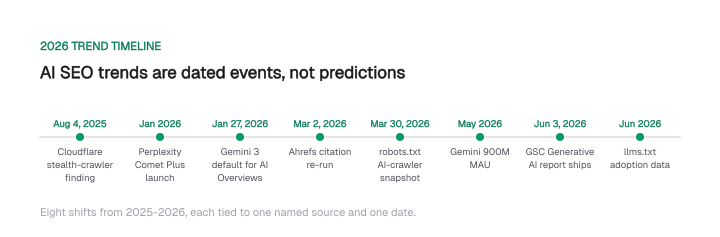
Presence depends on topic and keyword set, so the plan input is your own number. The audit section below shows how to get it.
Clicks: the studies disagree, so use direction only
Ahrefs found the top-ranking page's average click rate 34.5% lower when an Overview was present in its April 2025 study, and 58% lower on December 2025 data. It is a correlation on 300,000 keywords, and the window grew from one year to two between studies, so read it as a direction. Our AI SEO statistics hub collects the click studies side by side.
Semrush used a different method and read the other way. On the same search terms before and after an Overview appeared, people "actually clicked slightly more", and the zero-click rate of keywords with Overviews "has slowly declined since January 2025".
So whether clicks fall further once an Overview appears depends on whose method you trust. Ranking first remains your starting point, but its click value with an Overview present is unsettled.
For your ten highest-traffic informational pages, compare impressions in the Generative AI report with clicks in the Performance report. Then re-base your forecast on those pages and ignore both studies' rates.
Two popular claims that fail the test
The overlap drop and Gartner's volume forecast fail the test: one changed method mid-series, and the other has no measurement to score it. Don't rebuild a content plan on a 76% to 38% overlap drop or on a "search volume falls 25%" forecast.
The ranking-to-citation overlap drop changed method mid-series
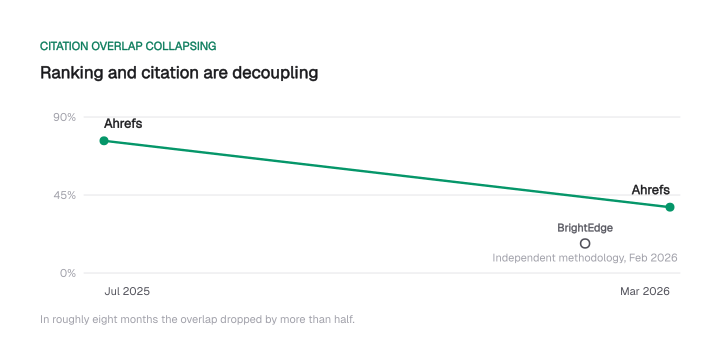
Ahrefs' two overlap readings (about 76% in July 2025 and 37.9% in March 2026) are not one series, because Ahrefs says it improved its parsing between them. BrightEdge's separate series stayed near 17%.
A drop that coincides with a better parser can be partly a better view of the same thing. The overlap series in our statistics hub keeps both readings together.
Your action: skip the re-plan, and check in your own audit whether the pages an Overview cites also rank for you.
Gartner's search volume forecast has no measurement to score it
Gartner predicted in February 2024 that "traditional search engine volume will drop 25%" by 2026, and Google's 2026 statements point the other way. Alphabet's April 2026 call said queries were at an all-time high, and its July 2026 call said usage hit a record during the World Cup and described AI Overviews and AI Mode as one search experience.
Those are one company's usage statements and not total volume across engines, so the prediction can't be graded exactly. One common restatement turns it into a claim that AI will handle 25% of global queries, which is a different claim.
If you want the wider question, read will AI replace SEO. For your plan, treat 2026 forecasts as unscored until a source measures the same quantity twice.
Google's dated changes for site owners since May 2026
Google made five changes for site owners between May and September 2026, and one of them, the eligibility chain, decides whether any other change matters.
Download CSV (CC BY 4.0)
The multimodal row is the one new data source to switch on. The September 24 announcement adds web multimodal reporting to both the performance report and the Generative AI features report, with a new multimodal search type filter. It covers Lens, Circle to Search on Android, image uploads and Chrome's right-click "Search this image".
Among Google AI search trends, changes to ranking run on a separate calendar, covered in the Google core update post.
Eligibility is the first gate. Google's generative AI features run on retrieval-augmented generation (grounding the answer on pages retrieved from the core index) plus query fan-out (the model's set of related searches). So a page must be indexed and eligible to be shown with a snippet before any of those features can use it.
The site must also be included in Search generative AI features in Search Console. Sites that opt out receive no traffic or impressions from those features, and the control isn't a ranking signal outside them.
That order gives you a rule: check indexing and snippet eligibility on your top pages before you touch format. A beautifully restructured page that isn't shown with a snippet can't be used by an Overview.
What Google's guide says to skip, and what it says to do
Google's guide says you don't need to rewrite pages for AI systems, seek inauthentic mentions or split content into separate pages for every fan-out query, and that unique, non-commodity content matters more than any other suggestion.
Here are the four tactics we can compare against the guide's own words:
Building a separate page for every fan-out variation to manipulate rankings or AI responses also violates Google's scaled content abuse policy. And the dual strategy of long ranking pages plus short citation blocks isn't something the guide asks for.
Non-commodity content means pages with first-hand data or experience that a competitor can't copy by rewording. So spend the time there, not on a second version of the page written for AI.
Three more tactics are covered by their owners, each in one clause:
- llms.txt. Google says Search itself doesn't use such machine readable files; see our llms.txt file guide for other uses.
- Chunking. There's no requirement to break content into tiny pieces; the multi-engine checklist is in how to optimize for AI search engines.
- Special markup. Structured data isn't required for generative AI search and no special schema.org markup is needed; see schema markup for AI search.
missiongrowth.io publishes its own llms.txt and llms-full.txt, a curated plain-text knowledge base for AI crawlers.
The guide also defines AI agents as autonomous systems that can perform tasks such as booking a reservation or comparing product specifications. We treat browser agents as out of scope for this page.
AI SEO, AEO and GEO are labels for the same job. Google's guide says that while the terms Answer Engine Optimization and Generative Engine Optimization are common online, many suggested "hacks" aren't effective or supported by how Google Search works. And when it asks whether SEO still applies, it answers "yes", because generative AI features rest on core Search ranking and quality systems.
That also answers what SEO means in 2026: the same best practices, aimed at pages that are indexed, eligible and worth citing. For the framework behind the naming, see generative engine optimization.
Audit your own queries
The own-query audit counts, for a sample of your target queries, how many show an AI Overview and how many of those cite your domain, using logged-out US searches.
Vendor percentages describe their keyword sets. Yours describes your topics, so run this once and again later with the same queries:
- Pick 30 to 50 target queries. We suggest this range for a quick check; it isn't a measured sample size. Include your buying questions and informational pages.
- Search each one logged out from a US location. Personalized results shift what appears.
- Record whether an AI Overview appears.
- For each Overview, record whether it cites your domain.
- Compute the two ratios and save the query list so you can repeat it.
The formulas:
- AI Overview share = queries with an Overview / queries checked
- Cited share = Overviews citing your domain / Overviews shown
For example, say you check Q queries, O show an Overview and C of those cite you. Your AI Overview share is O/Q and your cited share is C/O. If O/Q rises between two runs of the same query list, you have a trend on your own set. If C/O stays low while O/Q rises, the pages an Overview wants aren't yours yet.
This replaces the vendor metrics that circulate, such as citation frequency and share of model, with two numbers you can reproduce. For the wider metric set, see AI search visibility KPIs. Our own capture of US results pages for the topics we research is in the AI Overview sample behind our statistics post.
Your next 90 days: act now, watch, ignore
Act now on eligibility, the Generative AI report and one non-commodity page; watch presence, the merged AI Overviews and AI Mode counts and the opt-out toggle; ignore rewriting for AI, inauthentic mentions and unscored forecasts.
An SEO strategy in 2026 should contain three things: an eligibility check on your top pages, the Generative AI report switched on with one page of first-hand data, and a watch list for presence, the merged AI Overviews and AI Mode counts and the opt-out toggle. Everything else waits for a second reading.
The triage depends on who you are:
Your SEO strategy in 2026 needs no prediction. Every row follows from a verdict above: eligibility from the Google guide, reach and presence from the passing trends and the audit from the failures.
Mission Growth's platform tracks AI citations and visibility for customers.
A trend is a metric measured twice by the same method, so the plan only holds what meets that test. Start with the audit and the eligibility check this week, then use how to get cited in Google AI Overviews for the work on pages that already qualify.
Frequently asked questions
Which AI SEO advice can I ignore?
Ignore rewriting pages just for AI systems, seeking inauthentic mentions and building a separate page for every fan-out query. Google's guide says you don't need to write in a specific way for generative AI search, that inauthentic mentions aren't as helpful as they seem, and that a high quantity of pages doesn't make a site better.
How do I tell whether an AI SEO trend is real?
Check that it is one metric, measured by the same method on the same scope, on two dates. A single reading, a comparison across two panels, a changed scope or a forecast fails. SparkToro's zero-click pair fails because the panel changed from Datos to Similarweb between the 2024 and 2026 readings.
Are AI Overviews still increasing in 2026?
Not in the vendor series we can compare. BrightEdge's tracked set has been flat since August 2025, and Semrush's share of keywords fell between July and November 2025. Both series cover one vendor's keyword set, so neither speaks for your topics. Measure your own queries before assuming growth.
Does ranking number one still matter in 2026?
It still matters as the starting point, but what it is worth with an Overview present is unsettled. Ahrefs found a correlation with a lower click rate for the top page, while Semrush found people clicked slightly more on the same search terms. Re-base on your own impressions and clicks.
What is SEO for AI called?
It goes by AI SEO, AEO and GEO. Google's guide says many suggested hacks under the AEO and GEO labels aren't effective or supported by how Google Search works, and that SEO best practices continue to be relevant because generative AI features are rooted in core ranking and quality systems.
Cite this page
Aktaş, F. (2026, October 4). AI SEO Trends 2026: What's Real, What to Do, What to Skip. Mission Growth. https://missiongrowth.io/blog/ai-seo-trends-2026
Download the data: 2 tables as CSV (CC BY 4.0)
Figures we made for this post are free to reuse under CC BY 4.0 with credit to Mission Growth.
Get Mission Growth highlighted in your Google results.