
Gemini SEO: How Gemini Grounds Answers and How to Get Cited
Gemini SEO guide: what Google documents about Gemini's search grounding, which tactics its guide rules out for Search, and how to measure Gemini traffic.
By Furkan AktaşPublished Updated

On this page
Gemini SEO means getting your pages into the set of sources Gemini reads before it answers. Google documents that this set comes from searches the model writes itself, so how to rank in Google Gemini starts with different questions than keyword research does.
This guide is about Google Gemini SEO and SEO for Google Gemini AI, meaning being cited by it. Using Gemini inside Docs or Sheets to do your own SEO work is a different job, and we leave it out.
The Gemini-specific layer on top of the SEO you already run is three checkable things. Map the queries the model writes instead of the keyword you rank for. Set Google-Extended deliberately. Measure with the two signals that exist, because Search Console's report leaves the Gemini app out.
In this guide:
- How Gemini searches before it answers, and why ranking first can still leave you out
- Which controls apply to the Gemini app and which to AI Overviews and AI Mode
- A five step checklist with a worked query mapping exercise
- The tactics Google's guide says you can skip
- How to measure Gemini visits and what a vendor can honestly promise
How Gemini picks the pages it cites
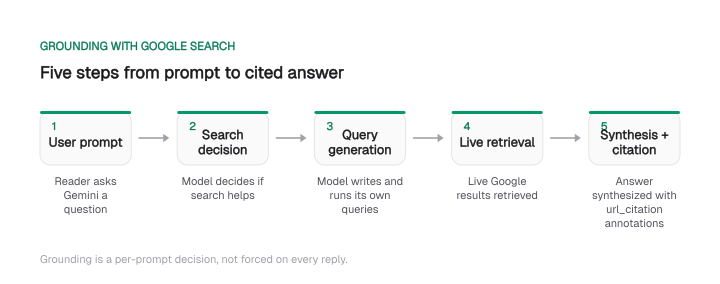
Google documents Gemini's search grounding for its API: the model decides per prompt whether to search, writes its own search queries, and cites the pages they return.
Here is the documented loop, from Google's Grounding with Google Search documentation:
- The model analyzes the prompt and determines whether a Google Search can improve the answer.
- If it can, the model generates one or multiple search queries and executes them.
- The response returns the search queries it ran, as
google_search_callsteps. - Citations link parts of the response to their sources.
One caveat belongs here, once. These pages describe the Gemini API. Google does not publish the app's internals. The link between the two is Google-Extended's description of grounding in Gemini Apps: providing content from the Google Search index to the model at prompt time. So this section is documented for the API and assumed for the app.
Google's own definition of query fan-out shows what model-written queries are: "a set of concurrent, related queries generated by the model to request more information and fetch additional relevant search results." The searcher typed one question. The model may run several.
That is why you can rank first for your keyword and still be missing. Suppose a buyer asks Gemini which project tool suits a ten-person agency. The model might search for comparisons, for pricing, for integrations. Your page, optimized for the one head keyword, ranks for none of those phrasings, while a page you outrank on the head term ranks for one of them and enters the set.
If the app works as the API is documented to, the pages Gemini reads are the ones that rank for the model's queries. You can't see those queries from outside the API, which is why step 2 of the checklist below shows how to read them.
Gemini SEO vs AI Overviews and AI Mode: what you can control
The Gemini app, AI Overviews and AI Mode answer to different controls: Google-Extended for the app, snippet and indexing controls for the two Search features.
That split matters for Gemini app SEO because a missing citation has different causes on each surface. Here are the four surfaces side by side:
Two of those rows have their own guides. For the Search side, read how to get cited in Google AI Overviews, which covers trigger logic and snippet eligibility in depth. For the other feature, there is a guide to Google AI Mode.
The Google-Extended row is the one most teams get wrong. Google's crawler documentation says the token controls whether content may be used for training Gemini models and for grounding in Gemini Apps and Grounding with Google Search on Vertex AI. It also says the token does not affect inclusion in Google Search and is not a ranking signal.
The token has no separate user agent string, so a robots.txt rule is the only place it shows up. Our AI crawler guide covers the Google-Extended token facts and the per-bot policy.
Here is the rule that follows. Search your robots.txt for a Google-Extended disallow before you treat a missing Gemini citation as a content problem. Google's stated scope says a site-wide disallow works against grounding in Gemini Apps. What Google doesn't publish is how much the disallow changes citations, so treat the check as a condition: if you want your pages eligible for Gemini Apps grounding, don't disallow the token.
For the two Search features, the second check is snippet eligibility. A page with nosnippet or noindex can't be shown, whatever its content.
Gemini SEO checklist: five steps in order
Gemini SEO starts with five steps: confirm eligibility, map the questions the model asks, publish non-commodity content, earn presence off your own site, and set Google-Extended deliberately.
Step 2 is the Gemini-specific work. The other four are SEO you already run.
-
Confirm eligibility. For AI Overviews and AI Mode, a page must be indexed, eligible to be shown with a snippet, and the site must be included in Search generative AI features in Search Console. Mobile friendliness and speed are good practice, but the eligibility test Google states is the one above.
-
Map the questions the model asks. If your page ranks first and Gemini still skips it, you need to optimize for Google Gemini's queries, so find out what Gemini searched for instead. The shape of the request and response is all you need:
request:  model + your prompt + tools: [google_search]
response: answer text with citations on text segments
          google_search_call steps -> the queries the model wrote
Run your prompt through the Gemini API with the Google Search tool enabled, read the
google_search_callsteps to see the queries the model wrote, and repeat for three runs. Keep the queries that recur. Then check where your page ranks for each one.Why repeat? A September 2026 Surfer analysis found only around 27% of fan-outs stay consistent across repeated searches of the same prompt. Surfer pulled those fan-outs with Gemini for keywords whose results show AI Overviews, so the figure does not measure the Gemini app's own searches, but it is the reason one run isn't enough.
Our decision rule, which is judgment and not a Google statement: if your page ranks for none of the recurring queries, you have a content gap to fill. If it ranks for several and still isn't cited, go back to steps 1 and 5.
-
Publish content nobody else has. Google's guide says that creating content people find unique, compelling and useful will likely influence your presence in generative AI search more than any other suggestion in it. Keep facts current as well: grounding pulls from the Search index at prompt time, so what the model reads is whichever version of your page is indexed at that moment.
-
Earn presence off your own site. In Ahrefs' September 2026 study of over 3 million US queries across all topics, Reddit took 28.5% of the citations among Gemini's 50 most-cited sources. That list is consumer heavy, so read it as a measured case that may not hold for B2B. Google adds a limit: seeking inauthentic mentions isn't as helpful as it might seem.
-
Set Google-Extended deliberately. Decide it as a policy and write down why. A Google-Extended disallow added years ago for a different reason is the common way a site ends up working against Gemini Apps grounding.
No source supports a Gemini specific weighting of E-E-A-T, domain authority or backlinks, so we don't claim one. For the cross-engine argument, our guide to generative engine optimization takes it from there.
Gemini SEO myths that Google's guide rules out for Search
Google's July 2026 guide tells site owners they can ignore llms.txt files, chunking, AI-only rewriting, bought mentions and special schema for generative AI features in Google Search.
The table pairs each tactic with Google's sentence and with what still holds:
The guide covers generative AI features in Google Search. It never mentions the Gemini app. Extending the list to the app is our reading, not Google's statement, though the logic is the same one: if the app's grounding draws on the Search index, tactics Search ignores have no obvious way in.
Two common Gemini SEO tips deserve a direct answer. A word-count rule for your opening answer has no Google source, and Google says there is no ideal length. And question-style headings are fine for readers, but rewriting content just for AI is unnecessary. Mapping the queries the model writes does more than rephrasing your headings.
We publish an llms.txt and llms-full.txt on missiongrowth.io for other AI crawlers, and Google says Google Search does not use them. If you want to check yours, the guide to llms.txt explains the file and our llms.txt checker tests it.
How to measure Gemini SEO without a Gemini report
Measuring Gemini SEO takes two signals, UTM-tagged visits and a prompt panel, because Search Console's Generative AI performance report does not list the Gemini app.
Google's report covers impressions in generative AI features in Search, such as AI Overviews and AI Mode, and in Discover. Here is what each available signal shows:
Search Engine Journal reported in October 2026 that Google added UTM parameters to outgoing Gemini links so site owners can attribute referrals. Google hasn't documented the change, so it is unknown under what circumstances the tags trigger. Before this, chatbot traffic like Gemini's could show up as direct in GA4.
Google's John Mueller said in the same report that he sees the tags too, and asked whether Gemini already passes a referrer. The only answer in the report is an unverified comment from a Reddit user, which is the reason to keep your own logs.
Set it up in three steps:
- Segment UTM sessions. Filter landing sessions for UTM parameters in your analytics and read what your own property shows, without assuming values.
- Keep raw logs. They are your evidence if a number looks wrong.
- Run a prompt panel. Pick a fixed list of prompts for your topic, run them on a schedule, and log whether your page is cited. The panel counts mentions. The UTM count counts clicks. Neither replaces the other.
Mission Growth's platform tracks AI citations and visibility for customers. If you want a tool rather than a spreadsheet, our Gemini visibility tracker guide compares what the options measure.
Is Gemini SEO worth it, and when to hire Gemini SEO services?
Gemini SEO is worth doing as part of SEO, not as a standalone traffic bet: across SE Ranking's January to April 2026 panel of 101,574 sites, Gemini sent about 37 visits per 100,000.
Here is how we got that number. SE Ranking put Gemini's share of all website traffic at 0.0368%, which is 36.8 visits per 100,000 (0.0368% times 100,000).
That is one Gemini visit per about 2,700 website visits. As a cross-check, 0.0368% divided by the 0.32% AI platforms account for gives 11.5%, against the 11.56% SE Ranking reports directly.
Gemini's share of AI referral traffic is second: ChatGPT leads with 74.78%, then Gemini at 11.56%, Perplexity at 7.23%, Copilot at 3.51% and Claude at 2.62%. ChatGPT sends 6.4 times Gemini's traffic.
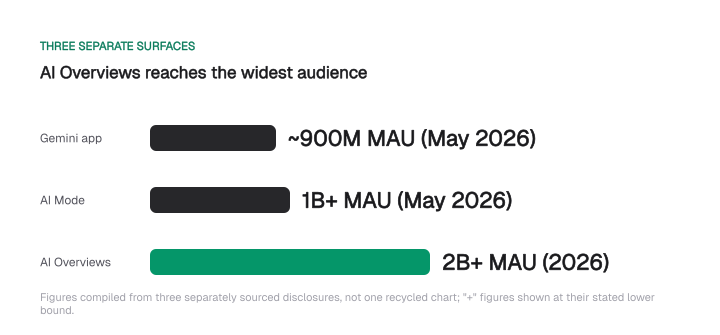
Read 37 per 100,000 as a snapshot of a fast-moving number. SE Ranking's data show Gemini's average share of website traffic grew 231%, from 0.0114% in 2025 to 0.0368% in 2026. Google says the Gemini app has passed 1 billion monthly users (August 2026), and our Gemini statistics page tracks the user numbers.
Put together: the traffic is small today, the growth is fast, and the work that earns it is shared with ordinary SEO. Spend on the shared fundamentals and a measured Gemini check. Those two moves are the scope of Gemini search optimization.
When a vendor pitches Gemini SEO services, test the claims against what Google has said:
Any Gemini SEO agency that promises guaranteed citations or cites internal Google metrics fails that test. Refuse the proposal. For how to vet a vendor in general, and what the service category includes, read our guide to AI SEO services; pricing lives there too.
Gemini SEO is three checks on top of the SEO you run: map the model's queries, decide Google-Extended yourself, and measure with UTM tags and a prompt panel. Start this week by searching your robots.txt for a Google-Extended disallow, then run one prompt three times through the API.
Frequently asked questions
Does blocking Google-Extended remove my site from Gemini answers?
Google's stated scope says the token governs use of your content for training and for grounding in Gemini Apps, and does not affect inclusion in Google Search. No source publishes the effect on citations. So the rule is conditional: if you want eligibility for Gemini Apps grounding, don't disallow it site-wide.
Why does Gemini cite a competitor that ranks below me?
Google documents that the Gemini API's search tool writes its own queries per prompt. If the app works alike, the pages that rank for those queries enter the set, not the pages that rank for your keyword. A competitor can match one of the model's queries better than you do.
Does Gemini use a separate index?
Google's wording is that grounding provides content from the Google Search index to the model at prompt time. The index is Google's. The queries are the model's, which is where Gemini differs from a keyword search.
Is SEO dead now that AI answers exist, and is SEO still worth it in 2026?
Google's July 2026 guide says the practices behind good SEO continue to be relevant because its generative AI features are rooted in core Search ranking and quality systems. So SEO is not dead, and the Gemini layer is a small addition. The same logic applies to Perplexity SEO and ChatGPT SEO.
Is Gemini a search engine?
Gemini is a chat assistant that calls Google Search as a tool when it decides search can improve the answer. Google documents that decision per prompt for the API. It is not a ranked list of ten links, which is why there is no Gemini ranking to check.
How long does it take to rank in Google Gemini?
No source supports the timelines in circulation, and none can exist: Gemini has no ranked list, and the queries it writes vary by prompt. Track what exists instead: UTM-tagged visits and a prompt panel, run on a schedule, then watch the trend.
Cite this page
Aktaş, F. (2026, October 4). Gemini SEO: How Gemini Grounds Answers and How to Get Cited. Mission Growth. https://missiongrowth.io/blog/gemini-seo
Figures we made for this post are free to reuse under CC BY 4.0 with credit to Mission Growth.
Get Mission Growth highlighted in your Google results.