
How to Optimize for AI Search Engines: A 9-Step Guide
How to optimize for AI search engines in 2026: a 9-step guide covering crawler access, answer-first writing, per-platform tactics, and measurement.
By Furkan AktaşPublished Updated

On this page
To optimize for AI search engines, do three things in order: let the right AI crawlers in, answer the question at the top of every section, and earn citations from sources these engines trust. That's the core of how to optimize for AI search engines, and the rest is execution.
Modern AI search doesn't work like the old ten blue links. ChatGPT, Perplexity, Google AI Overviews, Gemini, and Claude read your raw HTML at request time, pull the sentences that answer a prompt, and cite the pages that back their claims.
In this guide:
- Audit which AI crawlers can reach your site, and close the JavaScript rendering gap that hides content from the ones that do.
- Write every section to answer first, then back each claim with a specific number, source, and date.
- Decide where schema markup and llms.txt actually earn their place.
- Apply a tactics table built for each engine, from ChatGPT and Perplexity to Gemini, Claude, and Google AI Overviews.
- Measure citations with three metrics sized for a lean team.
What is AI search optimization?
AI search optimization is the practice of making your content easy for ChatGPT, Gemini, Claude, Perplexity, and Google AI Overviews to retrieve and cite.
The win condition changed. Classic SEO competes for a ranked link and a click. AI search competes to be the source an engine quotes inside its answer, often with no click at all.
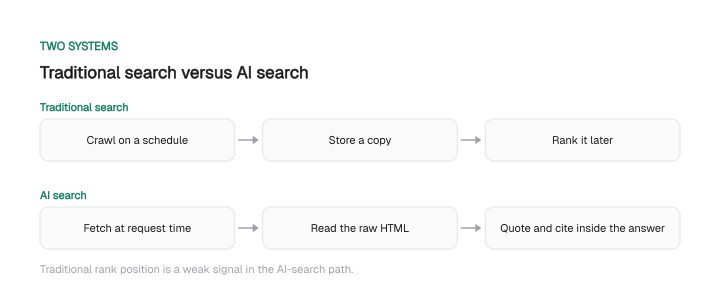
The mechanical difference matters. A traditional search index crawls your site on its own schedule, stores a version, and ranks it later.
Many AI systems fetch pages at request time instead, reading the raw HTML that comes back. That puts a premium on content a bot can parse in one pass.
Traditional rank position is a weak signal here. Semrush found that pages sitting at position 21 or worse in organic search still get cited in AI answers 90% of the time.
Terminology in this space is a mess: generative engine optimization (GEO), AEO, LLMO, and AI SEO all describe overlapping ideas. Our GEO vs SEO: What Actually Changes piece breaks the naming down. For this guide, one working definition is enough: get read, get cited.
How to optimize for AI search engines: the 9-step framework
The 9-step framework moves from crawler access, through content structure, to earned authority, and measurement.
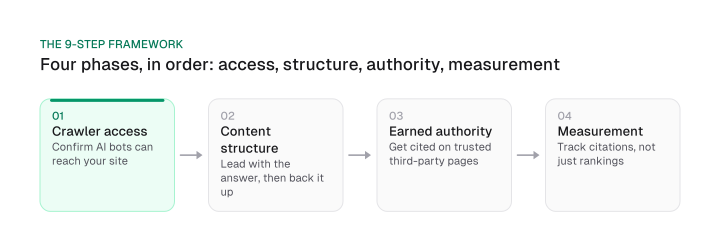
Each step ends with one action you can take today, and ties AI search optimization best practices to a real citation instead of a vanity checklist item.
1. Audit which AI crawlers can actually reach your site
Crawler access is the first gate to AI citations: confirm GPTBot, ClaudeBot, CCBot, Google-Extended, and PerplexityBot can reach your site before you touch a sentence.
Open your robots.txt file in a browser and search for those five agents. A Disallow: / under any of them means you're invisible to that engine, no matter how good your content is.
Blocking is more common than most teams realize. A March 2026 analysis of 4,047 robots.txt files found these block rates:
That's roughly one in seven sites shutting out OpenAI's crawler, often by accident from a copied boilerplate file. Google-Extended deserves a note: it isn't a separate crawler but a control token that decides whether content Googlebot already fetched can train Gemini. Blocking it doesn't remove you from Google AI Overviews, because those run on the standard Google index.
Do today: Open your robots.txt, list every AI agent you find, and decide, for each one, whether to allow or block it. If you want the citations, the block has to go. The FAQ covers whether to block or allow each bot.
2. Close the JavaScript rendering gap
The JavaScript rendering gap hides your content from crawlers that don't run JavaScript and read the HTML your server returns.
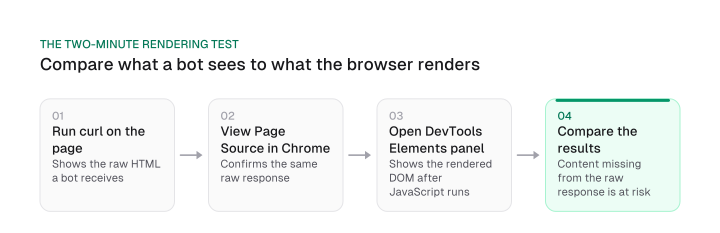
If your page renders its main content in the browser, a bot can receive an almost empty shell. Every guide asserts this. Almost none shows you how to check your own site, so here's a two-minute test:
- In your terminal, run
curl -s https://yourdomain.com/your-page | grep "a sentence you know is on the page". That's the raw HTML a bot sees first. - Open the same page in Chrome, right-click, and choose View Page Source (not Inspect). That's also the raw response.
- Now open DevTools and look at the Elements panel. That's the rendered DOM after JavaScript runs.
- Compare the results. If your key content shows up in the Elements panel but not in curl or View Page Source, JavaScript is adding it after the fact, and it's at risk.
This hits React and other JavaScript-heavy frontends hardest, and we've hit it ourselves. The Mission Growth marketing site started as a React app.
We migrated 20 marketing pages to prerendered static HTML for that exact reason. Those pages now return their full text on the first request, with no JavaScript run.
You don't have to rebuild your stack to match it. Server rendering, static prerendering, or a prerender service that serves bots plain HTML all close the gap.
Do today: Repeat this test on your three most important pages. If content is missing from the raw response, put SSR or prerendering on your roadmap.
3. Decide if llms.txt is worth building
llms.txt is a proposed standard: a plain text file at your site root that points AI tools to your most important content.
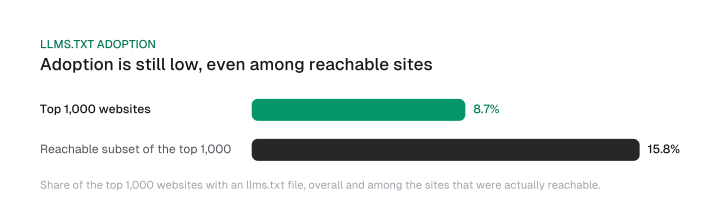
The pitch is tidy; the adoption reality is early. As of June 2026, only 8.7% of the top 1,000 websites had one (87 of 1,000 domains).
Among the 549 reachable sites in that sample, adoption rose to 15.8%. A separate SE Ranking scan of roughly 300,000 domains put adoption near 10%.
Google's own guidance on AI optimization doesn't require the file at all.
The short read: not mandatory, not standardized, and not yet a proven ranking factor. But it's cheap to add, and it won't hurt you. Use a decision framework instead of a blanket yes or no:
- Add it if you have a large docs site, an API reference, or a content library where pointing bots to canonical pages saves them guesswork.
- Skip it for now if you run a small marketing site where every important page is already one click from your homepage and listed in your sitemap.
- Never treat it as a substitute for the two things that do work: crawler access and parseable HTML.
We publish our own llms.txt and a fuller llms-full.txt, a curated plain text knowledge base that points crawlers at our canonical pages. We also built a free llms.txt checker so you can validate yours before you ship.
Do today: Check whether you have an llms.txt at all. If you're docs-heavy, draft one. If you're a five-page site, note it as low priority and move on.
4. Lead with the answer in every section
AI engines extract the sentence that answers the prompt, so the first line under every heading should be the answer itself.
Bury the answer under three paragraphs of context, and the bot works harder to find it, or a competitor who put it first gets picked instead. Use BLUF: bottom line up front. State the answer, then explain.
Imagine a client asks how often they should publish. Here's that same answer written two ways.
Before:
When businesses think about the question of how often they should be publishing new content, there are many factors to consider, and the answer really depends on a range of variables specific to each situation.
After:
Most B2B blogs should publish one to two high-quality posts per week. Below that, you lose search momentum. Above it, quality usually slips. Your exact number depends on team capacity and topic depth.
The second version can be quoted whole. The first can't. Apply this to every H2 and H3: the first sentence answers, the rest supports. That's also how you write for AI search without writing differently for humans, because people skim the same way bots parse.
For phrasing patterns by platform, our LLM optimization guide goes deeper on matching content to the way each model reads.
Do today: Rewrite the opening sentence of your top three pages so it answers the title's question on its own.
5. Use schema markup where it earns its place
Schema markup tells machines what a page is: an article, an FAQ, a step-by-step guide, a product.
But it doesn't write your content for you, and it isn't a magic switch.
Here's the contested part. Vendors show schema code and imply it guarantees AI citations.
Google's own guidance pushes back on that hype: it states plainly there's no requirement to break content into tiny pieces for AI systems to understand it. That undercuts the popular advice to chunk everything for machines. No one has published a clean, verified number for how much schema lifts direct AI citations, so we won't pretend one exists.
What's defensible: schema removes ambiguity, and unambiguous pages are easier to parse and quote. The types worth the effort for most B2B sites:
- Article on posts and guides
- FAQPage on pages with genuine Q&A blocks
- HowTo on numbered tutorials
- Organization and Product on your core commercial pages
Skip the cargo-cult schema that marks up things no engine rewards, and skip fake FAQ blocks bolted on only to trigger the markup.
Do today: Add FAQ and Article schema to your five busiest pages, then validate them in Google's Rich Results Test.
6. Back every claim with a specific number, source, and date
Specificity is what signals trust to both AI engines and readers: a claim with a source, a number, and a date.
AI engines favor content they can verify, and fresh content earns a documented edge. One 2026 analysis reports that AI engines prefer content that's on average 26% fresher than what ranks in traditional search, and that pages older than six months risk semantic drift out of AI answers.
For example, compare two claims:
- Weak: studies show fresh content performs better in AI search.
- Strong: A 2026 analysis found AI engines prefer content that's 26% fresher on average than traditional search results.
The second names the source, the number, and the year. That's the exact shape of a sentence an engine can lift and attribute. Vague attribution (experts say, research shows) is the opposite: unquotable and easy to distrust. This is one of the few AI search ranking factors you fully control.
Do today: Find the three vaguest claims on your most important page and replace each with a named source, a number, and a date.
7. Optimize per platform, not for "AI" in general
Each AI engine pulls from different sources and cites by its own rules, so optimizing for the average of all of them optimizes for none.
The table below maps the AI search optimization techniques that matter for each engine.
Two takeaways stand out. Google AI Overviews still runs on classic ranking, so your existing SEO isn't wasted, it's the input. We break that channel down in How to Show Up in Google AI Overviews.
Perplexity and ChatGPT reward freshness and third-party citations more heavily, so the earned-media work in Step 8 matters most there.
Do today: Pick the one platform your buyers actually use, and apply its row before touching the others.
8. Earn citations outside your own site
Third-party citations carry more weight with AI engines than your own branded pages, since being quoted on a trusted site often beats saying the same thing on your blog.
The concentration is stark: A cross-vertical analysis found that just 5 to 47 domains typically capture the first 50% of all AI-driven clicks. If you aren't among them for your category, you're splitting the long tail.
Concrete tactics:
- Contribute original data. A small proprietary stat or survey gets cited and re-cited. That's how a page becomes a source rather than a summary.
- Get into comparison roundups and listicles for your category. When an engine assembles an answer about tools in your space, it reads those pages.
- Target the domains that already dominate your vertical's AI answers. Run your top prompts, see which sites get cited, and pursue coverage or a listing there.
- Earn mentions on high-authority editorial and community sites, since those feed both training corpora and live search results.
Do today: Run your top three category prompts in ChatGPT and Perplexity, and write down which domains get cited. That list is your outreach target.
9. Set a real freshness cadence
A freshness cadence turns the six-month drift risk from Step 6 into a scheduled review instead of a worry.
Content older than six months risks semantic drift, so build a review rhythm before the drift happens:
- Quarterly: evergreen how-to guides and framework posts. Re-check steps, tools, and screenshots.
- Monthly: pages built around stats and trends. Refresh numbers, dates, and sources so the specificity from Step 6 stays true.
- On every review: update the published or modified date honestly, only when you've actually changed something, and check that the intro still answers first.
- Twice a year: re-audit crawler access and JS rendering from Steps 1 and 2, since site changes silently break both.
A calendar reminder is enough to start. The point is to make freshness a recurring habit.
Do today: Put your five most important pages on a quarterly recurring review, starting this week.
How to measure whether it's working
A stack of three metrics is enough to measure AI visibility for a lean B2B SaaS team, no analyst headcount required.
Most measurement advice is built for enterprise ecommerce teams with analyst headcount. Here's the starter stack:
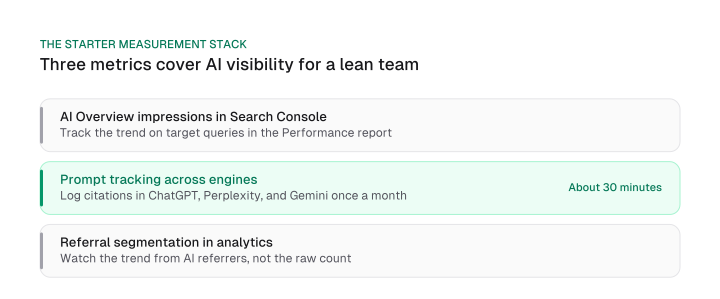
- AI Overview impressions in Google Search Console. GSC surfaces when your pages appear inside AI Overviews in the Performance report. Track the trend on your target queries more than the absolute number.
- Prompt tracking across two or three engines. Once a month, run your branded prompts (your company name, your product) and your category prompts (the problem you solve) in ChatGPT, Perplexity, and Gemini. Log whether you're cited, and how. This is the truest read on AI visibility, and it takes about 30 minutes.
- Referral segmentation in analytics. Create a segment for referrers like chatgpt.com, perplexity.ai, and gemini.google.com. AI referral volume is still small (a cross-vertical analysis saw organic at 20.45% of visits versus 0.19% from AI, roughly 108 times larger), so watch the trend and the quality of that traffic.
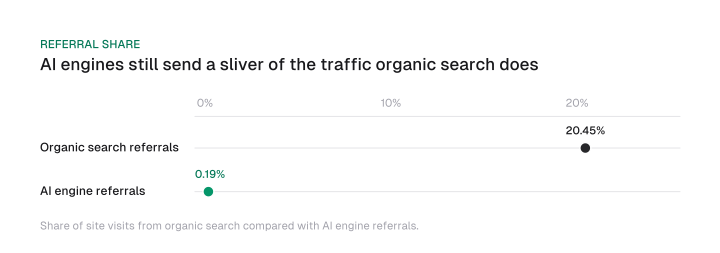
Two numbers should shape how you prioritize. Semrush found AI-search visitors convert at 4.4 times the rate of traditional organic visitors, so even small AI traffic can pay off. And concentrated citations mean a category is winnable if you commit to it. Measure so you know which prompts to chase.
That monitoring and execution is the workflow Mission Growth's platform runs for clients: AI catches the signal, our experts make the move. The discipline underneath is ordinary organic SEO done consistently.
Our work with Pozitif Teknoloji drove +225K organic clicks in six months, and MyPhotoStation, a US wall-decor brand, grew organic revenue 5x in five months. Both are classic organic search results, built on the same content and technical rigor these nine steps ask for.
Common AI search optimization mistakes to avoid
The failure patterns repeat across teams:
- Treating AI search as one monolith. ChatGPT, Perplexity, and Google AI Overviews reward different things. Step 7 exists for this reason.
- Chunking content into unreadable fragments. Google's guidance explicitly says there's no requirement to break content into tiny pieces. Write for humans and the parsing follows.
- Writing content before checking crawler access. A strong page behind a
Disallowearns zero citations. That's why Steps 1 and 2 come first. - Treating schema as a magic bullet. It clarifies structure. It doesn't manufacture authority.
- Shipping content with no freshness cadence. Publish it once and forget it, and it drifts out of AI answers within months.
- Measuring rankings instead of citations. Position 21 pages get cited 90% of the time, per Semrush, so a rank report tells you little about AI visibility.
For the full technical audit behind Steps 1, 2, and 5, work through our technical SEO checklist for 2026.
Your 9-step recap checklist
Nine steps recap the framework above:
- Audit AI crawler access in robots.txt.
- Close the JavaScript rendering gap with SSR or prerendering.
- Decide on llms.txt with data.
- Lead with the answer in every section.
- Add schema where it clarifies the page.
- Back claims with a source, number, and date.
- Optimize per platform, using the table.
- Earn citations on third-party domains.
- Run a real freshness cadence.
This is the practical version. For the exhaustive audit, our AI SEO checklist breaks the same territory into 35 steps.
Frequently asked questions
What is AI search optimization?
AI search optimization is the practice of making your content easy for AI search engines such as ChatGPT, Perplexity, and Google AI Overviews to retrieve and cite. It combines technical access (letting AI crawlers reach and parse your pages), content structure (answering questions directly), and earned authority (getting cited by trusted third-party sources). The goal is being quoted inside AI answers, not merely ranked in a list of links.
How is AI search optimization different from traditional SEO?
Traditional SEO competes for a ranked link and a click. AI search optimization competes to be the source an engine quotes inside its answer, often with no click at all. Traditional rank matters less here: Semrush found pages at position 21 or worse still get cited 90% of the time. For the full terminology and workflow breakdown, see our GEO vs SEO guide.
Do I need an llms.txt file to optimize for AI search?
Not yet. As of June 2026, only 8.7% of the top 1,000 sites (15.8% of the reachable ones) had an llms.txt, and Google's guidance doesn't require it. It's cheap and harmless to add, and useful for large docs sites that want to point bots to canonical pages. For a small marketing site, it stays low priority behind crawler access and parseable HTML.
Does schema markup actually improve AI search visibility?
Schema helps AI engines parse your page structure, which makes your content easier to understand and quote. Whether it directly lifts citation rates is contested, and no clean verified number exists, so treat any vendor claim of a guaranteed boost with caution. Add FAQ, HowTo, and Article schema where your content genuinely fits those formats. Skip schema added purely to game machines. Google rewards clarity over volume.
How long does it take to see results from AI search optimization?
There's no reliable published timeline, so be wary of anyone quoting an exact number. In practice it depends on how often AI engines recrawl and refresh their sources. Since AI systems favor content under six months old and refetch fresh pages faster, a page you publish or meaningfully update can enter answers within weeks on high-frequency engines like Perplexity, and slower on engines trained mainly on a fixed corpus. Set a cadence and measure monthly.
Should I block or allow GPTBot, ClaudeBot, and PerplexityBot?
If you want AI citations and referral traffic, allow them. Blocking is common (13.8% of sites block GPTBot and 11.5% block ClaudeBot, per a March 2026 analysis of 4,047 files), often by accident from copied robots.txt files. Allow the bots that power search and live browsing, since those send traffic. You might still block a pure training crawler like CCBot if you object to your content training models with no citation benefit in return.
Cite this page
Aktaş, F. (2026, September 15). How to Optimize for AI Search Engines: A 9-Step Guide. Mission Growth. https://missiongrowth.io/blog/how-to-optimize-for-ai-search-engines
Figures we made for this post are free to reuse under CC BY 4.0 with credit to Mission Growth.
Get Mission Growth highlighted in your Google results.