
LLM Optimization: The Complete Guide
LLM optimization (LLMO) gets your brand cited inside ChatGPT, Perplexity, and Google AI Overviews. A complete guide with formulas, workflows, and risks.
By Furkan AktaşPublished Updated

On this page
When a buyer asks ChatGPT which vendor to pick, the model names a handful of brands in its answer and skips everyone else. LLM optimization is the work that decides whether you're one of the names it says out loud.
Two pathways decide whether a model cites you, a nine-part framework moves the numbers that matter, and the platform you're optimizing for changes which tactics actually land.
Key takeaways
LLM optimization (LLMO) shapes your content, technical setup, and reputation beyond your own site so ChatGPT, Perplexity, Gemini, and Google's AI Overviews cite your brand by name. Two pathways decide whether that happens: slow training-data memory and fast live retrieval. Fix crawlability first, write answer-first and fact-dense passages, earn mentions beyond your site, then measure with a fixed prompt library and a citation-rate baseline.
What is LLM optimization (LLMO)?
LLM optimization is the practice of shaping your content, technical setup, and outside reputation so ChatGPT, Perplexity, Gemini, and Google's AI Overviews cite your brand by name.
It's also called LLMO or LLM SEO. It extends search optimization from ranking blue links to being named inside the answer itself.
The phrase "large language model optimization" also means something else: the engineering work of making a model run cheaper and faster through quantization, KV caching, or batching. That's a real discipline, but it isn't this one.
This guide is about marketing and visibility: getting cited inside AI-generated answers. Search results for "llm optimization" mix the two senses, so if you landed here looking for inference tuning, this is the marketing sense of the term.
LLMO covers four kinds of work:
- Technical accessibility. Making sure AI crawlers can actually read your pages.
- Content structure. Writing answer-first, fact-dense passages a model can quote and attribute.
- Reputation beyond your site. Earning mentions on the sites and forums models trust.
- Measurement. Tracking citation rate and share of voice across engines over time.
The shift behind all of this is already measurable. StatCounter data puts Google's worldwide search share below 90% for the first time since 2015, a threshold it first crossed in late 2024 and has stayed under since. When a buyer asks ChatGPT "what's the best tool for X," the model returns a short answer naming a handful of brands.
If you're not one of them, you weren't in the consideration set. The click that used to be yours never happened.
LLMO vs. GEO vs. AEO vs. SEO: how they actually relate
Four acronyms describe overlapping work, and the industry hasn't settled on clean boundaries between them.
There's no academic consensus here, so treat the table below as the practical rule we use at Mission Growth.
Use GEO as the umbrella when you're talking about the whole shift. Use AEO when your audience already says it. Use LLMO when the conversation is specifically about citation inside a chatbot.
The underlying tactics overlap heavily, so the term matters less than the work itself. We cover the head-to-head in detail in GEO vs SEO: what actually changes.
Why LLM optimization matters now
The numbers behind AI search visibility have moved from novelty to material traffic. Here's what the data shows, using only figures we verified against their source studies:
- Clicks are leaving traditional search. Sparktoro's zero-click study found that 58.5% of searches now end without a click.
- Search volume is shrinking. Gartner predicts traditional search volume will drop 25% by 2026 as users move to AI chatbots.
- AI engines already carry serious volume. OpenAI put ChatGPT's volume at over 2.5 billion prompts a day in July 2025 and its weekly active users at 900 million in February 2026.
- Multiple engines add up fast. Semrush found that ChatGPT, Copilot, Perplexity, and Claude combined for more than 600 million unique visitors in May 2025.
- AI answers show up inside Google too. Semrush found AI responses inside 13.14% of Google U.S. search results pages in March 2025.
- And that share is growing. Multilipi projects AI assistants will handle nearly 25% of global search queries by the end of 2026.
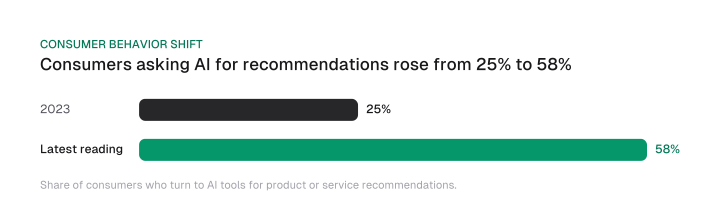
- The behavior change is real, not hype. Capgemini's consumer survey found 58% of consumers have replaced traditional search engines with generative-AI tools for product or service recommendations, up from 25% in 2023.
- Referral spikes prove it. That same data shows AI search referrals to retail sites surging 1,300% during the 2024 holiday season.
Now the part that decides whether this is worth your budget. Semrush found that AI search visitors convert at 4.4 times the rate of traditional organic visitors. Seer Interactive found that brands named as a source in AI answers get a 35% lift in organic clicks over uncited competitors.
Fewer clicks, but the clicks that remain are worth more. Being named is what captures them.
How LLMs actually find and cite your content
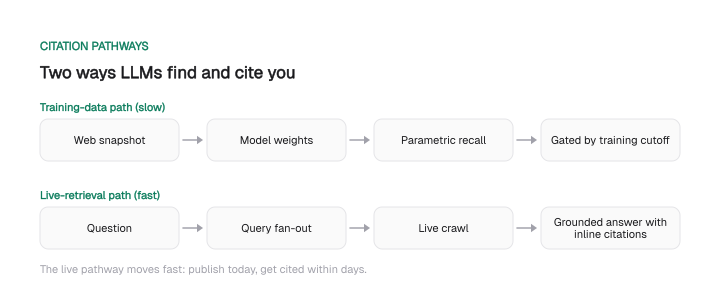
Your content reaches an AI answer through two separate pathways, and each one fails for a different reason. Understanding both is what makes the rest of this guide actionable.
The training-data pathway
The training-data pathway is how a model "remembers" your brand without looking anything up.
When a model is trained, it reads a large snapshot of the web and stores patterns in its weights. This is parametric knowledge: what the model "knows" without a search. If your brand was well represented in that snapshot, the model can name you from memory.
Two constraints matter here. Training data has a cutoff date, so anything published after the last training run stays invisible to parametric memory until the next one.
And models compress: being mentioned once won't survive that compression. Being mentioned consistently across many reputable sites is what makes a brand stick in the weights.
This pathway rewards broad, sustained presence, and it moves slowly.
The live-retrieval pathway
The live-retrieval pathway is how most modern AI search features actually work.
Instead of relying on memory alone, the engine runs a live search, pulls a handful of current pages, reads them, and generates an answer grounded in those pages with citations. This is retrieval-augmented generation, or RAG.
The mechanic to understand is fan-out. When you ask one question, the engine often rewrites it into several sub-queries, searches each, and merges the results.
Ask "best CRM for a small agency," and it may separately search CRM pricing, CRM for agencies, small business CRM reviews, and integrations, then assemble one answer.
So you're not competing for one keyword. You're competing to be the best source for each hidden sub-question the engine generates. The live pathway moves fast: publish a strong answer today, and you can be cited within days instead of waiting for the next training cycle.
The 3-tier crawler architecture
AI companies run three functional tiers of crawler, and each one controls a different part of your visibility.
"Allow AI bots" is too blunt as advice: blocking one tier but allowing another changes your outcome in ways a single robots.txt line hides.
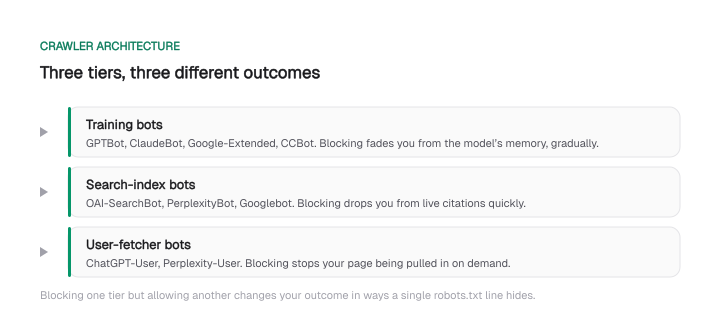
The practical takeaway: block training bots for IP-protection reasons but keep search index and user fetch bots allowed, and you keep your live citation visibility while opting out of model training.
Block search index bots by accident, and you can vanish from live AI answers within weeks, even though the model still remembers your brand.
Check exactly which agents your robots.txt allows, tier by tier, before you assume you're AI-friendly. Our free llms.txt checker inspects the AI-crawler directives on your domain so you can see which tier is open.
The LLMO framework: what to actually do
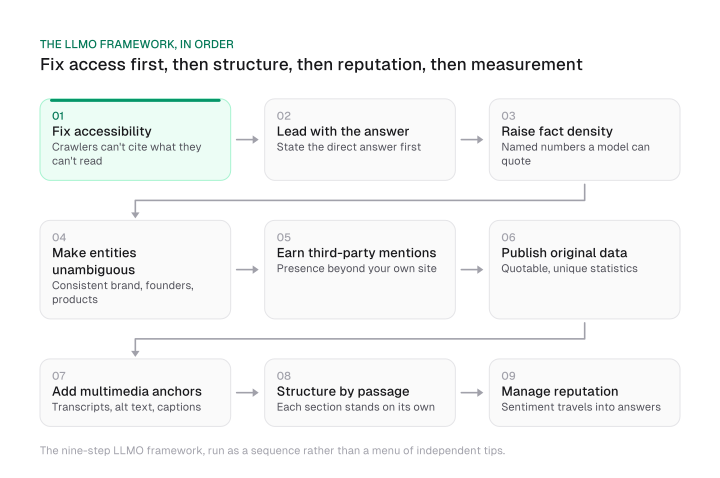
The LLMO framework runs as an operational sequence, not a menu of independent tips: fix access first, then structure, then reputation, then measurement.
Each step below is real work. If you want the condensed version to run through on a Friday afternoon, the AI SEO checklist has the actionable step list.
1. Fix content accessibility and technical health first
AI crawlers can't cite what they can't read, so accessibility comes before anything else in this framework. Check four things:
- Rendering. Confirm your key content is present in the raw HTML, before any JavaScript executes.
- Robots.txt. Check that it allows the crawler tiers you want (see the table above).
- Status codes. Make sure pages return a 200 directly, without a redirect chain or an error.
- Load time. Keep pages fast. Broken or slow pages get skipped during live retrieval because the engine has a fetch budget per query.
2. Lead with the answer
Answer-first structure is the single change with the biggest payoff you can make to existing pages.
LLMs extract the most quotable, self-contained sentence they can find, so use the inverted pyramid: state the direct answer in the first sentence or two of a section, then explain.
A section that opens with three sentences of background before reaching the point gives the model nothing clean to lift.
3. Raise information gain and fact density
Fact density is how many verifiable, specific claims sit in a given span of text, and it decides whether a model can quote you.
Models prefer passages they can extract and attribute cleanly, which means named numbers, dates, and specifics beat adjectives. For example, here's a worked rewrite that turns a generic pitch into something a model can quote:
Before (generic, low fact density): "Our project management tool is designed to help teams work more efficiently. With a range of powerful features and an intuitive interface, it is the ideal solution for businesses looking to improve productivity and collaboration."
After (dense with facts, extractable): "Acme PM is a project management tool for software teams of 10 to 200 people. It replaces separate boards, status channels, and spreadsheet roadmaps with one workspace. Pricing starts at $8 per user per month with a 14-day trial. In Acme's 2025 survey of 320 customers, teams that switched cut weekly status meetings from 4 hours to 45 minutes."
The "after" passage is illustrative, not a real product claim, but notice what changed. It names the buyer, the mechanism, the price, and a sourced result. An AI engine can quote any one of those sentences and attribute it. The "before" passage has nothing to grab.
Rewriting your top ten pages this way is often the difference between being read and being cited.
4. Make your entities unambiguous
Models resolve who and what you are through entities: your brand name, founders, products, and category, plus how consistently the web ties them together. Three places to align:
- Brand name. Use your exact name consistently everywhere.
- About page. Keep it accurate and current.
- Third-party description. Make sure other sources describe you the same way you describe yourself.
Ambiguous entities get confused with competitors or dropped from answers entirely.
5. Earn brand mentions on third-party sites
Both pathways reward presence beyond your own site.
In the training pathway, repeated mentions across reputable domains are what make a brand survive compression into the weights. In the live pathway, engines often cite roundups, review sites, and community threads rather than your own homepage.
Getting named in "best X tools" lists, industry publications, and relevant community discussions matters as much as your own content.
6. Publish original data and proprietary research
Original statistics are magnetic to LLMs because they're quotable and unique, which maximizes information gain.
A survey of your customers, a benchmark you ran, or an internal metric you can share becomes the sentence the model lifts and attributes to you by name. This is the highest-return content type for citation, and almost nobody produces enough of it.
7. Add multimedia with text anchors
Video and images increase the surface area of a page, but what the model extracts is the text around them. So give it text:
- Transcripts. Add a full transcript to every video.
- Alt text. Write descriptive alt text for every image.
- Captions. Write captions that state a fact.
A video with a full transcript is machine-readable. A video with an empty description is invisible to retrieval.
8. Structure at the passage level
LLMs cite passages rather than whole pages. Break long content into clearly headed sections, each answering one question and standing on its own.
Use descriptive H2 and H3 headings phrased the way people ask questions. A 3,000-word page built this way is really twenty extractable passages, each a separate chance to be cited.
9. Manage reputation and reviews
Sentiment travels into answers.
Review-platform data shows shoppers who see reviews converting at 161% higher rates than those who don't, and AI engines increasingly summarize review sentiment when they name a brand.
Keep your review profiles current and address negative patterns, because the model may repeat them.
Technical foundations you cannot skip
Three technical topics decide whether the framework above can even work, and the first is where our own product lives.
JavaScript rendering and why SPA sites lose citations
Many AI crawlers fetch your raw HTML and don't run JavaScript, or run it inconsistently.
If your site is a single-page app built with React, Vue, or a similar framework that renders content in the browser, an AI crawler may receive an almost empty HTML shell and see none of your actual copy.
That page gets no citations, because from the crawler's view, it has no content.
We build on a React stack ourselves, so this isn't a theoretical warning. The fix is rendering the page on the server or prerendering it as static HTML, so the crawler receives fully populated markup on the first request.
For example, view source on one of your marketing pages instead of opening dev tools: if the headings and body text you see on screen are missing from that raw HTML, that's your top priority, above any content tactic.
The broader crawlability checklist lives in our technical SEO checklist for 2026.
llms.txt: should you actually implement it in 2026?
llms.txt is a proposed file that lists your most important pages in a clean, machine-readable format for AI models, similar in spirit to a sitemap. Our full llms.txt guide covers the format, what Google says about it and how many published files actually get fetched.
It sounds sensible, but adoption is still early and support across engines varies. It depends on your site, so here's a decision rule instead of a blanket yes:
- Implement it if: the file is cheap to generate and keep current. For example, your CMS or build pipeline can produce it automatically, and you run a content-heavy site where pointing engines at your best pages could help. The downside is close to zero, and if support grows, you're ready.
- Skip it for now if: creating and maintaining it is manual work that would pull time from higher-return tasks like server rendering or original research. There's no confirmed ranking or citation guarantee tied to it today, so don't treat it as a priority over the fundamentals.
Automate it and ship it, or deprioritize it. Don't spend a sprint hand-crafting one on the belief that it's a citation switch, because the evidence for that doesn't exist yet.
You can validate any file you do publish with our llms.txt validator.
Schema markup: what the conflicting studies actually say
Schema markup's effect on AI citation is unsettled, and studies on it don't agree with each other. Here's what we can and can't claim.
What we can say with confidence: schema helps machines parse your content into clear entities and relationships, it powers rich results in traditional search, and it does no harm when implemented correctly.
What the evidence doesn't support: that adding schema reliably increases your citation rate inside ChatGPT or Perplexity. The data on that specific link is mixed, and anyone telling you schema is a guaranteed AI citation lever is overselling a case the evidence doesn't close.
The practical stance: implement Organization, Article, FAQ, and Product schema where they naturally fit, because they're low cost and help entity clarity, which the framework rewards anyway. Don't reorder your roadmap around schema on a promise of citation gains the studies contradict. Treat it as hygiene.
Platform-by-platform differences
Google AI Overviews, ChatGPT, Perplexity, and Gemini retrieve and cite differently, so a tactic that lands on one may not land on another.
This table reflects how they behave as of 2026, based on public documentation and observed behavior.
Perplexity cites the most aggressively and per claim, so fact-dense passages get pulled in fast. We cover this in the Perplexity SEO guide.
Google AI Overviews draw from the same index as classic Google search, so strong traditional SEO still feeds them. Details are in how to show up in Google AI Overviews.
Gemini leans on Google's index too, and the Gemini SEO guide covers its quirks. ChatGPT blends memory and live search, so both pathways matter for it.
Optimize for the retrieval source each engine actually trusts, not for one generic "AI."
How to measure LLM optimization: a real KPI stack
A real KPI stack for LLM optimization needs its pieces defined precisely instead of just named.
Mission Growth's platform tracks AI citations and visibility for customers. The numbers you generate with the method below become your own baseline.
Here's the concrete version, with formulas and a workflow you can run this quarter. If you want the deeper measurement playbook, see AI search analytics: the new measurement stack.
Build a prompt library first
You can't measure citation without a fixed set of prompts to test against.
Build a library of 40 to 60 prompts. That's enough to be stable across runs without being unmanageable to check by hand. Split them across four categories:
- Unbranded category prompts: "best [category] tool for [use case]." These test whether you get named at all.
- Comparison prompts: "[you] vs [competitor]" and "alternatives to [competitor]."
- Problem-first prompts: the actual pain your buyer types, like "how do I track brand mentions in AI answers."
- Branded prompts: "what is [your brand]," "is [your brand] any good." These test whether the model describes you accurately.
Sample the real language your buyers use. Pull it from sales call transcripts, support tickets, your Search Console query report, review-site language, and relevant community threads. Prompts written in marketer voice won't match how buyers actually ask.
Track share of voice and citation rate
Run every prompt across ChatGPT, Gemini, Perplexity, and Google's AI Overviews.
Log four things per prompt: were you cited, your position in the answer, sentiment, and whether the citation linked to you.
From that log, two core metrics fall out.
Citation rate = (prompts where you appear ÷ total prompts tested) × 100. This is your raw visibility. Track it monthly per engine, because they move independently.
AI share of voice = (your brand mentions across the prompt set ÷ total brand mentions by you and competitors across the same set) × 100. This is your slice of the named-brand pie.
If ChatGPT names three brands per answer and you're one of them across half your prompts, your share of voice tells you whether you're winning or just present.
This metric should move if the work is landing.
Segment referral traffic and run a before/after workflow
Not every AI citation shows up in analytics, but some send clicks.
In GA4, build a segment for referrals from ChatGPT, Perplexity, Gemini, and similar sources, so you can watch AI-sourced sessions separately and track their conversion rate, which should run higher than generic organic.
For tracking mentions specifically inside ChatGPT, how to track ChatGPT mentions of your brand goes deeper.
The audit workflow that ties it together:
- Baseline. Run the full prompt library once, and record citation rate, share of voice, and sentiment per engine. This is week zero.
- Fix. Apply the framework: rewrite top pages for fact density, ship server rendering, publish one piece of original data.
- Re-measure. Re-run the same library at weeks 4, 8, and 12, and compare to baseline. Because live retrieval refreshes faster than training, expect Perplexity and AI Overviews to move first.
To translate citation gains into a revenue case for your finance team, the SEO ROI calculator turns traffic and conversion assumptions into a dollar figure.
Timeline and ownership: what to expect
LLM optimization results depend on which pathway is moving, and the two run on different clocks.
Live-retrieval results: weeks, not months
Rewriting a page for fact density, fixing rendering, or publishing fresh original data can produce citations in the live pathway within roughly 2 to 6 weeks.
Engines re-crawl and their retrieval index refreshes on that order.
This is why freshness matters so much. Citation tracking data shows AI citations for a page drop sharply once it's older than roughly 3 months. The mechanism is the retrieval index aging out stale pages and preferring recent ones, so a quarterly refresh of your key pages keeps them eligible.
Training-pathway results: months to a full cycle
Becoming part of what the model "knows" from memory follows the training-cutoff clock, which turns over on the order of months and sits outside your control.
Broad, consistent mentions beyond your site are how you influence it, but you won't see the effect until the next model version ships. Plan for this pathway as a slow, compounding asset.
Who owns LLMO
LLMO sits across three teams that usually don't coordinate: SEO owns crawlability and structure, content owns fact density and original research, and PR or comms owns third-party mentions and reputation.
In practice, the work stalls when no single person is accountable. Assign one owner, usually whoever runs SEO or organic growth, with a mandate to pull in content and PR.
Budget: staff time, a retainer, or software
Budget follows the same split.
In-house LLMO is mostly staff time across those functions, and that's the biggest hidden cost, because the hours compete with everything else those teams already own.
An agency retainer converts it into a fixed monthly fee, where you rent expertise instead of building it. A software subscription is usually the smallest recurring line item, and it automates the repetitive measurement and monitoring, though someone still has to act on what it surfaces.
Most teams land on a subscription for always-on tracking, plus either internal time or an agency for the strategic calls. AI SEO agency vs AI SEO software covers how to decide between them.
What can go wrong: the risks nobody mentions
Aggressive optimization has downsides that upbeat guides skip.
Hallucination risk to your brand. LLMs make things up, and they can make things up about you: a feature you don't have, a price that's wrong, a claim you never made. The more the model talks about your brand, the more surface area there is for a confident, wrong statement to reach a buyer.
Monitor your branded prompts for accuracy as well as presence, and correct the source material the model is pulling from when it gets you wrong.
Tactics that edge toward cloaking. Serving one version of a page to a bot and another to a person is cloaking. It violates search guidelines, and it can get you removed. Optimizing your real, human-visible content for extraction is fine. Building a separate "AI version" that humans never see is the line you don't cross.
Over-optimization that backfires. Content stuffing, keyword-jamming, and manufacturing fake citations or fake reviews are the black-hat corner of LLMO. They can produce a quick bump and a penalty that lasts once engines detect the pattern, and they damage the reputation signal you spent months building. There's no version of fake authority that survives contact with a model trained to detect it. Earn the mentions instead.
Cannibalizing your regular SEO. Chasing AI citations by thinning your content into extractable snippets can hurt the depth that ranks in classic search. The two aren't in conflict when done well, because a page that's clearly structured and dense with facts serves both. But stripping pages down to bullet points just to feed AI can cost you traditional rankings. Optimize for both readers at once, human and machine.
Best tools for LLM optimization
The tooling category is young, and most of it is citation tracking rather than optimization.
Dedicated platforms exist for monitoring your presence across AI engines.
Verify their current feature sets yourself before buying, because this category changes fast and we won't describe features we haven't confirmed. The full comparison lives in best LLM SEO tools & software.
We built Mission Growth for this work. Mission Growth is an AI-led SEO and GEO growth service: AI catches the signal, our experts make the move, and you see the result.
Where it fits LLMO specifically is the always-on monitoring and execution described in our growth loop docs, so the fact-density rewrites and freshness cadence this guide calls for happen on a schedule instead of when someone remembers.
As a real proof point on the organic side, our MyPhotoStation case study documents a US wall-decor brand reaching 5x organic revenue in 5 months.
Whatever you choose, the sequence is the same: build the prompt library, baseline your citation rate and share of voice, fix rendering and fact density, publish original data, and re-measure at 4, 8, and 12 weeks.
Frequently asked questions
What is the difference between LLM optimization and SEO?
SEO gets your pages to rank as clickable links in search engines. LLM optimization gets your brand named and cited inside an AI-generated answer, where there may be no ranked list at all.
They share most underlying work, like crawlability and clear content, but LLMO adds fact-dense passage structure, off-site brand mentions, and answer-first writing so a model can extract and attribute you directly.
Is LLMO the same thing as GEO (Generative Engine Optimization)?
They overlap heavily and people use them interchangeably. GEO is the broader umbrella term for getting content into any AI-generated answer across all engines. LLMO is the narrower layer focused specifically on citation inside large language models like ChatGPT and Claude.
There is no settled consensus on the boundary, so use GEO when you mean the whole shift and LLMO when the discussion is specifically about chatbots.
How do I measure whether my LLM optimization is working?
Build a fixed library of 40 to 60 prompts in real buyer language, run them across ChatGPT, Perplexity, Gemini, and Google AI Overviews, and log whether you are cited each time.
Two metrics matter: citation rate (prompts where you appear divided by total) and AI share of voice (your mentions divided by all brand mentions in the same set). Re-run monthly and compare to a baseline.
Do I need an llms.txt file for LLM optimization in 2026?
Only if it's cheap to generate and maintain. llms.txt lists your key pages for AI models, but engine support is still early and no confirmed citation benefit is tied to it yet.
Automate it through your CMS or build and ship it, since the downside is near zero. Don't hand-craft one manually in the belief that it's a citation switch, because that evidence doesn't exist.
How long does LLM optimization take to show results?
The live-retrieval pathway typically moves in roughly 2 to 6 weeks: rewrite a page or publish fresh data, and engines re-crawl and can cite you soon after.
The training pathway, becoming part of what the model knows from memory, follows the model's training cycle and takes months. AI citations for a page drop sharply once it's older than roughly 3 months, which is why freshness matters.
Can aggressive LLM optimization hurt my brand or your regular SEO?
Yes. Models can hallucinate wrong facts about you, so more AI presence means more chances for a confident error to reach buyers.
Tactics that show crawlers different content than humans count as cloaking and can get you removed. Stripping pages into thin snippets to feed AI can also cost you traditional rankings. Optimize real, human-visible content for both audiences instead.
Cite this page
Aktaş, F. (2026, September 17). LLM Optimization: The Complete Guide. Mission Growth. https://missiongrowth.io/blog/llm-optimization-guide
Figures we made for this post are free to reuse under CC BY 4.0 with credit to Mission Growth.
Get Mission Growth highlighted in your Google results.