
AI SEO Software vs Agency: Which Option Beats a Retainer
AI SEO software vs agency: a tool plus about 30 expert hours a month costs the same as the $3,209 average retainer. Compare costs, speed and fit.
By Furkan AktaşPublished Updated
On this page
AI SEO software vs agency is a question with a number inside it. A $199 a month AI search tool plus about 30 hours of expert time a month costs as much as the $3,209 average agency retainer, so software is the cheaper route only while acting on its data takes you under about 30 hours a month.
We get the 30 from ($3,209 minus $199) divided by $98.90, the average hourly rate agencies charge in the same Ahrefs survey. Speed doesn't settle it either: an agent that ships a fix in hours still waits a few days to a few weeks for Google to recrawl it.
Key takeaways
Buy software when your team has the hours to act on what it shows. Hire an agency or a managed hybrid service when you have budget but no hours. Build in-house only with dedicated headcount behind it. Most growing teams blend two of these, and that's a reasonable place to land.
AI SEO software vs agency: what each option does and costs
An autonomous AI SEO agent is software that executes configured SEO workflows around the clock and changes your site, unlike monitoring software, which only reports.
One vendor's blog post puts its agent at $299 to $999 a month with no contracts, though its pricing page doesn't list that plan, and another vendor starts at $500 a month. That gives "a fraction of the price" a number, and it is the sellers' number.
Sort the four options by who changes your live site:
- Monitoring software: tracks prompts and engines, reports what AI answers cite, and changes nothing on your site. One vendor's tiers run $29 a month for 15 prompts up to $489 for 400.
- AI SEO agent: runs configured workflows and ships changes inside rules you set.
- Agency: a human team that works from its own queue. A traditional SEO agency optimizes for rankings and clicks in classic results; an AI SEO agency also works on AI citations in ChatGPT, Perplexity and Google AI Overviews answers.
- Hybrid model: software monitors, and experts do the strategy and the shipping.
Here is how the four compare on the rows buyers ask about:
The price row says the cheapest option is also the one that does the least. The turnaround row hides the real speed difference, which the speed section below isolates.
Is there an AI that can do SEO? For routine work, yes: an agent audits, drafts and ships fixes. It still hands every new page to a person, and the agent section below draws that line.
The same agency can handle both your SEO and your AEO if it measures both surfaces. Many agencies now do classic SEO and AI-answer work under one roof, so ask which engines they track and what they ship for each.
Names are loose in this market. An "AI SEO consultant" usually means a small agency or a solo operator selling the same service. If you want the deliverable list behind either label, AI SEO services breaks down what vendors include.
Here is the break-even in full. A $199 a month tool plus about 30 hours a month of expert time at the $98.90 hourly rate agencies average in Ahrefs' survey costs the same as the $3,209 average retainer.
So sort first by who changes the site, then settle it by the hours you can supply.
What an AI SEO agency costs, and which bands to trust
AI SEO agency pricing is best benchmarked at $3,209 a month, the average in Ahrefs' survey of 439 SEO providers (page updated August 2024), and mid-market bands of $2,500 to $10,000 agree.
The outlier is one vendor's $10,000-50,000 claim, whose low end sits 3.1x above the survey average ($10,000 divided by $3,209). Here are the agency price bands as checked in October 2026, with whose number each one is:
Download CSV (CC BY 4.0)
Compare like with like. The mid-market band from a US agency and the software vendor's $3,000 to $10,000 overlap with the survey average, so treat that range as the working band, and treat a band with no segment or sample as a seller's claim.
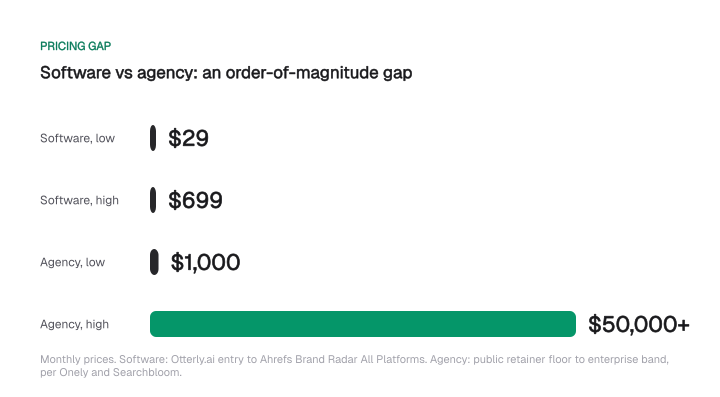
Two more survey numbers anchor the budget. The most common agency retainer is $500 to $1,000 a month, and 68.8% of providers charge $2,000 a month or less, so the average is pulled up by a smaller group of expensive firms.
Read the survey with two caveats. It covers SEO in general, not only AI SEO, and its averages count each respondent at the top of their own price tier, so they lean high.
An AI SEO consultant is not cheaper by default. Consultancies average $3,250 a month in the same survey, and their hourly rate of $171.18 is well above the $98.90 agencies charge, while freelancers average $71.59 an hour. Those three hourly rates feed the break-even in the next section.
One US agency also warns that a quote below roughly $1,000 a month usually means thin, automated work. Treat it as a warning about quality, not as a price band.
Contract terms matter as much as the fee. One agent vendor says most agencies require 6 to 12 month minimum contracts with 30 to 60 days of notice, a second vendor says 6 to 12 months is typical, and both are sellers describing their competitors, so check the notice period in your own agreement.
Budget from the survey average and your scope, and read SEO cost per month for the full price distribution behind it.
AI SEO software pricing and the break-even hours rule
A $199 a month AI search tool plus about 30 hours of expert time a month costs as much as the average $3,209 agency retainer.
The break-even hours come from one formula: retainer minus tool price, divided by the hourly rate. Using the average agency's own rate of $98.90 an hour, ($3,209 minus $199) divided by $98.90 is about 30 hours, or about 7 hours a week. The assumption is that your expert hour costs about what an agency's does.
Entry prices, checked in October 2026, explain why the tool side looks so cheap:
Download CSV (CC BY 4.0)
The $29 plan costs 2.9% of a $1,000 retainer, and the $199 plan costs 6.2% of the average retainer. A year of the $199 plan is $2,388.
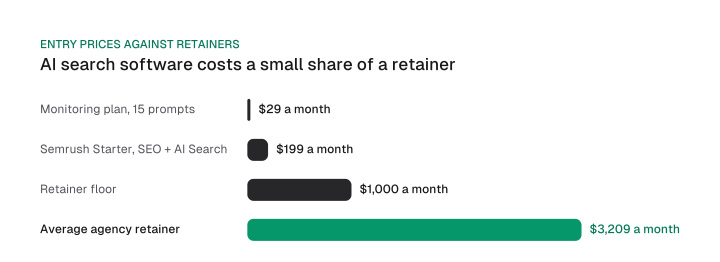
The hours move with the comparison. Against a $1,000 agency, the same tool crosses over at about 8 hours a month. At the consultancy rate of $171.18 an hour, break-even against the average retainer drops to 18 hours, and at the freelancer rate of $71.59 it rises to 42.
Agents shift the line again. Against the average retainer, a $299 agent tier breaks even at 29 hours and a $999 tier at 22 hours, because the agent fee uses up part of the budget.
That is far above what the vendor says an agent needs: 1 to 2 hours a month to review and approve. The two numbers measure different work.
The 30 hours counts you acting on a monitoring tool's findings, and the 1 to 2 hours counts you reviewing work the agent already did, so you should test the agent claim on output quality. For example, ask for a week of shipped changes and judge them directly.
Software is cheaper only while acting on its data takes under about 30 expert hours a month. If you're picking the tool layer, the best LLM SEO tool comparison sorts the monitoring options, and an agent that really needs 1 to 2 hours of review would beat both routes, which is the claim to test in a trial.
Speed: when a fix ships and when Google sees it
An AI SEO agent can ship a fix in minutes or hours, but Google still needs a few days to a few weeks to recrawl it.
So the speed gap to an agency is the queue before the fix ships, because the recrawl wait after it is identical for both. Google's documentation says crawling after a change can take anywhere from a few days to a few weeks.
Three clocks run on every fix:
An agent can detect a traffic drop overnight and draft the fix, but a person approves it, and Google still needs a few days to a few weeks to recrawl the change.
One agent vendor describes the first half: a diagnosis and a solution "ready for approval" by Monday morning. That sentence stops at approval. Detection is not delivery, and delivery is not visibility.
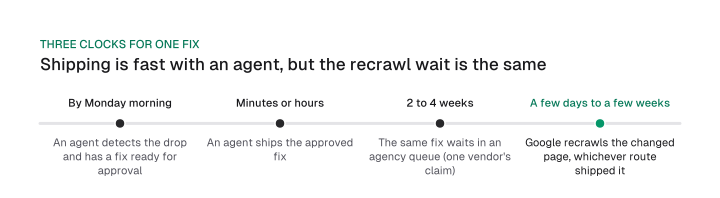
Take a title tag fix. An agent drafts it overnight and a person approves it, so it can be live within hours. An agency may hold the same fix for 2 to 4 weeks in its queue, which one vendor calls a 30 second change. Google then needs the same few days to a few weeks for either route.
Re-requesting indexing won't close that second gap. Google says requesting a recrawl multiple times for the same URL won't get it crawled any faster.
Ask every provider for time to live, then add the recrawl wait to all of them. One agent vendor also says there is no universal speed multiplier, so treat any "hours to days" claim as execution time only. For how that wait fits the longer arc, see how long does SEO take.
Autonomous AI SEO agents: what to let them ship alone
An autonomous AI SEO agent can publish fixes to existing pages unattended, but every new page needs a person's approval.
The reason is Google's spam policy. It defines scaled content abuse as many pages generated mainly to manipulate rankings, "no matter how it's created", so the method doesn't matter and volume without added value does. One vendor advertises 30 articles a month, and at that pace an unreviewed queue is how a site ends up on the wrong side of the line. For the policy detail, see is AI content bad for SEO.
The vendor that sells the volume also says nothing publishes without your sign-off. Hold it to that.
Here is the task matrix, with the gate that decides each one:
Three rules fall out of it:
- Auto-ship: fixes to pages that already exist and already rank, such as metadata, schema and internal links.
- Approve: every new page, however it was drafted, by someone who can say what it adds.
- Agency: digital PR, migrations and regulated industries, where one software vendor itself says agencies keep the edge.
The AI SEO agent vs agency split is a hybrid model in practice. Software ships the fixes, a person decides who approves new pages, and the agency takes the three jobs software doesn't do. Our AI agent SEO guide covers how agents are built and the approval-first default.
Let software ship fixes to existing pages unattended. Approve every new page.
Reporting and proof: the ship test and seven red flags
A provider that ships can hand you a dated list of live site changes from the last 30 days; a dashboard reseller can hand you only reports.
Run this ship test on any provider, human or software:
Take the render question. We migrated our own React single-page app to prerendered static HTML for 20 marketing pages because AI crawlers do not execute JavaScript. Ask a prospective provider: "Have you done render or prerender work so AI crawlers can read a site that renders in the browser, or do you only write content?"
A dashboard reseller is an agency reselling a self-serve tool as its own method. Divide the $3,209 average retainer by the $29, $199 and $489 monitoring tiers and the markup runs about 111x, 16x and 6.6x, and every deliverable is a report with no live change on your site.
Seven red flags separate a real provider from that pattern:
- Guaranteed placement. AI answers change by the query, so any fixed citation date is a misunderstanding or a lie.
- Wrong vocabulary. Talk of a "top spot in AI Overviews" or of keywords and clicks only, with no mention of citations and prompts.
- Secret methods. If they won't explain the work, there is often little behind it.
- One strategy for every client. A fintech brand and a wall decor brand need different work.
- No tracking of AI search. They can't show your visibility, a competitor's, or prompt performance.
- No brand authority work. Ahrefs' May 2025 study of 75,000 brands found a brand's web mentions track its AI Overview visibility at 0.664 and its backlinks at 0.218. Those are correlations, so ask what authority work they do.
- No proof. No case studies, performance data or references.
Guarantees fail because a generative engine reassembles its answer per query, so the same prompt can cite you today and skip you tomorrow. The mechanics are in our GEO vs SEO piece, and what AI SEO services include shows what a real deliverable list looks like.
Judge any provider by the dated list of live changes.
Which option fits: a decision table by company stage and hours
Software suits a team that can spend under about 30 hours a month acting on its data; a team with fewer hours should hire an agency or a hybrid.
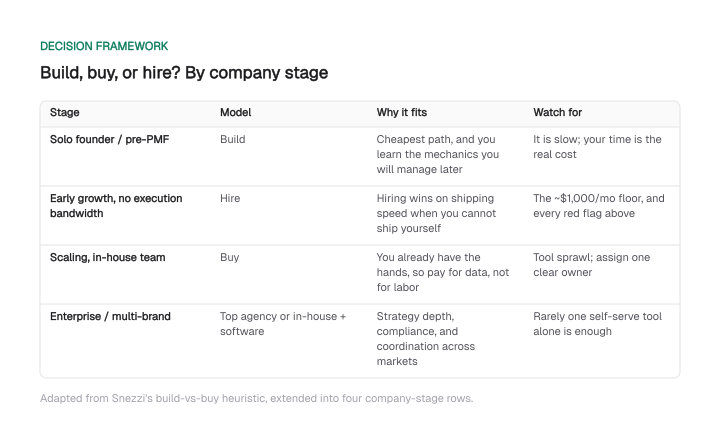
A solo founder builds, a scaling team with hours buys software, and an early-growth team without hours hires an agency.
Should I hire an SEO agency or use AI SEO tools? Choosing an SEO approach for your organization comes down to its stage, its hours and its know-how. Budget answers it less reliably.
Hire an SEO company or use AI based on that test, and apply it to in-house vs agency AI SEO as well. Here it is by stage:
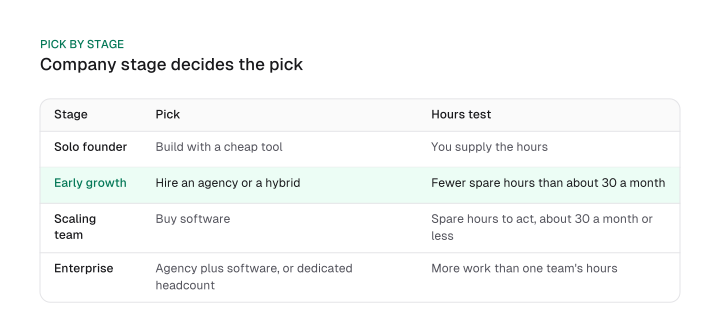
If you already have hours, buy the software and give it one owner. Against a $1,000 agency the tool route stays cheaper only below about 8 hours a month, so check your calendar before you cancel anything.
Most companies don't sit in one row. A scaling company often buys software for monitoring and hires a hybrid partner for the technical shipping it can't staff. Build in-house only with dedicated headcount, and see the in-house wage math before you do. For multi-market teams, enterprise SEO covers platform contracts and governance.
Mission Growth is an AI-led SEO and GEO growth service: AI catches the signal, our experts make the move, and you see the result. Mission Growth's platform tracks AI citations and visibility for customers.
Before you commit to any option, our SEO ROI Calculator puts a monthly spend next to an expected return.
Switching from an agency to software or agents: a 30-day parallel month
Run the new software alongside the agency for one month and score both on live changes shipped, not findings reported, before you cancel.
Start inside the notice window, so the overlap costs one retainer plus one tool. At the average retainer plus the $199 plan, a parallel month costs $3,408.
Here's how to run it:
- Read the notice period. One agent vendor says agencies often ask for 30 to 60 days of cancellation notice, so read your own contract and count back from its end date.
- Check ownership first. Confirm you hold the admin logins for Search Console and your CMS admin, plus analytics, so nothing disappears when the agency does.
- Set the scorecard. Count dated live changes that shipped, with URLs. Findings and recommendations don't score.
- Check weekly. Ask both for their dated list of live changes each Friday and open three URLs.
- Decide at day 30. Keep whichever route shipped more of what you can see, and keep the agency only for the tasks software didn't do.
The biggest risk of switching is the gap: nobody ships while you wait for access, or the new tool reports and nothing changes. The scorecard catches that in week two. Tell your agency about the test, since an agency that ships passes it.
The choice comes down to hours. Count the expert hours your team can really supply each month: under about 30, a tool plus your time beats the retainer, and above that, or with none to spare, hire an agency or a hybrid. Then start the parallel month inside your notice window.
Frequently asked questions
Is AI SEO software enough without an agency?
Only while acting on its data takes under about 30 expert hours a month. Monitoring software reports and changes nothing on your site, so a team with no spare hours gets data and no fixes. At the agency average of $98.90 an hour, more than 30 hours of your own time costs more than the retainer.
Is an AI SEO consultant cheaper than an agency?
Not on average. In Ahrefs' 2024 survey, consultancies charge $3,250 a month against $3,209 for agencies, and $171.18 an hour against $98.90. Freelancers are cheaper at $71.59 an hour, but a one-person provider carries less capacity, so ask who ships when they are busy.
Can I use AI SEO software and an agency at the same time?
Yes, and many teams do. Split by task: software monitors and ships fixes to existing pages, and the agency takes digital PR, migrations and new content under your approval. Run the ship test on the agency so you aren't paying a retainer for a resold dashboard.
What if I have signed a long-term agency contract?
Read the notice period first. One agent vendor says agencies typically require 6 to 12 month minimums with 30 to 60 days of notice. Start the 30-day parallel month inside that window, confirm you own your Search Console and CMS access, and cancel only after the scorecard.
Can an agency guarantee placement in Google AI Overviews?
No honest agency can. AI answers reassemble per query, so the same prompt can cite you today and skip you tomorrow. A guaranteed placement or a fixed citation date is the first of the seven red flags. Hold providers to dated, shipped changes and steady movement in your citation monitoring.
Is AI replacing SEO agencies?
Software now covers routine work: audits, drafts and fixes under approval. Agencies still win on digital PR, migrations and regulated review, and they still hold the human judgment on strategy. The wider question, will AI replace SEO as a discipline, has its own guide.
Cite this page
Aktaş, F. (2026, October 6). AI SEO Software vs Agency: Which Option Beats a Retainer. Mission Growth. https://missiongrowth.io/blog/ai-seo-agency-vs-software
Download the data: 2 tables as CSV (CC BY 4.0)
Figures we made for this post are free to reuse under CC BY 4.0 with credit to Mission Growth.
Get Mission Growth highlighted in your Google results.