
Best ChatGPT SEO Tools 2026: Price per Prompt Compared
ChatGPT SEO tools in two jobs: connectors that put Semrush and Ahrefs data in ChatGPT, and trackers compared by price per tracked prompt and run depth.
By Furkan AktaşPublished Updated

On this page
Someone asked "are we in ChatGPT?" and now you need to pick one of the ChatGPT SEO tools on sale. First, know which of two jobs you're buying. Connectors put Semrush or Ahrefs data inside the chat. Trackers, sometimes sold as ChatGPT SEO checkers, record whether the model names your brand.
Most of this page is about the second job, because that's where pricing pages stop being comparable. They sell prompts, credits, checks and "answers". We convert every plan to one unit, cost per tracked prompt, and then show how many runs a visibility rate needs before you can trust it.
If you want the tactics for earning mentions instead, that lives in our chatgpt seo guide.
In this guide:
- A comparison table with price and allowance for every tool
- How many runs a ChatGPT tracker needs per prompt
- Five disclosures that make a tracker's number readable
- One card per tool, each with a Best for line, Pros, Cons and Price
- A pick table keyed to prompt budget and run depth
Best ChatGPT SEO tools in 2026: the short answer and comparison
ChatGPT SEO tools are two products: connectors that put Semrush or Ahrefs data inside ChatGPT, and trackers that record whether ChatGPT names your brand.
Here's the pick by situation. Need keyword, difficulty or backlink data inside a chat? Use a connector. Need trend lines on a small prompt set? Take a daily tracker priced per prompt. Already watching other engines too? An all-engine plan makes sense, and our best llm seo tool guide covers that wider field.
The best ChatGPT SEO tracking tools are the ones whose price and run depth you can read, so the table below lists both. Prices checked October 2026.
Download CSV (CC BY 4.0)
Price per tracked prompt spans 46 times across the 16 plans that publish both a monthly price and a prompt count. It runs from about $0.15 on Morningscore Premium ($299 for 2,000 prompts) to $6.90 on Morningscore Lite ($69 for 10 prompts), with a median of $1.35. We got the figures by dividing each plan's monthly list price by its prompt allowance.
So the headline price tells you little. A $299 plan can be the cheapest per prompt on the page, and a $69 plan the most expensive.
Credit-based plans (Athena, Rankscale), check-based plans (Brand Radar), annual-only plans and custom plans sit outside the range. They publish no monthly dollar price beside a prompt count.
The Morningscore and SE Ranking prices also buy a wider SEO suite, so their per-prompt figures overstate what the tracker alone costs.
The bars show six plans: LLMrefs at $0.16, Morningscore Business at $0.99, Morningscore Premium at $0.15, AIclicks Pro at $1.26, AIclicks Starter at $1.97 and Morningscore Lite at $6.90, set against the $1.35 median.
One correction matters here. Profound's pricing page, in the brands view, lists a free Trial (50 prompts daily for 7 days across ChatGPT, Gemini and Google AI Overviews) and a custom Enterprise plan, and it shows no price for either. If a tool list quotes $99 or $499 a month for Profound, those may be older plan prices, so check them against Profound's pricing page before you rely on them.
How these ChatGPT tracking tools were compared
Every price, limit and cadence for the ChatGPT SEO tracking software here comes from the vendor's own page on 2026-10-04, and each tool is read for what the page discloses about how often it asks ChatGPT.
We ran no hands-on scoring, and no tool gets a grade. The criteria are five:
- Price: the monthly list price in dollars, where the page shows one.
- Prompt allowance: prompts, credits or checks, converted to one unit.
- Cadence: how often a prompt is asked.
- Engines: ChatGPT only, or several.
- Method: what the page says about how the tool queries ChatGPT.
The unit is simple: cost per tracked prompt equals monthly price divided by prompts included. A tool is only comparable once its price and allowance are in that one unit.
For the user evidence below, we counted comments in public Reddit threads rather than summarising impressions. Surfer, the Semrush AI Visibility Toolkit, Omnia, KIME, Botric, Traqer, ZeroRank and Beamtrace were left out because we did not check their plans against the one-unit comparison on 2026-10-04.
What a ChatGPT tracker can and cannot see
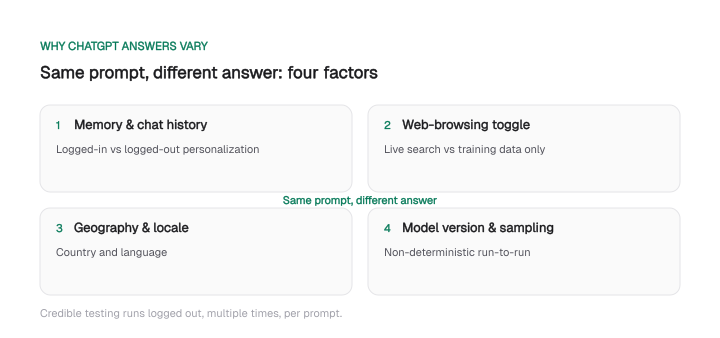
A ChatGPT tracker measures one draw from a system that may or may not search the web, estimates your location from the IP address, and can fold saved memories into the query.
That comes from OpenAI's own help page on searching the web with ChatGPT. ChatGPT may search automatically when a question would benefit from current information, and people who aren't signed in can use web search too. When it searches, it typically rewrites your question into one or more targeted queries.
With memory enabled, it may use relevant saved memories while rewriting. And it may use an approximate location based on your IP address, which a VPN or network location can change.
Each of those switches changes the answer. So a buyer should demand five disclosures.
Ask whether the run uses web search or answers from the model alone, and which country or IP the tracker uses. Ask whether it runs signed in or out, and what the memory state is. Ask whether it queries the API or the ChatGPT app, and how many runs stand behind each number.
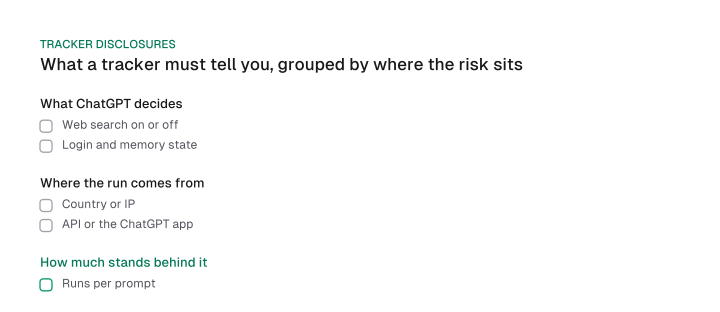
A tracker that can't state these is selling a number without the conditions that make it a measurement. If you'd rather start by hand, our guide to how to track chatgpt mentions walks through the same controls for a DIY panel.
Presence is reliable earlier than position. SparkToro's January 2026 study makes the contrast concrete: a Los Angeles hospital showed up in 69 of 71 ChatGPT answers, a 97% visibility rate, yet it was the top mention in only 25 responses. If a tool sells your exact position in answers, treat it as the shakier of the two numbers.
How many runs a ChatGPT tracker needs per prompt
SparkToro's study says to ask a prompt 60 to 100 times to see the set of brands it returns, and by our arithmetic a visibility rate from 5 runs carries a 44-point margin of error against 12.7 points at 60 runs.
Two labels keep this honest. The 60 to 100 advice is SparkToro's, from 2,961 runs across 12 prompts and 600 volunteers, spread over three tools (ChatGPT, Claude and Google's AI), and it is about listing the brands a prompt returns. It found under a 1-in-100 chance that two responses give the same list of brands.
The metric SparkToro endorses is visibility across dozens to hundreds of prompts, each run multiple times. If you want to track ChatGPT rankings with a number you can defend, that pooled rate is the one to ask for. The margins below are ours, from the normal approximation to the binomial, and SparkToro didn't publish them.
Here's a worked example. A brand named in 12 of 30 runs shows a visibility rate with a margin of about 17.5 points. The margin is widest at a 50% rate, so take 50% and change only the runs:
- 4 runs: 49 points.
- 5 runs: 44 points.
- 60 runs: 12.7 points.
- 100 runs: 9.8 points.
So a 3-to-5-run hand check tells you whether a brand appears, and it can't give you a rate. Our DIY guide treats 3 to 5 runs per check cycle as that floor. A rate needs far more.
Cadence is where trackers differ, as each vendor's page states it:
Brand Radar's number is its own arithmetic: 5 prompts on 1 platform equal 150 checks a month, so 30 checks per prompt. LLMrefs says only "weekly reports", so don't assume it runs a prompt weekly.
Daily tracking reaches 60 runs of one prompt in 60 days. That's slow for a single prompt. But a tracker with 100 prompts tracked daily pools about 3,000 runs a month, and that pooled portfolio rate is far steadier than any one prompt's rate.
Read cadence and runs per prompt on the pricing page before you read the price. A rate from a handful of runs is a hand check wearing a dashboard.
ChatGPT SEO tools reviewed one by one
Two connectors and twelve trackers (eleven vendors plus Mission Growth) are reviewed here, each with its price where the page shows one, one limit and the situation it fits.
Connectors that put SEO data inside ChatGPT
A connector gives ChatGPT access to an SEO platform's data. It can't see what ChatGPT says about your brand, so it answers a different question from a tracker.
Semrush app for ChatGPT
Best for: Semrush customers who want data inside ChatGPT without a ChatGPT-side fee.
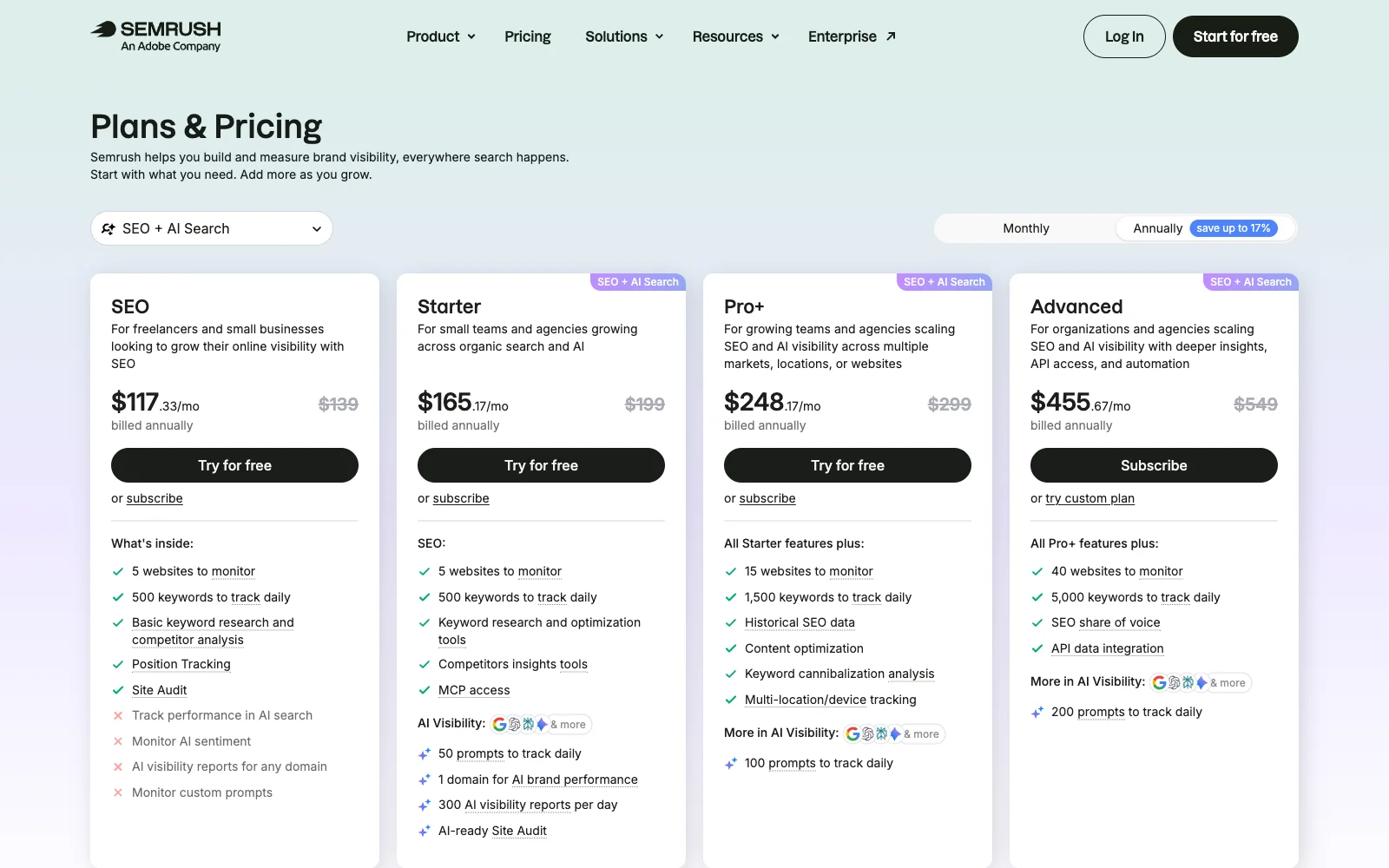
The Semrush app is the connector to pick if you already pay for Semrush and want keyword and domain data in a chat. It consumes API units from your Semrush API subscription, and Semrush states there are no additional ChatGPT fees.
Semrush One Starter, Semrush One Pro+, SEO Classic Pro and SEO Classic Guru include 50,000 API units, which refresh on your subscription renewal date. SEO Classic Business and Semrush One Advanced need a separately bought API units package. So the real budget question is how many units your prompts burn, and you'll only learn that by watching your balance.
Like every connector, it brings Semrush's data into the conversation. It can't tell you what ChatGPT says about your brand, so add a tracker if that's the question you were asked. If you only want keyword research done faster, the connector alone is enough.
Pros:
- No extra ChatGPT fees.
- Billing runs on API units you may already hold.
Cons:
- Every request draws down API units.
- It reads Semrush's data and none of ChatGPT's own answers.
Price: API units from your Semrush API subscription.
Ahrefs MCP for ChatGPT
Best for: Ahrefs users on Pro or Plus ChatGPT accounts who are comfortable in Developer mode.
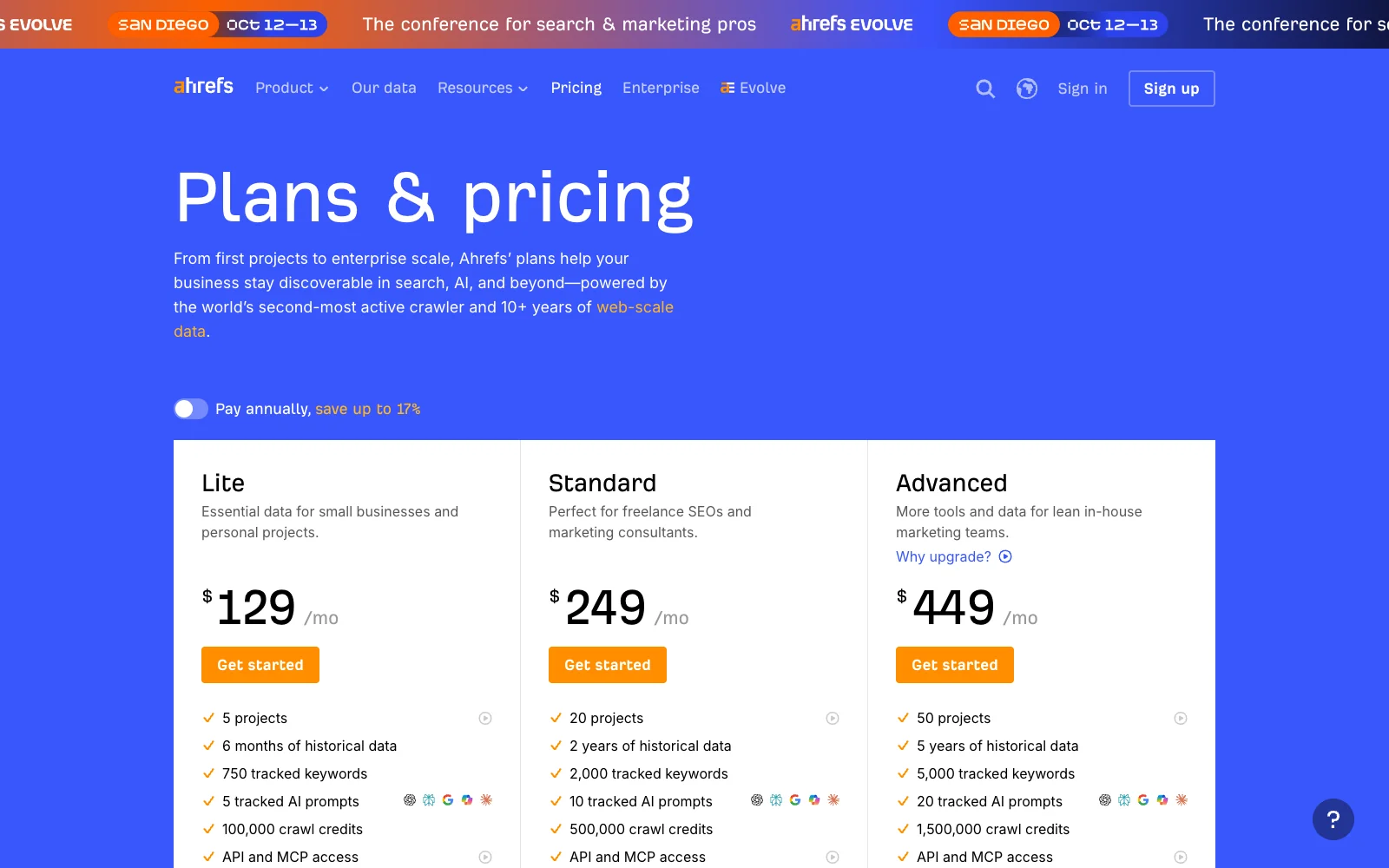
Ahrefs MCP is the better connector when your team already lives in Ahrefs and can accept a beta. Ahrefs' docs say full MCP client access in ChatGPT is in beta, and for now it's only available in Developer mode for Pro and Plus accounts on the web.
The docs also give a prompting rule worth copying: name the tool, the fields and the sort order, and explicitly ask ChatGPT not to use web search. For example, ask for a named report with named columns sorted by a named metric, and say so in one line.
That keeps the answer tied to Ahrefs data instead of a web search. It still reads Ahrefs' index and tells you nothing about how ChatGPT describes you.
Pros:
- The docs tell you exactly how to prompt it.
- Ahrefs data stays the source of truth.
Cons:
- Beta status.
- Developer mode on web accounts only.
Price: Depends on your Ahrefs plan.
Is a ChatGPT SEO plugin still an option?
A ChatGPT SEO plugin no longer exists as a ChatGPT feature: OpenAI ended conversations with plugins on April 9, 2024, and GPTs replaced them. Today "plugin" means a GPT or an MCP connector. Serpstat's page still calls its product a plugin for ChatGPT Plus subscribers, so expect the old word on vendor pages.
If you want content scoring on top, that's a different tool class, covered in our best content optimization tools guide.
What ChatGPT does on its own and where it needs data
ChatGPT alone drafts and outlines text but has no volume data, no rank data and no backlink data, so the line between the two jobs is the data each one brings.
Drafting, outlines, meta tags, keyword clustering, intent research, schema markup and code help are text tasks ChatGPT handles by itself, with human editing for brand voice and accuracy. Volume, difficulty, rank and backlinks need a connector, which is what the Semrush and Ahrefs cards above supply. For schema detail, our schema for AI search guide goes further.
Profound
Best for: Teams that want to test a multi-engine tracker before committing.
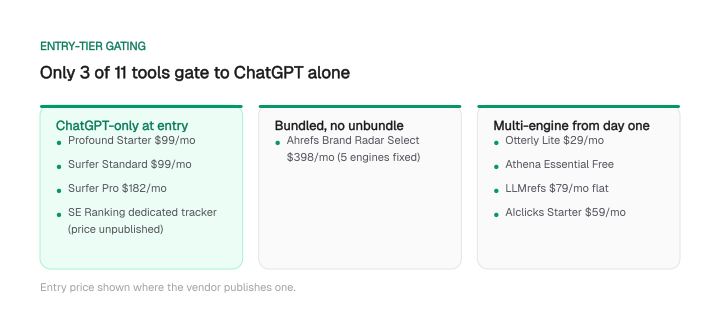
Profound is the tracker to try first if you want a free look across ChatGPT, Gemini and Google AI Overviews before talking to sales. The free Trial runs 50 prompts daily for 7 days on those three engines.
Enterprise tracks up to 9 answer engines on a custom plan. The brands pricing view shows no price for the Trial or for Enterprise, so budget by asking. Seven days of daily runs is enough to see whether the interface suits you, and too short to read a trend.
Treat the Trial as a demo of the dashboard, then decide whether a plan with a published price fits better. If you need ChatGPT only, remember the Trial spreads its 50 daily prompts across three engines.
Pros:
- A free Trial with daily runs.
- Up to 9 answer engines on Enterprise.
Cons:
- The brands pricing view lists no price on Trial or Enterprise.
- The Trial lasts 7 days.
Price: Free Trial for 7 days; Enterprise is custom.
SE Ranking ChatGPT Visibility Tracker
Best for: Teams already on SE Ranking who want a ChatGPT rank tracker next to their keyword data.
SE Ranking's ChatGPT-only tracker comes from a classic SEO suite, so it's the closest thing here to a ChatGPT SEO tracker you bolt onto the keyword tool you already use. The page says it is designed for ChatGPT mention monitoring and sells "where your brand ranks" in ChatGPT answers.
The tracker page lists no price. The Core plan lists at $129 a month ($103.20 billed annually) and includes 2,000 keywords and 100 prompts tracked daily, and the plan page doesn't say which engines those prompts cover.
A separate AI Search add-on lists $89 a month ($71.20 billed annually) for 200 prompts across AI Overviews, AI Mode, Perplexity and ChatGPT. Counting the 100 Core prompts as asked every day, that's about 3,000 runs a month pooled across the set.
The price also buys the SEO suite, which means the cost of the tracker alone is lower than the full fee suggests. If you don't already use SE Ranking, weigh it against a standalone tracker with the same prompt count before you commit.
Pros:
- A dedicated ChatGPT tracker page, with a separate AI Search add-on for other engines.
- Prompts sit beside classic keyword tracking.
Cons:
- The fee also buys a full SEO suite.
- It sells your rank in answers, which is the shakier number in the run math above.
Price: From $129 a month list, $103.20 billed annually.
Ahrefs Brand Radar
Best for: Ahrefs customers who want daily checks across several engines.
Brand Radar is the pick if you already pay for Ahrefs, since free prompts are included in paid Ahrefs plans. Each prompt is checked daily on every selected platform, so 5 prompts on 1 platform equal 150 checks a month.
It covers AI Overviews, AI Mode, ChatGPT, Perplexity, Gemini and Copilot. The Basic package adds 2,500 checks a month for $50, and overage is billed per check. Because it bills in checks, add platforms and the same prompts burn through the allowance faster.
A short prompt panel on one platform stays cheap, and the same panel on six does not. So pick the platforms you'd act on before you size the plan, and keep the panel small enough to read each week.
Pros:
- Free prompts come with a paid Ahrefs plan.
- Daily checks on every platform you select.
Cons:
- Billed in checks, so there's no clean per-prompt price.
- Overage is billed per check.
Price: Basic prompt package at $50 a month for 2,500 checks.
Otterly.ai
Best for: Small teams that want to start at $29 and tune prompts as they learn.
Otterly.ai is a ChatGPT rank tracker with a free trial and a three-tier ladder. Every plan tracks ChatGPT, Google AI Overviews, Perplexity and Microsoft Copilot; Google AI Mode, Gemini and Claude are paid add-ons.
Lite is $29 a month for 15 prompts, Standard is $189 for 100 prompts and Premium is $489 for 400 prompts.
Climb the ladder and the cost per prompt falls, so the cheapest way to pay per prompt is the largest tier, which also means the biggest bill.
Fifteen prompts on Lite is enough to try the method, and little else. If a team will read the numbers, start at Standard, whose 100 prompts cost about the same per prompt as Lite. On G2, reviewers most often ask for more filtering and more customizable reporting.
Pros:
- A free trial.
- Cost per prompt falls as you move up a tier.
Cons:
- Lite's 15 prompts cost the most per prompt of the three tiers.
- Premium costs $489 a month.
Price: From $29 a month.
AIclicks
Best for: Teams that want to pick their own engines and run 150 prompts a day on the Pro tier.
AIclicks lets you choose which LLMs to track, and its Pro tier is the best value of its three. Here are the three tiers:
- Starter: $59 a month, 30 prompts, 3 LLMs.
- Pro: $189 a month, 150 prompts, 4 LLMs.
- Business: $499 a month, 300 prompts, 6 LLMs.
Pro's 150 prompts cost about $1.26 each, against about $1.97 on Starter. So if you have more than a handful of prompts, skip Starter.
Business doubles the prompts and adds two LLMs, but its per-prompt price sits between the other two tiers. The LLM count rises with the tier, so check that the engines you need are in your pick before you pay, since a cheaper tier may leave one out.
Pros:
- You choose which LLMs to track.
- Pro costs less per prompt than Starter.
Cons:
- Starter is the priciest per prompt.
- The LLM count is tied to the tier you buy.
Price: From $59 a month.
Athena (AthenaHQ)
Best for: Teams tracking many models that can budget in credits.
Athena prices in credits, which makes it hard to compare per prompt. Its lowest paid plan, Starter, is $295 a month for 3,600 credits. The plans page states 1 credit = 1 AI response beside its Enterprise custom credits.
If Starter uses the same unit, that works out to about 8 cents per AI response, which is a different unit from a prompt. One prompt asked across several models and several days uses many responses, so Athena's number isn't comparable with a per-prompt price.
For the wider category, see our ai visibility tools roundup. Choose Athena when you want broad model coverage and can estimate your monthly responses, and another tool when you want a flat prompt count.
Pros:
- Credits scale up to a custom Enterprise plan.
- Broad model coverage.
Cons:
- Credits don't convert to prompts without assumptions.
- Its lowest paid plan is $295 a month.
Price: Starter is $295 a month for 3,600 credits; Enterprise is custom.
Peec AI
Best for: SEO teams that want daily tracking and will pay for model count.
Peec AI is ChatGPT tracking software built around daily runs on a fixed prompt set. Starter is $95 a month for 50 prompts on 3 models with daily tracking. Pro is $245 for 150 prompts, and Advanced is $495 for 350 prompts.
Peec's usage rule multiplies tracked prompts by active models and tracking frequency. That makes the bill easy to model: halve the models and you halve the usage.
At the entry plan, 50 prompts asked daily gives each prompt about 30 runs a month. That suits a small panel you want a trend line on, and it's a weaker fit if you need hundreds of prompts, since each step up in prompts or models multiplies the usage.
Pros:
- Daily tracking at the entry plan.
- A transparent usage rule.
Cons:
- Usage multiplies by models and frequency, so adding either raises the bill.
- Entry is $95 for 50 prompts.
Price: From $95 a month.
LLMrefs
Best for: Teams that need a large prompt set on a small budget.
LLMrefs has the cheapest chatgpt rank tracker pricing among plans that don't bundle an SEO suite, at about $0.16 a prompt. It's $79 a month, shown as a limited-time price, for 500 prompts, with weekly AI visibility reports and a 7-day free trial.
The catch is run depth. Its page says "weekly reports" and states no runs per prompt, so ask before you trust a rate from it. Don't assume it runs each prompt weekly. If the vendor can't tell you, treat every percentage from it as a coarse signal.
A large panel with unknown depth gives you wide coverage and an unknown margin of error per prompt. That's fine for spotting which topics you appear on, and a poor basis for a board slide that quotes a precise percentage.
Pros:
- 500 prompts for $79 a month.
- A 7-day free trial.
Cons:
- The $79 price is labelled limited time.
- No runs per prompt stated.
Price: $79 a month (limited-time price).
Rankscale AI
Best for: Analysts who want to control how often each term is queried.
Rankscale AI is the tracker for teams that want to set cadence anywhere from hourly to monthly. Pro is $99 a month for 1,200 credits and up to 4,800 answers.
Each time Rankscale queries an AI engine for you it costs a fraction of a credit, typically 0.25 credits per engine per prompt. That's why 1,200 credits stretch to 4,800 answers.
So your cost per prompt depends on how many engines you add and how often you schedule it, which a flat price per prompt hides. If you want to pool runs fast on a few prompts, hourly scheduling reaches a stable rate quicker than any daily plan, at the price of credits. Daily or weekly scheduling stretches the same credits across more prompts, with fewer runs behind each.
Pros:
- Hourly to monthly scheduling.
- Credits stretch to 4,800 answers on Pro.
Cons:
- Credits make the cost per prompt depend on engines and cadence.
- There's no fixed prompt count to compare.
Price: $99 a month for 1,200 credits.
Rankability
Best for: Local or position-focused teams who want a live-search method.
Rankability is the ChatGPT visibility tracker that sells position, so read it with the run math in mind, and treat its position figure as the thinner of the two numbers. It's $97 a month. The page says it queries ChatGPT through live web search and records your exact position among all cited sources for every keyword you track.
If you serve a local market, it appends your location to every query, which settles one of the five disclosures for you. Scans run daily, weekly or on a custom cadence. Because it sells position, check how many scans stand behind each reported position before you act on a move of one place. A one-place swing from a few scans is noise.
Pros:
- Live web search on every scan.
- Location appended for local markets.
Cons:
- One YouTube reviewer calls it a tracker that reports data without doing the work.
- Position is the shakier number.
Price: $97 a month.
Morningscore
Best for: Teams that want an SEO suite with ChatGPT tracking attached.
Morningscore has the widest range of any plan here, from $6.90 to about $0.15 per prompt.
It has four tiers:
- Lite: $69 a month, 10 prompts.
- Business: $99 a month, 100 prompts.
- Pro: $159 a month, 500 prompts.
- Premium: $299 a month, 2,000 prompts.
The Business tier works out to $0.99 a prompt, and Premium to about $0.15. Prompts are looked up weekly on every plan, not daily. The price buys a wider SEO suite, so the tracker's own cost is lower than these figures.
The same vendor charges you 46 times more per prompt on its smallest tier than on its largest. So size the plan to your prompt count before you pick a tier, and count prompts before you count dollars. One reviewer adds that extra countries cost credits and no history exists before setup.
Pros:
- Premium is the cheapest plan per prompt in the set.
- Four tiers from 10 to 2,000 prompts.
Cons:
- Lite is the priciest per prompt in the set.
- You pay for the suite whether you use it or not.
Price: From $69 a month.
Mission Growth (our platform)
Best for: Teams that want monitoring plus strategy and execution in one service.
Mission Growth is an AI-led SEO and GEO growth service: AI catches the signal, our experts make the move, and you see the result. We built Mission Growth for brands that want AI monitoring plus expert strategy and execution for SEO and GEO.
Mission Growth's platform tracks AI citations and visibility for customers.
Price: Monthly fee, quoted after an audit.
What users say about ChatGPT trackers
Practitioners in three Reddit threads (one from July 2025, two from 2026) keep naming the same few tools and the same three advice points, and 60 of 184 comments are gone or held for links.
We counted 184 Reddit comments across the three threads. Of those, 60 were removed or held for links, which leaves 124 readable. Semrush led the named tools with 23 comments, then SE Ranking with 12, Peec with 7, and Profound, AIclicks and Otterly with 5 each.
Three points come up repeatedly:
- Use a small fixed prompt set. One commenter's advice was to avoid treating it like rank tracking and to watch which pages the models cite.
- Prefer the interface to the API. A July 2025 commenter wrote that API results aren't the same as what you see on the interface.
- Prompt limits and cadence drive the bill. An August 2026 commenter said to look at prompt limits, models tracked and run frequency, since that's where the bill usually starts climbing.
Some commenters in these threads say they build trackers themselves, so weigh tool recommendations accordingly. For location, an August 2026 thread asked how trackers handle localized product queries, given that e-commerce recommendations can vary by location. And the r/SEO view from October 2024, that ChatGPT is good for spotting things you overlooked in manual keyword research, predates all of this.
Use threads for the questions to ask. Pick the tool from the pricing page.
Which ChatGPT SEO tool to pick
Pick a connector for keyword and backlink work, a daily tracker when you need trend lines on a small prompt set, and an all-engine plan only when other engines already send you traffic.
Here's the decision table:
Match run depth and prompt budget to the decision you must defend. Start with one tracker's free Trial or a trial month, pin a fixed prompt panel, and judge the tool by the runs behind each number before the price.
Frequently asked questions
Does a tracker's server location change what ChatGPT says?
Yes. OpenAI says ChatGPT may use an approximate location based on your IP address for local results, and a VPN or network location can change it. A tracker that doesn't state its proxy country gives you an answer for an unknown place.
Can ChatGPT do SEO on its own?
ChatGPT drafts, outlines and writes meta tags and schema by itself, but it holds no volume, rank or backlink data. Connectors such as the Semrush app and Ahrefs MCP supply that data inside the chat. A tracker is a separate tool that watches ChatGPT's answers about your brand.
Is there a ChatGPT SEO plugin I can still install?
No. OpenAI ended conversations with ChatGPT plugins on April 9, 2024, and GPTs replaced them. Serpstat's page still calls its product a plugin for Plus subscribers. For SEO data today, use an MCP connector or a custom GPT. Details sit in the connectors section above.
Can you actually rank track ChatGPT, or is it too random?
ChatGPT SEO rank tracking works as visibility tracking, because a stable rank doesn't exist to track. SparkToro found under a 1-in-100 chance that two responses give the same list of brands, so a single run proves little. Pool many runs across many prompts, then read the rate with its margin of error.
What is the cheapest ChatGPT SEO tracker with a free start?
Profound's Trial is free for 7 days at 50 prompts daily, Otterly offers a free trial, and LLMrefs lists a 7-day free trial at $79 a month for 500 prompts. Athena also has a free tier with a $25 credit, 300 credits. For no spend at all, the manual method in our get cited by chatgpt guide is where to begin.
Do I need a tracker if I already use Semrush or Ahrefs?
Possibly not. The Semrush app and Ahrefs MCP bring SEO data into ChatGPT, but they don't record ChatGPT's answers. Ahrefs Brand Radar does, and free prompts are included in paid Ahrefs plans. Add a separate tracker only when you need more prompts or more run depth.
Cite this page
Aktaş, F. (2026, October 4). Best ChatGPT SEO Tools 2026: Price per Prompt Compared. Mission Growth. https://missiongrowth.io/blog/best-chatgpt-seo-tools
Download the data: 1 table as CSV (CC BY 4.0)
Figures we made for this post are free to reuse under CC BY 4.0 with credit to Mission Growth.
Get Mission Growth highlighted in your Google results.