SEO MCP: How the Protocol Actually Works
Every SEO MCP server looks the same from a vendor comparison. This guide explains what the protocol actually exposes, what it costs, and where it breaks.

On this page
Every SEO MCP server reads the same on a vendor comparison page: connect it, ask it a question, get an answer back inside Claude or ChatGPT. What that page never explains is the protocol underneath.
Using MCP for SEO work means living with three things no vendor states plainly: why the number of tools you connect quietly eats your context window, why "automate a scheduled report" doesn't work the way a dashboard export does, and whether you need one of these servers at all versus sticking with a scheduled export.
What "SEO MCP" actually means
MCP is Anthropic's open protocol, released 2024-11-25, that lets an AI client like Claude or ChatGPT connect to an external server over JSON-RPC 2.0, instead of one custom integration per tool.
Anthropic open-sourced the Model Context Protocol on that date as a standard way for AI applications to reach outside their own context window.
Before MCP, connecting an AI assistant to, say, Ahrefs' data meant Ahrefs (or someone) writing a bespoke integration for each client it wanted to support. MCP replaces that one integration per client per vendor with a single interface: build a server once, and any client that understands MCP can use it.
The wire format is JSON-RPC 2.0: every request and response is a JSON object naming a method, its parameters, and a matching ID. Two transports carry that traffic:
| Transport | Where the server runs | Typical use |
|---|---|---|
| stdio | Local process on the same machine | A CLI tool or desktop app the client launches directly |
| Streamable HTTP | Remote endpoint | A hosted server that serves many clients over the network |
"SEO MCP" names a protocol, not a product category the way "rank tracker" names one. Any server built to this one protocol qualifies, which is why setup steps look nearly identical across vendors:
- Get the server's endpoint or install command from the vendor.
- Add it in the client's connector settings.
- Authenticate if the server requires it.
- Let the client discover what's available on its own.
No two vendors phrase it the same way, but every setup follows that order.
Most hosted servers need no coding at all. A local, stdio-based server can need a developer to configure the process the client launches, and Screaming Frog's is the one surveyed here that asks for an actual install rather than a connector setting.
The architecture is also why a reader can evaluate a server they've never seen before, instead of trusting its marketing page: any model context protocol SEO server has to expose the same tools, resources and prompts primitives, in the same discover-then-call sequence.
Readers building toward a full AI SEO agent rather than a single connected server will find that layer covered separately.
What a server exposes, and what happens on a call
An MCP server exposes three kinds of primitive: tools the model calls to act, resources the application reads for context, and prompts the user invokes as templates.
What is an MCP server doing differently from a plain API here? It's declaring a discoverable capability surface: a client finds all three with a server/discover request before it calls any of them.
| Primitive | Who controls it | SEO example |
|---|---|---|
| Tools | The model decides when to call it | A keyword-difficulty lookup, a SERP pull, a crawl trigger |
| Resources | The application decides what to attach | A site's current GSC performance data, fed in as context |
| Prompts | The user invokes it directly | A saved "audit this URL" template |
Discovery matters because MCP is stateless: there's no persistent session the server remembers between calls. Every request carries the protocol version and the client's capabilities again, and a server only ever advertises the primitives it actually implements, so a client can skip requesting a type of primitive a given server never declared.
Here's what that looks like as an actual round trip, using the specification's own field names, jsonrpc, id, method, params, result, applied to the kind of keyword-difficulty tool a real SEO MCP server's schema exposes. The client sends a tools/call request naming the tool and its arguments:
{
  "jsonrpc": "2.0",
  "id": "call-1",
  "method": "tools/call",
  "params": {
    "name": "keyword_difficulty",
    "arguments": {
      "keyword": "seo mcp",
      "country": "us"
    }
  }
}
The server executes the lookup and returns the result inside a content array:
{
  "jsonrpc": "2.0",
  "id": "call-1",
  "result": {
    "content": [
      {
        "type": "text",
        "text": "{\"difficulty\": <score>, \"serp\": [<results>], \"related\": [<keywords>]}"
      }
    ]
  }
}
That's the entire contract: discover, then call, then read the result back out of content. "Compatible with Claude and ChatGPT" means a server correctly implements this sequence, not that it has a nicer setup screen, and you can now read a vendor's MCP docs and check that claim directly instead of taking it on faith.
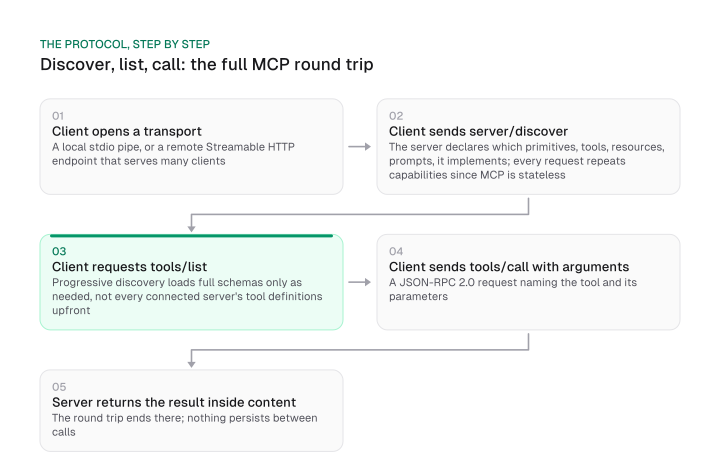
The catch is that every tool a server declares gets loaded into the model's context before it's ever called. That cost is real enough that the specification itself warns about it, and it isn't only a vendor's own cap: Cursor caps a session at 40 active MCP tools, and connecting more servers than that forces something to give.
The same mechanism extends past tool calls. Resources are how an assistant reads a page's context to build an answer for AI search, which is where the generative engine optimization primitives apply.
The SEO MCP landscape today
The surveyed SEO MCP servers span three cost models: free (Google Search Console), metered (DataForSEO, Ahrefs, SE Ranking), and Screaming Frog's server, the only one that runs an actual local crawl.
On the free end, both the Google Search Console MCP server and the official GA4 MCP server cost nothing to connect. The trade-off with the Search Console server specifically: it inherits the same roughly 16-month data window as the underlying Search Console API, so it can't hand you history the API itself doesn't have.
Tool count varies more than any single number suggests, because different reviewers count different things at different times:
- SE Ranking: 180+ tools by its own site's count, 160+ by an independent review of the same server
- DataForSEO (lean connector): just 4 tools, and it expects the model to read its own documentation before calling them
Neither number is wrong. They're measuring different things at different moments, and a raw tool count from one source isn't directly comparable to one from another. That variance traces back to discovery itself: a server only ever advertises the primitives it actually built, so a 4-tool connector and a 180-tool one are both fully compliant with the same protocol.
A few servers lean on MCP's prompts primitive instead of a live tool connection: they ship as ready-made templates the user invokes directly, closer to a saved project workflow than a server the client calls in real time.
In practice a connected session looks like this: "Pull this URL's current keyword difficulty and top 10 competitors," "Crawl this page and flag any broken internal links," or "Show me last month's Search Console clicks for /pricing." Each prompt maps to one declared tool or resource; nothing happens that the server didn't already advertise.
Pricing models split the same way. DataForSEO's own Google Organic SERP API prices access by request method, and the price buys speed:
- Standard Queue: $0.0006 per SERP, roughly a 5-minute turnaround
- Priority Queue: $0.0012 per SERP, up to a 1-minute turnaround
- Live mode: $0.002 per SERP, a result back in as little as 6 seconds
There's no subscription; you pay per call at whichever speed the workflow needs. Ahrefs takes the opposite approach: its MCP server is available only to users on the Lite plan and higher, not on its entry-level plan, so access is gated by subscription tier rather than metered per call.
Screaming Frog is the outlier in the list. Its official MCP, added in version 24 (released 2026-05-19), is the only surveyed server that runs an actual crawl from a prompt rather than querying an index built beforehand, which makes it the closest thing here to giving an AI client hands-on access to your site instead of a summary of it.
Among the surveyed servers, one bills itself specifically as an ai search visibility MCP capability: SE Ranking's server tracks brand mentions and source citations across AI answers, folding that tracking into the same connection as its classic SEO tools rather than requiring a separate product.
Mission Growth's platform tracks AI citations and visibility for customers. For a full pricing and ranking comparison across these and other AI-visibility tools, see our best LLM SEO tool roundup.
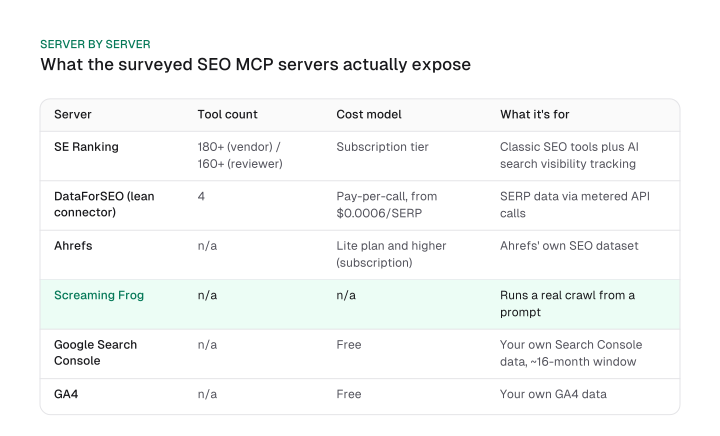
No server on this list is a drop-in substitute for another. The free tier only ever covers your own site's data, the server that can crawl needs a local install, and the metered servers charge by different units entirely. Which one fits depends entirely on the workflow in front of you.
What MCP can't do, and where it breaks
MCP has no scheduling primitive. Every tool, resource and prompt only runs when a client sends a request.
Two consequences follow: a recurring unattended report needs a scheduler outside the protocol, and connecting several servers that each declare many tools loads every schema into context whether that session ever uses them or not.
The second problem is large enough that the specification treats it as a core design constraint. The specification's own client best-practices page states plainly that loading every connected server's tool definitions upfront "wastes tokens, increases latency, and degrades model performance."
Its worked illustration puts a number on that: loading every tool definition upfront can consume roughly 150,000 tokens before a single question gets asked, versus roughly 2,000 tokens with progressive discovery. A lightweight search_tools meta-tool loads full schemas only when a task actually needs them.
Connect three or four vendor servers with every tool loaded at once, and that cost compounds before the model has done any work at all.
The scheduling gap trips up a different assumption. Statelessness means there's no background process inside MCP itself that fires a report on Monday morning; a server only ever answers the request in front of it.
Anything that has to run unattended, a weekly ranking summary, a monthly crawl comparison, needs a scheduler sitting outside the protocol. That scheduler can be a host application's own automation feature or a plain cron trigger calling the same server on a timer.
A second assumption breaks just as cleanly: an open-source MCP server isn't inherently fresher than a hosted one. MCP only relays what the connected data source provides; the protocol's own caching hints (a ttlMs freshness window and cacheScope) tell a client how long it can reuse a result, but a server sets those hints from its own data source, so they carry no freshness guarantee independent of it.
Freshness comes from the underlying data source's own crawl or index cadence, whoever runs the server on top of it, so "open-source vs. hosted" is the wrong axis to judge that question on.
None of this shows up on a vendor's feature list, because it's the protocol working exactly as designed, not a missing feature, which is why the reader's own AI search visibility metrics still need to come from wherever they're tracked directly, not from whatever a connected chat session happened to surface that day.
Do you actually need one? A decision rule
An SEO MCP server fits a workflow that is ad hoc and conversational, asked and answered inside a single chat session.
It does not fit a workflow that must run unattended on a schedule, because that's exactly the property MCP's statelessness rules out.
| Workflow | Fits an SEO MCP server? |
|---|---|
| "Pull this URL's current rankings and impressions while I'm looking at it" | Yes, asked and answered inside one session |
| "Send the team a weekly alert when traffic drops, every Monday at 9am" | No, needs a scheduler outside the protocol |
The question that matters isn't which server to connect, it's whether this workflow needs a live conversational connection at all, or whether a scheduled export would do the same job with less setup.
A one-off investigation, checking why a page dropped, pulling a competitor's crawl on the spot, comparing two keywords mid-conversation, is exactly what a chat session with a connected server is for. A report that has to land in someone's inbox every week without a human triggering it belongs to a scheduled pipeline built for exactly that job.
SEO MCP servers all look interchangeable on a list comparing vendors, but the protocol underneath decides what any given server can and can't do before its pricing page ever enters the conversation: whether tool count silently costs you context, whether "automate this" is even a real offer, and whether the workflow in front of you needs a live connection at all.
If the answer is yes, pick a server based on what it exposes and what it costs to run. If the answer is no, a scheduled export still does the job for less setup.
Readers ready to go further, building an agent around one of these servers rather than just chatting with it, should start with wiring an AI SEO agent.
MCP changes what a server can plug into, not who decides what to do with the answer. Deciding is still the reader's job, and will AI replace SEO answers that question directly.
Frequently asked questions
Yes, if the server supports it and the account's ChatGPT plan includes connectors. MCP itself doesn't distinguish between clients; whether a given server works in ChatGPT versus Claude is a decision made by the server and host, independent of the protocol itself.
The connection layer itself costs nothing. What's metered is the underlying vendor's data access: fully free for Google Search Console and GA4, per-call credits for DataForSEO, and subscription tiers for servers like Ahrefs, SE Ranking and Semrush.
Remote MCP servers authenticate over HTTP the way most APIs do: bearer tokens, API keys, or OAuth. MCP recommends OAuth for obtaining tokens but doesn't mandate any single method.
The MCP layer doesn't change what leaves your account. A server can only return what its underlying API scope already allows, and a Search Console MCP server inherits the same roughly 16-month data window as the Search Console API itself.
Not by itself. MCP has no scheduling primitive, so recurring automation is the host application's job, or an external scheduler's job.
Model Context Protocol, released by Anthropic as an open standard on 2024-11-25.
Figures and images in this post are free to reuse under CC BY 4.0 with credit to Mission Growth.
Get Mission Growth highlighted in your Google results.