Best AI Visibility Tools 2026: Methods, Prices, Free Trials
Compare 11 AI visibility tools by how each collects its number, what its score weights and which plans ship recommendations, with free routes and 2026 prices.
By Furkan AktaşPublished Updated
On this page
Most AI visibility tools sell one label for different instruments. One asks a model what it remembers about your brand, one searches a vendor's prompt index, one runs the prompts you choose every day, and one samples each prompt up to 100 times.
So pick by how a tool's number is collected and the report you owe someone, then by price. An "LLM visibility tool" is the same class as an AI visibility tracker, and this AI search visibility tools comparison covers 11 of them plus our own service.
In this guide:
- Which tool fits which situation, with entry prices, free routes and engines in one table
- What visibility, a score and share of voice actually measure
- A card per tool with pros, cons and a price line
- What reviewers say after they start, and which plans ship more than a dashboard
- A decision table by the report you owe, and five questions to ask before you pay
Best AI visibility tools by situation
The best AI visibility tool depends on the report you owe: Otterly.ai is the cheapest recurring tracker, Peec AI publishes its tiers, Ahrefs Brand Radar adds source discovery, and Profound Enterprise tracks up to 9 answer engines.
These AI brand visibility tools split by who needs the number and how often. Find your situation in this list:
- You want a cheap recurring tracker. Otterly.ai Lite is $29 a month for 15 search prompts on 4 engines, tracked daily.
- You want a free first look. HubSpot's AI Search Grader is free, needs no account and runs once.
- You want published tiers to budget with. Peec AI starts at $95 a month for 50 prompts and unlimited users.
- You pay per check. ZipTie charges $0.01 per prompt per engine per check.
- You already report from Semrush. Semrush Starter, in the SEO + AI Search plans, is $199 a month billed monthly, with 50 prompts a day.
- You want to research any brand with no setup. Ahrefs Brand Radar searches its own prompt index and adds Reddit and YouTube.
- You must defend a number. Evertune samples each prompt up to 100 times per model.
- You need breadth and a security review. Profound Enterprise tracks up to 9 answer engines, and Bluefish AI lists SOC 2 Type II.
The table puts the hard facts side by side. A dash means the vendor pages checked do not say.
Download CSV (CC BY 4.0)
Prices and plans verified October 2026. All prices are monthly list prices in US dollars.
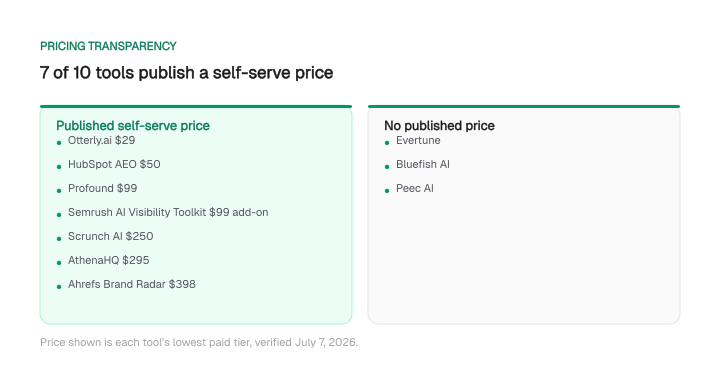
Nine of the 11 tools publish an entry price, and 6 of 9 start at $199 a month or less. Evertune's $800 is the outlier against Otterly.ai's $29. Profound and Bluefish AI publish no entry price. Eight of the 11 have a free route.
So budget narrows the list less than how the number is built does. AI visibility tracking software at $29 and at $800 answers different questions, which is why the sections below open the number before the cards.
If you think in prompts and positions rather than brand mentions, the AI rank tracker tools guide compares trackers by position.
For what a full workload costs once engine add-ons and prompt volume are billed, see our comparison of LLM SEO software.
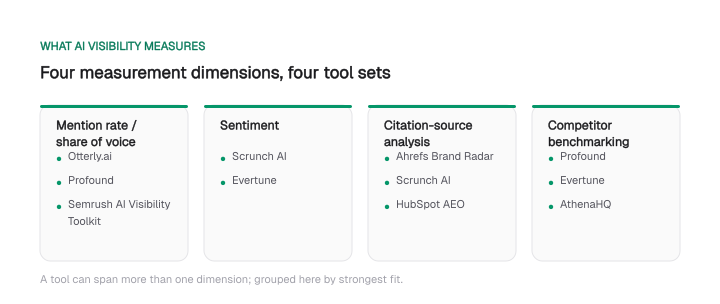
What AI visibility measures: four dimensions
AI visibility measures four things: how often and how prominently AI answers mention your brand, how favorably they describe it, which sources they cite, and how that compares with named competitors.
Brand visibility in AI search is therefore a bundle of readings rather than one metric. Here are the four, with what a vendor can legitimately claim for each:
- Mention rate and share of voice. A mention counts when the answer names your brand. A recommendation counts when the answer puts you forward as an option. A citation counts when the answer cites your page. For share of voice AI search tools mostly agree on the idea and differ on the rule: Ahrefs defines it as the share of AI responses in your topic set that mention or cite you versus competitors.
- Sentiment. Semrush benchmarks the positive and negative sentiment of brand mentions, and HubSpot's Grader gives sentiment up to 40 of its 100 points.
- Citation source analysis. Which domains, threads and videos the answer relies on. Ahrefs adds Reddit threads and YouTube, and 5 of the 10 G2 reviews captured for Profound name its view of sources or citations as a strength.
- Competitor benchmarking. Semrush shows the prompts and sources where competitors are cited and you aren't. Evertune says its AI Brand Index shows competitive positioning, which is a vendor claim.
Position inside one answer is not on that list. Answers move too much from run to run for it to be a reliable reading.
SparkToro's January 2026 study ran 12 prompts through 3 tools with 600 volunteers, 2,961 runs in all. Two responses returned the same brand list fewer than 1 in 100 times. The author's own hedge is that percent visibility across many runs is probably a reasonable measure of prominence.
So judge visibility as a rate across many runs. How many runs a prompt needs, and what that does to the price, is worked out in our guide to ChatGPT tracking tools.
AI visibility or AI rank tracking?
AI rank tracking checks where a page or brand appears for one specific prompt, while AI visibility measures the brand across a set of prompts and engines.
The buyer differs too. If you own a keyword list and report positions, you want a rank tracker. If you owe someone a statement about brand presence in AI answers, you want a visibility tool, which is what this page compares. AI rank tracking has its own guide.
What an AI visibility score is made of
An AI visibility score is a vendor-defined composite with no standard formula: HubSpot's Grader gives sentiment 40 of 100 points and share of voice 10, while Ahrefs defines AI share of voice as a share of responses.
A demand estimate a vendor shows for a topic is a different number again. What AI prompt volume actually measures explains how it is built.
That means two scores for the same brand cannot be averaged or compared across tools. Each tool built its own instrument, and the next three parts open them.
Four ways a tool produces its number
Tools produce their number in four ways, and each way answers a different question:
A number can be compared with itself over time only while its method holds still. The Ahrefs reviewer comment is the clearest case: when the index updates, the past gets restated, and the trend line you reported last quarter no longer matches.
Inside one composite: HubSpot's five weights
HubSpot's Grader is the one composite here that publishes its weights, which makes it the only score you can take apart:
- Sentiment: up to 40 points
- Presence quality: 20 points
- Brand recognition: 20 points
- Share of voice: 10 points
- Market competition: 10 points
Share of voice is 10 of 100 points, so it is 10% of the score, and sentiment alone is 40%. The other four dimensions together carry 90 points (100 minus 10), which means a brand can reach 90 points with no share of voice at all.
None of these dashboards shows the step that produced a sentiment label. How LLM brand sentiment scores are actually built covers the judge model behind it.
For example, a brand that models describe warmly but that rarely appears next to competitors can score well on a Grader and still lose the comparisons a buyer makes. If your board cares about a competitive number, read the weights before you trust the total. For denominators and which numbers belong in a board report, see AI search visibility KPIs.
Is there a good score?
No universal benchmark exists for an AI visibility score. Because each vendor defines its own composite, a good score is one that rises against your own baseline on the same tool, the same prompt set and the same method.
How we compared these AI visibility tools
The 11 third-party AI visibility tools here, plus Mission Growth, were read from each vendor's pricing, product and help pages and from G2 and Reddit comments as of October 2026, with no hands-on testing claimed.
We compared each tool on five criteria:
- Entry price and plan limits. The monthly list price of the cheapest plan that tracks, and what that plan caps.
- Engines at entry. The engines the entry plan covers, which can be fewer than the union a headline lists.
- How the number is built. Model recall, a vendor index, your prompts or heavy sampling, or a dash where the pages do not say.
- What happens after the number. Whether the plan ships recommendations or an agent.
- What users say. The first G2 page per vendor and the Reddit comments that name the tool.
The scope is brand visibility monitors. AI SEO suites and content tools belong to the AI search optimization tools comparison, rank trackers to the rank tracker guide above, and standalone free checkers to the AEO tool guide.
The tools here handle AI visibility monitoring. The optimization that follows is GEO work in content and off-site mentions, so the choice is about measurement and what follows it.
On user feedback, each count is the number of G2 and Reddit comments read that name the tool.
The 11 AI visibility tools, one by one
The 11 cards run from lowest to highest entry price, with the two vendors that publish no price last. Each has a verdict, what its number is built from, pros and cons that trace to vendor pages or counted user comments, and a price line.
Otterly.ai
Best for: Small teams and agencies on a budget
Otterly.ai is the cheapest recurring tracker here. Lite covers ChatGPT, Google AI Overviews, Perplexity and Microsoft Copilot with 15 search prompts, tracked daily. Its number comes from the prompts you set.
Engines cost extra above that. Google AI Mode and Gemini are $9, $59 or $149 a month each on Lite, Standard and Premium, and Claude is $29, $109 or $439.
One G2 review says Lite feels too small for a growing workload and the jump to Standard feels large. One third-party YouTube walkthrough from February 2026 showed a ranking table with zero mentions where the overview showed eight, which is a single observation. Agencies can join Agency Partners for 150 prompts on Standard, 500 on Premium and unlimited client workspaces.
Lite also includes unlimited brand reports, unlimited team members, one workspace and multi-country support, so the cap you hit first is the 15 prompts. Standard adds API and MCP access, and Lite lists multi-country support (50+). Start here if you want daily tracking this week on a small budget.
Pros:
- 4 engines from $29 a month and a free trial with no credit card
- The cheapest, lowest friction entry point, per 4 Reddit comments
Cons:
- Claude, Google AI Mode and Gemini cost extra
- Lite feels small and Standard a big step, per 1 G2 review
Price: Lite $29, Standard $189, Premium $489 a month (monthly list prices)
ZipTie
Best for: Teams that want to pay per check, and agencies with small client sets
ZipTie is usage based: you pay for checks rather than for a plan tier. The Starter preset starts at $42.75 a month, a check costs $0.01 per prompt per engine, and the rate drops to $0.0087 a check on all 7 engines.
The 7-day trial needs no card and gives 25 daily prompts on ChatGPT, Google AI Overviews and Microsoft Copilot. Its pages do not say how answers are collected. Above Starter the presets climb to Professional from $659.59 a month and Enterprise from $3,137.09, so the per check meter matters more as your prompt set grows.
Agencies should read the fine print. ZipTie says there are no white-label reports, because the PDF snapshot and the share page carry ZipTie’s mark, and there is no cross-client rollup.
After Otterly.ai's $29, ZipTie is the second cheapest of the nine published entry prices.
ZipTie's own site says it shows you what to change to win more answers, which is a vendor claim worth testing during the 7-day trial before you pay for a larger preset.
Pros:
- 7 engines
- A 7-day trial with no card
Cons:
- No white-label reports and no cross-client rollup
- The trial covers only 3 engines
Price: From $42.75 a month (Starter preset); $0.01 per prompt per engine per check
HubSpot AEO
Best for: A free first look, and HubSpot customers
HubSpot's AI Search Grader is a free way to see what models say about your brand, and HubSpot AEO is the paid tracker behind it. The Grader sends your brand information to ChatGPT, Perplexity and Gemini and asks each how it characterizes the brand based on its training data. It needs no account and gives a score out of 100.
It is a one-time snapshot. Tracking over time, specific prompts and competitor comparison need HubSpot AEO.
HubSpot states the Grader's output is AI-generated, not reviewed by a human and not guaranteed. Treat the score as a conversation starter rather than a KPI. The OpenAI model it queries is GPT-5.4 mini, so the ChatGPT reading comes from that one model.
HubSpot says results are cross-validated across the three platforms to produce a composite, so the total blends three models' answers into one number. Run the Grader once before you buy anything. If the output surprises you, you have a reason to track; if it matches what you expect, you've spent nothing.
Pros:
- Free, with no account
- HubSpot AEO is included in Marketing Hub Pro and Enterprise
Cons:
- The Grader is a one-time snapshot
- Output is AI-generated and not guaranteed, and it covers 3 engines
Price: Grader free; HubSpot AEO $50 a month with no HubSpot subscription required, or included in Marketing Hub Pro and Enterprise
Peec AI
Best for: Teams and agencies that want to budget before a sales call
Peec AI publishes three tiers: Starter $95 for 50 prompts, Pro $245 for 150 prompts and 2 projects, Advanced $495 for 350 prompts, 5 projects and Looker Studio. Starter already includes unlimited users.
The catch is models. Every plan chooses only 3, and each extra model costs $30 on Starter, $70 on Pro or $140 on Advanced a month. One G2 reviewer calls the limit a subscription wall.
Reviewers also want next steps. Two G2 reviews and one Reddit comment say it shows visibility but gives no clear recommendations, and 2 Reddit comments find prompt-sampled answers noisy as KPIs. The pricing page shows a Start free trial button without a length.
Starter includes 1 project and daily tracking, so an agency with several clients moves up to Pro (2 projects) or Advanced (5). Choose Peec AI over Otterly.ai if you want a ladder that adds projects and Looker Studio as you grow. Choose Otterly.ai if the four engines it ships are the ones you need and price is the constraint.
Pros:
- Three public tiers and unlimited users on Starter
- A free trial button on the pricing page
Cons:
- Only 3 models per plan, with extras from $30 to $140 a month
- Reviewers want recommendations
Price: Starter $95, Pro $245, Advanced $495 a month
Semrush AI Visibility Toolkit
Best for: Teams that already run reporting in Semrush
Semrush AI search tracking makes sense when your reporting already lives in Semrush. Older price lists show a separate per-domain add-on, but Semrush now sells AI visibility inside SEO + AI Search plans, first with a stated allowance at Starter.
Starter is $199 a month billed monthly ($165.17 billed annually) with 50 prompts a day. Pro+ is $248.17 for 100 and Advanced $455.67 for 200 with API, both billed annually. The SEO plan at $117.33 billed annually lists AI tracking features without a stated allowance.
The toolkit reports sentiment, visibility and share of voice across AI platforms and competitors, plus a gap view of prompts and sources where competitors are cited and you aren't. The product page does not itemise engines, and the pages do not say how answers are collected.
Additional users start at $45 a month. If you don't use Semrush for anything else, price the toolkit against dedicated trackers, because the plan includes the SEO suite around it. If you do, test the gap view in the trial first: it turns a visibility score into a list of prompts to go after.
Pros:
- Sentiment, share of voice and competitor gaps inside the suite
- A 7-day trial
Cons:
- The prompt allowance starts at Starter
- Engines are not itemised on the product page
Price: Starter $199 a month billed monthly ($165.17 billed annually); Pro+ $248.17; Advanced $455.67 billed annually
Ahrefs Brand Radar
Best for: Teams that want to research any brand and see Reddit and YouTube
Ahrefs Brand Radar is the research pick because it works two ways. The index runs Ahrefs' own prompt database through each AI platform, so you can search any brand with no setup. Custom Prompts lets you define the questions, with data starting when tracking starts.
The index has limits. Question sets are re-tested monthly on a 90-day window, coverage is limited for brands with little search volume, and a G2 reviewer says historical metrics change retroactively when the index updates. Claude is Custom Prompts only, at 8 checks per update.
Beyond answers, Brand Radar surfaces Reddit threads and YouTube. Ahrefs states no free trial.
Choose the index when you need to see a brand you aren't tracking yet, such as a competitor or a category. Choose Custom Prompts when the report depends on fixed questions you control.
Ahrefs says both index types derive from real search demand rather than synthetic guesses. If you only need to track your own prompts, buy a custom prompt package rather than the index.
Pros:
- Any brand searchable with no setup
- Reddit and YouTube surfaces
Cons:
- Limited coverage for brands with little search volume
- History restated when the index updates, per a G2 reviewer, and no trial stated
Price: Brand Radar AI from $199 a month; custom prompt packages from $50 a month (Basic, 2,500 checks)
Scrunch AI
Best for: Teams on a fixed budget, and Sitecore shops
Scrunch AI Core is a fixed budget: $250 a month for 125 prompts, 5,000 responses a month and 5 user licenses. It tracks 4 engines, ChatGPT, Perplexity, Google AI Overviews and Copilot.
Enterprise has a custom price and 9 LLMs, adding five that Core lacks: Claude, Gemini, Meta AI, Google AI Mode and Grok. Looker Studio, the Query API and MCP are Enterprise only. Core also caps competitors at 5 and page optimization at 1 a month, and lists AI Search Trends at 3 topics and Query Fan-out as Limited.
Core has a 7-day free trial, and a free AI audit needs no credit card. Sitecore announced its acquisition of Scrunch in June 2026.
Scrunch positions Core for teams that want to evaluate the tool, establish AI visibility benchmarks and prove impact before scaling. If you need all 9 engines or the API, you are pricing Enterprise.
A Sitecore team gets a vendor in its own stack; everyone else should ask what the acquisition changes for pricing and roadmap.
Pros:
- A 7-day trial and a free AI audit
- 5 user licenses
Cons:
- Core tracks 4 engines, and the full 9 need Enterprise
- API and MCP access is Enterprise only
Price: Core $250 a month; Enterprise custom
AthenaHQ
Best for: Teams that want to test free, then widen engines
AthenaHQ lets you test before you pay, then meters everything in credits. The free tier gives a $25 credit (300 credits) and 5 engines. Starter is $295 a month with 3,600 credits and 11 models.
One credit is one AI response, so 3,600 credits is about 120 responses a day (3,600 divided by 30 days). That is enough for 10 prompts a day on all 11 models, which is a small footprint for a $295 plan.
Starter adds CSV export and a content optimization agent. On Reddit, one post by a competing vendor groups AthenaHQ with enterprise-budget tools.
Starter's plan list names ChatGPT, Perplexity, AI Overviews and AI Mode among its engines, and the same page lists on-page and off-page actions, a content optimization agent and self-learning content improvement. Read that as AthenaHQ's action layer: it sits on Starter rather than behind the custom Enterprise plan.
Before you buy, check how many of the 120 daily responses your own prompt set would use on the engines you care about, and which of them you need.
Pros:
- A free tier with 300 credits and 5 engines
- A content optimization agent on Starter
Cons:
- Credits meter every response, which caps daily volume
Price: Free; Starter $295 a month; Enterprise custom
Evertune
Best for: Mid-market and enterprise teams that must defend a number
Evertune has the deepest sampling here: it samples each prompt up to 100 times per model, with its prompt strategy grounded in EverPanel, a proprietary panel of over 150 million user prompts. If you must defend a number to a board, a rate across 100 runs speaks directly to the run-to-run variance problem.
Pro is $800 a month for 100,000 prompts across 11 AI models and 25 AI-optimized articles a month. It reports an AI Visibility Score per model over time, and an Insights Agent prioritizes moves. Evertune says its AI Brand Index shows competitive positioning, which is its own claim.
Both tiers end in a demo request, with no free trial shown. On Reddit, 1 comment calls it expensive for what it reports, 2 call it overkill for most teams, and 1 mentions a 2-3 week wait for insights.
Pick it when the audience for the number is a skeptical executive. Skip it when you need a weekly trend on a handful of prompts, which is where the Reddit overkill comments are most likely to apply.
Pros:
- Each prompt sampled up to 100 times per model
- Prompt strategy grounded in a panel of over 150 million user prompts
Cons:
- $800 a month and no free trial
- Reddit calls it expensive and overkill, with a 2-3 week wait for insights
Price: Pro $800 a month; Enterprise by demo request
Profound
Best for: Enterprise teams that accept a sales conversation
Profound is the enterprise pick: the free Trial runs 50 prompts daily for 7 days on ChatGPT, Gemini and Google AI Overviews, and Enterprise tracks up to 9 answer engines at a custom price. Export and API are Enterprise only.
On G2, 6 of the 10 reviews captured praise a clear view of how the brand appears in AI answers, and 5 of them name sources or citations.
The complaints are price (4 of 10 captured reviews call it high or inflexible) and diagnosis: 1 G2 review says the dashboard shows scores moved but not why, another says fixing a gap still needs extra content work, and 1 Reddit comment says it is less useful when a client asks why.
For a small team that is a lot to pay for a score without a cause. For an enterprise that wants up to 9 engines, it is the one to price.
The Trial has no exports or API. Treat it as a sample of the dashboard rather than a pilot: 50 prompts for 7 days on 3 engines will show you the interface and the source view. It won't show whether Enterprise's 9 engines answer your questions.
Pros:
- Up to 9 engines on Enterprise versus 3 on the Trial
- A clear view of answers and cited sources, per 6 of 10 captured G2 reviews
Cons:
- Price is the top complaint
- The dashboard shows moves, not causes, and export and API are Enterprise only
Price: Free 7-day Trial; Enterprise custom
Bluefish AI
Best for: Large brands that want security, services and Alexa for Shopping
Bluefish AI is enterprise reputation monitoring sold through demos. It tracks 10+ LLMs daily, including Alexa for Shopping, without itemising the engines. Its number comes from static prompts with model drift controls.
It sells three suites: AI Monitoring, AI Optimization and AI Measurement. For security reviews it lists SSO, MFA, SOC 2 Type II, HIPAA-ready, API and MCP. Bluefish says more than 10% of the Fortune 500 use it, which is a vendor claim.
The site also lists 15+ provider integrations, which is where the demo should start. There is no pricing page. The calls to action are "Talk to an AI marketing expert" and "Request a demo."
Static prompts keep the questions fixed, which is what a trend line needs. The page does not describe the drift controls, so ask how they work before you rely on them.
Choose Bluefish when procurement asks for SOC 2 and a services relationship before a price. Skip it if you need to see a price before a call, since there isn't one.
Pros:
- SOC 2 Type II, SSO and HIPAA-ready
- Three suites: monitoring, optimization and measurement
Cons:
- No public price, so every route is a demo request
- Engines are not itemised
Price: Not published; request a demo
Mission Growth (our platform)
Best for: Teams that want findings acted on
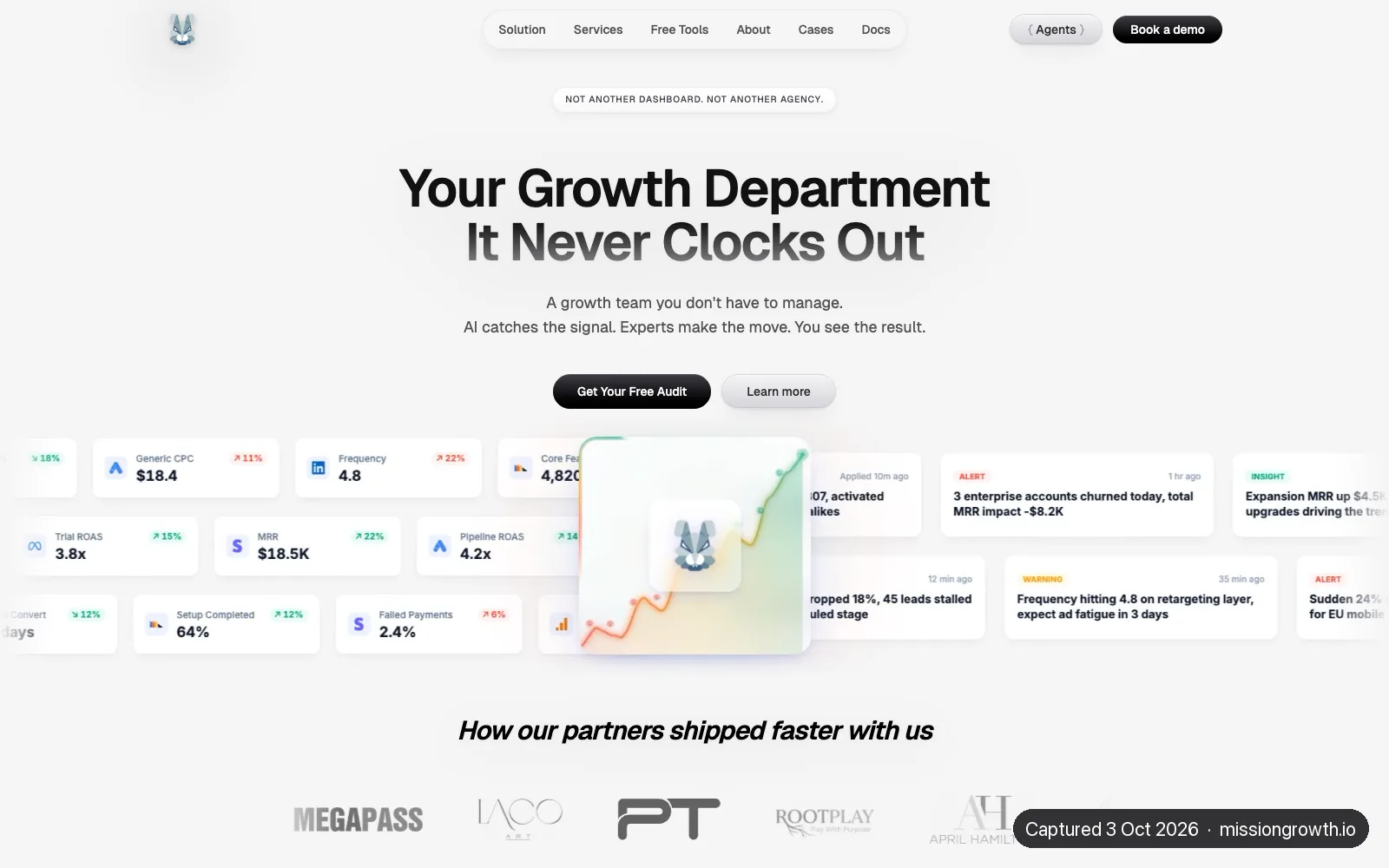
We built Mission Growth for teams that want findings acted on. Mission Growth is an AI-led SEO and GEO growth service: AI catches the signal, our experts make the move, and you see the result.
If you're weighing a monthly service against buying software, the comparison of an AI SEO agency with software covers that choice.
Mission Growth's platform tracks AI citations and visibility for customers.
Price: Monthly fee, quoted after an audit
What users say: dashboards that show the move but not the cause
Reviewers of Profound, Otterly.ai and Peec AI describe a dashboard that shows the score moved but not why or what to do next: 5 G2 reviews and 5 Reddit mentions, set against 3 G2 reviews praising Otterly.ai's recommendations.
Here is the count by vendor, in both directions:
Download CSV (CC BY 4.0)
The sample is the first G2 page per vendor and the Reddit comments that name the tool. One Reddit thread covers both Otterly.ai and Peec AI, and Reddit threads include posts by competing vendors, so they count as mentions and never as reviews.
The two directions fit together. The Otterly.ai complaint is from June 2026, and the praise for its new recommendations section runs to August 2026, Lite now includes 3 recommendations a week. So for this one vendor, reviewers praised the fix once it shipped, which is the case for choosing a plan by what it does after the number.
Here is which plans ship more than tracking:
Decide who will act. If nobody on your team will turn a gap into a page, buy the rung with an action layer or a service, because a $29 dashboard will not do it for you. If someone will, a tracker plus your own content work is enough. Turning a gap into a page is the job in our AI citation gap analysis guide.
How to choose an AI visibility tool by the report you owe
Choose an AI visibility tool by the report you owe: a board number needs a fixed competitor set and a stated counting rule, a weekly trend needs fixed prompts, and a fix list needs an action layer on your plan.
Match your situation to a row:
6 of 9 published entry prices are $199 a month or less, so a $199 budget still leaves the weekly trend and fix list rows open.
Before you pay, ask each vendor five questions:
- What counts as a mention? A name, a recommendation or a citation changes the number.
- How many times does each prompt run? One run is a single draw, and a rate needs many runs.
- Who writes the prompts? You, the vendor or a panel.
- Is history restated when the index updates? One G2 reviewer says it is for Ahrefs.
- Which recommendations ship on your plan? Ask for the plan, not the product.
Start with a free route, shortlist two tools whose number is built the way your report needs, and run the five questions on both before paying. A visibility score is an instrument reading, so the tool you pick should be the one whose method you can explain to the person who reads the report. When the tool is running, pair its numbers with referral and Search Console data in AI search analytics.
Frequently asked questions
What is an AI visibility tool?
An AI visibility tool tracks whether, how often and how favorably AI engines name your brand against competitors. "LLM visibility tool" names the same class. Most report the result, and where a tool acts on it, the action layer sits on a specific plan, as the ladder above shows.
Is Google visibility the same as AI visibility?
No. Google visibility is positions and clicks, which you measure in Search Console. AI visibility is the share of sampled answers that name your brand, and answers rarely repeat the same list: SparkToro found fewer than 1 in 100 repeats. GEO vs SEO explains how the two jobs differ.
Which AI visibility tools are free?
Eight of the 11 tools have a free route: the HubSpot Grader (a one-time check), AthenaHQ's free tier, and trials at Otterly.ai, Peec AI, ZipTie, Scrunch AI, Semrush and Profound. Ahrefs and Evertune state none, and Bluefish AI offers a demo request only. Standalone checkers are covered in our guide to free AEO tools.
What is a good AI visibility score?
There is no universal benchmark, because each vendor defines its own composite. HubSpot's Grader, for example, gives share of voice 10 of 100 points. A good score is one that rises against your own baseline on the same tool, the same prompt set and the same method.
How much do AI visibility tools cost?
Entry plans run from $29 to $800 a month across nine published monthly list prices, and six of the nine are $199 or less. Profound and Bluefish AI publish none. A full workload costs more once engine add-ons and prompt volume are counted, which the LLM SEO software comparison above prices.
Can an AI visibility tool improve my visibility automatically?
Tools mostly report. Some ship recommendations (Otterly.ai Lite includes 3 a week) or an agent (AthenaHQ Starter has a content optimization agent), and Evertune Pro includes 25 AI-optimized articles a month. The visibility gain itself still depends on content and off-site work, which is GEO.
Cite this page
Aktaş, F. (2026, October 4). Best AI Visibility Tools 2026: Methods, Prices, Free Trials. Mission Growth. https://missiongrowth.io/blog/best-ai-visibility-tools
Figures we made for this post are free to reuse under CC BY 4.0 with credit to Mission Growth.
Get Mission Growth highlighted in your Google results.