
Best LLM SEO Tools: What 50 Daily Prompts Really Cost
Best LLM SEO tools compared with October 2026 prices and engines per plan, plus what 50 daily prompts on 3 engines cost: $42.75 to $189 a month.
By Furkan AktaşPublished Updated

On this page
LLM SEO tools bill in checks and sell plans in steps, so the headline price tells you little. The cheapest plan that covers 50 daily prompts on 3 engines runs from $42.75 to $189 a month, a 4.4x spread across 7 tools.
Much of that spread is spare capacity and engine gating. The metered tools charge within about 2.1x of each other per 1,000 checks, while 8 of the 11 priced tools gate or meter engines by plan.
So pick by workload. ZipTie is the cheapest plan that covers it, LLMrefs gives the most prompts per dollar, and a team already on Semrush, Ahrefs or SE Ranking should price that suite's AI plan first.
Best LLM SEO tools at a glance
The best LLM SEO tools depend on the workload: ZipTie is the cheapest plan that covers 50 daily prompts on 3 engines, LLMrefs gives the most prompts per dollar, and suite users should price Semrush, Ahrefs or SE Ranking first.
Here is the shortlist by situation:
- Cheapest plan for the workload: ZipTie, from $42.75 a month for 50 prompts on 3 engines.
- Most prompts per dollar: LLMrefs, 500 prompts for $79 a month, reported weekly.
- Lowest headline price: Otterly.ai Lite at $29 a month for 15 prompts.
- Already on Semrush: Starter SEO + AI Search, $165.17 a month billed annually, 50 prompts daily.
- Already on Ahrefs: Brand Radar's custom prompt tracking comes bundled with paid Lite and above, and the Growth package at $100 a month covers 7,000 checks.
- Already on SE Ranking: Core at $129 a month on the monthly list, 100 prompts daily.
- Content team: Surfer SEO AI Search Analytics, 50 prompts refreshed daily, $82 a month billed yearly.
- Experts do the work: Mission Growth, a monthly fee quoted after an audit.
If ChatGPT is the only engine you care about, the list of ChatGPT SEO tools covers products built around that one engine.
LLM SEO tools compared: price, engines and limits
Entry plans for the 11 priced LLM SEO tools run from a $29 Otterly.ai Lite plan to a $295 Athena Starter plan, and the price rarely includes every engine.
Download CSV (CC BY 4.0)
Prices and plans checked October 2026.
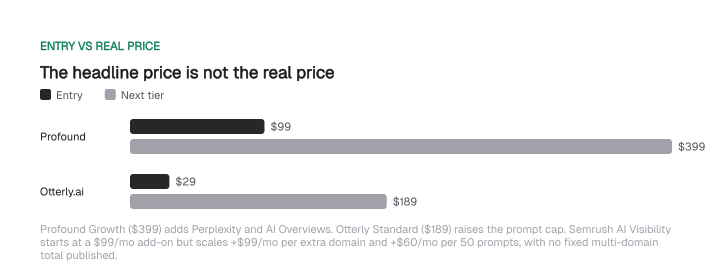
The cheapest headline is not the cheapest plan with the engines you want. Otterly.ai Lite with the add-ons for Claude, Google AI Mode and Gemini is $76 a month, which is $3 less than LLMrefs at $79, but it buys 15 prompts against LLMrefs' 500 (33x).
We got $76 by adding the Lite plan ($29), the Google AI Mode add-on ($9), the Gemini add-on ($9) and the Claude add-on ($29).
Trials soften the first month: 9 of the 11 priced tools name a free plan or a trial. We counted Profound, Peec AI, Otterly.ai, AIclicks, LLMrefs, Athena, Semrush, SE Ranking and ZipTie. Surfer's Start for Free buttons state no terms, so we left it out.
What an LLM SEO tool does and what it bills
An LLM SEO tool runs your prompts through AI engines on a schedule and reports whether and where your brand is cited, and every scheduled run is a check, the unit most plans bill.
Searchers also call the product an LLM SEO checking tool, LLM SEO analysis software or LLM SEO tracking software. All three mean software that tracks your brand in AI answers, which differs from using a chatbot to write content.
Each tool also reports which source URLs the engines link to or rely on. How a visibility number is produced and what to do with it is a separate job, covered in the guide to AI visibility tools.
Before you compare prices, convert every plan to checks. The check is the billing unit across vendors, but each defines it differently:
- Ahrefs: one check is one prompt on one platform in one location, and Claude consumes 8 checks per update.
- ZipTie: $0.01 buys one prompt, one engine and one check.
- Athena: 1 credit is 1 AI response.
- AIclicks: the price follows three meters, the prompts you track, the engines you monitor and the AI answers analyzed per month.
For example, a plan that says "100 prompts" and a plan that says "7,000 checks" are not comparable until you multiply prompts by engines by days. That multiplication is what the cost section below does.
How the tools were compared
The tools were compared on dated vendor-page plans, converted to one billing unit, the check, because engine count and prompt count mean different things on each pricing page.
This comparison uses vendor pricing pages as they stood in October 2026. If you want a buyer's checklist that goes beyond price, the guide to tools for GEO has one.
What we compared on each tool:
- Billing unit: checks, prompts, credits or responses, and what one unit covers.
- Engine count per plan: which engines a plan includes and which cost extra.
- Cadence: daily or weekly refreshes.
- Trial: length and limits.
- Agency features: white-label reports and client workspaces.
- Data export: whether you can take your results out. Ask before you buy.
Is it normal for tools to cover only 3 or 4 engines rather than 7? Yes, because engine count is itself a billing unit. 8 of the 11 priced tools gate or meter engines by plan: Peec AI, AIclicks, Ahrefs, ZipTie, Otterly.ai, Profound, Surfer and Athena.
Here is how each gates them:
- Peec AI and AIclicks: Peec AI lets you pick 3 models on every published plan, and AIclicks allows 3 LLMs on Starter and 4 on Pro.
- Ahrefs and ZipTie: Ahrefs bills per platform and ZipTie bills per engine.
- Otterly.ai: Claude, Google AI Mode and Gemini are add-ons.
- Profound, Surfer and Athena: Profound goes from 3 engines on its trial to up to 9 on Enterprise, Surfer's Standard plan covers ChatGPT only, and Athena's free plan lists 5 engines against 11 models on Starter.
LLMrefs and SE Ranking list their engines flat, and Semrush names two engines with no list.
Best AI-visibility trackers for LLM SEO
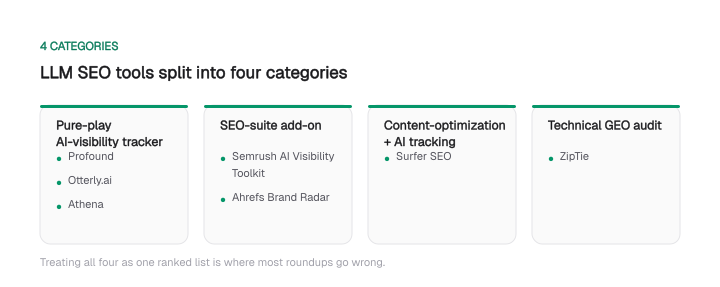
Peec AI, Otterly.ai, AIclicks, LLMrefs, Athena and Profound each bill a different unit: models picked, add-on engines, responses, prompts, credits or a custom engine count.
Pick among them by workload. Each card below names the number that decides.
1. Peec AI
Best for: SEO and content managers who want daily tracking of 50 prompts and choose which 3 models it runs on.
Peec AI is the entry pick when you want daily tracking without a metering puzzle. Starter is $95 a month for 50 prompts on 3 models you choose, which matches the workload's prompt count and engine count exactly.
Pro at $245 a month raises the cap to 150 prompts, still on 3 models, and Advanced at $495 a month targets teams managing multiple projects. Every step up buys prompts and projects, and each plan runs 3 models unless you buy more.
That makes Peec AI easy to size.
On the workload, Starter works out to $21.11 per 1,000 checks, the highest of the metered plans, which the cost section below explains.
If your prompt set sits near 50 and you're happy picking 3 engines once, Starter is the plan you'll use for months, and Pro only makes sense when the prompt set triples.
Agencies should read the project limits first: Starter allows 1 project and Pro allows 2, so a roster of clients hits the cap before the prompt count does.
Extra models are purchasable. One additional model costs $30 a month on Starter, $70 on Pro and $140 on Advanced, priced per plan and shown on the pricing page as annual figures.
So a fourth engine appears as its own line on the bill, and it costs more the higher the plan you start from.
Pros:
- Daily tracking on every plan
- Unlimited users
- You choose the 3 models
Cons:
- Every published plan includes 3 models
- Starter allows 1 project
Price: Starter $95, Pro $245 and Advanced $495 a month; the pricing page carries a free trial button.
2. Otterly.ai
Best for: Solo marketers and small teams that need a low entry price and can live with 15 prompts.
Otterly.ai has the lowest headline price in this list, $29 a month for Lite, but the base plans track 4 engines and the rest cost extra. Google AI Overviews is among the 4, while Claude, Google AI Mode and Gemini are paid add-ons.
Lite's 15 prompts fall short of a 50-prompt workload. Standard at $189 a month raises the cap to 100 prompts, which is 2x the workload.
The add-on prices matter more than the plan price. On Lite, Google AI Mode and Gemini are $9 a month each and Claude is $29, so Lite with all three comes to $76 a month for 7 engines and still only 15 prompts.
Buy Otterly.ai when you track a handful of prompts across many engines. If you track 50 or more, price the $189 Standard plan against the others.
Count the engines your buyers actually use before you pick a plan. If Google AI Overviews, ChatGPT, Perplexity and Copilot cover them, the base plan is all you'll pay for.
If Claude or Gemini matter, the add-ons turn a $29 plan into a different product.
The add-ons also scale with the plan. On Standard, Google AI Mode and Gemini are $59 a month each and Claude is $109, so the Standard bill grows quickly if you want every engine.
Pros:
- Google AI Overviews comes with every base plan
- 7-day free trial
Cons:
- Claude, Google AI Mode and Gemini are paid add-ons
- Lite's 15 prompts need an upgrade to Standard for 50 daily prompts
Price: Lite $29 and Standard $189 a month, with add-ons priced per plan.
3. AIclicks
Best for: Growing teams that want a mid-priced plan with a visible prompt, engine and response allowance.
AIclicks is the tracker that shows its meters on the pricing page. Starter at $59 a month allows 30 prompts on 3 LLMs and 4,650 responses a month, and Pro at $189 allows 150 prompts, 4 LLMs of your choice and 18,600 responses.
The vendor says it queries AI platforms through their user interfaces rather than APIs. Business is $499 a month.
Pro is the plan that covers the workload: 50 prompts sit well inside its 150, and its 18,600 responses are 4.1x the 4,500 checks. Starter does not cover it, since 30 prompts fall short of 50.
Growing any of those three allowances, prompts, engines or responses, raises the bill, which makes AIclicks easy to model.
Use the trial to test the vendor's method. Because AIclicks sends your prompts to each platform's own interface, the output should resemble what a customer sees on screen, and you can check that on a few of your own prompts.
Three days is short, so load your 50 prompts on day one and make all 3 days count. Then decide between Pro and a cheaper metered plan using the per-1,000 numbers in the cost section.
The plans differ in scope as well as volume. Starter covers 1 country per project, while Pro allows unlimited websites and countries per project, which matters for a brand that sells in several markets.
Pros:
- Pro's 18,600 responses cover the workload 4.1x
- Allowances for prompts, LLMs and responses are all listed
Cons:
- Starter's 30 prompts fall short of 50
- The 3-day trial is shorter than the 7 days at Otterly.ai or LLMrefs
Price: Starter $59, Pro $189 and Business $499 a month.
4. LLMrefs
Best for: Teams that care about prompt volume and can accept weekly reporting.
LLMrefs gives the most prompts per dollar: 500 prompts for $79 a month, with every engine included at no additional fee.
It also bundles an AI crawlability checker and an llms.txt generator, and its reports are weekly.
Weekly cadence is the catch. The daily workload used in this guide assumes a refresh every day, so LLMrefs sits outside the price ladder even though its 500 prompts are well above the 50 in the workload.
It is the better pick when you have a long list of prompts to watch and a weekly review rhythm. If you need to see a change the day after you publish, the alternative to LLMrefs is a daily tracker such as ZipTie, the cheapest plan on the price ladder below.
To use the 500 prompts well, group them by buying stage or product line and read the weekly report as a trend rather than a daily alert.
Try the 7-day trial with your full prompt list to see whether weekly is enough.
The 500 prompts track brand mentions, sources and fan-out queries. The plan also includes citation tracking of the sources that influence AI results, and a Reddit threads finder, so one $79 plan covers monitoring, source analysis and thread discovery.
Pros:
- All AI search engines are included at no additional fee
- The crawlability checker and llms.txt generator come bundled
Cons:
- Reports are weekly, so it sits outside a daily workload
- One plan only, so there is no step down for a smaller prompt set
Price: $79 a month, labeled limited time only on the pricing page, with a 7-day free trial.
5. Athena
Best for: Self-guided SMBs, enterprises and agencies that want to buy credits instead of prompts.
Athena has the highest entry price here, $295 a month for Starter, and its 3,600 credits fall 900 short of the 4,500-check workload. One credit is one AI response, and the price of extra credits is unpublished.
Starter lists 11 models, among them ChatGPT, Perplexity, AI Overviews, AI Mode, Gemini and Claude. The free plan, with 300 credits, lists 5 engines.
Do the credit math before you start. Credits are spent per response, so prompts times engines times refreshes has to stay inside the 3,600 a month, and anything above that sits at a price Athena doesn't publish.
Start on the free plan if you only want to see how credits drain: its 300 credits across 5 engines show the spend per prompt quickly. Move to Starter once the smaller prompt set you've settled on fits, and ask about extra credits before you grow it. Teams that run several brands should also ask how the 3,600 credits are shared before buying.
Here is a worked example. 30 prompts on 4 of the 11 Starter models for 30 days use exactly 3,600 credits (30 x 4 x 30), so Starter fits a prompt set of that size and no larger.
The free plan includes unlimited members. Enterprise has custom credits and adds a knowledge base and claim review.
Pros:
- A free plan with 300 credits across 5 engines
- Credits map one to one to AI responses
Cons:
- The highest entry price of the 11 priced tools
- Starter's credits do not cover 50 daily prompts on 3 engines
Price: Starter $295 a month; Free plan with 300 credits; Enterprise is custom.
6. Profound
Best for: Enterprise teams that want up to 9 engines and accept a quoted price.
Profound's pricing page shows two plans: a free Trial and a custom Enterprise plan. The Trial runs 7 days with 50 prompts a day on 3 engines, and Enterprise tracks up to 9.
Because there is no published step between the two, you cannot size Profound against the workload without a quote.
The Trial is the one way to test it at the workload's daily scale, since 50 prompts a day on 3 engines is the same daily load used throughout this guide. Run it for the 7 days, then ask what Enterprise would cost for your prompt count.
Some reviewers flag price, so budget for a quote before you commit.
If you're an enterprise team, the number to chase is what the quote includes. Ask for the engine list in writing, since the pricing page says up to 9 and your plan may cover fewer, and ask how many prompts the quote assumes. That prompt count is a tracking allowance, not prompt volume data, which estimates how often people ask.
Then compare the quote with the cost of the same 4,500 checks on ZipTie or Ahrefs in the cost section below, which gives you a figure to negotiate against. Smaller teams usually don't need 9 engines to start, and the workload in this guide uses 3.
Enterprise adds dedicated support, SSO/SAML and SOC 2 compliance.
Pros:
- Up to 9 engines on Enterprise
- A 7-day trial that runs 50 prompts a day
Cons:
- Enterprise pricing is custom
- 4 of the 10 G2 reviews captured raise price as a drawback
Price: Free Trial for 7 days; Enterprise is a custom price.
Best LLM SEO tools inside an SEO suite
Semrush, Ahrefs and SE Ranking sell LLM tracking inside plans you may already pay for, and the AI part is priced by plan tier or by checks.
The suite wins when you already pay for it, because the AI part rides on a plan you have.
7. Semrush
Best for: Teams already on Semrush that want AI visibility next to classic SEO reporting.
Semrush sells AI Visibility inside its SEO + AI Search plans, so the AI tracking has no separate sticker price. Starter is $165.17 a month billed annually and tracks 50 prompts daily for 1 domain, with 300 AI visibility reports a day.
The vendor names ChatGPT and Google AI plus other AI platforms but publishes no engine list for the plan. A 7-day free trial is available.
The 50 prompts a day match the workload's prompt count, so Starter clears it if the engines you need are among those tracked. Confirm the engines during the trial before you rely on it for 3.
Semrush stays off the median in this guide for that reason: the price covers a whole SEO plan and the engines are not stated, so a head-to-head with a pure tracker would flatter or punish it.
For an in-house SEO team already on Semrush, the check is simple: open your plan and see whether SEO + AI Search is the tier you pay for. If it is, the AI tracking is already inside the bill.
If you're on another tier, you'd be buying the whole SEO + AI Search plan, so compare $165.17 with a standalone tracker at the workload before you move.
The vendor positions Starter for small teams and agencies growing across organic search and AI, so it targets the same buyer as the standalone trackers above.
Pros:
- 50 prompts daily match the workload's prompt count
- AI tracking sits next to the rest of your Semrush data
Cons:
- Engines are not listed, only ChatGPT and Google AI by name
- You buy a full SEO plan to get the AI part
Price: Starter SEO + AI Search at $165.17 a month billed annually.
8. Ahrefs Brand Radar
Best for: Ahrefs users who want to add prompt tracking by buying checks.
Ahrefs Brand Radar's custom prompt tracking is free with every paid Ahrefs Lite plan and above, with a small bundled quota, and custom prompt packages add checks on top. Basic is $50 a month for 2,500 checks, Growth is $100 for 7,000, and Scale is $250 for 25,000.
For the workload, Basic's 2,500 checks fall short of 4,500, and Growth covers it with 1.6x to spare.
A check is one prompt on one platform in one location, so the number of platforms you track decides how fast the allowance drains. Watching one more platform on the same prompts adds checks in proportion.
That makes Ahrefs the right fit when you already pay for the suite and want to size AI tracking like a usage plan, and a poor fit if you want a flat per-prompt price.
Treat the checks as a budget. Multiply prompts by platforms by days, and compare the result with the package: on Growth, 7,000 checks across 3 platforms covers the 50-prompt workload with room to spare.
You can buy Basic for one platform and a handful of prompts and step up only when you add platforms. Claude consumes 8 checks per update, so leave it out of the first month unless your buyers use it.
Overage is billed at the end of the billing month, so a prompt set that outgrows its package is charged at the overage rate on that month's bill.
Pros:
- Custom prompt tracking bundled free with paid Lite plans and above
- Growth covers the workload at $100 a month
Cons:
- Each package is a fixed monthly allowance, with overage billed per check beyond it
- Claude consumes 8 checks per update, so engine choice moves the bill
Price: Basic $50, Growth $100 and Scale $250 a month.
9. SE Ranking
Best for: Teams that want keyword tracking and prompt tracking in one plan.
SE Ranking Core is $129 a month on the monthly list, or $103.20 billed annually, and includes 100 prompts to track daily. That clears the 50-prompt workload with 2x spare capacity.
The AI Search add-on is optional at +$89 a month on the monthly list. The free trial runs 14 days.
Core is a full SEO plan, so the price also buys 2k keywords, 5 domains in GEO research and site audits. That suits a team that wants keyword tracking and prompt tracking in one login.
If AI tracking is all you need, the plan is more than the workload requires, and the spare prompts are the part you pay for without using.
Treat SE Ranking as the pick for a team that wants one invoice. If you already track keywords there, the 100 daily prompts sit next to your rank data, and the 14-day trial, the longest stated length here, gives you time to compare both sets of reports.
Add the AI Search add-on only after the trial shows you need it.
Core also includes 5 domains in GEO research and 25K API credits with MCP access, which helps teams that pipe results into their own reporting.
The 14-day trial is smaller than the plan. It includes up to 10 projects, 20 AI prompts per day and AI competitive research for up to 3 domains, so it can't test the full 50-prompt workload.
Pros:
- 100 prompts daily, 2x the workload
- The longest stated trial in the list at 14 days
Cons:
- Core is a full SEO plan, so you also pay for 2k keywords and site audits
- The AI Search add-on costs +$89 a month more
Price: Core $129 a month monthly list, $103.20 billed annually.
Best LLM SEO tools for content and technical teams
Surfer SEO adds AI tracking to a content platform and ZipTie bills usage by prompt, engine and check.
Both pair tracking with content features, which is where LLM SEO optimization tools overlap with classic writing software. For content-first picks, the guide to AI search optimization tools goes further.
10. Surfer SEO
Best for: Content teams that want AI tracking in the workflow where they already write.
Surfer's AI Search Analytics plan is the cheapest Surfer plan that tracks every model daily. It costs $82 a month billed yearly, which works out to $95 on the monthly list once you add back the yearly saving, and it refreshes 50 prompts daily.
The Standard plan, $99 a month billed yearly, tracks 25 prompts refreshed weekly on ChatGPT only. Discovery, $49 a month billed yearly, includes 0 AI prompts.
So the plan names mislead. The cheaper AI Search Analytics plan tracks more prompts than Standard, daily and across models, while Standard bundles content documents with a ChatGPT only tracker.
Pick by which job comes first, writing or tracking.
If your writers already work in Surfer, adding AI Search Analytics puts the tracking where the edits happen, so you can publish a change and watch the next refresh.
If tracking is the whole job, ZipTie covers the same 50 prompts for $42.75 against Surfer's $95 on the monthly list. Buy Standard for its content documents and treat its ChatGPT tracking as a bonus. Before you choose between the plans, price the content documents you'd actually write each month, since that is what Standard adds over a pure tracker.
AI Search Analytics also includes mention gap and brand sentiments, plus 5 brand spaces, which lets one account follow several brands.
Pros:
- 50 prompts refreshed daily on the AI Search Analytics plan
- Tracking sits in a content workflow
Cons:
- Standard covers ChatGPT only, with weekly refreshes
- Discovery tracks no AI prompts
Price: AI Search Analytics $82 a month billed yearly; Standard $99; Discovery $49.
11. ZipTie
Best for: Teams that want to pay for exactly the prompts, engines and checks they use.
ZipTie is the cheapest plan that covers the workload because it bills usage: $0.01 per prompt, engine and check, with a lower rate when you track all 7 engines. Its configurator puts the default Starter build, 50 prompts on 3 engines, at $42.75 a month.
The trial lasts 7 days with 25 daily prompts on ChatGPT, Google AI Overviews and Microsoft Copilot. A Content Generation add-on is +$20 a month per context.
Usage billing removes spare capacity, which is why ZipTie sits at the bottom of the ladder. It also means the bill follows your prompt set: add prompts or engines and the total rises with them.
The gap is agency work. ZipTie has no white-label reports, because the PDF snapshot and the share page carry its own mark, and there is no cross-client rollup.
Run the configurator with your own numbers before you decide, since $42.75 assumes 50 prompts on 3 engines.
Start with the 7-day trial, then scale to the full 50 prompts and your own engines.
Tracking all 7 engines lowers the unit price to $0.0087 a check. The presets above Starter start at $659.59 a month for Professional and $3,137.09 a month for Enterprise, so the bill steps up sharply once your usage outgrows the Starter build.
Pros:
- The lowest cost for the workload in this list
- 7 engines on offer
Cons:
- No white-label reports and no cross-client rollup
- Usage billing makes the monthly total move with your prompt set
Price: Starter from $42.75 a month; the Professional and Enterprise presets start higher.
Best LLM SEO option when experts run it for you
A service replaces the do-it-yourself ladder above when you would rather buy the outcome than run a plan. If you are weighing that choice, the comparison of AI SEO agency vs software lays out the trade.
12. Mission Growth (our platform)
Best for: Founders and growth leads who want experts to run SEO and GEO instead of managing another dashboard.
We built Mission Growth for teams that want the work done. Mission Growth is an AI-led SEO and GEO growth service: AI catches the signal, our experts make the move, and you see the result.
Mission Growth's platform tracks AI citations and visibility for customers. Our experts deliver every engagement on that platform, so strategy and execution run in the same system as the monitoring.
Price: Monthly fee, quoted after an audit.
What 50 prompts a day on 3 engines costs
Tracking 50 prompts a day on 3 engines is 4,500 checks a month, and the cheapest plan that covers it runs from $42.75 at ZipTie to $189 at Otterly.ai and AIclicks.
The check math for Google's own AI surfaces sits in the guide to the best AI rank tracking tools. We got 4,500 by multiplying 50 prompts by 3 engines by 30 days. Each row below is the cheapest plan whose allowance covers that, on monthly list prices, with annual prices in their own column.
Download CSV (CC BY 4.0)
Prices and plans checked October 2026.
The median across the 7 ladder tools is $100 a month, the 4th of the 7 monthly list prices sorted from lowest to highest.
The spread between the cheapest and dearest plan is 4.4x ($189 divided by $42.75). Stepped plans carry spare capacity: Otterly.ai Standard and SE Ranking Core each hold 2x the prompts the workload needs, and AIclicks Pro holds 4.1x the responses.
ZipTie sits at the bottom because it is usage billed, so it carries no unused allowance. Semrush, LLMrefs and Athena stay off the ladder for the reasons in the last three rows, and Profound is custom.
Normalize by the check and the picture changes:
Download CSV (CC BY 4.0)
Prices are per 1,000 checks, or per 1,000 responses at AIclicks. Peec AI works out as $95 divided by 4,500 checks, times 1,000.
Metered plans sit within 2.1x of each other, $21.11 against $10.00. So much of the 4.4x ladder spread is the unused allowance and the engines a plan includes, and comparing monthly prices without capacity hides it.
If your prompt set grows, compare per-check prices again before you move up a step.
Plan facts that changed in 2026
Several plan facts printed about Peec AI, Otterly.ai, Profound and Semrush do not match the vendors' own pricing pages as of October 2026.
Here is what was printed against what the vendor pages show:
Download CSV (CC BY 4.0)
Surfer is a smaller correction. Its Standard plan tracks 25 prompts refreshed weekly on ChatGPT only, so a ChatGPT-only plan does exist.
The rule: price the vendor page. Plans on these pages move often, and a comparison written a month ago can already be wrong.
Which LLM SEO tool to pick
Pick by situation: an in-house SEO team already on a suite adds that suite's AI plan, and an agency with several clients prices workspaces and white-label reports first.
Here is the decision by situation:
Shortlist two tools, start both trials and run the same 50 prompts through each. Hold the prompt set fixed for 4 weeks so any change in the numbers comes from the engines and not from your edits.
Once a tool is live, AI search analytics covers how to read the numbers it gives you.
Frequently asked questions
What is an LLM SEO tool?
An LLM SEO tool tracks how often AI engines such as ChatGPT, Perplexity and Google AI Overviews mention or cite your brand, by running your prompts on a schedule. LLM SEO checkers, analysis software and tracking software are the same product under different search words.
Is there SEO for LLMs?
Yes. These tools measure your visibility in AI answers, while earning citations is a separate practice. The guide to LLM optimization covers how to do it, and the tools above tell you whether it worked.
How is an LLM SEO tool different from a rank tracker?
A rank tracker reports your position in a results list. An LLM SEO tool checks whether an AI answer mentions or cites you. Suites bundle both: Ahrefs Brand Radar's custom prompt tracking is free with paid Lite and above, and SE Ranking Core includes 100 prompts daily next to keywords.
Is there a free LLM SEO checker worth using?
Athena has a free plan with 300 credits across 5 engines. Trials are more common: 9 of the 11 priced tools name a free plan or trial, such as ZipTie's 7 days with 25 daily prompts. Peec AI has a free trial button but no permanent free tier.
Which LLM SEO tool has the most accurate data?
None of the vendor pricing or product pages we read publishes an independent accuracy benchmark. Methods differ: AIclicks queries AI platforms through their user interfaces rather than APIs. Hold the prompt set fixed and compare trials on the same prompts.
Cite this page
Aktaş, F. (2026, October 4). Best LLM SEO Tools: What 50 Daily Prompts Really Cost. Mission Growth. https://missiongrowth.io/blog/best-llm-seo-tools
Figures we made for this post are free to reuse under CC BY 4.0 with credit to Mission Growth.
Get Mission Growth highlighted in your Google results.