AI Search Analytics: The New Measurement Stack
AI search analytics splits into three measurable layers. Get the per-platform measurability matrix, metric formulas, and a maturity model to start today.
By Furkan AktaşPublished Updated

On this page
AI search analytics is the discipline of measuring whether your brand appears, and to what effect, across AI search surfaces.
Google's AI Overviews and AI Mode are the biggest of these. ChatGPT, Perplexity, Gemini, and Copilot are the others. Copilot is the one with a free first-party citation report behind it, which is where to start if you want to get cited in Copilot.
That measurement splits into three distinct layers: native platform reporting, referral traffic tracking, and prompt sampling. None of the three alone gives a complete picture, and vendors sell all three under one label.
In this guide:
- The three layers AI search analytics actually measures, and where the label gets fuzzy
- A matrix of what's measurable today on each platform, from Google to Claude
- A maturity model with three stages for building the practice from zero budget
- Exact formulas for the four metrics vendors define differently, including citation rate and AI share of voice
- The parts of AI search visibility nobody can measure yet
What "AI search analytics" actually covers (and where the term gets fuzzy)
AI search analytics is really three separate measurement problems wearing one label.
Vendors sell them as a single "AI analytics" product, but the data comes from three different places, and each place has its own blind spot:
- Native platform reporting is data a platform publishes about itself. Only Google does this today, through Search Console's AI surface impressions.
- Referral traffic tracking counts sessions reaching your site from a click inside an AI answer, the only layer tied to a real visit. It lives in GA4.
- Prompt sampling means sending a fixed set of prompts to AI platforms on a schedule, then recording whether your brand gets mentioned or cited. It catches visibility that never produced a click.
To measure AI search traffic properly you need all three, because each one covers what the others miss. Native reporting tells you impressions on a single platform. Referral tracking tells you who actually arrived. Prompt sampling tells you whether you show up at all in answers where nobody clicked.
A stack built on one layer will quietly misreport the other two, and most "AI analytics" pitches lead with whichever layer the vendor happens to sell. The numbers still need a schedule and a reader: stakeholder SEO reporting decides which lines go to whom and how often.
What's measurable today, platform by platform
Each major AI surface exposes a different measurement mix right now.
The table below separates native reporting, referral tracking and citation tracking, so you can see exactly where a platform gives you a clean number and where you're stuck with an approximation.
Google's report doesn't separate AI Overview clicks from organic
Google's Generative AI performance report doesn't separate AI Overview clicks from ordinary organic sessions.
That happens once they land in GA4, so a clean click count doesn't exist yet.
The Generative AI performance report in Search Console gives you impressions. What those impressions are worth in clicks comes from third-party studies, collected in our AI Overview CTR figures.
Pairing it with GA4 gives you an approximation of the rest: you can see that your pages surfaced and roughly how often, then infer what happened next.
ChatGPT and Perplexity sit at opposite extremes
ChatGPT and Perplexity behave in sharply different ways, and that shapes what you can track.
Perplexity cites multiple sources per answer and passes a referrer, so referral tracking catches a genuine slice of it. ChatGPT rarely includes a source URL, so even heavy ChatGPT visibility can show almost no referral clicks.
That gap comes from platform design; your tracking isn't failing.
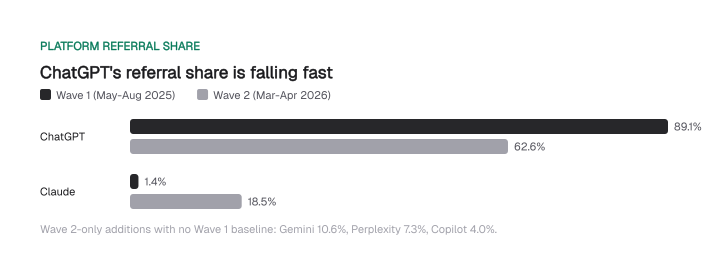
Higoodie's May 2026 AI Search Traffic Report shows how fast the mix moves.
Across its business-facing brand panel, ChatGPT's average GA4 referral share fell from 89.1% in Wave 1 (May to August 2025, measured across 2,802,519 AI referral sessions) to 62.6% in Wave 2 (March to April 2026). Claude's climbed from 1.4% to 18.5% over the same waves. Referral share is not audience share: Claude market share looks different depending on which measure you pick.
Referral sessions only count the humans who click through. The bots that fetch your pages before any answer cites them show up in server logs instead, and our ai crawler statistics date each panel's share of that traffic.
Build your stack around the platforms as a set, not around whichever one leads referrals this quarter.
The AI search measurement maturity model
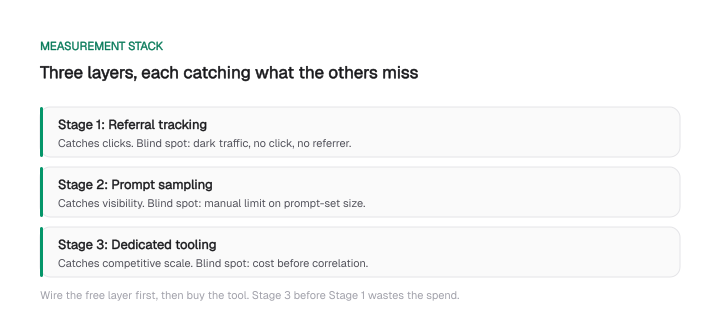
The AI search measurement maturity model runs through three stages.
It starts with what you can measure this week with GA4 and no budget, and ends where a dedicated tool pays for itself.
Most teams don't need a tool that costs $400 a month on day one. Each stage catches something the previous one can't see. Whichever stage you stop at, the budget case runs through how to calculate SEO ROI for the organic channel as a whole.
Stage 1: Referral tracking
Referral tracking starts with GA4's default AI Assistant channel, which groups visits from sources like ChatGPT, Gemini, DeepSeek, Copilot and Grok. A custom channel group lets you set the AI referrer list yourself.
It costs next to nothing, and you can finish it in an afternoon.
The blind spot is real, though. It only catches sessions where a click happened and a referrer was passed, so it misses dark traffic: the majority of AI-driven influence that never produces a click.
Picture someone who reads about your brand inside a ChatGPT answer, remembers the name, and searches for you directly a week later. That session lands as direct or branded organic, never as AI.
AI referral traffic tracking is the floor of the stack. Nothing above it works without it.
Stage 2: Prompt sampling
Prompt sampling means writing a fixed set of prompts in the exact language your customers use.
Run them monthly against each platform, and log whether your brand gets mentioned or cited. One run per prompt only shows presence, so size your prompt universe by the runs each prompt needs before absence means anything.
This catches the visibility referral tracking can never see, because it measures answers where no link was clicked. Cost scales with how many prompts and platforms you track, so a set of ten prompts across three platforms stays manageable by hand.
If you want this method applied specifically to ChatGPT, our walkthrough on how to track ChatGPT brand mentions covers the prompt sampling method in detail.
Stage 3: Dedicated tooling
Dedicated AI visibility tools earn their price once your prompt set outgrows what you can run by hand.
They also pay off when you want AI share of voice across a much larger prompt panel.
They run prompt panels far larger than any manual set, with historical trend lines built in:
- Ahrefs' Brand Radar tracks more than 405 million search-backed prompts, derived from People Also Ask data, across six AI engines.
- Semrush's AI Visibility Index launched in September 2025 on roughly 2,500 real-world prompts across 100 brands; its 2026 edition expanded to 126 million U.S. AI search prompts analyzed from January to April 2026.
- Mission Growth (our platform) includes AI citation and visibility tracking as part of its growth monitoring.
For a vendor-by-vendor breakdown of the pure-play trackers and suite add-ons in this tier, our roundup of the best LLM SEO tools compares pricing and platform coverage tier by tier.
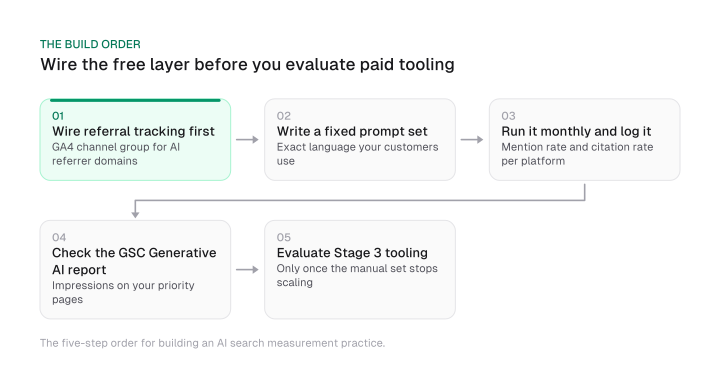
Wire the free layer first, then buy the tool. Stage 3 before Stage 1 wastes the spend: without referral tracking already in place, there's no way to correlate a visibility gain to a real business outcome, so you end up paying for share-of-voice charts that connect to nothing.
Core metrics, defined precisely
Four metrics do most of the work in AI search analytics: mention rate, citation rate, AI share of voice, and AI-referral conversion rate.
Vendors use the same words for different calculations, though. Here are the exact formulas, plus the one caveat that matters per metric.
All four measure what happened after someone sent a prompt. AI prompt volume estimates how often people send it in the first place, and that number is modeled rather than counted.
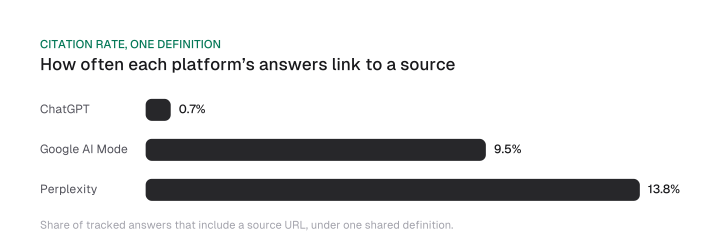
The citation rate AI search tools report is the single most confusing number in this category, because the same phrase describes different measurements.
RanketAI's April 2026 deep-dive defines citation rate as the proportion of AI answers that include a source URL. Under that definition, ChatGPT's citation rate is about 0.7%. Google AI Mode's is about 9.5%. Perplexity's is about 13.8%.
Those aren't brand rankings; they describe how often each platform links out at all. RanketAI aggregates the figures from several third-party benchmarks without publishing its own method, so read the spread as a warning rather than a leaderboard.
Before you compare a citation rate from one tool to another, ask which definition it uses. Two vendors quoting "citation rate" can be counting completely different events. Why the retrieved-to-cited share differs by study is covered in ChatGPT retrieval vs citation.
Computing a metric and deciding it belongs in front of a stakeholder are different jobs. The second one is worked through in how to read AI search visibility KPIs, down to what each percentage divides by.
Tone is the reading these four formulas cannot produce, because a mention can be counted and still be unflattering. How that score gets built, and why two engines disagree about the same brand, is how to track brand sentiment in AI answers.
How to track AI referral traffic in GA4
AI referral traffic tracking in GA4 starts with the default AI Assistant channel: GA4 sets the medium to ai-assistant when the referrer is on its list of AI assistants, such as ChatGPT, Gemini, DeepSeek, Copilot and Grok. Google's AI Overviews and AI Mode stay in Organic Search. When you want your own referrer list, a custom channel group routes the AI domains into one channel.
Here's the working set of domains to route:
- chatgpt.com, chat.openai.com
- perplexity.ai
- claude.ai
- gemini.google.com
- copilot.microsoft.com
- deepseek.com, meta.ai, grok.com
Group them under one AI channel and you get sessions and conversions per platform, tracked the same way as any other channel.
GA4-captured AI traffic is always a partial view. Sessions from mobile apps, logged-out flows, and platforms that strip the referrer never pass a domain at all, so the number you see is a floor.
Audit what you already capture before you layer AI-channel tracking on top of your existing setup, using our free tracker audit tool. A channel group is only as trustworthy as the tag firing underneath it.
How to read Google Search Console's generative AI performance report
Google Search Console's Generative AI performance report shipped in June 2026, covering AI Overviews and AI Mode. For how often AI Mode users click out at all, see our AI Mode click-through rate figures.
You can group the data by Pages, Countries, Dates, and Devices. That's the useful part.
The limits matter more, though:
- Impressions only. No clicks, CTR, average position, or query data in version 1.
- No history before May 18, 2026. There's no backfill from before that date.
- Partial rollout. It began with a subset of site owners, so you may not see it in your own property yet.
The Google Search Console AI Overviews report tells you that your pages appeared inside AI answers and roughly how often. It doesn't show what anyone did next.
For the full Google-specific optimization playbook, including how to earn those AI Overview appearances and a deeper walkthrough of this exact report, see our guide on how to show up in Google AI Overviews.
What nobody can measure yet
Your classic SEO dashboard won't show this at all, since it only sees clicks, and the AI-specific tools have limits of their own.
Four gaps sit under every AI analytics dashboard on the market, and naming them keeps you from over-trusting a clean-looking chart:
- There is no AI search volume denominator. Google reports total query volume for classic search. No AI platform publishes the equivalent for AI answers, so every AI share of voice figure is share of a tracked prompt sample rather than of all real conversations. When a tool says you own 12% share of voice, read it as 12% of the prompts that tool happened to run.
- Dark traffic understates real influence. Most AI-influenced research ends without a trackable click. The referral numbers in GA4 systematically undercount how much AI actually shapes buying decisions, and no current method closes that gap.
- Citation rate is not comparable across vendors. As the metrics section showed, the same term hides different definitions. That ambiguity is a measurement limit in its own right, well beyond loose vocabulary.
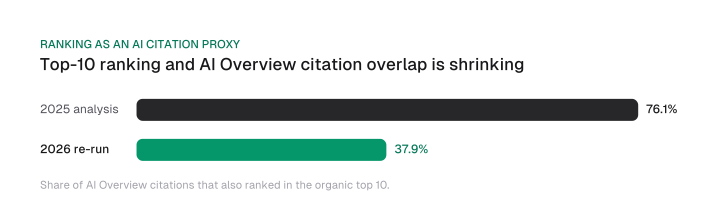
- Ranking is a fading proxy, not a measurement. Some teams still read organic position as a stand-in for AI citation. Ahrefs' March 2026 re-run across 863,000 keyword SERPs and 4 million AI Overview URLs found the overlap between organic top-10 rankings and AI Overview citations had dropped to 37.9%, down from 76.10% in its 2025 analysis of 1.9 million citations. Ranking still correlates with citation, but the link is weakening fast, and Google's report covers only two of the five to six major AI surfaces.
A proxy that halves in seven months is not something to build a stack on.
Building your measurement stack (practical checklist)
Start this week with tools you already own:
- Wire referral tracking first. Check GA4's AI Assistant channel first, then add a custom channel group for any AI referrer domains above that you want grouped your own way. It is the foundation every later stage correlates against.
- Write a fixed prompt set. Ten to thirty prompts in the exact language your customers use. Save them, because you'll run the same set again every month.
- Run the set monthly and log it. Record mention rate and citation rate per platform in a simple sheet. A consistent baseline beats a single perfect check.
- Check the GSC Generative AI report if you have access, for Google-surface impressions on your priority pages.
- Evaluate Stage 3 tooling only when the manual set stops scaling. The trigger is a prompt or platform count that outgrows a monthly by-hand run, plus Stage 1 referral tracking already in place to correlate against.
Run this on the same cadence as the rest of your growth work. Our guide to a growth experiment cadence covers how to fold a monthly measurement review into a regular experiment rhythm, so the numbers actually drive decisions instead of sitting in a tab.
Frequently asked questions
What is AI search analytics?
AI search analytics is measuring whether your brand appears, and to what effect, inside AI search answers. Google's AI Overviews and AI Mode are the biggest surfaces. ChatGPT, Perplexity, Gemini, and Copilot are the others. It splits into three layers: native platform reporting (what a surface publishes about itself), referral tracking (visits that reach your site from an AI answer), and prompt sampling (running fixed prompts to see if you get cited). No single layer gives the full picture.
Can Google Analytics track ChatGPT and Perplexity traffic?
Yes, partially. GA4's default AI Assistant channel groups visits from sources like ChatGPT, Gemini, DeepSeek, Copilot and Grok, and a custom channel group can add other AI referrers such as perplexity.ai; then you read sessions and conversions per platform. The catch is that this only ever captures a partial view: mobile-app and logged-out sessions often pass no referrer, so the count is a floor. Perplexity, which cites sources heavily, tends to show more referral clicks than ChatGPT, which rarely links out.
What's the difference between citation rate and share of voice?
Citation rate is how often your specific URL appears as a cited source, measured for one brand: (answers citing your URL / total tracked answers) x 100. AI share of voice compares your visibility against your whole category: (your citations or mentions / all citations or mentions across the tracked prompts) x 100. Citation rate is about you alone. Share of voice is your slice of the tracked competitive set.
Does Google Search Console show AI Overview clicks?
No. The Generative AI performance report that Google launched in June 2026 reports impressions only in version 1. There is no click, CTR, average-position, or query data yet, and no history before May 18, 2026. It confirms your pages appeared in AI answers without telling you what happened next. For the full walkthrough and how to optimize for those appearances, see our guide to getting cited in Google AI Overviews.
How often should I check AI search visibility?
Monthly is the practical baseline. Run your fixed prompt set against each platform once a month and log mention and citation rate, which is enough to spot a real trend without chasing daily noise that mostly reflects model randomness. Increase the frequency only when you tie a specific campaign or launch to a visibility change and need a tighter read on the effect.
When do I need a dedicated AI visibility tool instead of manual tracking?
When two things are true: your prompt set or platform count has outgrown a monthly by-hand run, and your Stage 1 referral tracking already works so a tool's visibility numbers can correlate to real sessions. Buying dedicated tooling before referral tracking exists means paying for share-of-voice charts you can't tie to any business outcome. Fix the free layer first, then scale into a paid tool.
Cite this page
Aktaş, F. (2026, September 17). AI Search Analytics: The New Measurement Stack. Mission Growth. https://missiongrowth.io/blog/ai-search-analytics
Figures we made for this post are free to reuse under CC BY 4.0 with credit to Mission Growth.
Get Mission Growth highlighted in your Google results.