How to Show Up in Google AI Overviews
AI Overviews SEO in one guide: what triggers them, why top-10 ranking no longer guarantees a citation, and how to measure it in Search Console.
By Furkan AktaşPublished Updated
On this page
Showing up in Google AI Overviews comes down to three moves. Get your page indexed and eligible for a snippet, put a complete answer in the first third of the page, and back it with named E-E-A-T signals.
When you work out how to show up in AI Overviews, SEO is the starting point. Ranking in the top 10 used to be enough on its own. It isn't anymore. The overlap between top-10 rankings and AI Overview citations has fallen sharply, and that gap is why AI Overviews optimization now needs its own checklist, separate from classic SEO. For how often AI Overviews appear by intent and industry, see the dated numbers.
In this guide:
- What actually triggers a Google AI Overview, and why the trigger rate keeps shifting
- Why ranking in the top 10 no longer guarantees a citation, with the data behind the gap
- A step-by-step checklist for how to get cited in Google AI Overviews
- Whether you need schema markup, and how to measure your Overview performance in Search Console
- What to do when a competitor gets cited instead of you
What triggers a Google AI Overview (query fan-out, plainly)
Google does not show an AI Overview on every search, even on a query that looks like a perfect fit.
Google's own documentation puts it plainly:
"AI Overviews are only shown when our systems determine that it is additive to classic Search, and as such, often don't trigger."
When an Overview does appear, query fan-out is the mechanism behind it. Google states that both AI Overviews and AI Mode "may use a 'query fan-out' technique, issuing multiple related searches across subtopics and data sources."
In plain terms, Google breaks your one search into several smaller questions instead of matching it to a single ranked list. It runs each of those separately, then assembles the answer from whichever pages satisfy each piece best.
That's why a page can get cited for one piece of a question it answers well, even when it doesn't rank first for the original search.
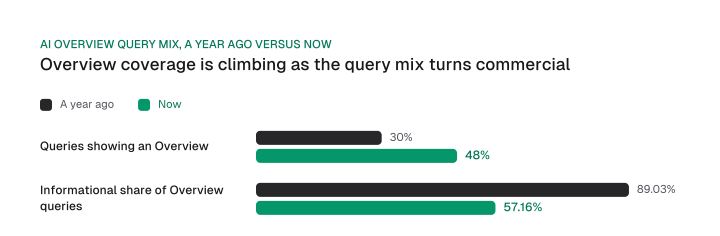
Chasing a fixed "what percentage of queries trigger an Overview" number wastes your time, because the rate keeps moving. BrightEdge's February 2026 study found:
- ~48% of tracked queries showed an AI Overview, up from about 30% a year earlier, a 58% jump in twelve months.
- ~52% of tracked queries still showed no AI Overview at all.
Read together, coverage is expanding, but a large share of search still has nothing to compete for.
The query types skew in ways you can use:
- Complex, multi-step questions, and "how" or "why" questions, trigger Overviews more often than simple factual lookups, which Google often answers with a classic snippet instead.
- Commercial intent is climbing. Semrush's tracking found informational queries made up 57.16% of AI Overview appearances in October 2025, down from 89.03% a year earlier.
If your money pages sit on commercial queries, that shift is moving toward you.
Why ranking in the top 10 no longer guarantees a citation
Ranking in the top 10 no longer reliably earns an AI Overview citation. That link used to hold.
It's measurably weaker now, and the decline shows up across two independent studies with dates attached.
In eight months, Ahrefs' own overlap figure fell from 76.10% to 37.9%. Ahrefs itself flags an improved parsing methodology between the two runs, so treat the drop as directionally real rather than a strict before-and-after comparison. Google now pulls roughly a third of its citations from pages ranking 11-100, and another third from pages that don't rank in the top 100 at all.
BrightEdge, using a different methodology, lands even lower: about 17% overlap, a figure it called "remarkably flat" across its tracking period.
The two studies disagree on the exact level, which is expected given different sampling and citation definitions. They agree on the direction: source selection for AI Overviews is decoupling from classic rank position, and the gap is widening.
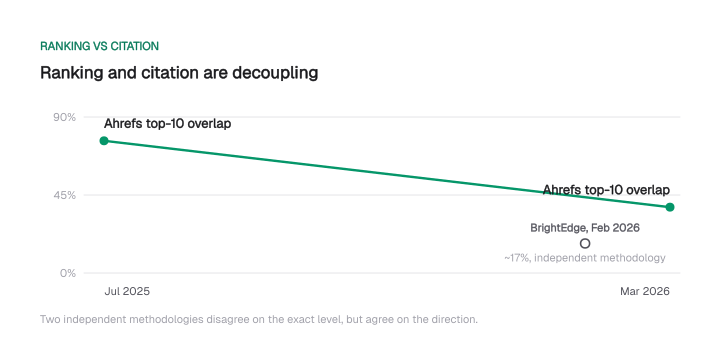
This split previews how AI Overview will change SEO: rank position stops being the whole game, and citation eligibility becomes a second, separate scoreboard to win.
Here's what still holds: first-page presence remains a directional signal. A page that ranks well is easier to fetch and index cleanly, and the fundamentals that put you on page one are the same ones that make you citable.
Our work with MyPhotoStation, a US wall-decor brand, grew organic revenue 5x in five months on exactly those fundamentals: clean technical SEO plus content that answers buyer questions directly.
What's now wrong is the old assumption that ranking top 10 gets you cited automatically.
How to show up in AI Overviews SEO: the optimization checklist
AI Overviews SEO is mostly classic SEO plus an extraction layer: get indexed, put the answer where a bot can find it, and back it with real signals.
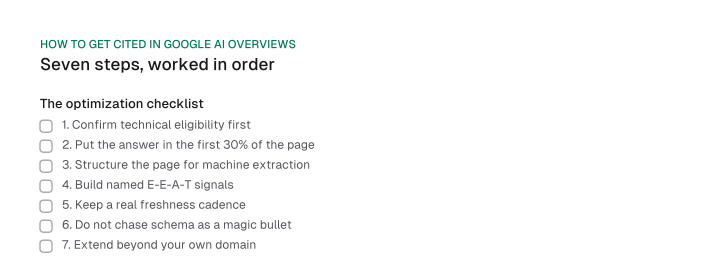
That combination is how to get cited in Google AI Overviews. Work through the seven steps below in order, because the early steps gate the later ones: a perfect answer unit behind a crawler block earns zero citations.
1. Confirm technical eligibility first
Google's bar for technical eligibility is short and non-negotiable: your page must be indexed and eligible to show with a snippet in classic Search.
Google Search Central states it directly: "to be eligible to be shown as a supporting link in AI Overviews or AI Mode, a page must be indexed and eligible to be shown in Google Search with a snippet." No index, no snippet, no citation.
The trap most B2B teams miss is JavaScript rendering. Many crawlers read the HTML your server returns without executing client-side scripts, so a single-page app can hand a bot a near-empty shell.
We hit this ourselves. We migrated our own React app to prerendered static HTML across 20 marketing pages, because AI crawlers don't execute JavaScript.
Check your eligibility before writing new copy:
- Confirm indexing. Run Search Console's URL Inspection on the page.
- Confirm raw HTML. View Page Source (not Inspect) and check for real content, with no
nosnippetdirective stripping your snippet eligibility. - Run the full pass. Work through our technical SEO checklist for 2026 for the complete crawlability and indexation check.
- Spot-check machine readability. Our free llms.txt checker flags general AI-crawler hygiene; it doesn't score AI Overview citation odds directly.
Do today: Inspect your top three target pages in Search Console. Any that aren't indexed or eligible for a snippet can't be cited.
2. Put the answer in the first 30% of the page
Where you place the answer changes whether it gets pulled. CXL's March 2026 analysis mapped where 100 AI Overview citations came from on the source page:
- Top 30% of the page: 55% of citations
- Middle third: 24% of citations
- Bottom 40%: 21% of citations
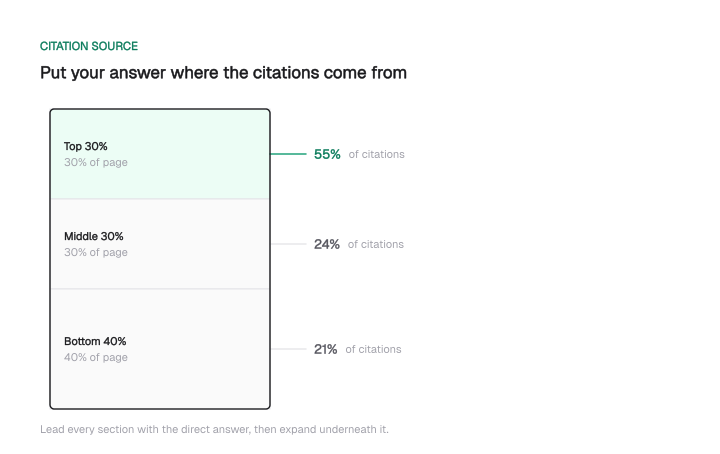
The action is concrete: lead every section with the direct answer, then expand underneath it. Compare two openings for the same section:
- Buried: "There are several factors that influence whether a page appears in an AI Overview, and before we get to answer placement we should consider indexing, structure, and authority in turn."
- Answer-first: "AI Overviews pull most cited passages from the top of the page. Put your direct answer in the opening of the section, then add detail below it."
The second gives a bot a complete, quotable unit in the first two sentences. The first makes it dig.
3. Structure the page for machine extraction
A bot copies a passage, so make that passage easy to lift cleanly:
- Keep paragraphs short. Two to four sentences beats a wall of text.
- Cover one topic per section. A descriptive H2 or H3 gives the fan-out mechanism a clear match for each part of a question.
- Put comparisons in a table. Rows map cleanly to values with no ambiguity.
Do today: Open your target page and check whether each section answers its own heading in its first sentence. If a section wanders before it answers, tighten the opener.
4. Build named E-E-A-T signals
Google's systems weight experience and authorship as a direct signal:
- Use a real, named author with a verifiable bio and Person schema, not an "editorial team" byline.
- Show published and updated dates on the page.
- Include firsthand claims: what you tested, what you run, what your own data shows.
The signal hardest to fake is original synthesis: take conflicting numbers from multiple sources and reconcile them into one clear answer, instead of repeating what one source said. For the exhaustive version of this checklist, broken into 35 steps, see our AI SEO checklist.
5. Keep a real freshness cadence
AI Overviews favor current content. A page that was accurate at launch drifts out of the answer set as the topic moves.
Set a review cadence:
- Quarterly for evergreen sections.
- Faster for anything tied to a moving metric or product.
Update the number, update the date, and re-submit for indexing each time. A publish-and-forget page loses its Overview slot to the competitor who refreshed theirs.
6. Do not chase schema as a magic bullet
Schema is worth adding, but not for the reason vendors usually sell it.
The next section reconciles the contradiction in full, so add schema where it clarifies your content and move on. Don't build a schema strategy on the promise of an AI Overview citation lift: no verified number supports that promise.
7. Extend beyond your own domain
Your page isn't the only surface Google cites, and third-party citations are climbing.
Ahrefs' March 2026 data named YouTube the single most-cited domain in AI Overviews, up 34% over six months and accounting for 5.6% of all AI Overview citations.
For a B2B SaaS team, that's a distribution signal. A clear explainer video, or a guest answer on an authoritative industry domain, can put you inside an Overview even when your own page isn't the one Google pulls. Off-domain presence is the second lever, and it's getting more valuable.
Do you need schema markup to show up in AI Overviews?
Short answer: no, not as a requirement, and yes, still worth doing for the reasons it always was.
Google is unusually blunt on this. Its documentation states there "are no additional requirements to appear in AI Overviews or AI Mode, nor other special optimizations necessary."
It adds that "you don't need to create new machine readable files, AI text files, or markup to appear in these features," per Google Search Central. No schema requirement, no special AI file, no secret markup.
Here's the split:
- What it does: helps parsers understand your page and unlocks rich results in classic Search.
- What it doesn't do: raise your AI Overview citation odds by any verified amount.
So why does schema advice keep coming up? Because it still does its original job: structured data makes you eligible for rich results (FAQ, HowTo, Article) in classic Search.
What no verifiable source supports is a citation lift: the claim that schema raises your AI Overview odds by some percentage. Treat any vendor guaranteeing that lift with caution, because the number has no traceable source.
The practical rule: add schema where your content genuinely fits the type, because it earns rich results and clarifies structure for parsers. Skip schema bolted on purely to influence machines. It's not a shortcut into an Overview.
How to measure AI Overview performance in Google Search Console (2026)
Until recently, the answer to "how do I measure this" was "you mostly can't." That changed on June 3, 2026.
Google launched a dedicated Generative AI performance report inside Search Console.
It's the first Google AI Overviews Search Console view to break out impressions of your URLs inside AI Overviews, AI Mode, and Discover's generative features. It's a real step forward and a limited one, so knowing what it shows and what it withholds keeps you from drawing the wrong conclusions.
Where it sits among this year's other Google changes is in AI search trends 2026.
Two rollout facts set expectations. Historical data starts May 18, 2026 with no backfill, so you can't compare against last year. Google completed the worldwide rollout by the end of August 2026, so the report should show up for any property with an existing Search Console setup by now; if it doesn't, that's more likely a low-visibility issue than a pending rollout.
Because the report gives impressions without clicks, you still need proxies while click data is missing:
- Branded-query lift. Watch your branded search volume in the standard Search Console Performance report; a rise after you start appearing in Overviews suggests the exposure is registering.
- Landing-page session delta in GA4. Segment sessions to the pages appearing in the Generative AI report and watch for changes classic organic clicks don't explain.
- Direct-traffic anomaly checks. Zero-click exposure often surfaces later as direct visits when a searcher returns by typing your name; watch for bumps on the days your impressions climb.
If you also track brand mentions across other AI engines, the analogous method applies to ChatGPT: see how to track ChatGPT mentions of your brand for the non-Google version of this measurement problem.
What to do when a competitor gets cited instead of you
A competitor citation is recoverable. Work through this playbook in order:
- Audit the citing page's structure. Find the exact passage in the Overview and locate it on their page. Is it in the top 30%, and is it a tight, self-contained answer unit? Usually the cited passage is a clean opening statement, and yours is buried.
- Check the citing page's freshness date. If their page was updated last month and yours a year ago, freshness is a plausible reason. Note the gap.
- Confirm your own page still ranks page-one. If you've slipped off the first page for the query, that's an ordinary rankings problem, and the fix is ordinary SEO before anything Overview-specific.
- Tighten your answer unit. Rewrite your opening so the direct answer sits in the first two sentences of the relevant section, self-contained enough to quote without context. This is Checklist Step 2 applied to a specific losing query.
- Re-submit for indexing and re-check on a cadence. Request indexing in Search Console, then re-check after two to four weeks. There's no reliable published timeline for when a page re-enters an Overview, because fan-out re-runs aren't instant and Google doesn't document a schedule. Treat the two-to-four-week window as a monitoring cadence; reappearance has no promised date.
The point is diagnosis before action. A competitor citation is data about what Google preferred on that query, and the fix is usually structural rather than a wholesale rewrite.
This is Google-specific. what about ChatGPT, Perplexity, and Gemini?
Everything above is tuned to Google AI Overviews: query fan-out, the indexing and snippet eligibility bar, and the June 2026 Search Console report.
ChatGPT, Perplexity, and Gemini fetch and cite by their own rules, and the tactics diverge past a shared core. Our guide to how to optimize for AI search engines covers that cross-platform picture, with a tactics table for each platform and a Google AI Overviews row that links back here. Start there for the full multi-engine plan, and stay on this page for the Google execution.
For the Gemini app's own rules, read Gemini SEO.
Frequently asked questions
What triggers a Google AI Overview?
Google's own documentation says it shows an Overview only when its systems judge it "additive to classic Search," so many queries never trigger one. When one appears, Google often uses query fan-out: it breaks your search into multiple related searches and assembles the answer from pages that satisfy each part. Complex, multi-step, and "how" or "why" questions trigger Overviews more often than simple factual lookups.
Do I need schema markup to appear in AI Overviews?
No. Google's documentation states there are no additional requirements or special markup needed to appear in AI Overviews or AI Mode, and that you don't need to create new machine-readable or AI files. Schema is still worth adding where your content fits (FAQ, HowTo, Article), because it clarifies structure and earns rich results in classic Search. Don't expect a specific citation lift, since no verified source supports that claim.
Can Google Search Console show AI Overview clicks?
Not yet. The Generative AI performance report Google launched June 3, 2026 shows impressions of your URLs in AI Overviews, AI Mode, and Discover generative features, grouped by Pages, Countries, Devices, and Dates. The v1 report doesn't include clicks, CTR, position, or query data, and its history starts May 18, 2026 with no backfill. Use branded-query lift and GA4 session deltas as interim proxies until click data ships.
Does ranking #1 guarantee an AI Overview citation?
No, and the gap is widening. Ahrefs found top-10-and-cited overlap fell from 76.10% in July 2025 to 37.9% in March 2026, though Ahrefs also disclosed an improved parsing methodology between the two studies, so the two runs aren't a strict apples-to-apples comparison. BrightEdge measured the same pattern independently at about 17%. Google now pulls roughly a third of its citations from pages that don't rank on the first page. Page-one presence still helps directionally, but the old "rank top 10, get cited" rule is measurably outdated.
Why did my page stop showing up in an AI Overview it used to appear in?
Usually freshness or a structural loss. AI Overviews favor current content, so a page that drifts out of date gets replaced by a competitor who refreshed theirs. Fan-out also re-runs over time, and a re-run can re-select sources. Check whether a rival page is now newer or better structured for the query, tighten your answer unit, update the date, and re-submit for indexing.
What is the difference between AI Overviews and AI Mode?
Both are Google generative-search features, and per Google's documentation both may use query fan-out to gather sources. An AI Overview is the generated summary above classic results on a normal search. AI Mode is a separate, fuller conversational experience. Both share the same eligibility bar: your page must be indexed and snippet-eligible. For ChatGPT, Perplexity, and Gemini, see our cross-platform AI search guide.
Cite this page
Aktaş, F. (2026, September 17). How to Show Up in Google AI Overviews. Mission Growth. https://missiongrowth.io/blog/how-to-show-up-in-google-ai-overviews
Figures we made for this post are free to reuse under CC BY 4.0 with credit to Mission Growth.
Get Mission Growth highlighted in your Google results.