GEO vs SEO: What Actually Changes
GEO vs SEO compared activity by activity: what changes for keyword research, links, and schema when you optimize for AI citations, not rankings.
By Furkan AktaşPublished Updated

On this page
GEO vs SEO comes down to one shift: what counts as a win. SEO optimizes for ranking and clicks in a list of search results.
GEO optimizes for being cited and recommended inside the answer that ChatGPT, Perplexity, or Google AI Overviews generates. The underlying goal is the same: getting found. Only the mechanics differ.
Key takeaways
SEO wins you a ranking and a click. GEO wins you a citation inside an AI answer, sometimes with no click at all. Most of the underlying work overlaps, but backlinks matter less for citations, and tracking shifts from rank position to citation share by platform. Do both: keep ranking, and start measuring citations.
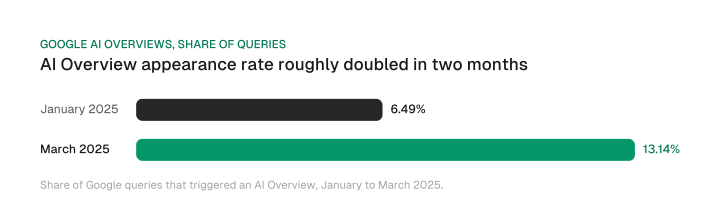
The reason this matters right now is measurable:
- Semrush found Google's AI Overviews appeared in 13.14% of queries by March 2025, up from 6.49% in January 2025.
- A 2026 buyer study found 73% of B2B buyers already use AI tools somewhere in vendor research.
When most of your buyers ask an AI before they ask you, ranking #1 on a page they never scroll to is a smaller win than it used to be.
This guide goes past goals, formats, and KPIs to map the actual work behind GEO vs SEO. If you already do keyword research, internal linking, and schema markup, you'll see exactly which of those tasks change, which stay the same, and which extend into new territory.
What is SEO, what is GEO
SEO (search engine optimization) is the discipline of getting a web page to rank higher in the organic results of a search engine like Google or Bing.
The unit of success is a position and the click that follows it. You optimize titles, content, links, and technical health so a crawler indexes the page and an algorithm ranks it near the top for a query.
GEO (generative engine optimization) is the practice of getting your content cited, quoted, or recommended inside the answer an AI system generates. The unit of success is a citation or a mention rather than a ranked position.
The core difference in one line:
- SEO's currency is a ranking position and the click that follows.
- GEO's currency is a citation or a mention inside someone else's answer.
Say a user asks ChatGPT which project management tool fits an engineering team. GEO is the work that names your product in the answer and links your page as the source.
The generative engine optimization vs SEO question comes down to what counts as a win: a ranked position, or a named citation.
People often ask about a third acronym: "GEO vs SEO vs AEO." AEO (answer engine optimization) is the older, narrower term for winning featured snippets and voice assistant answers in traditional search.
GEO is broader. It covers generative systems that synthesize a full response from many sources instead of lifting one snippet. Most teams today treat AEO as one slice of GEO.
Where the term "GEO" actually comes from
The term GEO comes from a 2023 academic paper rather than a vendor slogan.
Most vendors, when asked what is generative engine optimization, point to a slogan instead of a source.
Researchers Aggarwal, Murahari, Rajpurohit, Kalyan, Narasimhan, and Deshpande, spanning Princeton, Georgia Tech, IIT Delhi, and the Allen Institute for AI, wrote it as arXiv 2311.09735. The paper introduced the term and built GEO-bench, a benchmark that tests how specific content changes affect a page's visibility inside generative engines.
Why the origin matters: it shows GEO was defined and studied before the vendor hype cycle, so the idea has a real research spine. Naming a primary source instead of a vague "recent studies" is itself a GEO tactic.
The paper measured which edits moved visibility; we're pointing to its existence and method, not its exact lift numbers, since those deserve a direct read of the paper.
What actually changes: SEO vs GEO, activity by activity
SEO and GEO diverge task by task, more than concept by concept.
The table below marks each task already on your content team's plate as changed, unchanged, or extended, which is where the real GEO SEO differences show up.
How to read the verdict column
The verdict column is your reallocation map.
"Same" rows are habits worth keeping. "Extends" rows are where you add new work on top of what you already do. Nothing here is "Changes" in the sense of throwing away old skills, which undercuts most of the GEO panic buried in vendor pitches.
What doesn't change (the real overlap)
The overlap between SEO and GEO is larger than most vendor pitches admit.
Quality content that answers a real question well serves both goals at once. A page that ranks because it's genuinely useful is also the page a model is most likely to cite, since both systems look for the same thing: the most helpful, accurate source.
The technical baseline is shared too. Neither Google nor an AI retrieval system can use a page a crawler can't fetch and render. Both need:
- Clean HTML a crawler can parse
- Working canonical tags
- A valid sitemap
- No accidental noindex on pages that matter
If your technical foundation has gaps, fix those first. GEO work on a page AI bots can't reach returns nothing.
We hit this ourselves:
- Our marketing pages ran as a React single page app, and AI crawlers don't execute JavaScript, so we migrated 20 of them to prerendered static HTML.
- We publish our own llms.txt and llms-full.txt, a curated plain text knowledge base that points crawlers at the content we most want quoted.
Our technical SEO checklist for 2026 covers that baseline in full, and every item on it still applies in an AI search world.
Authoritative sourcing is the third shared pillar. Naming your sources, citing real data, and showing direct experience have always helped SEO trust signals.
They now double as the raw material AI systems prefer to quote. The work you already do to make content credible for humans is most of the work that makes it credible for machines.
How LLMs actually decide what to cite
LLMs decide what to cite based on two kinds of knowledge:
- Parametric knowledge is baked into the model's weights during training and frozen at the cutoff, with no live link back to your site.
- Retrieval is content fetched at query time: the system searches the live web, reads pages, and summarizes them into an answer with citations.
GEO targets retrieval rather than parametric memory. When ChatGPT with browsing, Perplexity, or a Google AI Overview answers a query, it runs a search, pulls a set of candidate pages, and decides which to quote and cite. Among the sources it could quote, it then picks the cleanest one to cite.
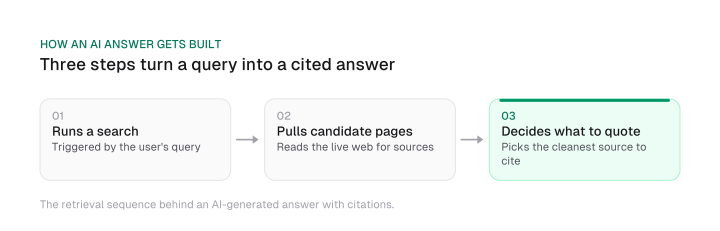
Your job is to be in that candidate set, then be the cleanest, most quotable source once you're in it. That's a different task from ranking, which explains why the two outcomes can diverge so sharply.
Our guide on how to show up in Google AI Overviews breaks down that pipeline for one specific engine.
Why you can rank #1 on Google and get zero ChatGPT citations
Ranking and citation ecosystems barely overlap.
An analysis of 680 million AI citations gathered between August 2024 and June 2025 found that only 11% of domains are cited by both ChatGPT and Perplexity.
That same report found Google's own AI Overviews and AI Mode share only 13.7% of cited sources, despite reaching semantically similar conclusions 86% of the time. Same company, similar answers, different citations.
Part of the reason is that each platform trusts different types of sources. Here's the mix, drawn from that same dataset:
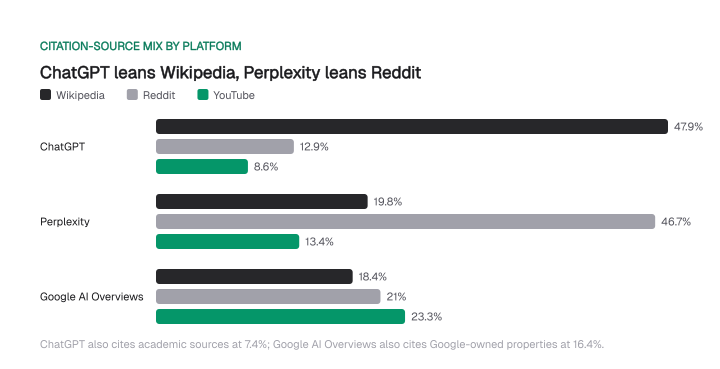
Look at how differently these systems weight the web: ChatGPT leans hard on Wikipedia, Perplexity leans hard on Reddit, and Google AI Overviews spread across video, forums, and its own properties.
For example, a page ranking #1 on Google can be invisible to ChatGPT if the answer for that query was built mostly from Wikipedia and a Reddit thread, neither of which mentions you.
This is also how competitive displacement happens. You can hold the top organic position and still watch an AI engine cite and recommend a competitor, because the engine built its answer from sources where your competitor appears and you don't.
The fix isn't to rank higher. It's to be present and referenceable in the specific source types each engine trusts.
Measuring GEO: the KPIs that actually change
Measurement is the weak point in most GEO advice: name the problem, say "track your brand mentions," and stop.
Industry research from 2026 reports only 22% of marketers currently track AI visibility, and fewer than 26% plan to build content specifically for AI citations. That gap is the opportunity. Three metrics beat one vague score:
- Citations per platform, tracked separately. ChatGPT and Perplexity share only 11% of cited domains, so a single "AI visibility" number hides more than it shows. Watch ChatGPT, Perplexity, and Google AI Overviews as three separate lines for your priority queries.
- AI referral traffic, read from server logs. Much of it arrives without clean referrer data and lands in "direct" inside GA4. Filter your logs by crawler user agent (GPTBot, PerplexityBot, Google-Extended) and watch for referral spikes from ChatGPT and Perplexity.
- Share of voice, built by hand. Pick your ten most important buyer questions, ask the major engines, and record whether you or a competitor gets cited. The percentage where you appear is your share of voice, and it exposes displacement a rankings report never will.
The AI referral impact isn't hypothetical for SaaS. For example, the same 680-million-citation report found ChatGPT refers about 10% of Vercel's new signups, a channel worth measuring properly. Our guide to AI search analytics walks through the full measurement stack.
A practical GEO checklist for B2B SaaS teams
B2B SaaS buying looks nothing like a cordless screwdriver purchase: most of the decision happens before anyone talks to you.
Forrester data in Loganix's 2026 release shows 61% of the B2B buying journey completes before the buyer contacts a vendor. Similarweb data in the same release shows 35% of buyers now use AI tools at the discovery stage, versus 13.6% still starting with traditional search.
Your buyers are shortlisting you, or not, inside an AI answer before they ever reach your site. Here's the checklist for that reality:
- Answer the buying committee's real questions. Cover "what does this integrate with," "how does pricing work," "who is this not for," and "how do you compare to X" directly.
- Lead every section with the answer. Put the extractable claim first, then support it; models quote the clean statement and skip the setup.
- Publish comparison and alternatives pages. When a buyer asks an AI for "alternatives to [Competitor]," you need a page in that answer.
- Show up where each engine actually looks. That means Reddit and community threads, an accurate Wikipedia footprint where it applies, and explainer video content.
- Keep llms.txt clean and your structure crawlable. Run yours through our llms.txt checker to confirm it's valid and pointed at the right content.
- Add data you collect yourself, and named authors. Original numbers and a real byline beat an anonymous rewrite of common knowledge.
- Track citations per platform every week. Use the metrics above so you see what's working before it shows up in traffic.
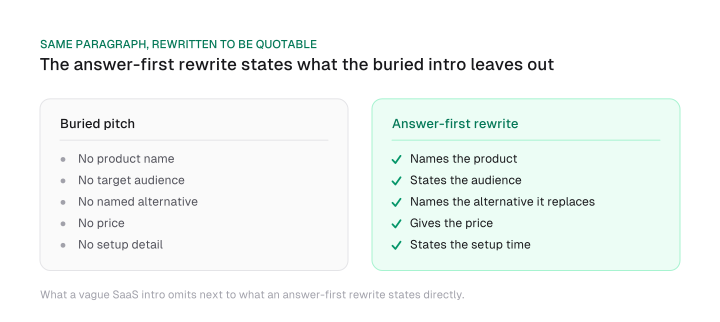
For example, here's what "lead with the answer" looks like in practice. Take a typical SaaS intro paragraph and rewrite it for extraction.
Before (buried, fluffy):
Our platform is designed to help modern teams work smarter. With a range of powerful features and an intuitive interface, businesses of all sizes can improve their workflows and get more done.
After (leads with the answer, structured):
Acme is project management software for engineering teams of 10 to 200 people. It replaces Jira for teams that want sprint planning and issue tracking tied to Git in one tool. Pricing starts at $8 per user per month, and setup imports existing Jira boards in about 15 minutes.
The rewrite names the product, the audience, the alternative it displaces, the price, and the setup time in four sentences. An AI engine can lift any one of those as a factual answer. The original gives it nothing to quote.
Why GEO results show up before ranking results do
Content restructuring shows up in citation tracking faster than in ranking reports.
AI engines crawl and rewrite their summaries on a shorter cycle than Google updates rankings. So treat GEO as a reallocation of the content effort you already spend, not a separate budget line with a fixed payback week. Anyone promising you a guaranteed timeline in weeks is guessing.
Common myths about GEO vs SEO
Three claims about GEO don't hold up:
- GEO replaces SEO. It doesn't, at least not for most companies today. SEO still drives the organic traffic and the crawlable foundation that GEO depends on, and traditional search volume hasn't collapsed. BrightEdge data shows total Google search impressions rose more than 49% in the year after AI Overviews launched, even as click-through rates fell nearly 30% over the same period: more searches, fewer clicks each. We treat the full "does GEO replace SEO" question, with the data, in will AI replace SEO.
- Schema markup guarantees AI citations. It doesn't. Schema helps search engines understand entities, and it's worth keeping for SEO. But studies on whether schema actually increases AI citation rates conflict with each other, and no one has shown a reliable causal link. Do it for the SEO value it clearly has. Don't restructure your GEO strategy around a promise no dataset supports yet.
- You need entirely separate content for AI. You don't need a second content library. The activity table above shows most of the work extends your existing pages rather than replacing them. And an article that's well sourced and leads with the answer earns rankings and citations from the same words. For the broader version of this comparison across all of AI search, see AI SEO vs traditional SEO.
Do you need both? A decision framework
Whether you need both depends on where your buyers actually are. The split isn't the same for every company:
- Weight SEO first when you're early stage, your category sees low AI referral share, and your analytics show most qualified traffic still comes from organic search. GEO work on a site AI bots barely reach, for buyers who rarely research through AI, is premature. Build the rankings and the technical base, then layer GEO on.
- Invest in GEO now when your buyers research through AI before they talk to you, which for B2B SaaS is already common: 73% use AI tools in vendor research, and 61% finish most of the journey before contacting sales. If your buying committees are technical or do heavy research, assume you're already being shortlisted inside AI answers today.
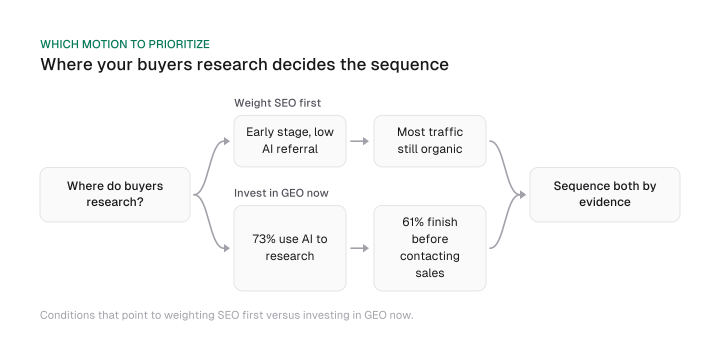
For most B2B SaaS teams the answer is both, sequenced by evidence. Watch your own AI referral logs and your citation share by platform.
When those numbers climb, shift more effort toward GEO. Mission Growth's platform tracks AI citations and visibility for customers, so the reallocation decision runs on data instead of a hunch.
Whatever tool you use, let the measured share of research that happens through AI decide the split, rather than the acronym of the month. If you plan to hire help for either side, check what AI SEO services cost before you commit.
GEO vs SEO at a glance
GEO and SEO differ on five practical dimensions, summarized below.
Most of what's in this table extends what you already do; very little of it replaces it.
Frequently asked questions
Does GEO replace SEO?
No. GEO extends SEO rather than replacing it. Traditional search still drives most organic traffic for most companies, and the crawlable pages SEO produces are the same pages AI engines cite.
BrightEdge found Google search impressions rose over 49% in the year after AI Overviews launched. The shift is that clicks per search are falling, so citations inside AI answers become a second target alongside rankings.
What is the difference between GEO and AEO?
AEO (answer engine optimization) is the narrower, older practice of winning featured snippets and voice assistant answers inside traditional search.
GEO (generative engine optimization) is broader, covering systems like ChatGPT and Perplexity that synthesize a full answer from many sources and cite them. Most teams now use GEO as the umbrella term and treat AEO as one part of it.
Do I need different content for ChatGPT than for Google?
Usually not a separate library, but you should tune structure. The same answer-first, well-sourced article can earn a Google ranking and a ChatGPT citation. What changes is which source types each engine trusts.
An analysis of 680 million AI citations shows ChatGPT leans on Wikipedia (47.9% of top sources) while Perplexity leans on Reddit (46.7%), so where you build presence matters as much as the page itself.
Can I see AI search traffic in Google Analytics?
Partially, and unreliably. Much of that traffic arrives without clean referrer data, so GA4 often files it under "direct." To measure it properly, read your server logs and filter by AI crawler user agents (GPTBot, PerplexityBot, Google-Extended) and by referrers like Perplexity. Server logs catch what analytics alone miss.
Does schema markup guarantee my content gets cited by AI?
No. Schema helps search engines parse entities and is worth keeping for SEO. But studies on schema's effect on AI citation rates conflict, and no dataset has shown a dependable causal link to more citations.
Use schema for its proven SEO value. Don't build your GEO plan on a guaranteed-citation promise that the evidence doesn't support.
How is GEO success actually measured?
Through three tracked metrics: citation frequency by platform (ChatGPT, Perplexity, and Google AI Overviews separately, since they share only 11% of cited domains), AI referral traffic isolated from server logs rather than GA4 alone, and a share-of-voice score across your top buyer questions.
Only 22% of marketers track AI visibility today, so a basic measurement habit already puts you ahead.
Cite this page
Aktaş, F. (2026, September 15). GEO vs SEO: What Actually Changes. Mission Growth. https://missiongrowth.io/blog/geo-vs-seo
Figures we made for this post are free to reuse under CC BY 4.0 with credit to Mission Growth.
Get Mission Growth highlighted in your Google results.