
AI SEO vs Traditional SEO: What Changes, What Stays
AI search optimization vs traditional SEO, mapped task by task: what changes in your workflow, what stays the same, and a 30-day plan to adapt.
By Furkan AktaşPublished Updated

On this page
Traditional SEO fundamentals still work. Most of your current playbook stays intact.
AI search optimization vs traditional SEO comes down to one added layer: new research inputs, an extractability pass in content production, tools that check whether AI engines cite you, and a new question about who owns that monitoring.
If you already run SEO, you're not starting over. You're extending a workflow you already know.
For what GEO and AEO actually mean, and how AI engines decide which sources to cite, read GEO vs SEO: What Actually Changes. This piece is about the daily work instead: what a practitioner does differently on a Tuesday.
Key takeaways
The short answer: traditional SEO fundamentals, crawlability, authority, E-E-A-T, and structured content, still carry the work AI answers draw from. Keep funding them as maintenance. AI search adds a layer on top: wider research inputs, an extractability pass, per-bot crawler access, and a weekly citation review. Nothing here replaces the old work. It sits next to it.
AI search optimization vs traditional SEO: what this comparison covers
The difference between AI SEO and traditional SEO isn't the fundamentals.
It's the operating layer on top: your research inputs, your content production steps, your tool stack, and how often you check results.
This comparison stays on operations: workflow, skills, budget, and cadence. Not the vocabulary, which the GEO vs SEO piece already covers.
Why plan for this now, when AI search is still a minority of discovery? Because the direction is set.
Semrush's own forecast has search traffic driven by LLMs overtaking traditional organic search by 2028, though a projection this specific about a market this young tends to have a short shelf life.
Treat the year as a guess and the direction, AI's share of search keeps growing, as the real signal. How large that AI search engine market share is today depends on whether you count referrals or prompts.
Two numbers from that same analysis show the current gap:
- ChatGPT: roughly 700 million weekly active users
- Google: roughly 5 trillion searches a year
Google is still the giant. But 700 million weekly users already justifies building for the channel now, before it moves your pipeline without you.
The comparison of goals and formats ends quickly: rankings shift to citations, pages shift to passages. What actually changes, the tasks your team stops, starts, or keeps doing this quarter, is the gap this piece closes.
What stays exactly the same
Traditional SEO fundamentals stay exactly the same across most of your workflow. Crawlability, site speed, backlinks, E-E-A-T, and structured data need zero new tools or skills.
Is traditional SEO dead? No, and the panic around AI search usually overstates the risk here.
None of these rows need new work. If your technical foundation is solid, you keep maintaining it the way you already do.
For example, our own client results came from exactly these fundamentals: Pozitif Teknoloji added 225,000 organic clicks in six months through organic SEO work, not tactics aimed specifically at AI search. What sets that pace on your own site, authority and competition, is covered in how long for SEO to work.
For a running list of the technical basics that still hold in 2026, our technical SEO checklist is the reference.
The takeaway for a team planning a quarter: budget the fundamentals as maintenance, the same as last year. The new work sits on top of a foundation you already fund.
What changes: the task-by-task workflow
The AI SEO workflow adds a layer to tasks your team already runs. It isn't a separate process.
The table below takes the concrete tasks already on your plate and marks what each one adds for AI search.
The research row is where the shift shows first. For example, Semrush's Petlibro case study found that traditional target keywords averaged four words, while AI search prompts on the same topic averaged eight.
People type keywords into a search box and speak full questions to an assistant. Your research has to capture both. So a keyword list becomes a list of keywords and questions.
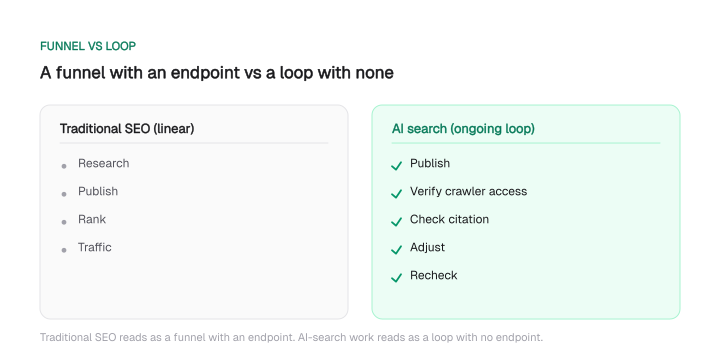
The diagram above lands the point that a paragraph cannot. Traditional SEO reads as a funnel with an endpoint: you publish, you rank, traffic arrives.
AI search work reads as a loop with no endpoint: you publish, verify a bot can read the page, check whether answers cite it, adjust, and check again.
The two rows in that table that most people underestimate, technical setup and monitoring, are the ones that turn the funnel into a loop.
The editorial process change
The step most teams miss sits between draft and publish: an extractability pass.
Before a page goes live, someone confirms that each section answers its own heading in the first sentence or two. That way, an AI summarizer pulling the top of a passage gets a complete answer instead of a setup.
One commonly cited guideline, offered as guidance rather than a measured study: AI answer tools tend to pull from roughly the first 20 to 30 percent of a paragraph.
Lead with the answer and you control what gets extracted.
The extractability pass isn't extra length. It's a check that takes about five minutes and moves the answer to the front of each section.
The technical setup change
Traditional technical SEO ends at a clean sitemap and sensible robots rules. AI search adds a layer for crawler access on top.
Three things sit on that layer:
- Per-bot robots rules. GPTBot, PerplexityBot, and Google-Extended each read robots.txt on their own, so you decide per bot who gets to fetch your content.
- An llms.txt file. A plain text map of your most important pages, written for AI crawlers to read.
- A render check. Most AI crawlers don't execute JavaScript, so an app that renders content in the browser can look empty to them.
The bigger trap is JavaScript rendering. We hit this ourselves: we migrated our own React single page app to prerendered static HTML for 20 marketing pages, because AI crawlers don't execute JavaScript.
If your site is a single page app, a render check isn't optional. Start by confirming a readable plain text version of each key page exists. Our free llms.txt checker is one way to see what a crawler actually gets from your pages.
What changes: skills and team structure
SEO skills for AI search split into three buckets: what carries over, what needs upskilling, and what's new.
Where a skill sits decides whether you train, hire, or do nothing.
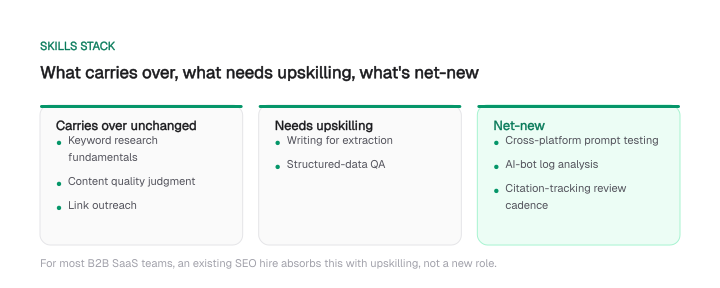
Three buckets, three different actions:
- Carries over. Keyword research, judging content quality, and outreach don't change.
- Needs upskilling. Writing sections so they extract cleanly, and checking structured data with AI parsing in mind.
- Genuinely new. Testing AI answers across ChatGPT, Perplexity, and Gemini, reading server logs for AI bot traffic, and owning the weekly citation review.
For most B2B SaaS teams, your existing SEO hire absorbs this through upskilling, without a new role. Two of the three columns are already theirs or close to it.
A dedicated AI search specialist starts to make sense once AI referrals become a channel you report revenue against, or once your content volume outgrows one person running two disciplines at once.
If you're weighing whether to build that capability in-house, bring in an agency, or buy software, we cover that decision in AI SEO agency vs software.
What changes: the tool stack
Comparing AI SEO tools vs traditional SEO tools comes down to addition rather than replacement. Your old stack keeps every job it had.
What you add sits on a second shelf next to it.
On budget, the practical move is to reallocate existing content production time rather than ask for entirely new budget. Split the spend into three buckets.
The content and technical work you already fund already serves both traditional and AI search. New monitoring time is a recurring weekly task you assign to one named owner rather than a new hire. Tooling is the smallest of the three, closer to an added subscription than a line item.
The real cost sits in that owner's time each week more than in the software. For example, in an InfluencerMarketingHub survey, 17 percent of users said AI tools saved them over 10 hours a week on SEO tasks. Treat that as directional rather than a promise.
It still points to the real tradeoff: AI tooling can free hours on repetitive work, which is roughly the time the new monitoring work asks for.
Mission Growth is our AI-led SEO and GEO growth service, and our platform tracks AI citations and visibility for customers: that's the monitoring row in the table above.
For a full roundup of citation trackers and AI SEO software rather than a single pick, see the best LLM SEO tools.
What changes: measurement and reporting cadence
Traditional SEO measurement runs on a schedule you control: a quarterly audit, monthly rank reports, a fixed rhythm.
AI search visibility doesn't hold still that long. Citation inclusion moves as models retrain and crawl the web again, so a page cited this week can drop next week with nothing changed on your end. That turns measurement from a periodic project into a standing check.
The process question matters more than the metric here. Decide who owns the weekly citation review, what counts as a meaningful drop, and what triggers a content update.
Here's a workable default: one person checks citation and AI referral share every week, flags any tracked question where you lost a citation, and queues an extractability rewrite when an important page drops out of answers two weeks running.
That two-week rule keeps you from chasing noise on every fresh crawl.
For the full measurement stack, which metrics to track and how to build the dashboard, see AI search analytics. This section is about the cadence.
A practical 30-day adaptation plan
A practical 30-day adaptation plan translates every section above into an order a small SEO or content team can actually run:
- Week 1: Audit crawler access. Check robots.txt for AI bots (GPTBot, PerplexityBot, Google-Extended), and if your site is a single page app, run a render check on your top 10 pages to confirm the content is visible without JavaScript.
- Week 1 to 2: Publish or fix your llms.txt. Map your most important pages in plain text, then run a free llms.txt check on your top pages to see what a crawler receives.
- Week 2: Run one extractability pass. Take your top 10 pages and rewrite each key section so the answer leads in the first sentence or two.
- Week 3: Set up citation tracking. Pick a citation or AI visibility tool, define the 15 to 20 questions your buyers ask AI, and take a baseline.
- Week 3 to 4: Assign the review cadence. Name the owner, set a weekly check, and write down what triggers a rewrite.
- Week 4: Report the baseline. Add AI referral share and citation frequency to your existing SEO report so next month has a comparison point.
None of this pauses your existing SEO. It runs in parallel, on the same fundamentals, with a thin new layer on top. Start with the crawler audit in week one, because if AI bots can't read your pages, nothing downstream matters. If the classic side hasn't been checked in a while, run an SEO audit on it in dependency order too.
What changed in AI search this year, by date, is in AI SEO trends 2026.
AI SEO vs traditional SEO at a glance
AI SEO vs traditional SEO splits cleanly once you line the tasks up side by side. The table below pulls the verdict from every section above into one place.
Frequently asked questions
Is traditional SEO dead now that AI search exists?
No. Traditional SEO fundamentals, crawlability, authority, E-E-A-T, and structured content, still feed AI answers, because AI engines draw heavily from pages that already rank.
The foundation underneath stays; what changes is the layer added on top. For the fuller "will AI replace SEO" debate rather than the one-line version, see Will AI Replace SEO?.
What SEO tasks change first when a team adds AI search optimization?
Research and content structure change first. Research widens from keywords to the longer natural-language prompts people ask AI. Content structure shifts to answer-first sections a model can extract cleanly. Technical setup, crawler access and llms.txt, comes next. Everything else extends gradually from there, and the fundamentals underneath stay put.
Do I need new tools, or can I use my existing SEO stack for AI search?
Both. Your rank tracker, keyword tool, backlink tool, and audit crawler all keep working. You add a citation or AI-visibility tracker, an llms.txt validator, and a log analyzer for AI-bot traffic. The old stack isn't replaced. It gets a second shelf of tools sitting next to it, most of them incremental cost.
What new skills does an SEO team need for AI search visibility?
Three genuinely new skills: cross-platform prompt testing (checking how ChatGPT, Perplexity, and Gemini answer your target questions), AI-bot log analysis (seeing which crawlers fetch your pages), and a citation-tracking review cadence.
Writing for extraction and structured-data QA are upskilling on familiar ground. Most existing SEO hires absorb all of this without a new role.
How is AI SEO different from GEO or AEO?
AI SEO is the broad practice of adapting SEO for AI search surfaces. GEO (generative engine optimization) and AEO (answer engine optimization) are more specific terms for optimizing to be cited inside generated answers. The terminology, and how AI engines actually pick which sources to cite, is covered in GEO vs SEO.
How often should a team check AI search visibility compared to a traditional SEO audit?
More often. A traditional SEO audit runs quarterly and rank reports monthly. AI-search citation checks work best weekly, because citation inclusion shifts with model retraining and re-crawls rather than a fixed update schedule. A weekly review of your tracked questions catches drops before they compound into a pattern you notice too late.
Cite this page
Aktaş, F. (2026, September 15). AI SEO vs Traditional SEO: What Changes, What Stays. Mission Growth. https://missiongrowth.io/blog/ai-seo-vs-traditional-seo
Figures we made for this post are free to reuse under CC BY 4.0 with credit to Mission Growth.
Get Mission Growth highlighted in your Google results.