Will AI Replace SEO? Is SEO Dead? 68.01% Zero-Click Data
Will AI replace SEO? 68.01% of US Google searches ended without a click in early 2026, yet demand and jobs tell a different story. Data plus three tripwires.
By Furkan AktaşPublished Updated

On this page
Will AI replace SEO? No, but the question bundles three separate claims, and only one of them has strong evidence behind it. AI is replacing some clicks on answer-shaped queries (the click claim). It has not replaced the habit of searching (the searches claim).
It has tilted job listings toward senior titles without anyone showing that SEO jobs are disappearing (the jobs claim). Of the three, jobs has the thinnest evidence, because no source in this guide tracks total SEO openings over time after 2024.
Each claim below gets a verdict, a dated number and a tripwire that would change our answer. If you run growth or SEO at a B2B SaaS, e-commerce or consumer brand, the useful question is which claim reaches you, and that depends on your query formats and on which tasks your team does.
In this guide:
- The verdict on each claim, with what would flip it
- Whether ChatGPT is taking Google's searches, and why one famous share figure misleads
- Which clicks are lost and which skills sit in junior and senior listings
- A Search Console audit you can run this quarter
Will AI replace SEO? Three claims, three different answers
SEO is not being replaced; AI is taking some clicks, shifting where junior skills sit and leaving the search habit largely intact, and each of those three claims needs its own evidence.
"Replace" fuses them, and they move independently. SEO is dead only if all three turn at once. A discipline can lose clicks and still gain senior titles, and it can keep its searches while losing a type of page.
Is SEO dead because of AI? No, and that answer holds when the question is whether AI will kill SEO or make it obsolete: searches are largely intact, clicks are partly replaced, and no source here shows total openings falling.
The table gives each claim a verdict, its key number and the observable that would flip it. The thresholds in the last column are our judgment, and no source set them.
Searches hold up best: Google's 2025 share loss came while Amazon, Bing and YouTube grew, and AI tools are a small slice of the whole. Clicks are the claim with real damage on answer-shaped formats, which the third section measures.
Jobs is the weakest of the three, because Semrush gives one snapshot of one day and Previsible's 2024 trends end before 2025, so neither can say whether total openings are rising or falling. Semrush's 59% is a share of listings on one date, which describes a mix rather than a trend.
Each reading has a source you can re-read when it is republished. The full tables behind these numbers, including the zero-click series and the job-listing counts, sit in our ai seo statistics roundup.
Will ChatGPT replace Google? The answer depends on the unit
No on the evidence we can verify: AI tools made up 3.2% of desktop searches across 41 major sites in the US in the fourth quarter of 2025, and ChatGPT's share against Google changes with the unit counted.
SparkToro and Datos published that reading in March 2026. Google alone accounted for 73.7% of those desktop searches, about 80% happened on traditional search engines, and Google lost 3.5 points of share during 2025. ChatGPT and Google both shrank in that study while Amazon, Bing and YouTube grew, so ChatGPT did not take the share Google lost.
Will AI kill search
AI will not kill search on this reading: about 80% of the desktop searches in that study still happened on traditional search engines.
The future of search engines, on this reading, is more places to search, with Google still dominant at 73.7% of those desktop searches.
The scope matters. This is US desktop traffic on 41 major domains in one quarter, with mobile and the rest of search outside it. It is a recent panel reading for AI tools as a whole, and no figure here should be stretched to all search.
The 4.33% share figure that circulates for ChatGPT is Rand Fishkin's reading from Similarweb and Datos data for October 2024, reported in November 2024. It is dated, and it uses a different scope and a different unit from the reading above, so the two are not a like-for-like update.
Referral clicks, prompts and searches give different shares for ChatGPT against Google, and our chatgpt vs google market share page lists them by unit.
One company statement belongs in this picture. Alphabet said in July 2026 that AI Mode is driving an incremental increase in Search queries overall. That is Alphabet's claim about its own product and not a measurement of total search volume, so we read it as context and no more.
What the evidence supports is narrower and still useful: searches have not moved to a rival habit, and any single ChatGPT-versus-Google percentage needs its unit and its date before you repeat it.
Zero-click search is real, but a falling CTR can hide a gain
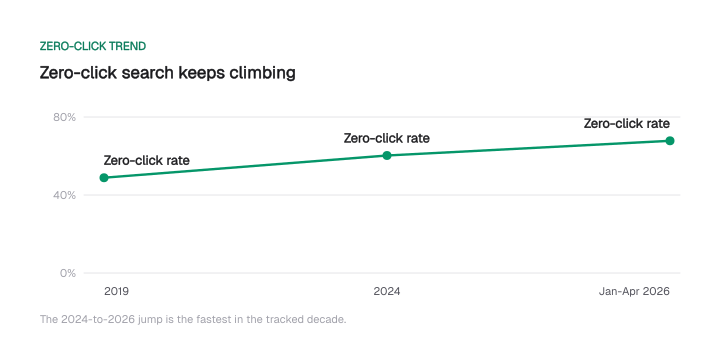
Zero-click is real: 68.01% of US Google searches ended without a click in the first four months of 2026, but a falling click-through rate can mean the denominator grew, so read clicks and impressions separately.
SparkToro measured that figure on a Similarweb panel. Its 2024 reading, 60.45%, came from a Datos panel, and SparkToro itself calls the comparison "apples and oranges". Treat the step from 60.45% to 68.01% as a direction and never as an exact change.
Fishkin's own advice on SparkToro's page is that SEO still matters as much or more than before, but it no longer earns traffic the way it once did.
Seer Interactive's data shows what that looks like in click-through rates. Seer tracked queries from many brands between January 2025 and February 2026, and its results are directional rather than a benchmark.
Organic CTR on queries with an AI Overview fell to a floor of 1.3% in December 2025, then climbed to 2.4% in February 2026. The January 2025 level was 3.2%, so the recovery regained about 58% of the decline (our arithmetic: (2.4 - 1.3) / (3.2 - 1.3)). The rebound is partial, and one study cannot say it will last.
Which content formats are exposed to AI Overviews
Question and comparison queries are the most exposed formats: an AI Overview showed on 85.9% of 1,413 question queries and 95.4% of 280 comparison queries in Seer's analysis published in April 2026, which tracked 30,842 informational queries.
Download CSV (CC BY 4.0)
This measures exposure. It does not show lost clicks, and it does not show that content in those formats is dying. A page can sit under an Overview and still earn clicks or be cited in it.
What the table does tell you is where to look first in your own data, which the last section turns into an audit. For the intent split behind these rates and the click math for cited and uncited pages, see what ai overviews means for seo.
Read clicks and impressions separately
Seer's own rule is that a drop in click-through rate for brand-cited queries is not automatically bad news: if clicks held while impressions doubled, the content earned more citations, and if clicks also fell, that is a different story. Its cohort shows both cases within three months.
These are informational queries where the tracked brand was cited in the AI Overview, from September to November 2025.
Download CSV (CC BY 4.0)
From September to October, clicks rose 0.37% while impressions rose 109.5%, so CTR fell from 2.52% to 1.21%. Set September to 100 and October reads 100.4 for clicks, 209.5 for impressions and 48 for CTR (our calculation from the table).
Seer says the CTR compressed because the denominator grew far faster than the numerator. So October shows a falling CTR without any click loss.
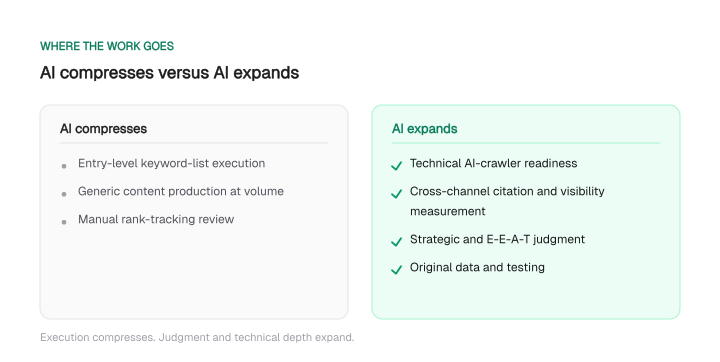
November is the month that stops the happy reading. Clicks fell 24.6% to 301,783 while impressions rose another 19.3%.
Seer says it cannot attribute the impression surge to new citations or to the Overview's source selection without account-level investigation, so we do not either. Two months make no trend, and a CTR chart alone could not have told you which month was which.
Why AI answers cannot replace the pages they cite
AI answers would replace SEO only if they stopped depending on the pages search indexes, and Google's documentation says they still do: a page must be indexed and snippet-eligible to be a supporting link in AI Overviews or AI Mode, with no additional technical requirements.
That is the dependence test. Replacement requires the answer layer to stand without the index, and Google's own rule describes an answer layer built on top of it.
Google also says AI Overviews and AI Mode may use a "query fan-out" technique, issuing multiple related searches across subtopics and data sources to build a response. Each of those searches is a retrieval from the same index.
Fishkin makes the same point from the traffic side: AI answers draw extensively from what ranks highly in Google, so even without clicks you are still creating brand influence. Our guide on how to get cited in google ai overviews covers the mechanics of getting chosen.
Our own capture shows how much overlap there is. Across 58 US Google results pages we captured between 22 September and 1 October 2026 (searches for the SEO, GEO and AI-marketing topics we research, not a random sample of US queries), 50.4% of the 268 cited sources were domains that also ranked in that page's organic results, or 40.7% when matched by exact URL.
Overlap figures move with the match unit and the rank depth, so ask which unit and which depth any overlap figure uses. About half of cited domains also ranking means ranking is one route in and is not the only one.
The full series is on our AI Overviews statistics page, and this capture covers Google AI Overviews only. Whether ChatGPT, Gemini or Claude trigger web searches in the same way is a claim we have not measured.
Original data changes less than people expect. Because the eligibility rule sets no requirement beyond indexing and a snippet, originality can matter at two later points: when the system selects among eligible pages, and when a reader decides to click. For the method and vocabulary of working on both surfaces at once, see generative engine optimization vs seo.
Which SEO skills sit in junior and senior listings
AI will not replace SEO strategy, but keyword research appears about 2x and SEO best practices about 2.5x as often in non-senior SEO listings, while experimentation and SQL skew senior.
In our 5 October 2026 capture of this query's results page, Google's AI Overview listed bulk keyword research, meta tag generation, basic coding audits and performance reporting as the repetitive work AI handles. The listings let us check where those skills sit.
Semrush analyzed 3,900 US SEO listings on Indeed as of 25 November 2025. Its senior bucket includes Head, Director, VP, Chief, Lead and Executive titles, and it counts SEO Manager as mid-level. The ratios in the last column are ours, computed by dividing the two shares.
Download CSV (CC BY 4.0)
The question "can AI replace SEO experts" has a narrow answer: not the work that skews senior. Keyword and reporting skills lean toward non-senior listings, and testing and data skills lean senior. The repetitive work the Overview names includes bulk keyword research, and listings ask for keyword research of non-senior roles about 2x as often.
Technical SEO leans neither way at 1.1x, which is what you would expect if it stays a core skill at every level.
The listings show which skills employers ask for, and they do not show that AI automates them. What they do show is the limit of the junior tasks: experimentation (A/B testing) and SQL are what senior roles are asked for more often, and they are the work of deciding what to test and reading the result.
Previsible's 2024 data points the same way, with content SEO roles down and manager and VP titles up, and Microsoft's scores below rank writing-heavy occupations high. Neither source measures SEO tasks, so we read them only as a check on direction. On AI drafting itself, is ai content bad for seo covers what it does to rankings.
How AI changes the role of SEO professionals
How AI will change SEO professionals' roles shows up in the listings: testing and data work at senior level, with routine skills concentrated in other listings.
Where AI falls short in SEO
No source here measures where AI falls short in SEO or whether AI is enough for SEO success.
What the sources do show is narrower: AI answers draw on indexed pages, senior listings ask more often for experimentation and SQL, and Seer says explaining a CTR drop takes account-level work.
Whether AI makes SEO strategists more effective is something this data does not measure. It shows only where strategist work sits: SEO strategists fall in an occupation Microsoft scores 0.350.
New technical work shows up here too. We migrated our own React single-page app to prerendered static HTML for 20 marketing pages because AI crawlers do not execute JavaScript.
What the job data shows, and what it cannot
Job data shows content SEO titles shrinking and VP and manager titles growing in 2024, and one 2025 snapshot tilted to senior titles, but no source tracks total openings after 2024. So will AI replace SEO jobs? No source here shows it. Each source below is read for what it can carry:
- Previsible (March 2025 report): open SEO jobs and the number of firms offering them both decreased at the end of 2024. Content SEO roles fell 28% over 2024 while SEO manager positions rose 58%, and vice president of SEO titles rose 50% in frequency. Previsible says the 58% rise in SEO manager positions shows the natural and ongoing process of title change, in a sentence that concedes the 28% drop in content SEO roles.
- Semrush (data as of 25 November 2025): Director, VP and Head-level roles were 59% of the listings analyzed, with SEO Specialist at 15% and SEO Manager at 10%. Director, VP and Head-level listings per SEO Specialist or SEO Manager listing come to about 2.4x (our division: 59% / (15% + 10%)). Median pay was $130,000 for senior roles and $71,630 for others.
- What is missing: neither source tracks total openings over time after 2024, and Semrush's 3,900 listings are one day's snapshot, so neither can say that SEO jobs are shrinking now.
Keep manager and leadership titles apart. Semrush counts SEO Manager as mid-level, while Previsible's VP figure is a rise in frequency of one title. The evidence supports "tilted toward senior titles", and Previsible's reading of the 2024 movement is ordinary title change.
Microsoft's study of Copilot conversations adds a different kind of data, an AI applicability score per occupation. It captures whether a non-trivial amount of AI usage completes activities relevant to an occupation. Microsoft cautions that relative comparisons between occupations are more meaningful than absolute values. These are the scores that matter for this question:
- Interpreters and Translators score 0.492, the top of the 40 highest scores, and Writers and Authors score 0.454.
- Public Relations Specialists score 0.365, and Market Research Analysts and Marketing Specialists score 0.350. O*NET lists SEO Consultant and SEO Strategist among the reported titles under Search Marketing Strategists, which sits under that last occupation, so 0.350 is the closest score to SEO work.
- Dishwashers and roofing helpers sit among the 40 lowest scores, at 0.018 and 0.010.
Which 3 jobs will not survive AI
No source here names the 3 jobs that will not survive AI, and a score is not a displacement forecast. It measures usage that completes an occupation's activities and is best read as a ranking.
Interpreters and Translators top the 40 highest scores and Writers and Authors score 0.454, while dishwashers and roofing helpers sit among the 40 lowest. No score here says that a role will vanish.
Could ChatGPT replace SEO writers
ChatGPT and similar tools replacing SEO writers is a usage question, and Microsoft scores Writers and Authors at 0.454, which marks writing as exposed to AI usage, while Previsible, noting the 28% fall in content SEO roles in 2024, calls the rise in SEO manager positions part of the natural and ongoing process of title change.
Will SEO exist in 5 years? Three tripwires and one test
SEO will exist in five years unless search demand, click share and listing counts all turn the same way; each has a source to re-read, and one test frames which tasks to automate. On "will SEO exist in 5 years", today's readings say yes, because none of the three has tripped. The table gives each source, how often it is republished, its last reading and our tripwire.
Download CSV (CC BY 4.0)
Clicks is the nearest tripwire, since AI Overview query CTR once fell to the floor shown above. Jobs is the weakest evidence, because no source tracks totals over time after 2024. We would call a tripwire tripped only when the same direction repeats, since Seer's own series bounced back from its floor within two months.
Alphabet reports quarterly, and its statement about incremental queries is a company claim, so it stays out of the table. The future of SEO with AI turns on whether the three series move together, and so far they have not.
What would need to change before SEO becomes obsolete
What would need to change before SEO becomes obsolete is all three series turning together: AI tools taking share from Google, CTR on AI Overview queries falling back to its December 2025 floor, and a source reporting total openings falling.
SEO in the 2030s cannot be forecast from this data, and no source here reaches that far.
What the future of SEO looks like in an AI-driven world depends on those same three readings, so re-read them when they are republished.
Which SEO tasks to automate: a demand elasticity test
The test for which tasks to automate builds on one labor economics finding. Bessen found, in a 2019 paper in Economic Policy using long-run US data on textile, steel and auto, that automation first raised employment because demand for the output was highly elastic, and later cut it once that demand was satiated. Applying that to a single task is our extension, as a three-step test about demand elasticity:
- Name the task's output: a page, a brief, an audit.
- Ask whether demand for that output is still elastic (more surfaces to cover, more tests to run) or already satiated (one more generic answer page for a query an Overview already answers).
- Expect people on the task to grow where demand is elastic and shrink where demand is satiated, and check that against your own data before you hire or cut.
The limit is real. Bessen's result is about employment by industry over decades, no elasticity estimate for SEO output exists, and a page's value is partly positional, since a results page has ten links and a handful of citations.
It would be disproved if spend on SEO services and listings for content production keep growing while answer-page output per query saturates. For the dated shifts and how forecasts have held up, see ai seo trends 2026.
What to do this quarter: a Search Console audit by query format
Do one audit first: label your Search Console queries by format, compare clicks and impressions between an earlier and a later period, and let the pattern suggest which hypothesis to test. Budget moves only where clicks fell, and a falling CTR alone is not enough. The steps:
- Export queries from Search Console for a before period and an after period of equal length, split at the date you suspect the change began.
- Label each query by format: question, comparison or other.
- Compare clicks and impressions separately for each format. Skip CTR until both are in front of you.
- Match what you see to a pattern in the table below, then run the check that separates it from its rival.
Every row is a hypothesis. This is the logic behind Seer's advice to read clicks and impressions separately, applied to a site owner's data.
One limit applies throughout: Search Console's Generative AI performance report, launched in June 2026, shows impressions in AI Overviews and AI Mode by page, country and device but no clicks, so confirm citations with a separate tracker. Mission Growth's platform tracks AI citations and visibility for customers.
How to future-proof an SEO strategy for the AI era
To future-proof an SEO strategy for the AI era, keep pages indexed and snippet-eligible, run the audit above on each format, and test where demand for the output is still elastic.
What each role does with the result:
- Growth lead: decides whether the budget moves, which it does only where clicks fell. Our ai seo agency guide covers the build, buy or hire side of that call.
- In-house SEO: labels the queries and runs the checks.
- Writer: learns which formats still earn clicks and which are better built to be cited.
For the workflow changes behind this audit, see ai seo vs traditional seo.
AI crawlers also have to be able to read the pages you audit. To check your own llms.txt file, run our free llms.txt checker.
Is SEO still worth it in 2026, and what to do next
SEO is still worth it in 2026 for the fundamentals that get pages indexed, eligible and chosen, even though SparkToro's Fishkin says it no longer earns traffic the way it did. Pozitif Teknoloji earned +225K organic clicks in six months on organic SEO work, the same fundamentals that feed classic results and AI answers alike (read the case study).
So the answer to "is SEO still worth it" and to the headline question holds up under all three claims: AI is replacing the click on answer-shaped queries, and the habit of searching and the SEO job have survived so far. Which claim reaches you depends on your formats and tasks, so run the audit before you change a budget.
Frequently asked questions
Which jobs will not survive AI?
Microsoft's study ranks Interpreters and Translators highest at 0.492, with Writers and Authors at 0.454, while dishwashers and roofing helpers sit among the 40 lowest scores. The score measures AI usage that completes an occupation's activities, and it is a ranking that does not forecast displacement. SEO strategists sit inside an occupation scored 0.350.
Will SEO exist in 5 years?
Yes, unless search demand, click share and listing counts all turn the same way. AI tools were a small slice of US desktop searches in the fourth quarter of 2025, and 59% of Semrush's listings were senior titles. Clicks is the nearest tripwire, with the December 2025 CTR floor as the mark. None of the three has tripped.
Is SEO still worth it in 2026?
Yes, SEO is still worth it in 2026, as influence and citations as well as traffic. SparkToro's Rand Fishkin says SEO still matters as much or more than before but no longer earns traffic the way it did. Google also says a page must be indexed and snippet-eligible to be a supporting link in AI Overviews, so the same fundamentals feed both surfaces.
Is SEO dead?
No. AI tools were a small share of US desktop searches across 41 major sites in the fourth quarter of 2025, and Google's 3.5-point share loss in 2025 came while Amazon, Bing and YouTube grew. What fell is the click on answer-shaped queries, with 68.01% of US Google searches ending without one in early 2026.
Can AI replace SEO experts?
Not the work that skews senior in listings. Experimentation appears about 1.7x as often and SQL about 2.2x as often in senior listings, while keyword research appears about 2x as often in non-senior ones. Listings show who employers ask for a skill, and they do not show what AI automates.
Will ChatGPT replace Google search?
Not on the evidence we can verify. ChatGPT's share against Google depends on the unit counted, and the 4.33% figure that circulates is an October 2024 reading. A later SparkToro and Datos reading puts all AI tools together at a small share of US desktop searches. Our market share page lists shares by unit.
Cite this page
Aktaş, F. (2026, October 6). Will AI Replace SEO? Is SEO Dead? 68.01% Zero-Click Data. Mission Growth. https://missiongrowth.io/blog/will-ai-replace-seo
Figures we made for this post are free to reuse under CC BY 4.0 with credit to Mission Growth.
Get Mission Growth highlighted in your Google results.