AI Rank Tracking Tools 2026: Cost per Check, Plan by Plan
AI rank tracking tools compared on checks per month, engines and dated 2026 prices: Ahrefs, Nightwatch, Semrush, Otterly and more. Pick by your prompt volume.
By Furkan AktaşPublished Updated
On this page
AI rank tracking tools price their plans in prompts, credits, keywords and answers, so two sticker prices never compare directly. This guide converts every plan that publishes an allowance into checks per month and a cost per check. The range runs from $0.010 on Ahrefs prompt packages to $0.11 per daily prompt-check on Semrush Starter.
Whether you shop for AI overview rank tracking software or AI search rank tracking software, the plan units are the same problem. One question decides how you read any tracker: an AI Overview is a sample of a moving block, so a single check tells you little. Cadence is therefore a cost to price in rather than a feature to buy.
In this guide:
- the pick for your daily prompt volume
- 13 tools in one comparison table, then one card each
- the arithmetic for a 300-prompt program
- how to reconcile a tracker with Search Console
Best AI rank tracking tools by situation
Ahrefs, Nightwatch, Semrush and SE Ranking are the picks if you already pay for one of them and track Google surfaces, Otterly and Rankscale are the cheap prompt trackers, and Mission Growth fits teams that want the work done.
Your daily prompt volume and your existing plan decide the choice. Feature lists rarely do. Count the prompts you would check every day, then read down this ladder:
Download CSV (CC BY 4.0)
Semrush gets cheaper per prompt as you climb. The price per daily prompt falls from $3.30 on Starter to $2.48 on Pro+ and $2.28 on Advanced (annual price divided by the 50, 100 and 200 prompts each tier lists).
So which AI-powered rank tracker is the best? The one whose allowance covers your daily prompts at the lowest cost per check, and the best AI Overview rank tracking tool for you is the one that reports AI Overviews as their own row. Two quick rules follow from the ladder.
If you already run Semrush, Ahrefs or SE Ranking, check whether its tier lists the prompts you need before you buy anything else. If your prompt count is above what the suite allows, a dedicated prompt tracker like Otterly costs less than the next suite tier.
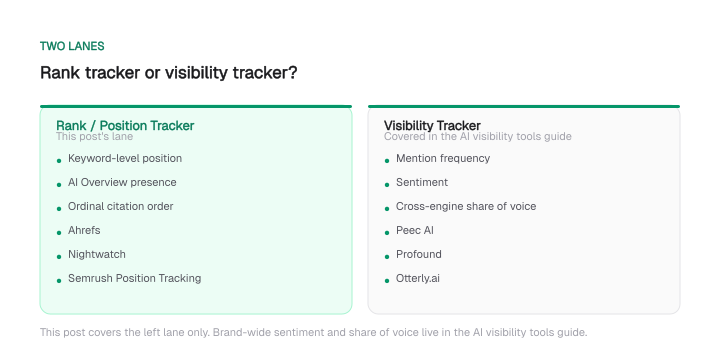
This guide stays at keyword and prompt level. Brand-level share of voice and sentiment live in our guide to ai visibility tools, and the Mission Growth entry below is a service rather than a tracker you log into on your own.
AI rank tracking tools compared: price, prompts and engines
The 13 tools differ most in what one plan buys per month, measured in checks or answers, so this table converts every allowance to the same unit where a vendor publishes one. Prices and plans verified October 2026.
Download CSV (CC BY 4.0)
Cost per check is only computable where a vendor states both a price and a check count.
By that rule, Ahrefs prompt packages fall from $0.020 to $0.010 per check as you buy more, and the Growth package works out to $0.014 (100 divided by 7,000).
Semrush's AI tiers cost $0.076 to $0.11 per daily check, meaning the annual price divided by prompts and 30 days. Nightwatch states answers instead: EUR 0.053 each on Starter and EUR 0.027 on Agency (79 divided by 1,500, and 399 divided by 15,000).
A plan with few prompts can cost many times more per check than a bigger package, which is why we compare checks per month.
How we compared the tools
We compared each piece of AI rank tracking software from its own pricing and product pages, read on 4 October 2026, and converted every allowance into checks per month. We claim no hands-on testing.
The cards carry our own dated screenshots of those vendor pricing pages where one was captured. The criteria were:
- Price: the entry plan and the main paid tier, in the billing currency and period the page shows.
- Allowance: prompts, keywords, credits or checks, exactly as the plan states them.
- Engines: which AI surfaces the vendor names for tracking.
- Conversion rule: one check is one prompt, one platform, one location, the unit Ahrefs defines for its prompt packages.
Here is the worked conversion. Nightwatch lists 50 prompts and 1,500 answers a month on Starter, 150 and 4,500 on Professional, and 500 and 15,000 on Agency. Dividing gives 30 answers per prompt per month on every plan, about one a day. The page does not say how those answers split across its 6 platforms, so we never divide by 6.
Why one AI Overview check is not a rank
An AI Overview is one sample of a moving block: it has a 70% chance of changing between consecutive observations and 45.5% of cited sources are new, yet its meaning stays about 0.95 similar. So one check tells you what the block said at that moment, and nothing about what it will say tomorrow.
Ahrefs' November 2025 study followed more than 43,000 keywords, each with at least 16 recorded AI Overviews, over one month. Here is what moved and what held:
- Wording changes. An AI Overview has a 70% chance of changing from one observation to the next.
- Cited sources rotate. Nearly half, 45.5% of cited sources, are entirely new between observations.
- Meaning holds. The semantic similarity between consecutive responses averages 0.95 cosine similarity.
- Block position is a separate fact. Ahrefs' July 2025 analysis of 10M SERPs found AI Overviews outside position 1 for 8.64% of queries, which says nothing about which source is cited.
AirOps' December 2025 data points the same way for brands: only 30% stay visible across back-to-back answers, and more than 50% of those that drop out resurface within two runs.
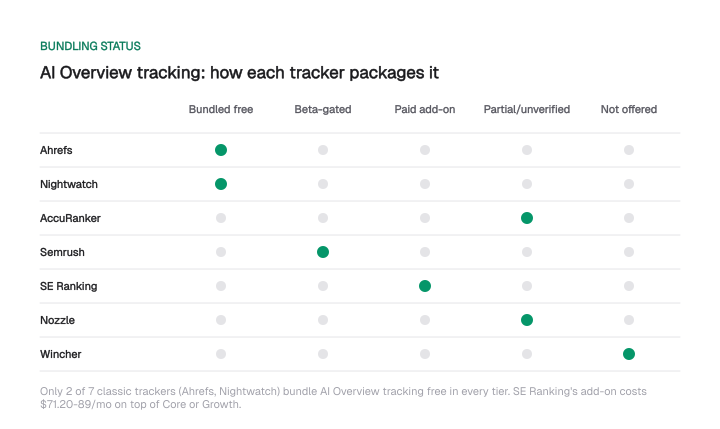
The 70% figure is a chance of changing between observations, measured on 43,000 keywords in one month. It does not tell you how many results move over a quarter, so don't quote it that way.
Ahrefs also gives an average persistence of 2.15 days, meaning the content tends to change every 2.15 days. Treat that as an upper bound. Its own write-up says the checks weren't daily, so the real citation change rate is likely higher.
Don't use the 2.15 days to justify daily checks. Use the arithmetic instead. A daily cadence is 30 checks per prompt a month, and a weekly one is about 4. Read the cited-source set across repeated samples and never off a single check.
That makes cadence a cost decision. Check daily the prompts that drive decisions, and weekly the rest.
One more trap sits in how tools score position. Semrush's Position Tracking records an AI Overview citation as #1 regardless of where your page ranks in the organic results below, and a SERP features toggle includes or removes those rankings. A Semrush #1 is therefore a citation, not an organic position, and block position stays a different measurement.
Whether you still need a classic rank tracker comes down to where your revenue sits. If organic positions pay your bills, keep one: AI Overviews often don't trigger, and your organic rank still earns the click when they don't. It holds the baseline while the AI layer is sampled around it.
AI Overviews, AI Mode and chat answers: three kinds of rank
AI Overviews and AI Mode may use different models and query fan-out, so a tracker that reports them as one Google AI line hides which surface moved.
Google's documentation says both features may issue multiple related searches across subtopics and data sources, and that AI Overviews often don't trigger because they appear only when Google judges them additive. That gives three surfaces with three different things to record:
Ask each vendor whether AI Overviews and AI Mode are separate rows. Nightwatch, the SE Ranking add-on, Ahrefs Brand Radar, AccuLLM and the Otterly add-on all list it, which makes them the shortlist among AI mode rank tracking tools. Google AI Mode is a surface of its own, and its answer can differ from the AI Overview on the same query.
Position also depends on who asks. Google notes that results vary with the data center answering, and that personalization can change the order of results. Trackers answer for a hypothetical user, so a tracker reading and your own search can legitimately differ.
Metrics such as share of voice and sentiment sit one level up, at brand level, so we leave them to the visibility guide above.
The 13 AI rank tracking tools
Ahrefs and Nightwatch are the lowest-friction picks for Google surfaces, Semrush and SE Ranking suit teams already inside those suites, and the prompt trackers trade seats and keywords for prompts. Each card names the situation where that tool wins and the limit that ends it.
1. Ahrefs
Best for: teams that already pay for Ahrefs and want AI prompts next to classic keywords.
Ahrefs is the pick when your SEO stack already lives there, because AI prompts arrive as a line on a plan you pay for anyway. Brand Radar prompt tracking is free on every paid Lite plan and above, and Brand Radar monitors Google AI Mode mentions and citations.
The plans run $129, $249 and $449 a month with 5, 10 and 20 tracked AI prompts beside 750, 2,000 and 5,000 tracked keywords. Those prompt counts are small, so the real AI capacity sits in the custom prompt packages: $50, $100 and $250 a month for 2,500, 7,000 and 25,000 checks.
One check is one prompt, one platform, one location, which makes the arithmetic exact. Ahrefs' own example for the Growth package is 100 prompts daily on 2 platforms.
The free AI Overviews preview needs no signup, so you can see what a tracker reports before you pay anyone. The limit that ends Ahrefs for most teams is volume: past about 416 prompts a day on two surfaces the Scale package runs out, and Lite's 5 prompts only sample the feature.
In practice, Ahrefs suits a team that tracks a modest prompt set beside its keywords. If you need a few hundred prompts, expect to buy a package on top of your plan, and run the allowance arithmetic in the section below first.
On Lite, the 5 prompts are enough to validate the workflow before you buy a package.
Pros:
- Brand Radar prompt tracking is free on paid Lite and above
- Packages fall to $0.010 per check on the Scale package
- A limited AI Overviews preview needs no signup
Cons:
- Lite tracks only 5 AI prompts
- Packages bill overage per check ($0.020, $0.015, $0.010)
Price: $129, $249 and $449 a month; prompt packages $50, $100 and $250 a month.
2. Nightwatch
Best for: teams that want AI Overview and AI Mode tracking inside a classic rank tracker.
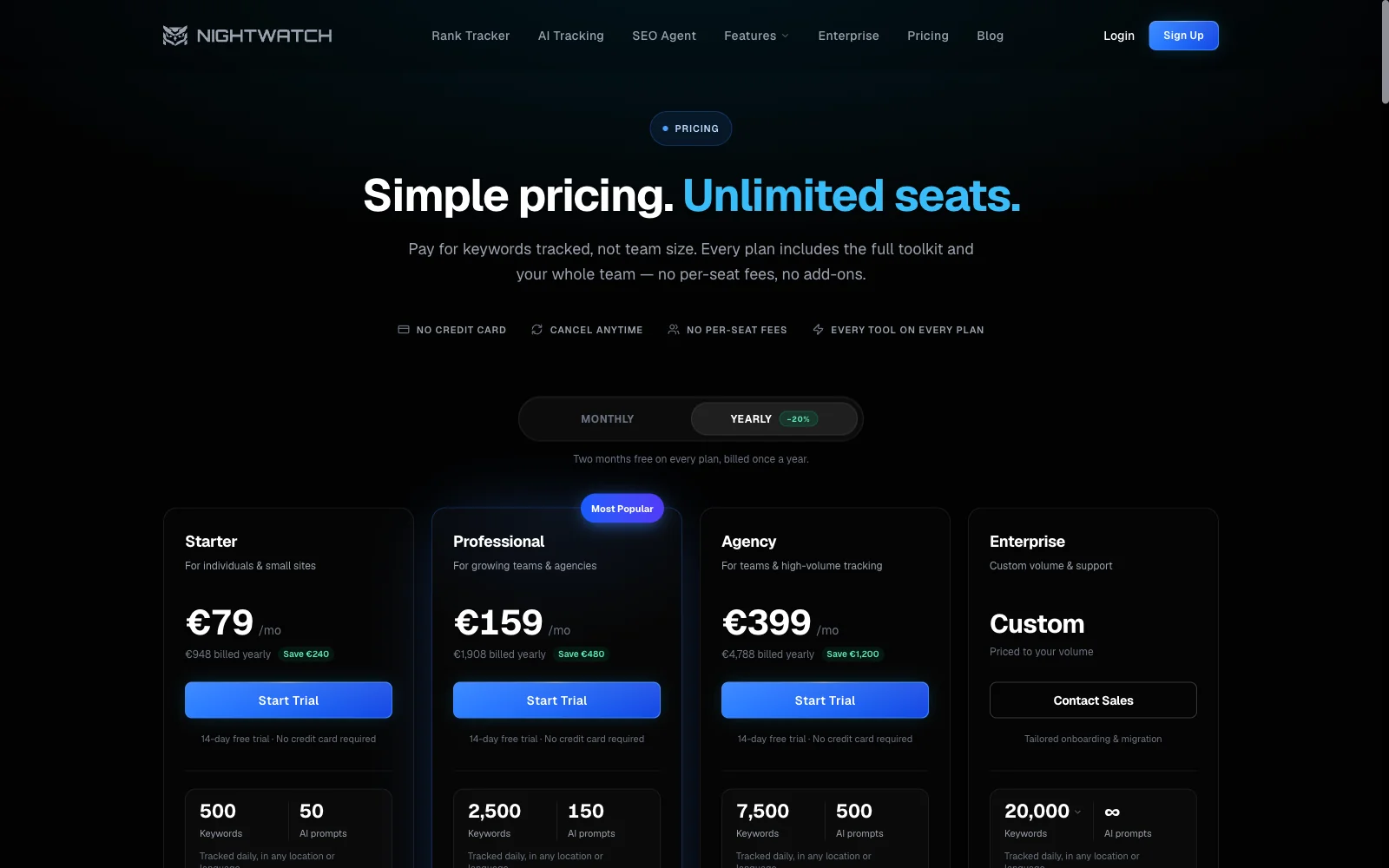
Nightwatch is the cleanest pick for that job because every plan covers ChatGPT, Claude, Gemini, Perplexity, AI Mode and AI Overview. What changes between plans is how much you track: 50, 150 or 500 prompts, with 1,500, 4,500 or 15,000 AI answers collected a month.
Divide the answers by the prompts and you get 30 answers per prompt per month on every plan, about one a day. That's the number to remember. A bigger plan buys more prompts, never a faster cadence. The cost per collected answer is EUR 0.053 on Starter and EUR 0.027 on Agency. Those figures use the yearly-billed prices; billed monthly, plans start at EUR 99.
The page doesn't say how those answers split across its 6 platforms, so confirm the split with the vendor before you plan around coverage of all six.
The classic side is solid too: 500, 2,500 and 7,500 keywords tracked daily in any location or language. Every plan carries a 14-day free trial and the full toolkit, which makes Nightwatch the easiest tool here to test against your own prompts.
For example, a team with 150 prompts on Professional collects 4,500 answers a month and gets the full toolkit, so the monthly bill is predictable.
If you run classic and AI tracking together, Nightwatch is our pick for teams that want one tool for both, once the vendor confirms the platform split.
Pros:
- Six platforms on every plan
- 14-day free trial on every plan
Cons:
- The page does not say how its answers split across the 6 platforms
- The EUR 79 entry price needs yearly billing, paid as a single payment
Price: EUR 79, EUR 159 and EUR 399 a month with yearly billing, paid once a year with two months free.
3. Semrush
Best for: teams already on Semrush that need daily prompt tracking inside the suite.
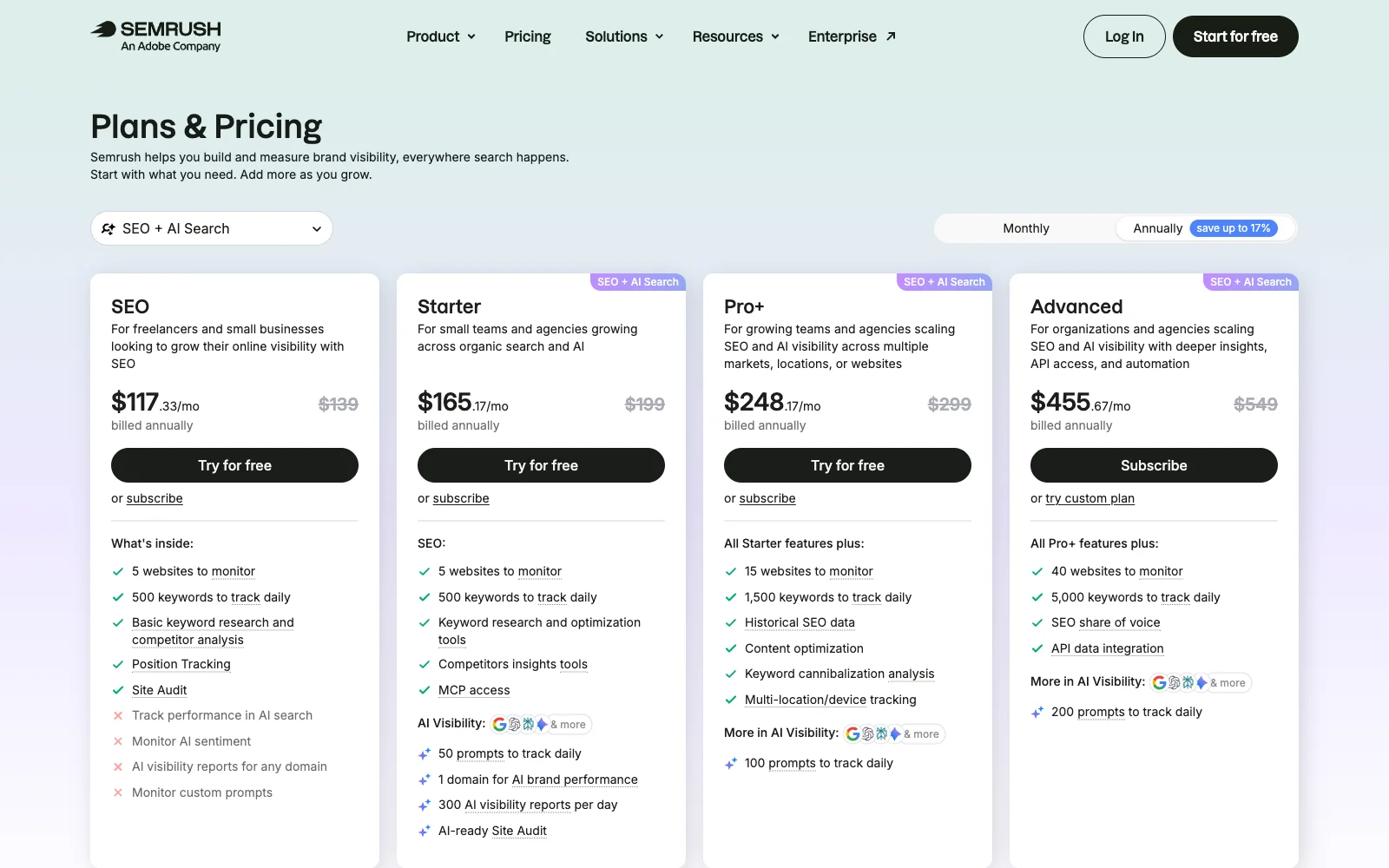
Semrush is the better pick if your reporting already runs through it, because the AI tiers sit on top of plans you know. Starter SEO + AI Search is $165.17 a month for 50 prompts daily, Pro+ is $248.17 for 100, and Advanced is $455.67 for 200, all billed annually.
The base SEO plan at $117.33 a month, billed annually, covers 500 keywords daily but marks AI search tracking as not included. The AI Visibility Toolkit monitors prompts on Google AI Mode and ChatGPT.
Read its #1 carefully. Position Tracking records a cited domain as #1 whatever its organic position, and a SERP features toggle includes or removes AI Overview rankings. A Semrush AI Overview #1 is therefore a citation record, and you should keep it apart from your organic position when you report.
Price per prompt is where Semrush earns its place. A daily prompt costs $3.30 on Starter, $2.48 on Pro+ and $2.28 on Advanced, so the tier with the most prompts is the cheapest per prompt if you use them all.
If you don't already use Semrush, the entry price is steep for the prompt count. The 100 daily prompts that cost $248.17 here cost $103.20 on SE Ranking Core. The case for Semrush is the suite around the tracker, so buy it for the whole workflow and not only for prompts.
For reporting, keep AI Overview citations and organic positions in separate columns, and use the SERP features toggle to show both views of the same keyword. A client who sees #1 for an AI Overview citation and a lower organic position needs that split explained once.
Pros:
- The price per daily prompt falls from $3.30 to $2.28 as you climb tiers
- A SERP features toggle shows rankings with or without AI Overviews
Cons:
- A citation is scored as #1 regardless of organic position
- Dedicated AI prompts start at the $165.17 tier
Price: $117.33, $165.17, $248.17 and $455.67 a month, billed annually.
4. SE Ranking
Best for: agencies that want 100 or more daily prompts at a lower suite price.
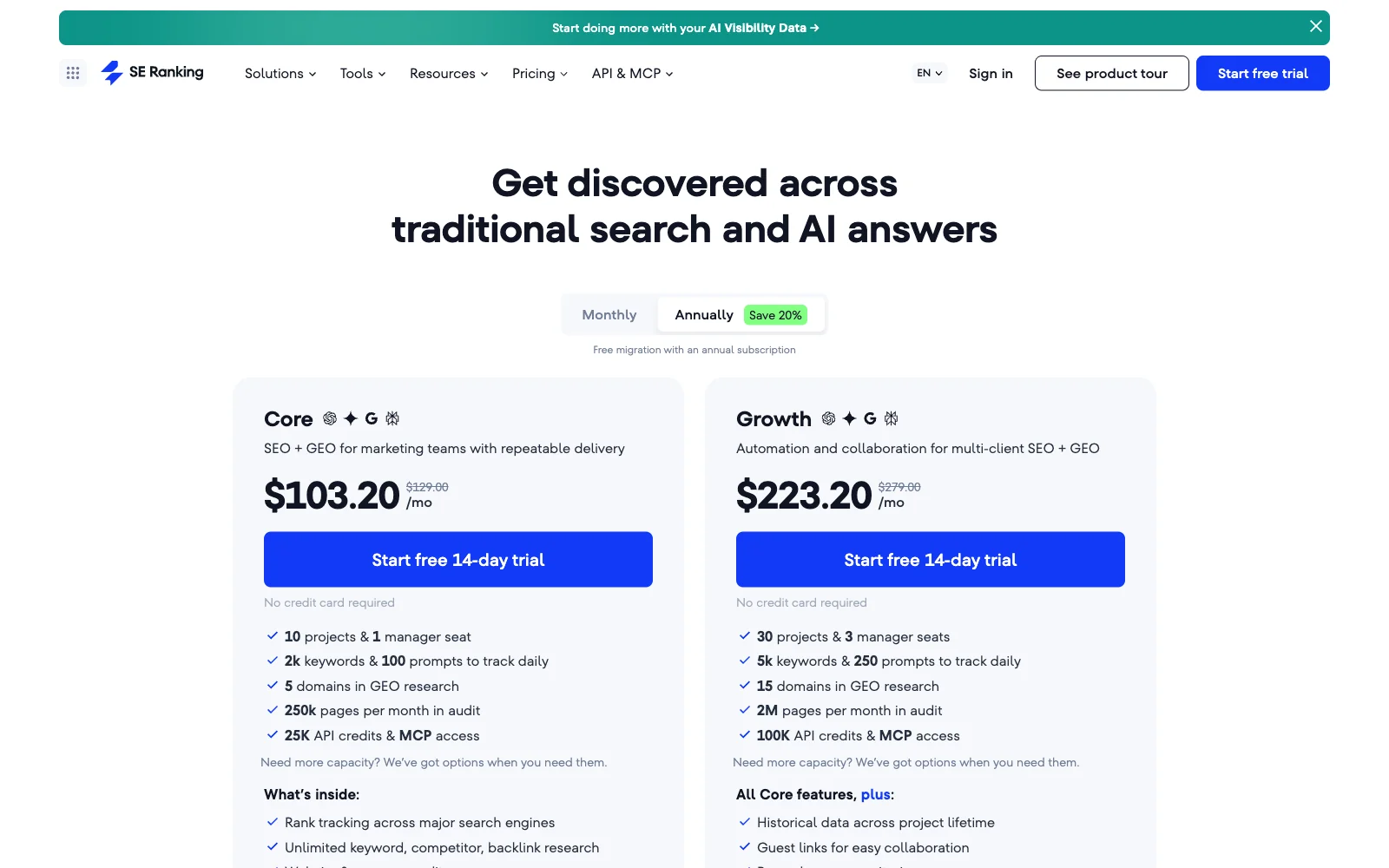
SE Ranking is the lower-cost route into daily prompt tracking inside a full suite. Core is $103.20 a month, billed annually, for 2k keywords and 100 prompts to track daily. Growth is $223.20 for 5k keywords and 250 prompts. Both list 5 LLMs to track.
That makes Core the cheapest suite plan on this page that reaches 100 daily prompts. Semrush needs its $248.17 Pro+ tier for the same count.
For AI Overviews, AI Mode, Perplexity and ChatGPT there is also an AI search add-on, $71.20 a month on annual billing or $89 monthly. It sits on top of a base plan, so budget for both lines when you compare it with a suite that bundles prompts.
The practical question is which of the two routes fits. If your prompts live on ChatGPT, Perplexity and Google, the plan's 5 LLMs may already cover them. If you need the Google AI surfaces named explicitly, price the add-on in.
Our judgment: SE Ranking suits an agency that needs daily prompts across many clients on a tight budget, with Perplexity and ChatGPT coverage worth confirming in the add-on. It is the weakest fit for a team that wants every AI surface named in one plain price, because the plan and the add-on are priced separately.
Because the plans list 5 LLMs while the add-on names four surfaces, ask support to map them for your prompts. That one email settles whether you need the add-on at all.
Pros:
- 100 prompts daily from $103.20 a month
- The add-on covers four AI surfaces
Cons:
- The add-on is a second line on the invoice
- Plans list 5 LLMs, so check which five before committing
Price: $103.20 and $223.20 a month, billed annually; AI add-on $71.20 a month annual or $89 monthly.
5. AccuRanker
Best for: teams that want a classic tracker with an AI layer for ChatGPT, Perplexity, AI Overviews and AI Mode.
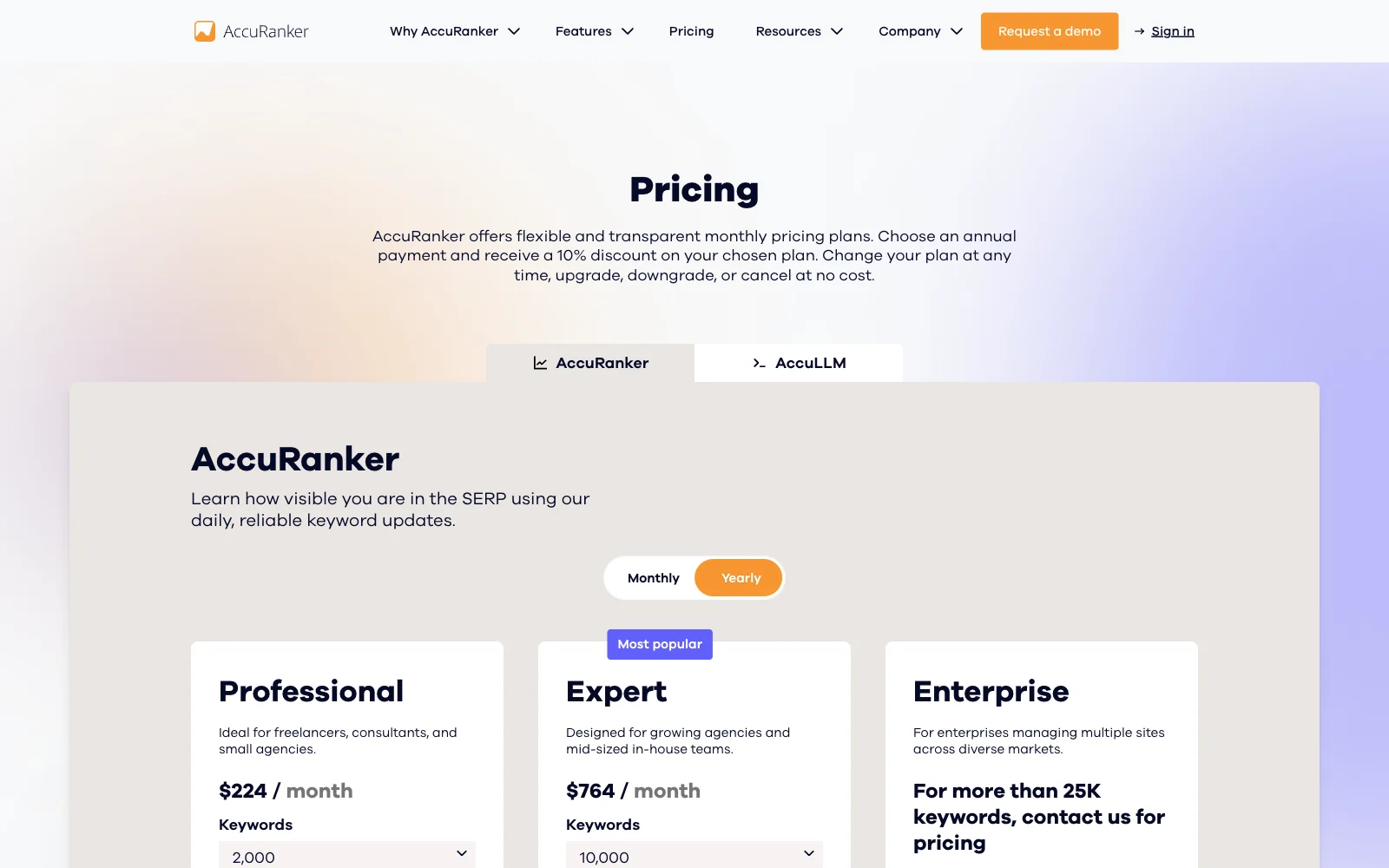
AccuRanker is a classic tracker with an AI layer called AccuLLM, which tracks ChatGPT, Perplexity, AI Overviews and AI Mode. You can follow visibility across prompts, monitor sentiment, see which sources get cited and benchmark against competitors.
The metric worth a closer look is the web search rate. AccuLLM reports how often LLMs search the web to answer your tracked prompts. When a web search is triggered, you have a chance to influence the response. If the model relies on training data alone, the answer is harder to move. That tells you which prompts are worth optimizing for first.
AccuLLM has its own tab on the pricing page. LLM Lite is $206 a month billed annually ($229 monthly) for 100 prompts and 1 brand, and LLM Pro is $521 ($579 monthly) for 300 prompts and 5 brands. Enterprise starts at 500 prompts on custom pricing.
The $224 Professional plan on the other tab is the classic keyword tracker, at $224 a month billed annually ($249 monthly) for 2,000 keywords. Its AI CTR and AI Search Volume metrics start at the Expert plan.
The page states a prompt count and says one prompt is tracked across ChatGPT, Perplexity, AI Overviews and AI Mode, but it gives no checks per month, so confirm that figure in writing before you compare it with Ahrefs or Nightwatch.
Choose AccuRanker when you already use it for classic tracking and want AI tracking from the same vendor, and budget for AccuLLM as its own line, since the keyword plans do not include it.
Because AccuLLM names Perplexity, ChatGPT, AI Overviews and AI Mode, test it on a prompt set where the web search rate varies. Prompts that rarely trigger a web search are the ones where optimization effort is hardest to repay.
Pros:
- AccuLLM covers four AI surfaces
- A web search rate per tracked prompt
Cons:
- AI CTR and AI Search Volume need Expert
- AccuLLM is priced separately from the keyword plans
Price: AccuLLM from $206 a month billed annually ($229 monthly); keyword plans from $224 a month with annual payment.
6. Advanced Web Ranking
Best for: agencies that need unlimited users and projects with AI Visibility tracking in a classic tracker.
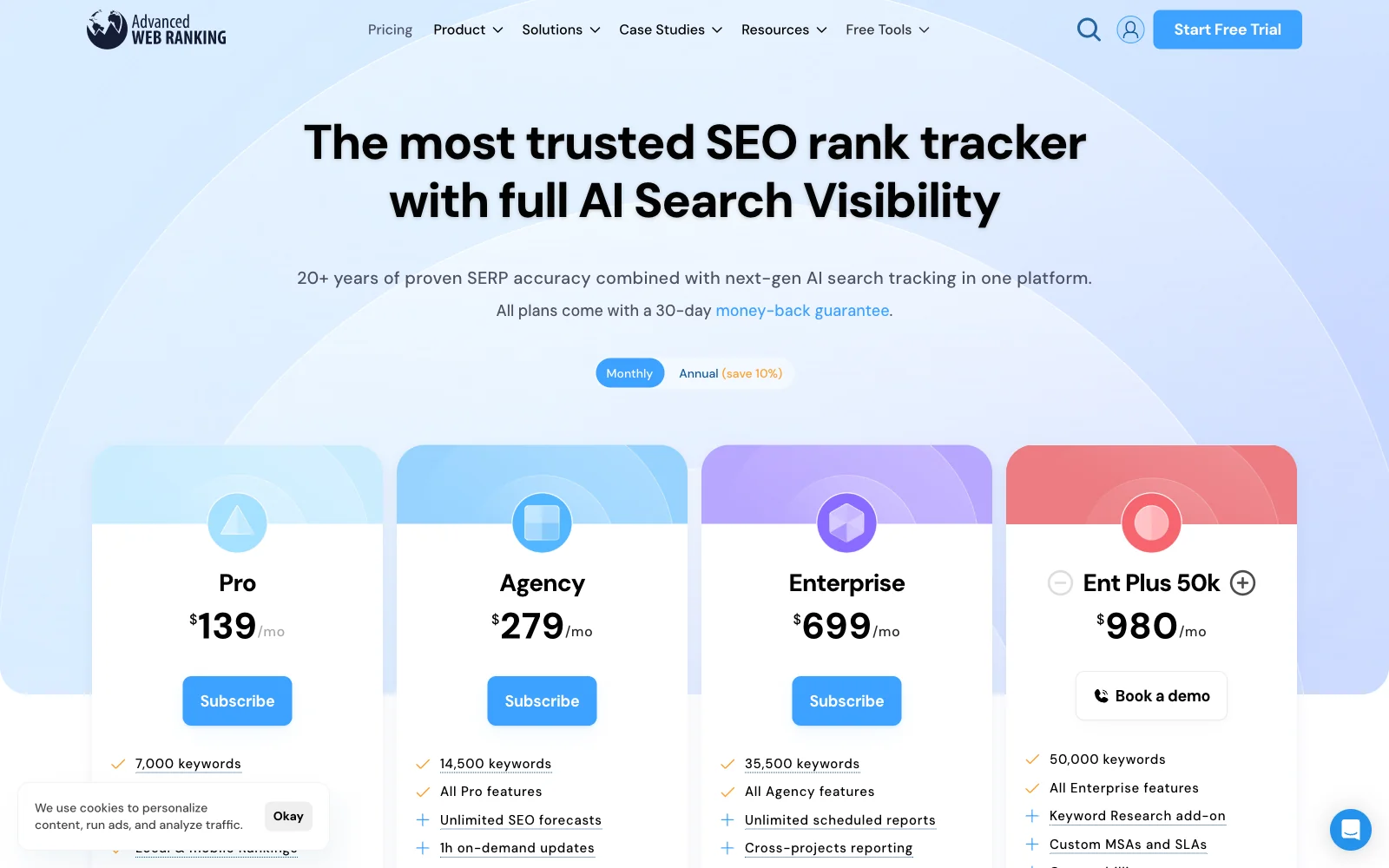
Advanced Web Ranking is built for agencies, and the plan row shows it: Pro is $139 a month for 7,000 keywords, unlimited projects, unlimited users, AI Visibility tracking and AI Citations and Mentions. Agency is $279 for 14,500 keywords.
Unlimited users matters when you report to many clients. Here the limit is keywords, so the cost scales with how much you track.
The plan row counts keywords, and it gives no AI prompt allowance, so you can't convert it to checks per month. Treat AI Visibility as a feature to test, since no quota exists to price.
A 30-day money-back guarantee covers every plan, which makes this one of the lower-risk tools to validate. If it doesn't fit, you ask for a refund within 30 days.
Here is where it fits: an agency with many clients and a long keyword list that wants AI Visibility tracking in a tool its team already knows. Here is where it doesn't: a team that needs a prompt budget, because 7,000 keywords on Pro says nothing about how many prompts you can run.
The sensible test is a pilot inside the refund window. Load your top prompts, check that the AI Citations and Mentions report shows the surfaces you care about, and ask support for the allowance in writing. The engine list isn't beside the AI Visibility line, so that is the first thing to confirm.
Pros:
- Unlimited users and projects on Pro
- 30-day money-back guarantee
Cons:
- The plan row counts keywords, not AI prompts
- No engine list sits beside the AI Visibility line
Price: $139 and $279 a month.
7. Nozzle
Best for: data teams that want raw SERP data and BigQuery access.
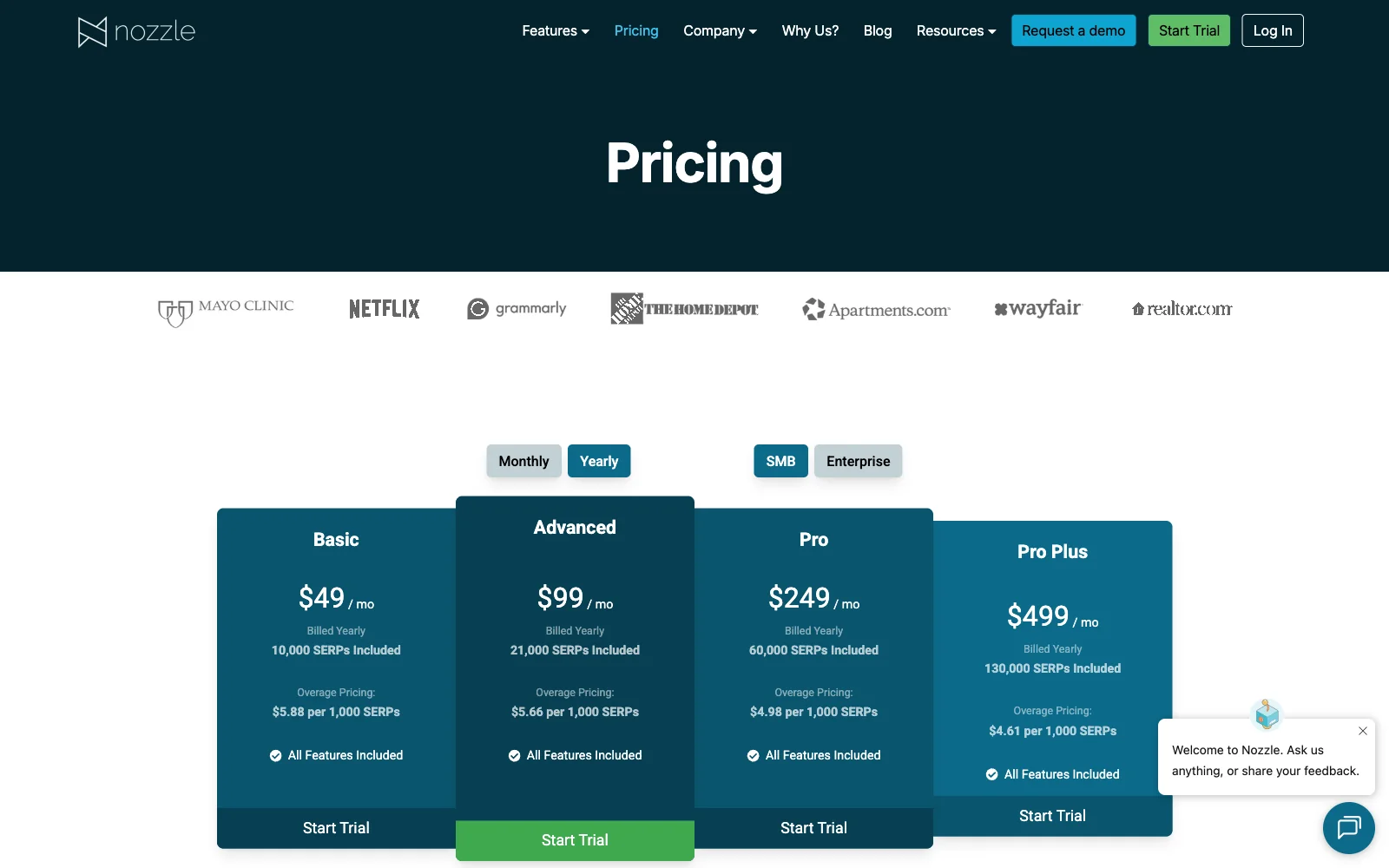
Nozzle is a data product more than a dashboard. It bills by usage, and one SERP is the top 5 pages for each unique search, a retrieval for one keyword, engine, language, device and location combination.
That unit changes how you budget. A tracker that bills per keyword charges you for a list. Nozzle charges you for every combination you ask about, so adding a second device or a second location multiplies the SERPs you pay for.
API access is included, and you can reach the data in BigQuery, which suits analytics teams: the AI Overview data lands next to the rest of your warehouse.
Its October 2024 post documents an AI Overviews segment for measuring how often you and your competitors show up as cited sources in AI Overviews. That makes Nozzle a fit when the question is analysis, and a weaker one when you want a ready prompt library.
The fit question is team skill. If your analysts write SQL, the usage model and BigQuery access give them the raw material to build their own citation reports.
If you want a dashboard and a fixed monthly bill, the SMB tab of the pricing page lists Basic at $49 a month billed yearly for 10,000 SERPs, Advanced at $99 for 21,000, Pro at $249 for 60,000 and Pro Plus at $499 for 130,000.
Because the unit is a SERP, run a small pilot: pick one keyword, one device and one location, check what the dashboard returns for AI Overviews, then multiply by the combinations you need. That multiplication is your real monthly volume.
Pros:
- API and BigQuery access included
- Documents AI Overview citations in its dashboards
Cons:
- Plans are sized in SERPs, so your keyword, device and location mix sets the tier
- Usage billing makes monthly cost depend on your SERP count
Price: $49, $99, $249 and $499 a month billed yearly, by SERP allowance.
8. Wincher
Best for: small teams that only need a classic rank tracker and will add AI tracking elsewhere.
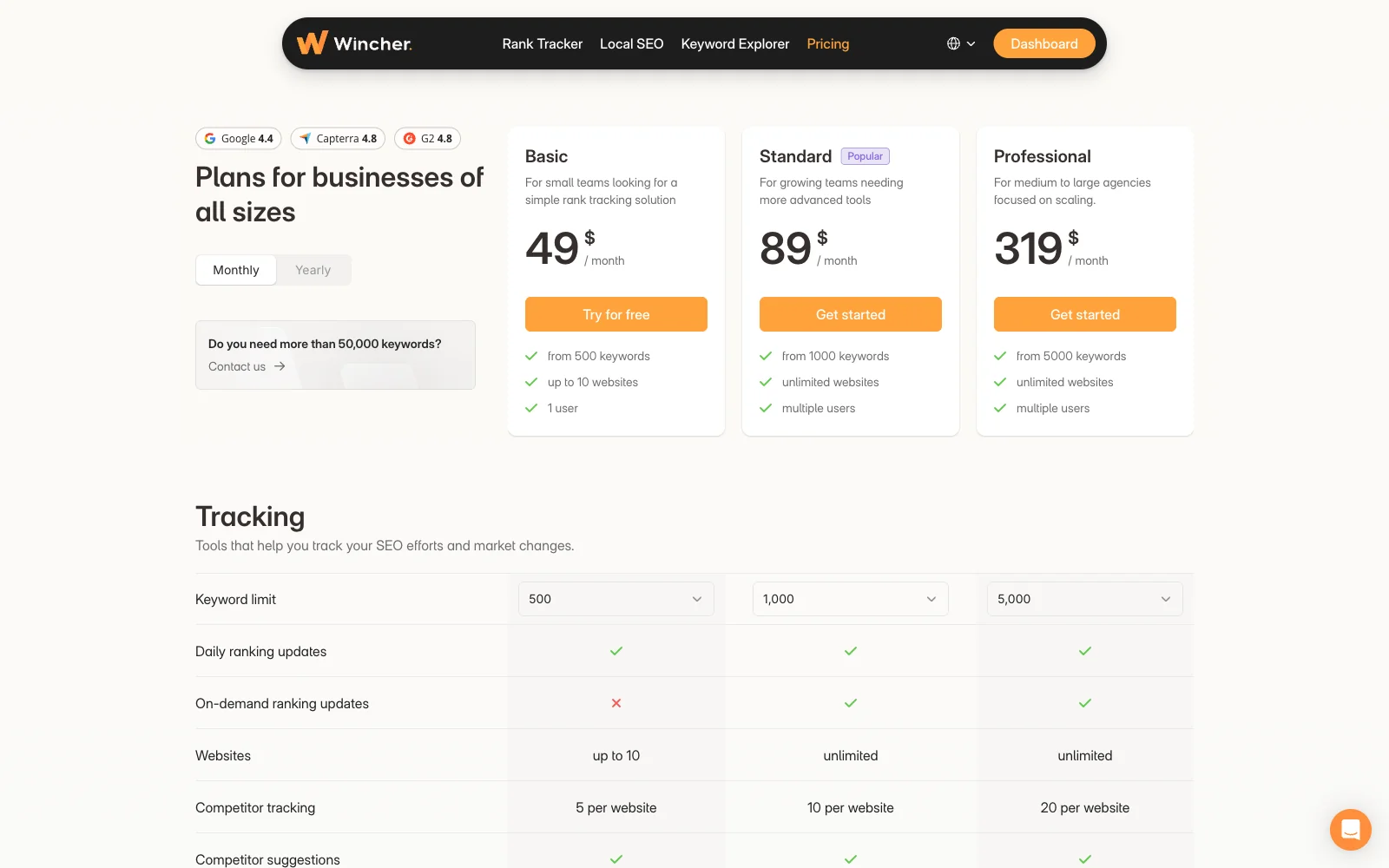
Wincher is here as the contrast. It is a classic rank tracker whose pricing page lists AI keyword suggestions and an AI content outliner, and it names no AI Overview, AI Mode or AI engine tracking.
On monthly billing, Basic is $49, Standard $89 and Professional $319, from 500, 1,000 and 5,000 keywords. Those are plan floors, so the keyword count on the page is where each plan starts.
The lesson is about reading feature names. AI keyword suggestions use AI to help you choose keywords. They don't track how AI answers cite you. When a classic tracker's page says "AI", check which of the two it means.
If you pair Wincher with a prompt tracker you pay for two tools. For a team that tracks classic rankings and a handful of prompts, one of the suites above is usually simpler.
For example, a team tracking 500 keywords for classic rankings and 15 AI prompts would run Wincher for the keywords and a prompt tracker like Otterly Lite for the prompts. That splits your data across two dashboards. A suite that lists both in one plan costs more per month but keeps one report, so decide on reporting effort, because that is where the split costs you.
Wincher's value is simplicity. If a classic tracker with AI keyword suggestions is what you want, it does that job, and the pricing page makes no AI tracking promise you would need to test. If AI visibility is on your roadmap this quarter, start with a tool that lists it.
Pros:
- Low entry price at $49 a month
- A simple classic tracker from 500 keywords
Cons:
- No AI Overview or AI Mode tracking listed
Price: $49, $89 and $319 a month on monthly billing.
9. Otterly
Best for: small teams that want a cheap prompt tracker.
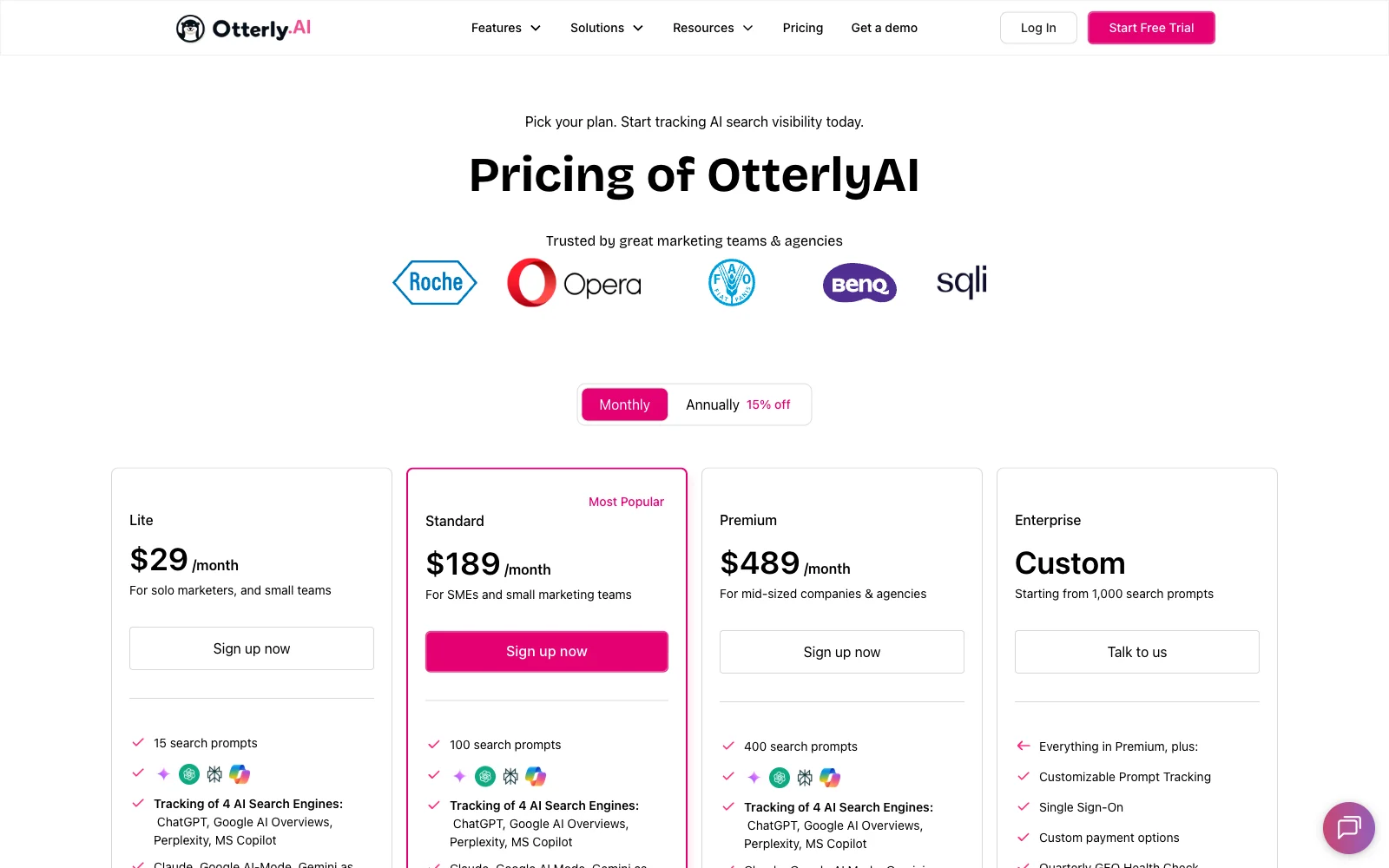
Otterly is the entry-level prompt tracker: Lite is $29 a month for 15 search prompts, Standard $189 for 100 and Premium $489 for 400. The price per included prompt is $1.93, $1.89 and $1.22, so the saving comes from the top tier and the middle one barely beats Lite.
Microsoft Copilot, Google AI Overviews, Perplexity and ChatGPT are the four engines on every plan. Google AI Mode, Gemini and Claude are paid add-ons, and AI Mode costs $9, $59 and $149 a month on Lite, Standard and Premium.
Add-ons change the comparison. If AI Mode matters to you, the real Otterly price is the plan plus the add-on, and that is the number to put next to Nightwatch, which lists AI Mode on every plan.
Extra engines can be bought for up to 1,000 prompts. Standard can add up to 300 additional prompts before it moves you to Premium, and each extra 100 prompts costs $99.
Here is the buying logic. At 15 prompts or fewer, Lite is the cheapest way to start. Standard at 100 prompts costs about the same per prompt as Lite, so move up when you need the volume and not for a saving. Premium's $1.22 per prompt is the best rate. Price the AI Mode add-on in from the start, since it is a separate line.
Check the engine list against your audience too: Microsoft Copilot is included, while Gemini and Claude are extra, so a team whose buyers use Gemini should price that add-on first.
Pros:
- $29 entry price
- Premium brings the price per prompt to $1.22
Cons:
- AI Mode, Gemini and Claude cost extra
- Standard can add up to 300 prompts before it moves you to Premium
Price: $29, $189 and $489 a month; AI Mode add-on $9, $59 and $149 a month.
10. LLMrefs
Best for: teams that want to track keywords and let the tool generate the prompts.
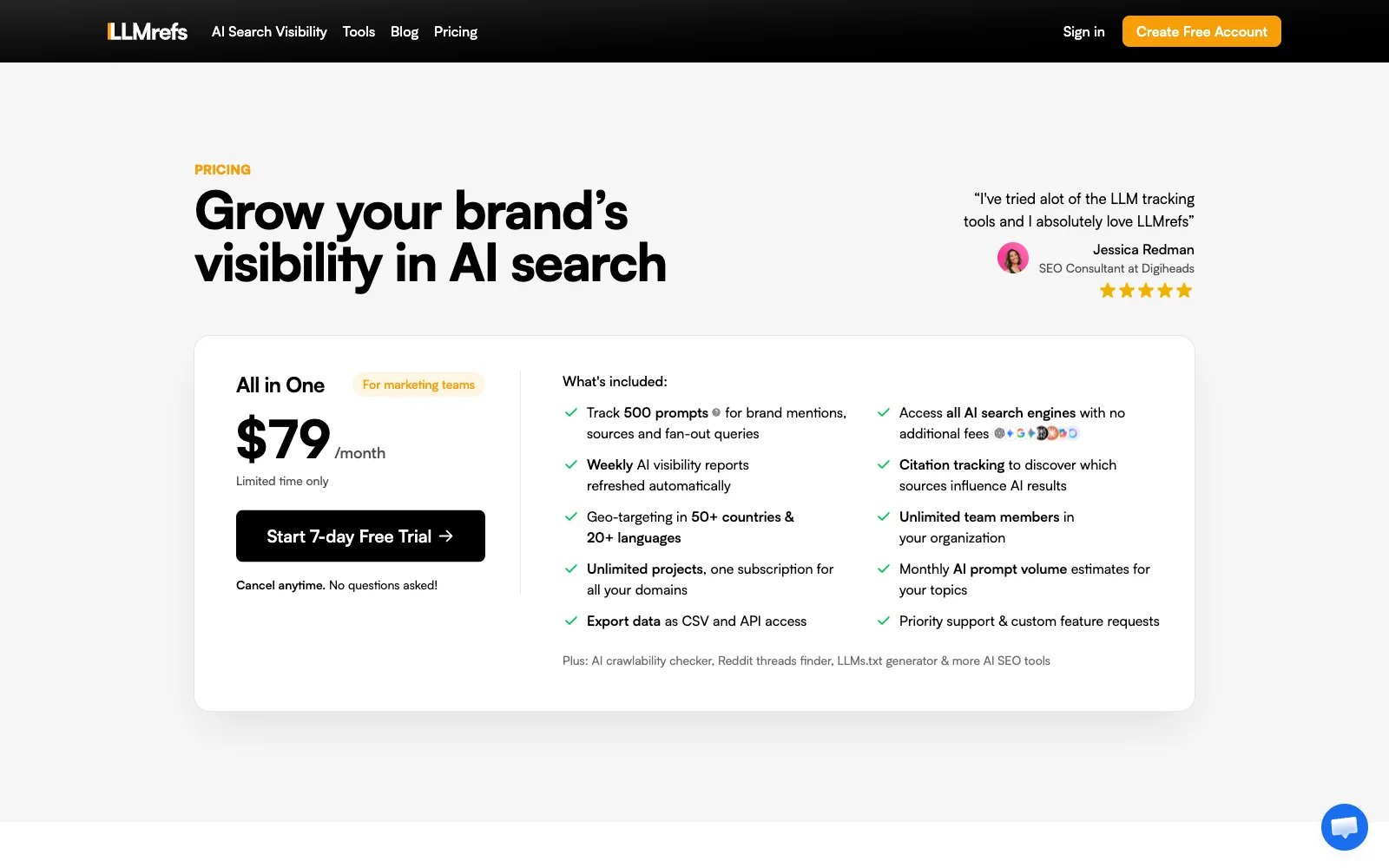
LLMrefs' All in One plan is $79 a month, labelled limited time only, and includes 500 prompts for brand mentions, sources and fan-out queries. Its unit is the keyword: you track keywords and the tool generates the prompts, which suits teams that think in keyword lists.
It tracks ChatGPT, Google AI Overviews, Perplexity, Gemini, Claude and Grok, and reports weekly. Weekly reporting is a cadence choice, in line with the 4 checks per prompt a month we price for weekly sampling. Prompts that drive decisions need a tool that checks daily.
The $79 label deserves care. Because the page says limited time only, budget for the price changing, and re-check it before you commit to a year.
In practice the keyword unit saves setup time. You give it the keywords you already track and it generates fan-out prompts from them, so the 500-prompt allowance caps generated prompts and you don't write them yourself. That suits an SEO team migrating from keyword lists. A team that wants exact control over prompt wording will find a prompt-first tool like Otterly closer to how it works.
Because reports are weekly, treat LLMrefs as a trend tool. It answers whether your visibility is moving over weeks, and a daily tool answers what changed yesterday. In our view the first question comes first for most programs, and the second matters for launches.
Pros:
- 500 prompts at $79 a month
- Six named engines
Cons:
- The $79 price is labelled limited time only
- Weekly reports only
Price: $79 a month, limited time.
11. Rankscale
Best for: teams that want a cheap credit-based tracker with a query fanout view.
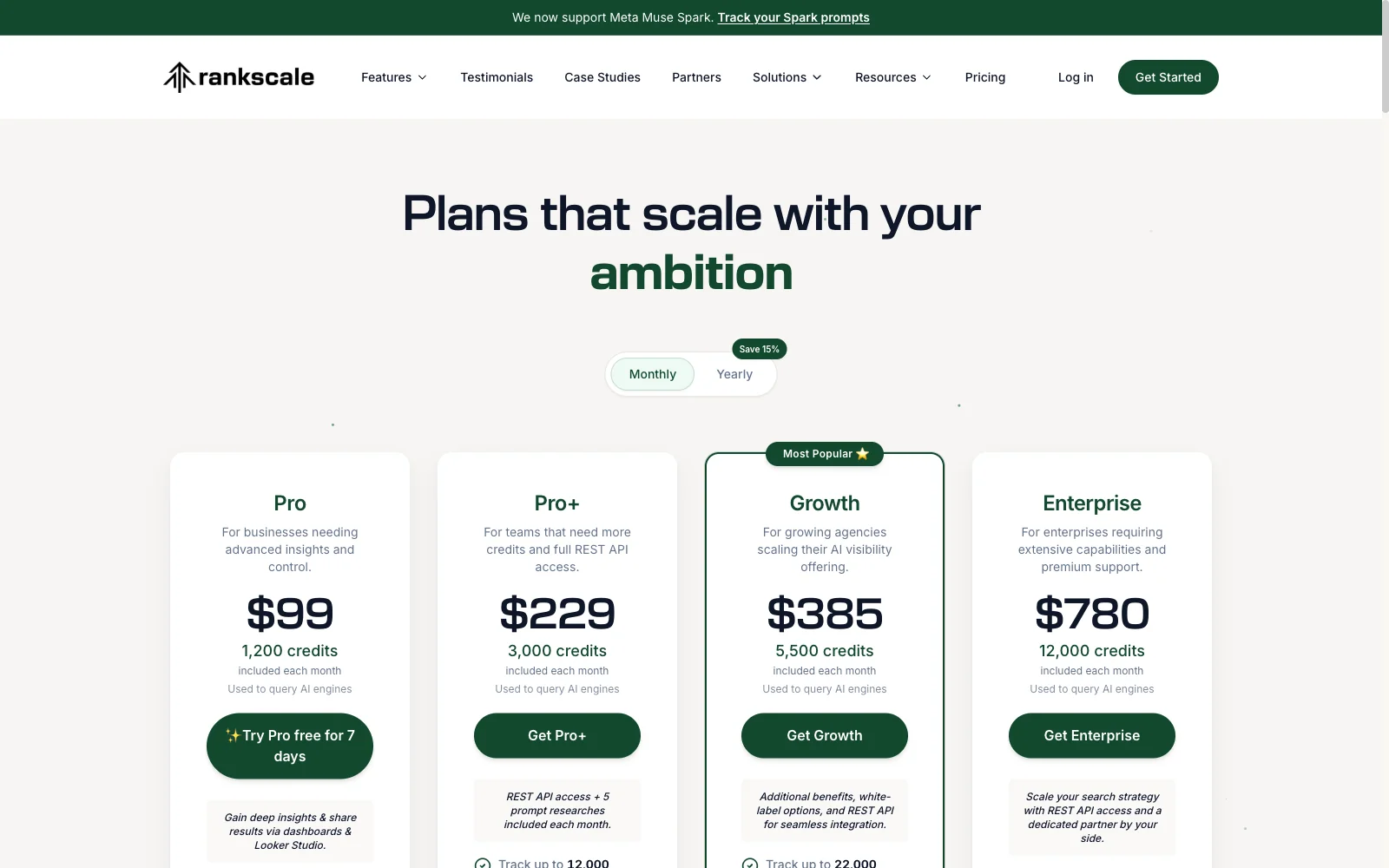
Rankscale's Essentials plan is $20 a month on the list price, or $17 on yearly billing only. Pro is $99 with 1,200 credits and Pro+ is $229 with 3,000.
Those credits become up to 4,800 and 12,000 answers, but only at the typical 0.25 credit per engine query. Meta Muse Spark costs 4 credits per run, so mix it in and the answer counts shrink. Treat the headline number as a ceiling.
The query fanout view on every plan shows the internal searches engines run while answering your prompts: coverage, probed domains, wins and losses. For content planning that is more useful than a position, because it shows which sub-questions your pages should answer.
It tracks 8 named engines: ChatGPT, Gemini, Perplexity, Claude, DeepSeek, Mistral, Grok and Copilot. That is the widest named list in this guide outside Enterprise plans.
Here is the arithmetic that matters. At the typical rate, 1,200 credits is 4,800 answers on Pro and 3,000 credits is 12,000 on Pro+.
A Meta Muse Spark run uses 4 credits instead of 0.25, so a few runs on that engine eat the credits of many on the others. If you plan to track it, weigh it separately. Essentials at $20 is the low-cost way to look at the fanout view, though the $17 price needs yearly billing.
The fanout view also helps you choose prompts. If engines probe domains and phrases your pages don't cover, those are the sub-questions to add, which a position number can't tell you.
Pros:
- Query fanout view on every plan
- Eight named engines
Cons:
- Answer counts hold only at the typical credit rate
- Essentials' $17 price needs yearly billing
Price: $20 (Essentials), $99 (Pro) and $229 (Pro+) a month.
12. Profound
Best for: teams that want to trial an enterprise tracker before a demo.
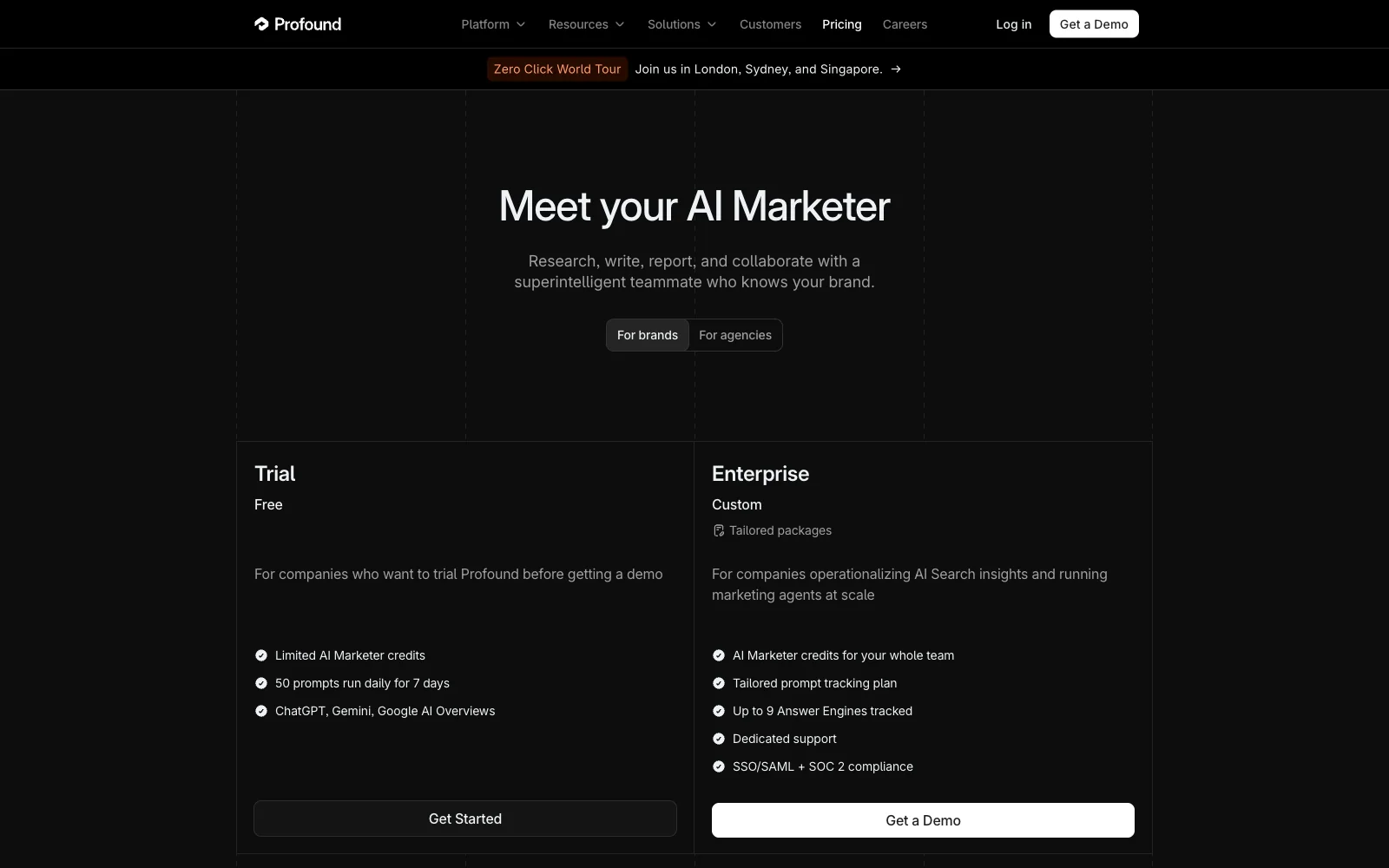
The Profound free trial gives 50 prompts daily for 7 days on ChatGPT, Gemini and Google AI Overviews, with limited AI Marketer credits. It is for companies that want to trial Profound before getting a demo.
Seven days is short for a cadence decision, but it is enough to see how the tool reports a prompt set on three engines, and 50 prompts daily is the same volume as Nightwatch Starter and Semrush Starter.
Enterprise has custom pricing and tracks up to 9 answer engines. Plan for a sales conversation, because no list price exists to compare.
If you're also weighing chat-first trackers, our ChatGPT SEO tools guide covers them, and the Perplexity rank tracker post covers that engine alone.
Use the trial like a pilot. The prompt set is recommended by industry and can't be customized, so judge how the tool reports answers, not coverage of your buyers' questions. Run your own prompts in a cheaper tracker and compare which answers cite you. If Profound shows something the cheaper tool missed, that is what the Enterprise price buys.
The trial's limits shape the test. Seven days is one weekly cycle, so you see one sample of any weekly pattern and none of the month. That is fine for judging the interface and prompt coverage, but it can't tell you whether visibility trends up. For that you need repeated samples over weeks in whichever tool you pick, the sampling point from the section on one AI Overview check.
Pros:
- Free trial before any demo
- Up to 9 answer engines on Enterprise
Cons:
- The trial lasts 7 days
- Enterprise pricing is custom
Price: Free trial; Enterprise on custom pricing.
13. Mission Growth (our platform)
Best for: teams that want AI rank tracking plus the strategy and fixes done for them.
Mission Growth is an AI-led SEO and GEO growth service: AI catches the signal, our experts make the move, and you see the result. We built it for teams that don't want to run a tracker themselves. Mission Growth's platform tracks AI citations and visibility for customers.
Price: Monthly fee, quoted after an audit.
What a prompt allowance really buys
300 prompts checked daily on AI Overviews and AI Mode is 18,000 checks a month, which fits Ahrefs Scale at 25,000 but not Ahrefs Growth at 7,000.
The formula is prompts times surfaces times 30 days, so 300 prompts on 2 surfaces need 18,000 checks. Divide the plan's checks by surfaces times 30 before you compare prompt counts:
Download CSV (CC BY 4.0)
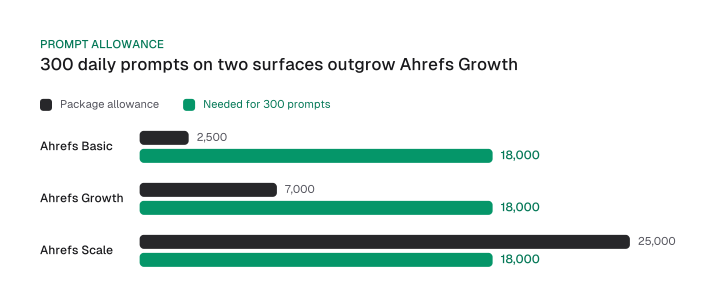
The example is exact on Ahrefs because it defines one check as one prompt, one platform, one location. Nightwatch counts answers per prompt, so we don't use it here: its allowance is 30 answers per prompt per month on every plan.
For a decision, ask what the allowance does when you hit it. Ahrefs bills overage per check at the end of the billing month, so a busy month costs more instead of leaving gaps in your sample.
For the cross-engine picture before you size anything, see our guide to the best LLM SEO tool choices and where prompt trackers sit among them.
Search Console vs a tracker: reconcile before you trust either
Search Console's generative AI report counts impressions per property by page, country, date and device, with no query dimension, so you reconcile it with a tracker by URL, because keywords won't match.
Google's Search Console Help describes how the report works. Data is aggregated by property, so two results from one site in the same feature count as a single impression.
Pages groups data by the final URL after redirects, and most data is assigned to the canonical URL rather than a duplicate. The usual 1,000 row limit applies. Google rolled the report out to all websites worldwide as of 31 August 2026.
Our ai search analytics guide walks through the report itself. Here is the reconcile rule:
- Export the tracker's cited URLs for a date range.
- Open the Pages dimension for the same dates and match by canonical URL.
- Compare per page, not per keyword, and expect the tracker's count to exceed impressions because one site counts once per property.
When the tracker says cited and the Pages tab shows zero, check three things before blaming either tool: whether the cited URL is a duplicate whose data went to its canonical URL, whether the row falls outside the 1,000 row limit, and whether the dates precede the 31 August 2026 rollout.
Which AI rank tracking tool to pick
Choose the plan you already pay for if it lists AI prompts, a prompt tracker if your prompt count exceeds the suite's allowance, and a service if you want the fixes done too.
Here is the choice by situation:
Best LLM rank tracker for an SEO agency owner in the USA
As an SEO agency owner, you want a recommendation on the best LLM rank tracker for client work.
SE Ranking Core is the cost-first pick, with 100 prompts daily from $103.20 a month on annual billing, and Advanced Web Ranking Pro suits many clients because it lists unlimited users and projects at $139 a month. If your agency already runs on Semrush, Pro+ at $248.17 keeps 100 daily prompts inside the suite.
Affordable AI Overviews checker for small businesses
Otterly Lite is the lowest-priced paid plan here that lists Google AI Overviews with a stated prompt count, at $29 a month for 15 search prompts. Ahrefs' free AI Overviews preview, with no signup, costs nothing if you only need a one-off look.
Wincher vs Nightwatch
In Wincher vs Nightwatch, Nightwatch wins when you want AI tracking, because it covers six platforms from EUR 79 a month on yearly billing and lists 500 keywords tracked daily. Wincher costs less at $49 a month from 500 keywords but names no AI Overview or AI Mode tracking, so it only fits if AI tracking comes from another tool.
Prices are in different currencies and billing periods, so compare features first.
Validate before you pay. Nightwatch has a 14-day free trial, Profound runs 50 prompts daily for 7 days, and Ahrefs offers a free AI Overviews preview. Measurement is also not the fix: once the tracker shows a gap, our best AI SEO tools roundup covers the tools that close it.
One check is a sample, and trends need repeated samples. So price the cadence into the allowance first, then pick the plan whose checks per month cover your prompts. Start with the free preview or trial, run your 20 most important prompts for a week, and compare the result with your Search Console pages.
Frequently asked questions
Which AI-powered rank tracker is the best?
It depends on your daily prompt volume and the suite you already pay for. Nightwatch from EUR 79 a month on yearly billing, Semrush Starter at $165.17 and SE Ranking Core at $103.20 cover 50 to 100 prompts, and Otterly is the cheapest dedicated prompt tracker. See the ladder at the top for each volume.
How often should an AI rank tracker check a prompt?
Check daily for prompts that drive decisions and weekly for the rest. A daily cadence is 30 checks per prompt a month and weekly is about 4. Because an AI Overview changes between observations, the cadence is a cost choice, and you should read repeated samples rather than one check.
Is there a free AI rank tracker?
Not a full one, but there are three free ways to validate an AI Overviews rank tracker before paying. Ahrefs offers a limited AI Overviews preview with no signup, Nightwatch gives a 14-day free trial on every plan, and Profound's trial runs 50 prompts daily for 7 days on ChatGPT, Gemini and Google AI Overviews.
What is the cheapest AI rank tracker for AI Mode?
Among the AI mode rank tracker tools that name it, Otterly Lite at $29 plus the $9 AI Mode add-on is the lowest entry for 15 prompts, on monthly billing. SE Ranking's add-on is $71.20 a month on annual billing and sits on top of a base plan. Nightwatch includes AI Mode from EUR 79 a month on yearly billing. Rankscale tracks it too and lists an Essentials plan at $17 a month, sold on yearly billing only, but its page doesn't say which engines Essentials covers.
Does Search Console track AI Overviews and AI Mode?
Search Console's generative AI report shows impressions for AI features by page, country, date and device. It has no query dimension, so it can't tell you which prompt triggered an impression. Reconcile it with a tracker by URL, and see the reconcile rule above.
Is an AI rank tracker the same as an AI visibility tool?
No. An AI rank tracker records checks for your keywords and prompts on named surfaces such as AI Overviews and AI Mode. An AI visibility tool measures brand-level metrics such as mentions, citations and sentiment. Many products do both, so check which unit the plan sells.
Cite this page
Aktaş, F. (2026, October 4). AI Rank Tracking Tools 2026: Cost per Check, Plan by Plan. Mission Growth. https://missiongrowth.io/blog/best-ai-rank-tracking-tools
Figures we made for this post are free to reuse under CC BY 4.0 with credit to Mission Growth.
Get Mission Growth highlighted in your Google results.