
How Does Google AI Mode Work? Query Fan-Out Explained
Google AI Mode explained: how query fan-out splits your question, which Gemini model powers it, and what a follow-up turn changes. Full dated rollout timeline.
By Furkan AktaşPublished Updated
On this page
Google AI Mode is a conversational Search surface built around reasoning. It answers a complex question with one synthesized, cited response instead of a page of blue links.
It's a separate feature from AI Overviews, and it runs on a custom version of Google's Gemini model. The mechanism behind it is what Google calls query fan-out: your single question gets broken into many parallel searches before the answer comes back.
In this guide:
- What is Google AI Mode, and how it differs from AI Overviews
- How a Google AI Mode search compares to AI Overviews and classic results
- How does Google AI Mode work, step by step, through query fan-out
- The dated rollout, from a Labs experiment to a billion monthly users
- What it means for your site
What is Google AI Mode?
Google AI Mode replaces ten links to sort through with one organized, sourced answer for complex questions.
Google Search Central describes it as a place for "further exploration, reasoning, or complex comparisons." Its consumer page frames it as a way to search "whatever's on your mind" using Gemini's "advanced reasoning, thinking, and multimodal understanding."
In plain terms, you type a long, messy question. Instead of opening ten tabs to stitch an answer together yourself, AI Mode runs the research and hands you one organized answer with links to its sources.
Four quick clarifications, because the naming causes real confusion:
- Not AI Overviews. AI Overviews is a short summary above normal results; AI Mode is a separate surface you choose to enter. The citation data below shows they barely overlap.
- Not a rebrand of SGE. Google's Search Generative Experience graduated into AI Overviews. AI Mode launched separately, as its own product.
- Google's search chatbot, with Search underneath. If you're looking for Google's AI search chatbot, AI Mode is the closest thing inside Search: you ask in plain language, ask follow-ups in the same session, and it keeps that conversation's context. Unlike a standalone chatbot such as the Gemini app, it answers from Google's own search index and cites the pages it used.
- Not a new acronym. It's one Google product inside generative engine optimization; the GEO vs AEO vs LLMO vs AIO guide maps the vocabulary.
How Google AI Mode actually works
Google AI Mode runs on a pipeline with no fully published spec, but Google's own patent filings map it in real detail.
The clearest public map comes from a patent cluster analyzed by Mike King of iPullRank in May 2025. What follows is a reading of those filings; Google has not confirmed it as a spec.
Treat the patent numbers as a documented blueprint of the capability, not proof of exactly how the live system is wired.
1. Query fan-out: one question becomes many searches
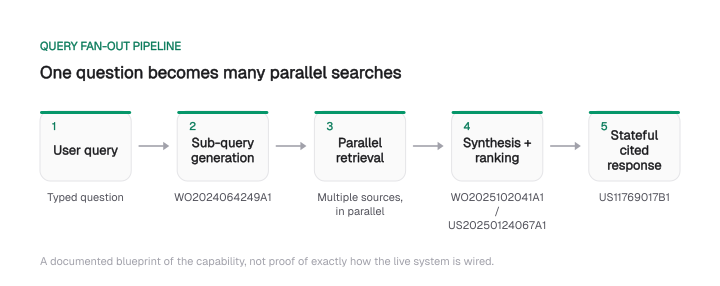
Query fan-out is Google's term for splitting one question into many parallel searches against its index.
Google explains the move in its own words: AI Mode works by "issuing multiple related searches across subtopics" to surface "a wider and more diverse set of helpful links" than traditional search (Google Search Central).
One patent, WO2024064249A1, gets cited across the industry as fan-out's blueprint. Read the filing and it describes something narrower: prompting a language model with a couple of examples to generate synthetic query-document pairs from a corpus, then training a retrieval model on those pairs. That is few-shot training for a retriever, not a query-time step that splits the question you just typed, and Google has never confirmed any patent as AI Mode's live mechanism. Treat the patent as evidence that Google works on query generation, not as the spec. Here's the sequence Google's own description supports:
- Your question generates synthetic queries. A model reads what you typed and creates several queries, each aimed at a different facet of it.
- Each one retrieves in parallel. They hit Google's index at the same time, which a Googler described as AI Mode "forking" the search.
- The results pool into one candidate set. Passages from every query feed the model that writes your answer.
For example, say you run a small sales team and ask AI Mode to find an affordable CRM that fits your team and integrates with Slack. That single question likely splits into parallel searches such as:
- CRM pricing for a small team
- Slack integration specifics
- tools built for small sales teams
The results pool together, and AI Mode merges them into one cited answer.
Nobody has measured how many queries AI Mode generates per question. The patent language says only "multiple"; claims of "5 to 10" or "hundreds" have no citable measurement behind them, so treat the count as unknown.
This is why AI Mode SEO differs from ranking one page for one query: your page can get pulled in through searches you never targeted and can't see in a keyword tool.
Why entity coverage matters for Google AI Mode
Entity coverage decides how many of AI Mode's parallel searches your page can answer, which is why it matters more here than an exact-match keyword. Each generated query targets a different facet or entity around the topic: the CRM question above split into pricing, Slack integration and team size, and a page covering only one of those facets is eligible for only one of those searches.
A page that covers the full set has more of those parallel searches to be pulled into. Build for the whole topic cluster, not the single query you typed into a keyword tool.
2. The Gemini model backbone (and why the version matters)
The Gemini model behind AI Mode has been upgraded at every rollout stage, each version sharpening its reasoning:
- Custom Gemini 2.0 at the March 2025 Labs launch.
- Custom Gemini 2.5 at I/O 2025.
- Gemini 3 in November 2025.
- Gemini 3.5 Flash as the global default at I/O 2026.
The version matters because the model does the reasoning and plans the fan-out. Better reasoning and better multimodal handling mean sharper query generation and tighter synthesis. That's why Google keeps pushing new models into this surface first.
Longer, more conversational queries are also why the model keeps changing. The average AI Mode search runs three times the length of a classic Search query. Google's own one-year review put a number on the shift too: planning-related searches grew 80% faster than AI Mode traffic overall over the past six months, and brainstorming searches grew 30% faster than queries overall since launch.
Gemini here matters only as AI Mode's engine. For the separate job of optimizing toward Gemini as an assistant, in the Gemini app and Gemini in Search, see Gemini SEO.
3. Personalization: why two people see different answers
Personalization in AI Mode shapes which queries get generated in the first place, ahead of any later reordering.
"Personalized results" often gets flattened into a quick bullet point, but the mechanism is more specific than that.
Per patent US20240289407A1, "Search with stateful chat" (FIG.9), your context feeds directly into query generation. With permission, that context includes your prior queries plus Gmail and Maps signals.
Say you ask for dinner recommendations. Here's the difference it makes:
- A brand-new user gets generic queries about popular restaurants.
- Someone with Maps history in a specific neighborhood gets queries scoped to that area and their cuisine pattern.
Same typed question, different generated queries, and potentially different cited sources.
Google confirmed this personalization, drawn from Search and Maps history, shipped in its August 21, 2025 update. It's already live in production, well beyond the original patent filing.
But that raises the obvious next question: does a person read your Maps history to make this work? Google's answer is no, in the way that matters. Data that human reviewers see to improve these models is disconnected from your account, and automated tools strip identifying and sensitive information before it gets there.
4. From passage pool to cited answer
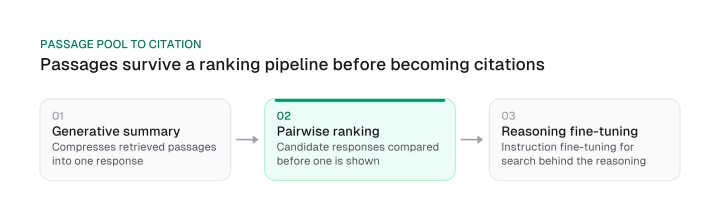
Two more patented steps turn the pooled passages into the answer you actually read:
- Generative summary. A pipeline (WO2025102041A1, "Generative summaries for search results") compresses the retrieved passages into a single response.
- Pairwise ranking. Candidate responses get compared against each other (US20250124067A1, "Method for Text Ranking with Pairwise Ranking Prompting") before one is shown.
- Reasoning fine-tuning. A separate patent (US20240256965A1) covers instruction tuning using intermediate reasoning steps, a general reasoning technique Google could apply behind the model's final answer.
The practical upshot: the citations attached to an AI Mode answer are whatever survived that pipeline. That's not the same list you'd get by ranking the top ten organic results for your original phrasing, which is why AI Mode citation and classic ranking diverge.
5. Stateful, multi-turn conversation
AI Mode holds session context across a conversation, unlike classic search, which treats every query as fresh with no memory of the last one.
That persistence is documented in patent US11769017B1, "Search with Stateful Chat." It's why you can ask a follow-up, like "cheaper options?" or "what about vegetarian?", and get an answer that remembers the thread instead of starting over.
It's also the foundation for agentic behavior. The restaurant-reservation booking Google added on August 21, 2025 (for Google AI Ultra subscribers, via Project Mariner with OpenTable, Resy, and Tock) needs a persistent session to hold your constraints across turns. A search box with no memory couldn't carry a booking task from question to confirmation.
6. Deep Search: fan-out at a bigger scale
Deep Search is AI Mode's extended-research mode: it runs on the Gemini 2.5 Pro model, issues hundreds of searches, and returns a fully cited report instead of a short answer.
It's the same fan-out-then-synthesize pipeline from section 1, just run at a much larger scale and for longer, which is why you get a report instead of a paragraph. Google launched Deep Search for Google AI Pro and AI Ultra subscribers who opted into the AI Mode Labs experiment in the US.
7. Information Agents: watching after you close the tab
Information Agents extend AI Mode's stateful session model into a persistent one: they run in the background 24/7 and surface an update without you asking again.
They watch the web for a condition you set, like a price drop or a new listing, and alert you the moment it changes. That's the same session model behind the follow-up questions in section 5, just kept alive between visits instead of only within one conversation. Google is rolling Information Agents out first to Google AI Pro and Ultra subscribers this summer, with broader availability to follow.
Google AI Mode vs. AI Overviews vs. classic Search
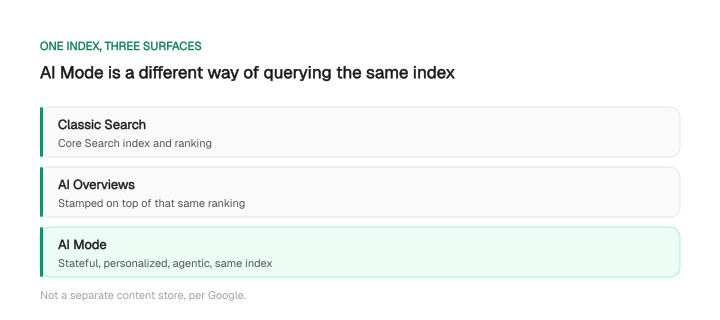
Google AI Mode, AI Overviews and classic Search all sit on the same index, but they trigger, answer, and cite differently. The AI Overviews users and appearance figures are dated on their own page.
The underlying index
All three surfaces query the same core Search index; AI Mode isn't a separate content store bolted onto Search.
A Googler put it plainly on Google's Search Off the Record podcast: AI Mode "does have its own fan outs... it is kind of in essence still based on this uh kind of standard concept of how we do things on search." It's a different way of querying the same index of content.
One dissenting observation exists and should be labeled as such: an SEO agency test reported in May 2025 that some deleted URLs returned 404 in AI Mode responses while still appearing in the standard index, which it read as a hint of a separate store.
That's a single, unreplicated test that Google's own statements contradict, so treat it as an open minority hypothesis rather than a settled finding.
Citation overlap between AI Mode and AI Overviews
AI Mode and AI Overviews cite almost entirely different sources, even though they usually agree on the answer.
Ahrefs' December 2025 study of 730,000 response pairs (540,000 used for the citation analysis) found:
- Citations overlap only 13.7% (16.3% comparing just the top three from each), even though the answers are 86% semantically similar on average.
- Identical opening sentences appear just 2.51% of the time.
- AI Mode carries roughly 2.5x more brand and person entity mentions than AI Overviews (3.3 versus 1.3 on average).
- A citation in AI Overviews has only a 61% chance of also showing up in AI Mode, which means roughly 4 in 10 domains cited in AI Overviews never appear in AI Mode citations at all.
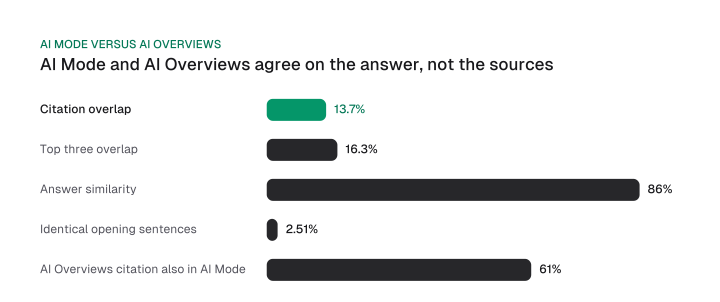
That answers the google ai mode vs ai overviews question directly: strong agreement on the answer, sharp divergence on the sources.
Earning a citation in one doesn't automatically earn it in the other, so if you only track one surface you're missing the other. For what the AI Overviews citation data specifically means for your content strategy and reporting, see What AI Overviews Mean for Your SEO.
Google AI Mode rollout timeline
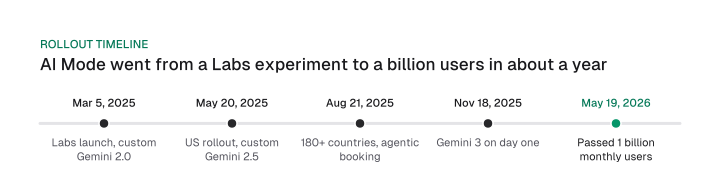
Google AI Mode's rollout ran from a subscriber-only Labs experiment to a surface with a billion monthly users in about a year. Our AI Mode statistics trace each usage and click figure to its source.
2025: Labs to global rollout
AI Mode's first year moved it from a members-only Labs test to a global, agentic surface. Here's each dated stage:
- March 5, 2025, Launch. A Labs experiment for Google One AI Premium subscribers, on a custom build of Gemini 2.0.
- May 20, 2025, US rollout at I/O 2025. Opened to all US users, upgraded to a custom version of Gemini 2.5.
- August 21, 2025, Global expansion. Reached 180+ countries and territories in English, with new agentic features.
- November 18, 2025, Gemini 3 on day one. The first time Google shipped a new Gemini model to Search before any other surface.
That March launch is also where Google first used the term "query fan-out." The May update previewed Deep Search, Live via Project Astra, agentic actions via Project Mariner, and personal context from Gmail for Labs.
August added agentic restaurant booking (Google AI Ultra subscribers, via Project Mariner with OpenTable, Resy, and Tock), personalization from Search and Maps history, and conversation link-sharing. November's Gemini 3 upgrade unlocked generative UI: physics simulations and custom calculators built live inside AI Mode responses.
2026: Gemini 3.5 Flash and a billion users
Google AI Mode's second year swapped in a faster model and features that keep working after you close the tab.
- May 19, 2026, I/O 2026. Gemini 3.5 Flash became the global default, and AI Mode passed 1 billion monthly users. The Gemini app is a separate count; see how Gemini users are measured.
Query volume has "more than doubled every quarter" since launch. The same update introduced Information Agents, the persistent background-monitoring feature covered above.
It also redesigned the Search box (called the largest change to it in 25+ years), added new agentic features rolling out through summer 2026, and expanded Personal Intelligence to nearly 200 countries in 98 languages.
In roughly a year, AI Mode went from a subscriber-gated Labs experiment to a billion-user default surface running on a new-generation model. That pace is why "wait and see" is an expensive posture if your traffic comes from Google.
What Google AI Mode means for site owners
Google's official position
Google's official position leaves no room for a secret AI Mode ranking factor.
To appear in AI Overviews or AI Mode, a page needs to be indexed and eligible to show as a snippet. Google's own guidance states there are "no additional requirements to appear in AI Overviews or AI Mode, nor other special optimizations necessary" (Google Search Central).
Traffic from both surfaces folds into the standard Search Console Performance report under the "Web" search type, so there's no hidden AI Mode report to hunt for. Take that at face value: there's no secret AI Mode ranking factor for sale.
The nuance the official guidance doesn't spell out
Two things sit alongside that official line without contradicting it.
First, eligibility is a real technical bar. "Indexed and eligible" assumes Google can actually crawl and render your content. We migrated our own React single-page app to prerendered static HTML for 20 marketing pages because AI crawlers don't execute JavaScript.
Nothing about AI Mode changed that requirement. It just raised the cost of getting it wrong: content that never gets indexed can't be pulled into any fan-out, no matter how good it is.
Second, being cited in AI Overviews doesn't mean you're covered for AI Mode. The 13.7% citation overlap already makes that point, and Ahrefs' domain-level data sharpens it:
- Across 5.5 million AI Mode queries analyzed in September 2025, the most-cited domains skewed toward high-trust reference and community sources rather than whoever ranked first.
- The top five were Wikipedia (1,135,007 mentions), YouTube (961,938), blog.google (601,835), Reddit (588,596), and Google's own site (568,774).
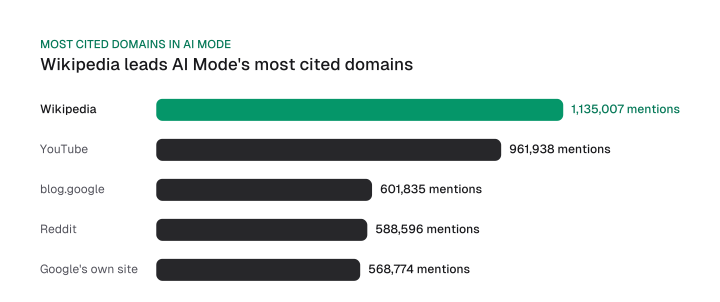
Trust and topic coverage decide the citation here more than rank position does.
One clarification on a common tangent: Google said on its Search Off the Record podcast in November 2025 that it doesn't support or require an llms.txt file for its AI features.
We built a free llms.txt checker because other AI platforms, like Anthropic and Perplexity, do read that file. It has no bearing on Google AI Mode citation, though. Adding one won't make AI Mode notice you.
What to actually do about it
What you do about AI Mode depends on which adjacent playbook you need next, so this section points there instead of re-teaching it. Here's where to go:
- For the AI Overviews citation checklist, see How to Show Up in Google AI Overviews; those fundamentals carry over, because AI Mode sits on the same index.
- For optimizing toward Gemini as an assistant surface, see the Gemini app optimization guide.
- For how AI Mode fits the broader move from ranking to citation, the GEO hub is the anchor.
- For the full site checklist, from indexing eligibility through schema and digital PR, see How to Optimize for AI Search Engines.
The one takeaway specific to AI Mode is about measurement. Because AI Mode and AI Overviews cite different sources, tracking only one surface leaves you blind to the other.
Mission Growth's platform tracks AI citations and visibility for customers. For the GA4 referrer-stripping problem specifically and the rest of the measurement stack, see AI Search Analytics.
How this explainer was put together
Every rollout date here traces to a dated Google post, cited inline.
Patent numbers are read from the filings themselves rather than from write-ups about them, which is how the fan-out attribution above ended up corrected: the patent most often named as the mechanism describes training a retriever, and saying so is more useful than repeating the claim. Independent measurements, like the citation-overlap figures, come from named, dated studies. Anything that can't be traced to a primary source is marked unverified instead of stated as settled.
Frequently asked questions
What is Google AI Mode?
Google AI Mode is a conversational Search surface that answers complex questions with one synthesized, cited response rather than a page of links.
It runs on a custom Gemini model and uses query fan-out to break your question into many parallel searches across Google's index. Google positions it for questions that need real reasoning or a side-by-side comparison rather than a quick lookup.
How is Google AI Mode different from AI Overviews?
AI Overviews is a short AI summary that appears above normal results only when Google decides it helps. AI Mode is a separate, opt-in surface built for multi-turn questions that need heavier reasoning. They share the same index but cite different sources: Ahrefs found only 13.7% citation overlap between them in its December 2025 study. Ranking in one doesn't guarantee the other.
What is query fan-out and how does Google AI Mode use it?
Query fan-out is Google's term for turning one question into many related searches that run at once. AI Mode generates several queries, retrieves results for each in parallel, pools the passages, then synthesizes one cited answer; patent WO2024064249A1 documents a related technique for training a retrieval model on diverse query variants, though Google hasn't confirmed it as the exact live process. Google has confirmed directly that it forks the search to run the retrieval for multiple queries at the same time.
Does Google AI Mode use my Gmail or Maps data to personalize results?
With permission, yes. Google's August 21, 2025 update added personalization drawn from Search and Maps history, and patent US20240289407A1 describes user context feeding the query generation step itself. Two people asking the identical question can get different generated queries, and therefore different cited sources. Personalization here shapes what gets retrieved, ahead of any later reordering of results.
Is Google AI Mode replacing traditional Google Search results?
No. Google AI Mode is a separate surface you choose to enter, and classic blue-link results still run underneath it on the same index. Google's own guidance confirms AI Mode traffic folds into the standard Search Console Performance report. Classic Search, AI Overviews, and AI Mode coexist, each querying the same core ranking system in a different way.
When did Google AI Mode launch and how widely available is it now?
Google launched AI Mode on March 5, 2025 as a Labs experiment for Google One AI Premium subscribers. It opened to all US users on May 20, 2025 at I/O 2025 and expanded to 180+ countries in English by August 21, 2025. At I/O 2026 on May 19, 2026, Google reported AI Mode had passed 1 billion monthly users.
Cite this page
Aktaş, F. (2026, September 20). How Does Google AI Mode Work? Query Fan-Out Explained. Mission Growth. https://missiongrowth.io/blog/google-ai-mode
Figures we made for this post are free to reuse under CC BY 4.0 with credit to Mission Growth.
Get Mission Growth highlighted in your Google results.