
GEO vs AEO vs LLMO vs AIO: Full Disambiguation
GEO vs AEO vs LLMO vs AIO, disambiguated: dated origins for all four terms plus a decision rule for which one your team should standardize on.
By Furkan AktaşPublished Updated

On this page
GEO vs AEO vs LLMO vs AIO all describe optimizing content so AI tools find and cite it. The real difference is which surface each term originally described, not four separate disciplines needing four separate strategies.
You need one program and one deliberate vocabulary choice. This page gives you the decision rule, plus a dated origin for each term.
For the discipline itself, start with our generative engine optimization guide; this page resolves the acronym confusion.
Key takeaways
The short answer
- GEO gets your content retrieved and cited inside the answers generative engines produce.
- AEO gets your content selected as the direct answer to one specific question.
- LLMO is the technical layer inside GEO: crawler access and files a model can parse.
- AIO has no agreed meaning yet: either "AI Overview optimization" or an umbrella over the other three.
GEO: retrieval and citation inside generated answers
GEO (Generative Engine Optimization) is the discipline of getting your content retrieved and cited inside the answers ChatGPT, Perplexity, Gemini, or Google AI Overviews generate.
GEO is the only term of the four with a precise, verifiable birth certificate. Researchers Aggarwal, Murahari, Rajpurohit, Kalyan, Narasimhan, and Deshpande coined it in a November 2023 paper (arXiv:2311.09735), with affiliations spanning Princeton, Georgia Tech, IIT Delhi, and the Allen Institute for AI.
The same paper introduced GEO-bench, a benchmark for measuring visibility inside generative engine responses.
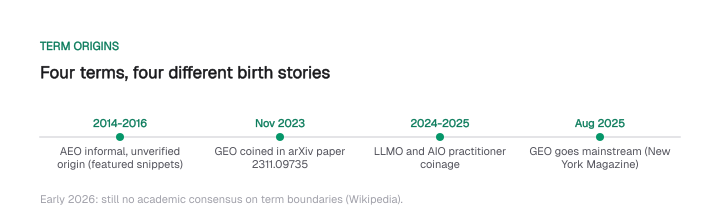
The term jumped from academic vocabulary to mainstream marketing in August 2025, when John Herrman published "SEO Is Dead. Say Hello to GEO." in New York Magazine.
Wikipedia's article on generative engine optimization treats that piece as the term's mainstream moment. It adds a caveat worth keeping: as of early 2026, no consensus definition distinguishing these terms existed in the academic literature.
AEO: being selected as the direct answer
AEO (Answer Engine Optimization) is the practice of structuring content to be selected as the direct answer to a specific question.
The discipline predates AI chat. It originally targeted featured snippets and voice assistants, back when "the answer" meant a snippet box rather than a generated paragraph. Applied to one AI engine, the same work becomes how to get cited by Perplexity AI.
Practitioner accounts place AEO's emergence around 2014-2016, tied to Google featured snippets.
Both are plausible, and neither cites a primary source: no Google announcement, no dated first publication anyone can point to. Treat 2014-2016 as informed industry memory rather than established fact.
LLMO: the technical layer inside GEO
LLMO (Large Language Model Optimization) is the technical layer inside GEO covering how large language models retrieve and cite your content.
The LLMO meaning is stable across sources; its origin isn't. Deepak Gupta says a vendor coined the term, Pepper Content credits vague practitioner efforts, and neelnetworks' guide offers no attribution at all.
None of the three names a person, a company, a publication, or a date. LLMO is the one term in this set with no traceable coinage event. Practitioner use spread through 2024-2025.
What the term points at is real: the retrieval layer. Robots.txt access, llms.txt files, structured data, and HTML a model can parse without running JavaScript.
We publish our own llms.txt and llms-full.txt as a curated plain-text knowledge base for AI crawlers, whatever the discipline is called that week. For the full execution framework, see our LLM optimization guide.
AIO: one acronym, three incompatible definitions
AIO stands for either "AI Overview Optimization," a tactic specific to Google, or "AI Optimization," an umbrella over the other three terms, depending on which source you read.
Search "what is AIO in marketing" and the ranking pages contradict each other without acknowledging it:
- Pepper Content defines AIO narrowly: "AI Overview Optimisation," meaning Google's AI Overviews feature and nothing else.
- Onely and Firebrand both define AIO broadly as "AI Optimization," an umbrella coordinating the other three toward overall AI visibility.
- Wikipedia's coverage treats AIO the same way, as an umbrella grouping the other terms.
So AIO's meaning depends entirely on who's speaking: one camp means a single Google feature, the other means the whole category. Our decision rule below handles it: write "AI Overview optimization" in full and skip the acronym otherwise.
The term territory map
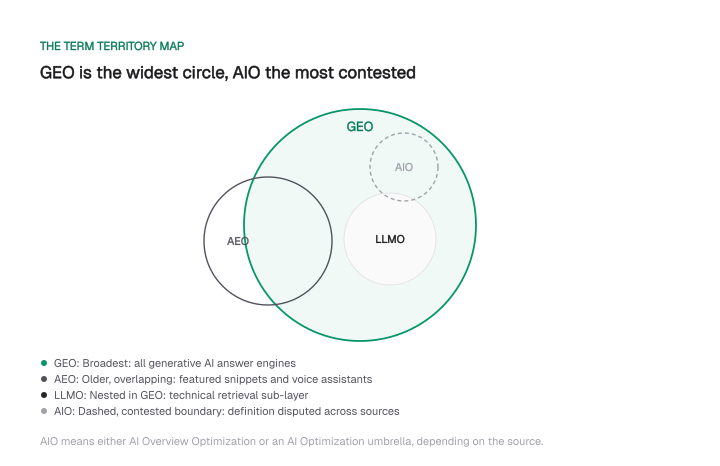
GEO, AEO, LLMO, AIO: none of these four are parallel categories; they nest and overlap, which is why a flat table alone can mislead.
GEO is the widest circle: it covers visibility in any generative answer engine. AEO overlaps it from the past, since answer boxes and voice assistants existed years before ChatGPT.
LLMO sits inside GEO as the technical retrieval layer. AIO's border is dashed, because its size depends on which contested definition you accept.
Are the practical differences real, or just branding?
The practical differences are partly real and mostly branding.
AEO vs GEO, written out as generative engine optimization vs answer engine optimization, is the pairing with genuine substance on both sides.
Classic AEO targets a narrower, older surface: featured snippets, People Also Ask, voice answers, position zero. GEO targets citations inside generated prose, and the two surfaces reward somewhat different formatting choices. LLMO's focus on the retrieval layer is also real, distinct work.
The execution overlap dwarfs those differences, though. One May 2026 practitioner analysis frames it plainly:
- About 80% of the work across GEO, AEO, LLMO, AIO, plus SEO and SEM, is shared foundation: semantic HTML, schema markup, authorship signals, topical depth.
- Only about 20% is discipline-specific.
That's a qualitative estimate rather than a measured statistic. Its conclusion is the useful part: run one program instead of six.
The strongest evidence that the acronym war is branding comes from the companies building the engines. Google Search Central published a guide on this exact topic: "Optimizing your website for generative AI features on Google Search."
No GEO, no AEO, no AIO, no LLMO in the title. The guide's stated position is that optimizing for generative AI features on Google Search is still SEO. When the platform owner declines all four labels, betting your vocabulary or your budget on any one of them is a marketing choice.
The SERP won't help you sequence the work either. neelnetworks' guide recommends this order, with no stated criteria for why it fits any given business:
- AEO first
- AIO second
- GEO third
- LLMO fourth
Sequencing advice without a diagnostic is astrology. What you need is a decision rule.
Which term should you actually use? A decision rule
The decision rule is simple: who you're talking to matters more than which term is "correct."
Here's the if/then version:
- If you write for a technical or research-adjacent audience: use GEO, and cite the founding paper by Aggarwal et al. You can footnote it; none of the other three terms has an academic citation.
- If your team or client roster already says AEO: use AEO and don't fight it. Our own keyword research shows why.
- If you mean Google AI Overviews specifically: write "AI Overview optimization" in full. The bare acronym AIO will be misread by someone in the room.
- If the conversation is crawler and retrieval-layer technical work (robots.txt rules, llms.txt files, structured data for LLM ingestion): LLMO is the most precise word available, even though it's the least searched of the four.
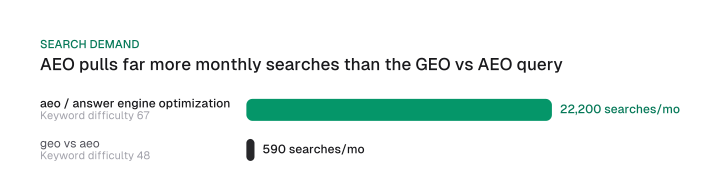
"aeo" and "answer engine optimization" pull 22,200 monthly searches at keyword difficulty 67. The direct comparison query "geo vs aeo" pulls just 590 searches at KD 48, roughly 38 times fewer. The confusion is real but small; AEO's mindshare in B2B marketing is large.
Here's how we applied the rule ourselves. Mission Growth's platform tracks AI citations and visibility for customers, so we couldn't stay neutral, and the product and the content needed one vocabulary:
- Discipline name: GEO, for its traceable origin and broadest accurate scope.
- Blog category label: AI SEO, because that's the phrase our B2B SaaS readers actually search. We draw that boundary in AI SEO vs traditional SEO.
- Retrieval-layer work: LLMO, used strictly for that specific layer.
That's one worked example, not the universal answer: a team already running an "AEO program" should keep calling it that.
Whichever word you pick, the work underneath barely changes. Our AI SEO checklist breaks that work into 35 steps, and none of them depends on the acronym at the top of your deck.
How this differs from GEO vs SEO
GEO vs SEO answers a different question: what changes in the work.
SEO optimizes for rankings and clicks on a results page. GEO optimizes for being cited inside a generated answer.
Most of the underlying craft transfers between the two: crawlability, entity clarity, original data, and structure built around real questions.
For the activity breakdown, see GEO vs SEO: What Actually Changes.
GEO vs AEO vs LLMO vs AIO: the comparison table
GEO, AEO, LLMO, and AIO differ mainly in what they optimize for and where they apply.
GEO is the broadest term. AEO is the oldest in practice. LLMO is the narrowest. AIO is less a term than an unresolved argument between two camps.
Frequently asked questions
Is GEO the same as AEO?
No, but they overlap heavily. AEO predates AI chat and originally targeted featured snippets and voice answers; GEO was coined in a November 2023 academic paper and targets citations inside answers AI generates. In 2026 practice most answer surfaces are AI surfaces, so the two programs share most of their execution. The order you say it doesn't matter: GEO vs AEO and AEO vs GEO mean the same comparison.
What does AIO stand for in marketing?
It depends on the source, and the sources conflict. Pepper Content defines AIO as "AI Overview Optimisation," meaning Google's AI Overviews feature only. Onely and Firebrand define it as "AI Optimization," an umbrella over all three of the others. Because of that split, write out the full phrase you mean instead of the acronym: "AI Overview optimization" is unambiguous; AIO isn't.
What is LLMO, and how is it different from GEO?
LLMO stands for Large Language Model Optimization: the technical layer of getting your content retrieved and cited inside LLM outputs, covering crawler access and structure a machine can read, such as llms.txt. GEO is the broader discipline of visibility across all generative engines, including how you write and structure the content itself. Think of LLMO as a layer nested inside GEO rather than a competing strategy.
Which term should I use with my boss or clients?
Mirror their vocabulary. If the deck or the dashboard already says AEO, use AEO; renaming a program mid-flight costs more clarity than it buys. If no term is established yet, default to GEO, which has a citable academic origin and the broadest accurate scope. Reserve LLMO for technical retrieval discussions, and avoid the bare acronym AIO until the industry settles what it means.
Who coined the term generative engine optimization?
Researchers Aggarwal, Murahari, Rajpurohit, Kalyan, Narasimhan, and Deshpande coined it in a November 2023 paper (arXiv:2311.09735), with affiliations across Princeton, Georgia Tech, IIT Delhi, and the Allen Institute for AI. The paper also introduced GEO-bench, a benchmark for measuring visibility in generative engines. John Herrman's August 2025 New York Magazine piece took the term mainstream.
Do I need a separate strategy for each of these four terms?
No. The execution overlap is large: a May 2026 practitioner guide estimates about 80% of the work is shared foundation, and Google Search Central's own guidance treats optimizing for generative AI features as still SEO. Run one program built on crawlable content, clear entities, citable original data, and content structured around real questions. Change the label to fit your audience; the work stays the same.
Cite this page
Aktaş, F. (2026, September 15). GEO vs AEO vs LLMO vs AIO: Full Disambiguation. Mission Growth. https://missiongrowth.io/blog/geo-vs-aeo-vs-llmo-vs-aio
Figures we made for this post are free to reuse under CC BY 4.0 with credit to Mission Growth.
Get Mission Growth highlighted in your Google results.