
Generative Engine Optimization: What the 40% Figure Means
Generative engine optimization explained: how AI engines pick sources, what the 40% study measured, and what later studies found about content tweaks.
By Furkan AktaşPublished Updated

On this page
Generative engine optimization is the work of getting your content used and credited inside AI-written answers. Its most quoted number, "up to 40%", is a lab result, and its conditions decide what it means for you.
The studies that came after it measured ranking outcomes instead of word share, and found few stable content effects. In C-SEO Bench, what moved results most was where a page sat in the model's context.
If you're asking what is generative engine optimization and whether it works, start here. This page defines the field, decodes the 40% and ranks tactics by the strength of their evidence, so you can decide what to do first and how to run a fair test.
In this guide:
- What GEO is and how one paper turned it into a metric
- The four steps an AI engine runs, and how engines differ
- What the 40% figure measured
- What later studies found
- A Do now, Test first, Skip ladder for tactics
What is generative engine optimization?
Generative engine optimization (GEO) means making content more likely to be retrieved, used and credited in the answers that AI search engines generate.
Generative engines are search systems that fetch web sources and have a language model write one synthesized answer from them. Google's AI Overviews, Perplexity and ChatGPT search all work this way.
You'll also meet the same idea as answer engine optimization or LLM optimization. The labels overlap, and geo vs aeo sorts out which one to use where.
The term comes from a paper first submitted to arXiv in November 2023. It also built a benchmark, GEO-bench, to test whether rewriting a page changes how an engine treats it.
The paper's definition of visibility decides what its numbers mean. It uses a position-adjusted word count: the words of the answer attributed to each source, with each word's weight reduced by an exponentially decaying function of the citation position. The impressions of all citations in a response are then normalized so they sum to one.
That makes a GEO win a bigger share of the answer, and it makes every gain a redistribution. If you gain share, another source loses it.
Why that matters for you:
- Use without rank. On average 53% of the domains Google's AI Overviews consult sit outside the organic top 10, by a May 2026 study, so a page can feed an answer without ranking.
- A fixed prize. Shares sum to one, so a competitor's gain is your loss.
- A conditional prize. Google says AI Overviews appear only when its systems judge them additive to classic Search, and they often don't trigger.
How does generative engine optimization work?
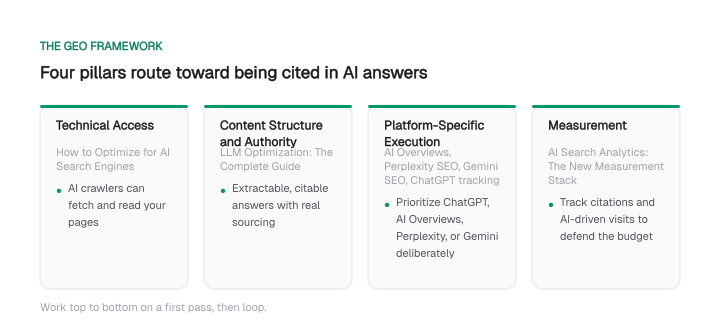
Generative engine optimization works by influencing four steps an engine runs: whether it searches, what it retrieves, what enters its context, and what the answer credits.
So how does generative engine optimization work in practice? Through these four steps, with evidence on each:
- Whether the engine searches. Claude searches when a request depends on information that is current, changing or outside its training data. A May 2026 study found that many engines also search for simple, static facts.
- What it retrieves. Google's documentation says AI Overviews and AI Mode may use query fan-out. An April 2026 study found the sources retrieved by Google, AI Overviews and Gemini differ substantially, under 0.2 average Jaccard similarity.
- What enters context. Newer Claude web search versions write code that filters results before they reach the context window, according to Anthropic's documentation. The pages an engine consults per query range from under one to 14.
- What the answer credits. An Ahrefs April 2026 analysis found ChatGPT ends up citing about 50% of the URLs it retrieves.
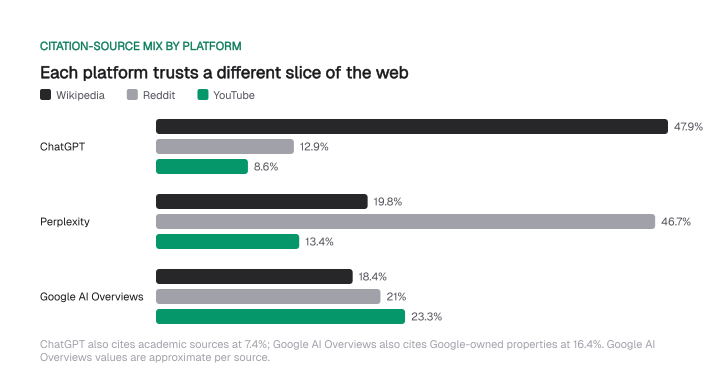
The retrieval step differs most. A May 2026 study counted how many pages each engine consulted per query:
Perplexity's Sonar retrieves 14 pages on average, Google's AI Overviews and Gemini 9, GPT-4o Search 4, and GPT-4o with a search tool consults less than one web page on average. An April 2026 study measured Gemini at 9.68 sources, AI Overviews at 9.24 and the classic results page at 8.75, which agrees with the first count.
Engines gate, retrieve and credit by different rules, so a result in one engine tells you little about another. For example, if your page wins a place in Sonar's 14 pages, you've still said nothing about GPT-4o Search's 4. Check each engine on its own.
Crawler access is the entry condition. OpenAI's documentation says sites that opted out of OAI-SearchBot will not be shown in ChatGPT search answers, and technical geo covers that setup.
Retrieval is only half of ChatGPT visibility, because the engine cites about half of what it fetches. The steps for how to get cited by chatgpt start there.
Perplexity casts the widest net of the engines measured. That means perplexity seo is a contest for context space against more neighbours than anywhere else.
Gemini and AI Overviews both consult 9 pages yet draw largely different sources. Treat gemini seo as its own check, not a copy of your AI Overview work.
What the GEO paper's 40% figure measures
The GEO paper's 40% is a relative change in one source's share of a generated answer, measured on a lab engine that was handed five pages.
The setup decides what the number means:
- Queries. GEO-bench has 10K queries split 8K, 1K and 1K into train, validation and test, and methods are evaluated on the test split. Some queries were generated by GPT-4.
- Engine. Only the top five Google results are fetched for each query, and gpt3.5-turbo writes the answer. Five responses are sampled per query at temperature 0.7.
- Treatment. In the main test, one randomly chosen source per query is rewritten with each method. A separate test optimized all sources at once.
- Metric. Position-adjusted word count. The top methods reached a relative improvement of 30-40% on it and 15-30% on the paper's subjective impression metric.
So the figure compares one source before and after a rewrite, inside an answer built from five pages. Pages with quotes were not compared with pages without quotes.
As an illustration (our arithmetic with equal shares assumed, not the paper's data), suppose five sources split one answer equally. Each gets 20%, which is 1 divided by 5. A 40% relative gain moves the average source from 20% to 28%.
Shares sum to one, so the other four sources now hold 72% between them. That's 18% each, a 10% cut apiece, and they pay for the gain.
The paper's own rank breakdown shows the same redistribution. By its count, the Cite Sources method raised visibility for fifth-ranked sites by 115.1% and lowered it for the top-ranked site by 30.3% on average. The spread between the two is 145.4 points, our subtraction of 115.1 and -30.3.
Read "up to 40%" as the best method's gain under lab conditions, in one engine, on one metric. It's a ceiling for a rewrite that already made the five-page context, and a poor forecast of what a rewrite does to your traffic.
What later studies measured
Later studies measured ranking outcomes instead of word share and found few stable content effects, with topical relevance and context position the most reproducible levers.
Here is what each study measured and found:
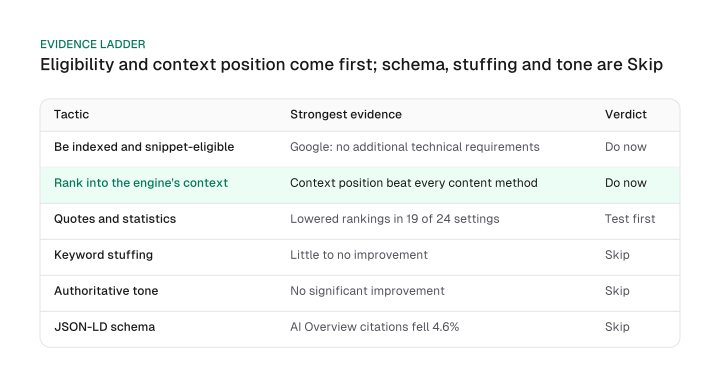
C-SEO Bench found only 3 of 54 cases significantly positive, which is 5.6% by our division. Only its own two methods, LLM guidance and content improvement, produced those gains. The Statistics method decreased rankings in 19 of 24 settings, or 79%.
Moving the target document to first position in the model's context produced far greater citation ranking gains than any content method. Content modifications, its authors write, are often outweighed by ordering.
E-GEO tested 15 prompts for rewriting product listings. Eleven did worse than a plain prompt that scored about zero, and one of the fifteen is a deliberate negative control, a request for a short story. A bulleted list had a small but significant positive effect.
E-GEO's optimized prompts, built by a prompt meta-optimization algorithm, significantly improved over those heuristics. That points to tuning the instruction to the task, which a generic tactic list can't supply.
A July 2026 survey adds that the GEO paper's gains hold within its experimental setting but are conditional on a source already being present in a fixed context. It also found that competition can erode individual gains.
The GEO paper and C-SEO Bench answer different questions. The C-SEO Bench authors write that the results of both papers on LLM preferences do not contradict each other.
Word share asks how much of an answer talks about you once you're in context. Citation rank asks where you land among the sources the answer cites. The first can move with a rewrite. In C-SEO Bench the second was dominated by position, and gains shrank as more actors adopted the same method.
Which GEO tactics to do first
Google's AI optimization guide tells site owners to keep doing SEO, because its generative AI features are rooted in core ranking and quality systems, and to create unique, useful content. It says to ignore chunking, llms.txt files and inauthentic mentions, and points to the Generative AI performance report in Search Console.
Do first what has platform or study support: be indexed and eligible, rank into the engine's context, and publish content worth citing; test the rest.
The ladder sorts each tactic by its strongest evidence into Do now, Test first or Skip:
How GEO and SEO differ in practice is the subject of geo vs seo.
Ranking is a base layer and no guarantee. 47% of AI Overview domains sit inside the organic top 10 and 73% inside the top 100, which we get by subtracting the 53% and 27% outside shares from 100. That leaves a large group of cited pages that rank lower, so earn the context slot with relevance on the specific question.
Earned media is the one place where Google's guidance and the research pull apart. The preprint finds a systematic bias towards earned media, and Google says to ignore inauthentic mentions, so earn mentions you could defend in public and stop there.
Treat every Test first row as a hypothesis. Change one thing on a set of pages, keep matched control pages untouched, and compare citation presence and rank over repeated runs. Ahrefs' schema test shows the shape: it tracked 1,885 pages that added JSON-LD against 4,000 matched controls, using the controls to separate the change from drift.
Mission Growth's platform tracks AI citations and visibility for customers.
What to track and how much noise to expect is the job of ai search visibility kpis. Choosing software for it is a separate decision covered in tools for geo.
Once the ladder is clear, sequencing the work is a planning problem. The geo roadmap turns these levers into a schedule, and the llm optimization guide covers the model-side view.
Limits of the GEO evidence
The GEO studies test how a generator uses sources it was handed, not how an engine finds them, so they cannot predict AI Overview or ChatGPT results.
Here are the limits to keep in mind:
- Use of sources, not retrieval. The paper's main engine is GPT-3.5 given five pages. Its Perplexity check used 200 samples with source text uploaded as files, and Quotation Addition improved word count by 22% there. The July 2026 survey calls that a black-box test of document use, not an experiment in crawling or ranking in production.
- Conditional gains. The survey finds no reviewed technique with a stable, longitudinal, cross-platform causal effect on organic discoverability.
- Congestion. Gains fall as more actors adopt a method, and when one source gains share another loses it.
- Fidelity gaps. Word count and rank don't show whether the answer states what your page says, so a cited rewrite can still be misrepresented.
- Scaled content abuse. Google says creating separate pages for fan-out queries, primarily to manipulate rankings or generative AI responses, violates its scaled content abuse spam policy. The prompt universe framework explains how to cover fan-out queries inside one strong page.
The generative engine optimization research record is thinner than the claims built on it. Treat lab gains as hypotheses until they survive a matched test on your own pages. The survey also notes that citation-oriented rewrites can impair retrieval, which is one more reason to test before you roll a change out.
The 40% is a share of one lab answer, the later studies measured ranking outcomes (C-SEO Bench found context position dominant), and tactics belong on a ladder ordered by evidence. Pick one row from Test first, set up matched controls this week, and measure it before you scale it.
Frequently asked questions
Is GEO just SEO?
Largely, at the base. Google says SEO guidance stays relevant because its generative AI features are rooted in core ranking systems. C-SEO Bench found that putting a page first in the model's context beat every content method. GEO adds the work of being used and credited once you're retrieved.
Does the GEO study apply to Google AI Overviews or ChatGPT?
It tested GPT-3.5 answering from five pages, plus a Perplexity check with source text uploaded as files. Both test how a generator uses handed sources, so they can't tell you whether AI Overviews or ChatGPT retrieve your page. A July 2026 survey calls the Perplexity test a test of document use.
Is GEO the future of digital marketing?
It may become part of it, but the evidence is thin so far. A July 2026 survey found no reviewed technique with a stable, longitudinal, cross-platform causal effect on organic discoverability. Google says unique, useful content will likely matter most. Invest in being worth citing, and test tactics before scaling them.
Is optimizing for ChatGPT different from Perplexity or Gemini?
Yes, because engines retrieve different numbers of pages by different rules. A May 2026 study measured 14 pages per query for Perplexity's Sonar, 9 for Gemini, 4 for GPT-4o Search and under 1 for GPT-4o with a search tool. Test each engine on its own.
Is SEO still worth it?
Yes, as the base layer: the ladder above puts eligibility and ranking first. For the full case, including whether SEO is dead, read is seo still worth it.
Cite this page
Aktaş, F. (2026, October 4). Generative Engine Optimization: What the 40% Figure Means. Mission Growth. https://missiongrowth.io/blog/generative-engine-optimization
Figures we made for this post are free to reuse under CC BY 4.0 with credit to Mission Growth.
Get Mission Growth highlighted in your Google results.