
Best AI SEO Tools in 2026
The best AI search optimization tools for 2026, sorted into 4 real categories with verified, dated pricing. No unverifiable 'tested' claims.
By Furkan AktaşPublished Updated

On this page
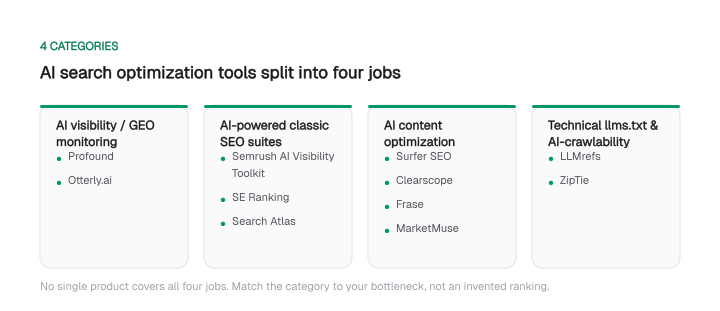
AI search optimization tools split into four categories in 2026: AI visibility and GEO monitoring, AI-powered classic SEO suites, AI content optimization, and technical llms.txt and AI crawlability tooling. No single product covers all four jobs, so the useful question is which category matches your problem.
Profound and Otterly.ai lead AI visibility and GEO monitoring. Semrush, SE Ranking, and Search Atlas bolt AI features onto classic SEO suites. Surfer SEO, Clearscope, and Frase lead content optimization. LLMrefs and ZipTie handle llms.txt and AI crawlability.
If you already know you need AI visibility tracking, the AI-visibility tool comparison or the ChatGPT SEO tools guide go further on that single category. This best AI SEO tools 2026 guide covers all four; jump to the category you need.
What are AI search optimization tools? The 4 categories
AI search optimization tools help your brand get found and cited in AI-generated answers and classic search results.
If you're asking what are AI SEO tools in the first place, the label spans four distinct product types:
- AI visibility and GEO monitoring. Trackers such as Profound and Otterly.ai that check whether ChatGPT, Perplexity, and Google AI Overviews cite your brand.
- AI-powered classic SEO suites. Rank-tracking platforms that added AI visibility as an add-on or a higher tier. Semrush, SE Ranking, and Search Atlas fit here.
- AI content optimization. Briefing and scoring tools such as Surfer SEO, Clearscope, Frase, and MarketMuse; 3 of these 4 now bundle some form of AI-visibility tracking too.
- Technical llms.txt and AI crawlability tooling. Tools such as LLMrefs and ZipTie that audit the machine-readable surface both classic bots and AI crawlers read. Before picking one, know what a free ai seo audit tool can and cannot establish about real crawler behaviour.
If GEO, AEO, or generative engine optimization is new terminology to you, our GEO vs SEO explainer defines the terms.
Category 4 exists because AI crawlers behave differently from Googlebot. We learned that firsthand: we migrated our own React single-page app to prerendered static HTML for 20 marketing pages because AI crawlers don't execute JavaScript. If your site renders client-side, no amount of content optimization fixes what a crawler never sees.
One exclusion worth naming: link-building exchange communities, cold-outreach software, and generic AI chat apps like ChatGPT Plus don't appear here. None has search or AI-search optimization as its primary job.
How we picked and evaluated these tools
Every price and plan below comes from each vendor's own pricing page or documentation, checked in September 2026.
Ahrefs belongs in the AI-powered suite category through its Brand Radar add-on; its pricing lives in our LLM SEO tools comparison, so it appears here in prose only.
The best AI SEO tools in 2026 (by category)
Download CSV (CC BY 4.0)
Prices checked in September 2026. Plans change often, so confirm on the vendor's page before you buy.
Category A: AI visibility and GEO monitoring
1. Profound
Best for: Mid-market and enterprise teams that want a dedicated tracker with room to scale.
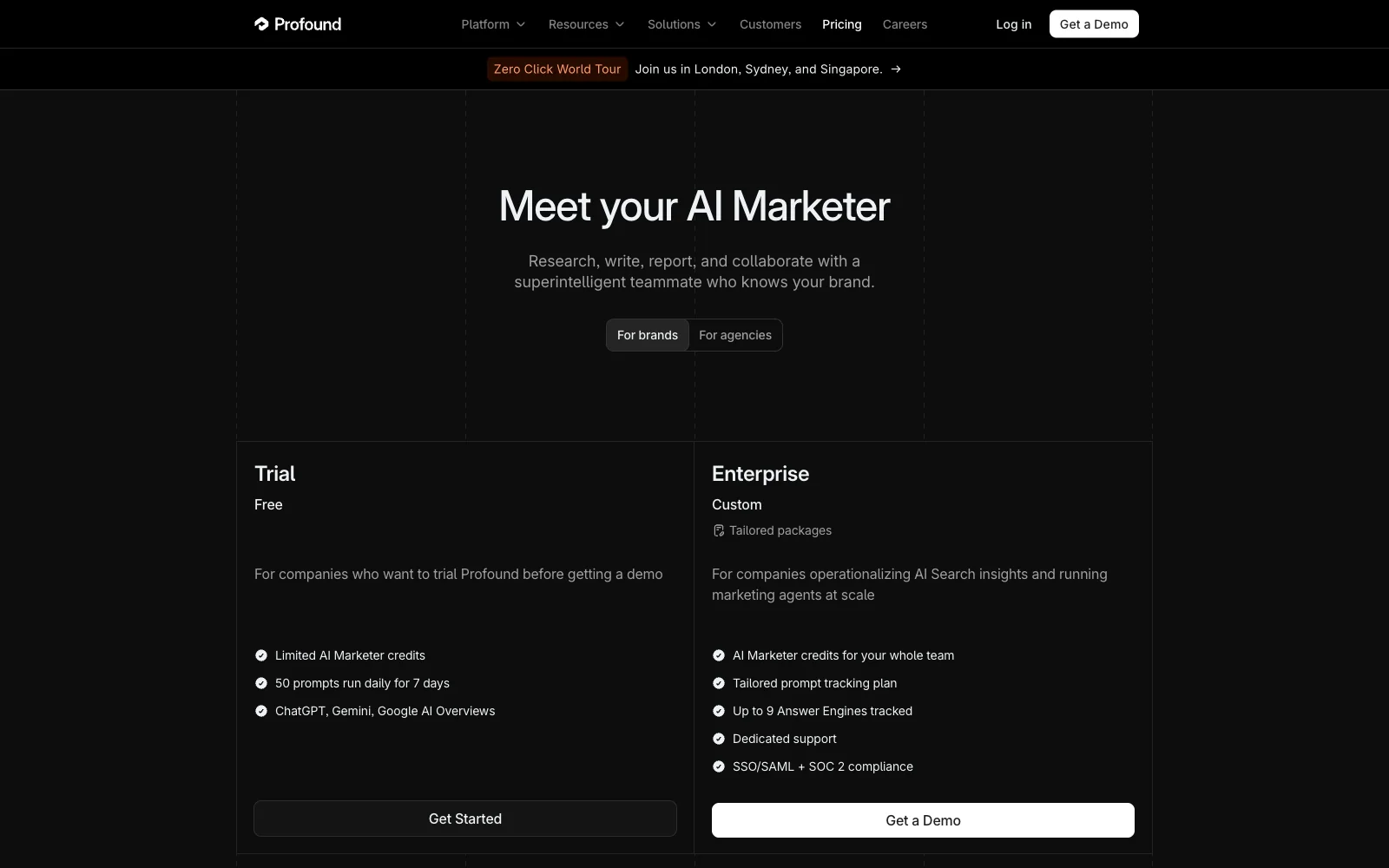
Profound is a pure-play AI-visibility tracker built for teams that want a dedicated dashboard. Coverage now sits at two steps: a free Trial that tracks ChatGPT only for 10 one-time prompts, and a custom-priced Enterprise tier that covers up to 9 answer engines, including Perplexity, Google AI Mode, Gemini, Copilot, DeepSeek, Claude, Google AI Overviews, and Exa Search.
Run the free Trial to test the workflow, then get a quote for Enterprise before you commit real budget.
Pros:
- A dashboard built only for AI-visibility tracking.
- Enterprise coverage reaches up to 9 answer engines, including Perplexity, Gemini, Copilot, DeepSeek, and Claude.
Cons:
- The free Trial, the only self-serve option, tracks ChatGPT only for 10 prompts, run once.
Price: Free Trial (10 prompts) or custom-priced Enterprise
2. Otterly.ai
Best for: Small teams running a first AI-visibility experiment before committing real budget.
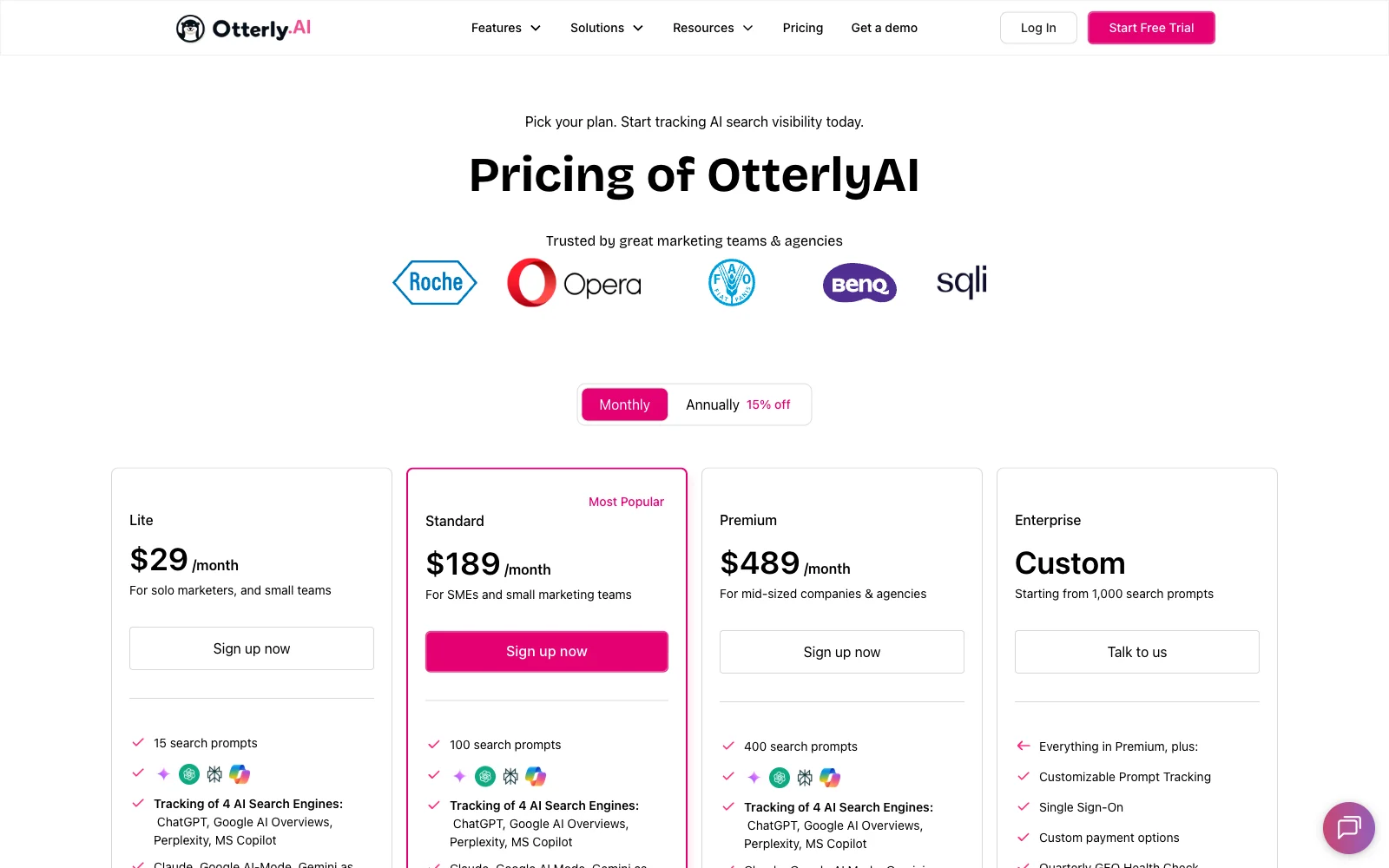
Otterly.ai is the lowest-cost dedicated cross-engine tracker in this comparison. Lite already spans four engines: ChatGPT, Perplexity, Microsoft Copilot, and Google AI Overviews.
Claude, Gemini, and Google AI Mode sit behind paid add-ons at every tier. Standard and Premium raise the prompt ceiling; the core engine list stays the same.
Pros:
- Lite already spans four engines at the entry price.
- The lowest entry price of any dedicated cross-engine tracker here.
Cons:
- Claude, Gemini, and Google AI Mode all sit behind paid add-ons at every tier.
Price: $29/mo (Lite, 15 prompts)
Category B: AI-powered classic SEO suites
3. Semrush AI Visibility Toolkit
Best for: Teams that want AI tracking inside the Semrush dashboard they already use.
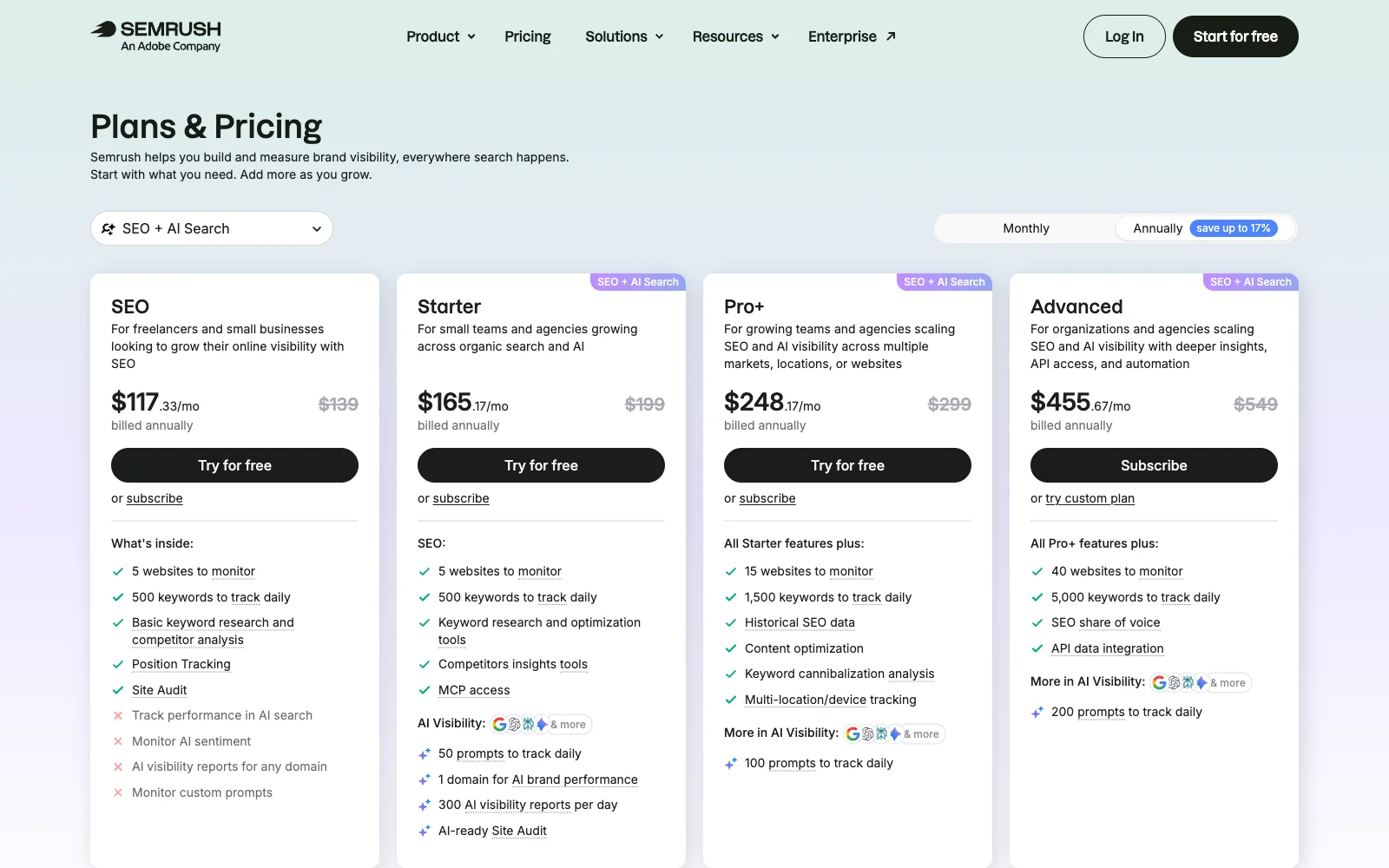
As of October 2026, Semrush no longer sells its AI Visibility Toolkit as a separate add-on: AI tracking now sits inside its SEO + AI Search plans. Starter costs $165.17 a month billed annually, or $199 billed monthly, and tracks 50 prompts a day across Google Search, ChatGPT, Perplexity, and Gemini for one domain, with 300 AI visibility reports a day.
The cheaper SEO plan, $117.33 a month billed annually, lists AI search tracking and custom prompt monitoring but states no prompt allowance; Starter is the first tier that does. An extra seat starts at $45 a month.
Pros:
- Four engines named at entry: Google Search, ChatGPT, Perplexity, and Gemini.
- Tracking lives inside the Semrush dashboard your team already uses.
Cons:
- Starter's 50 daily prompts cover one domain for AI brand performance.
- At $165.17 a month on annual billing, it is the highest published entry price in this lineup.
Price: $165.17/mo (Starter SEO + AI Search, annual billing; $199 monthly)
4. SE Ranking
Best for: Agencies that want a classic suite now and can bolt on AI tracking when clients start asking for it.
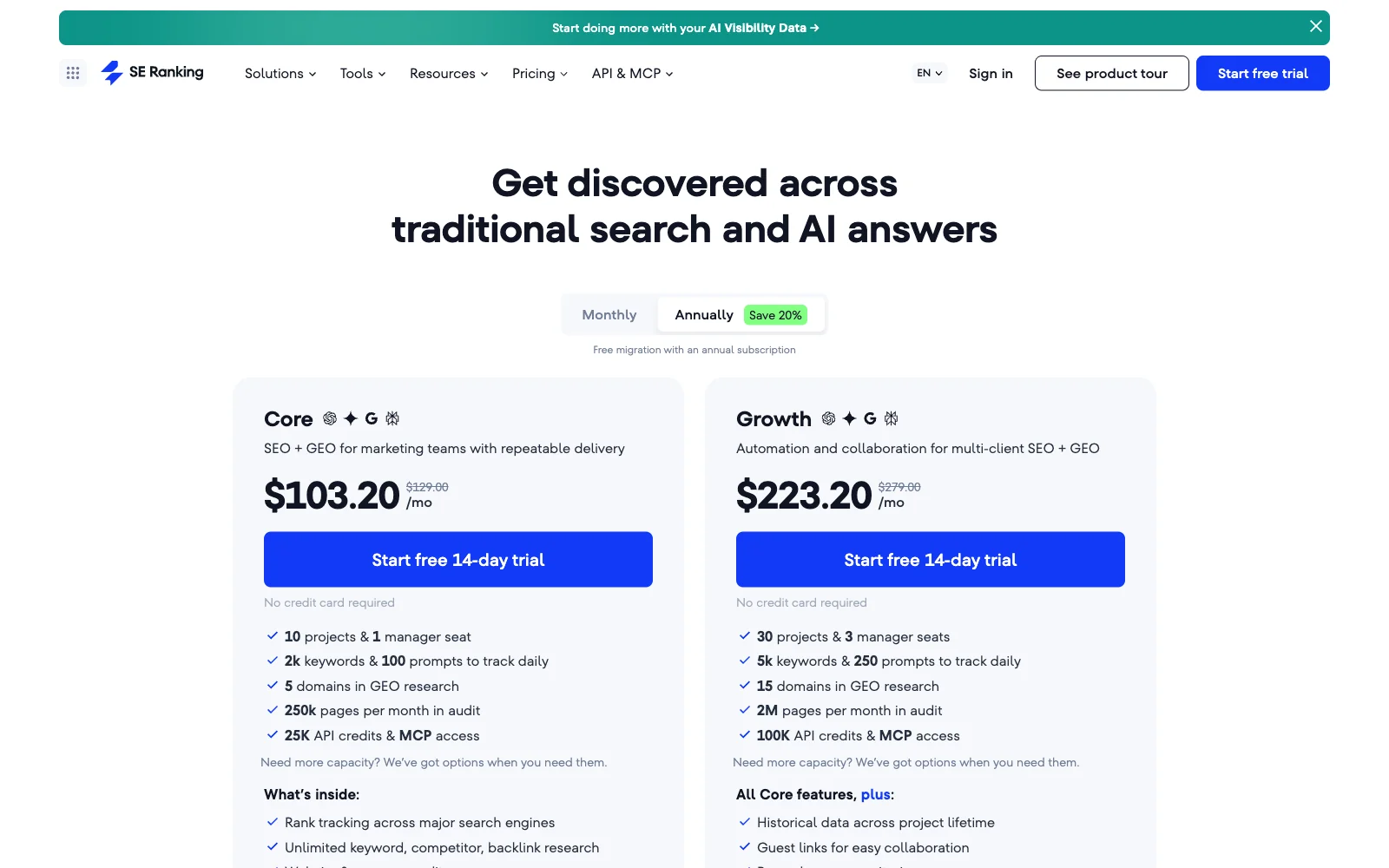
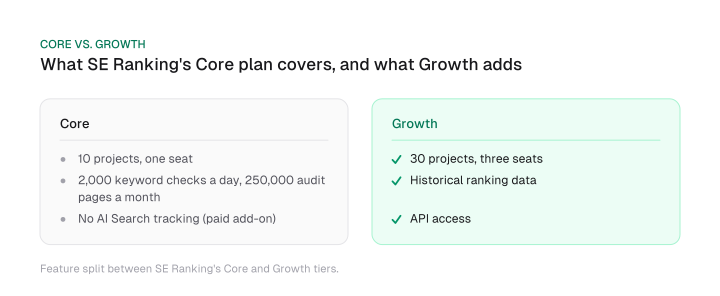
SE Ranking's Core plan bundles 10 projects, 2,000 keyword checks a day, one seat, 250,000 audit pages a month, and white-label reporting, but not AI Search tracking: that's a separate paid add-on. Growth adds 30 projects, three seats, historical ranking data, and API access.
Pros:
- Core covers a full classic SEO suite, rank tracking through audits, before any AI add-on.
- Growth adds historical ranking data and API access.
Cons:
- Core doesn't include AI Search tracking; that's a separate paid add-on.
Price: $103.20/mo (Core, annual billing)
5. Search Atlas
Best for: Teams that want automation-heavy SEO software and are budgeting for the Growth tier.
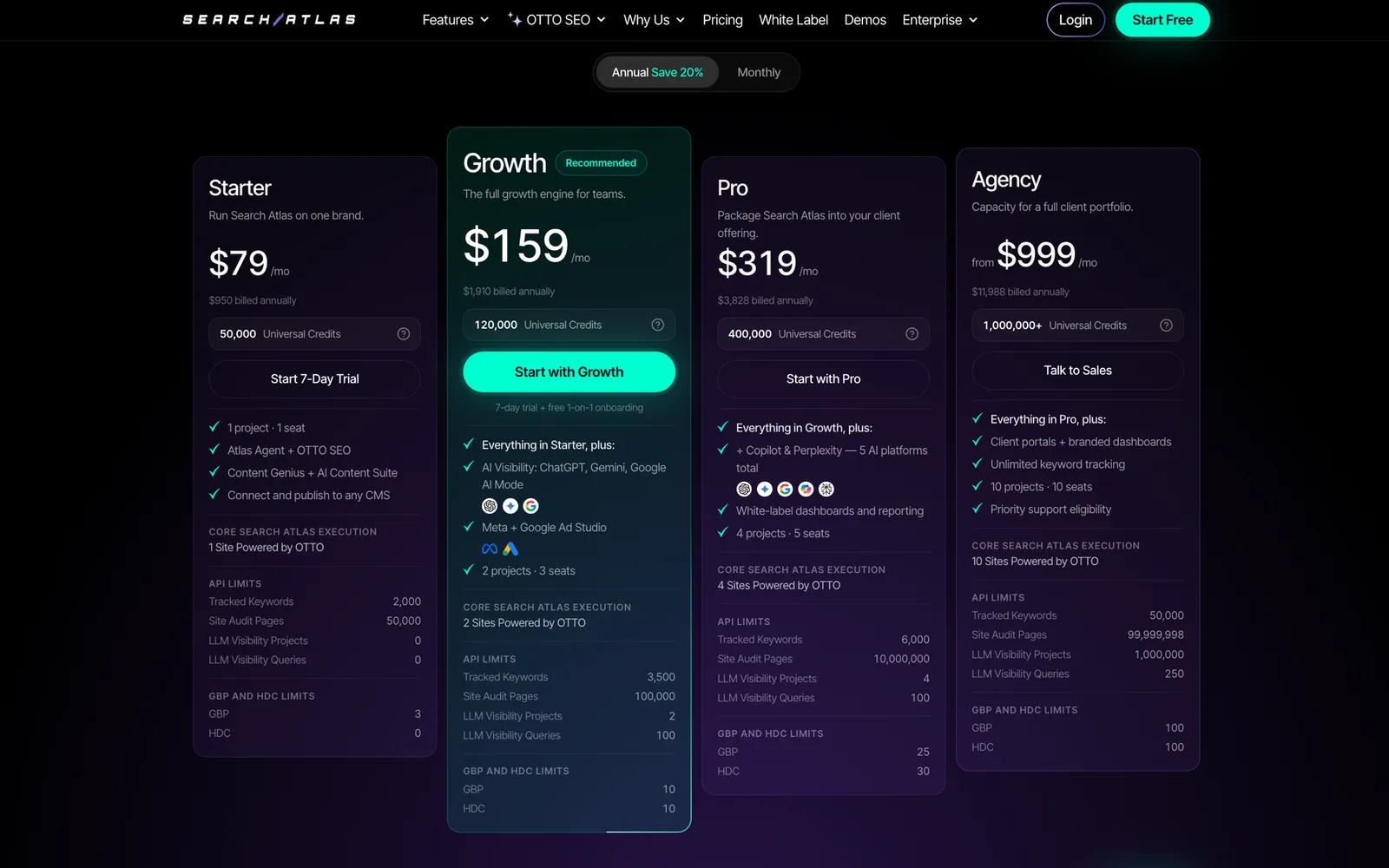
Search Atlas's Starter tier covers OTTO SEO automation and Content Genius, with no AI Visibility feature included. AI Visibility starts at Growth, covering ChatGPT, Gemini, and Google AI Mode; Pro, at $319 a month, adds Copilot and Perplexity for five-engine coverage.
Pros:
- Starter includes OTTO SEO automation and Content Genius before any AI add-on.
- Pro reaches five-engine AI coverage.
Cons:
- AI Visibility isn't available until Growth, more than double the Starter price.
Price: $79/mo (Starter, billed annually; $99 monthly); AI Visibility from $159/mo (Growth)
Category C: AI content optimization
6. Surfer SEO
Best for: Content teams that want classic scoring today and pick the AI-tracking tier by prompt volume and engine coverage.
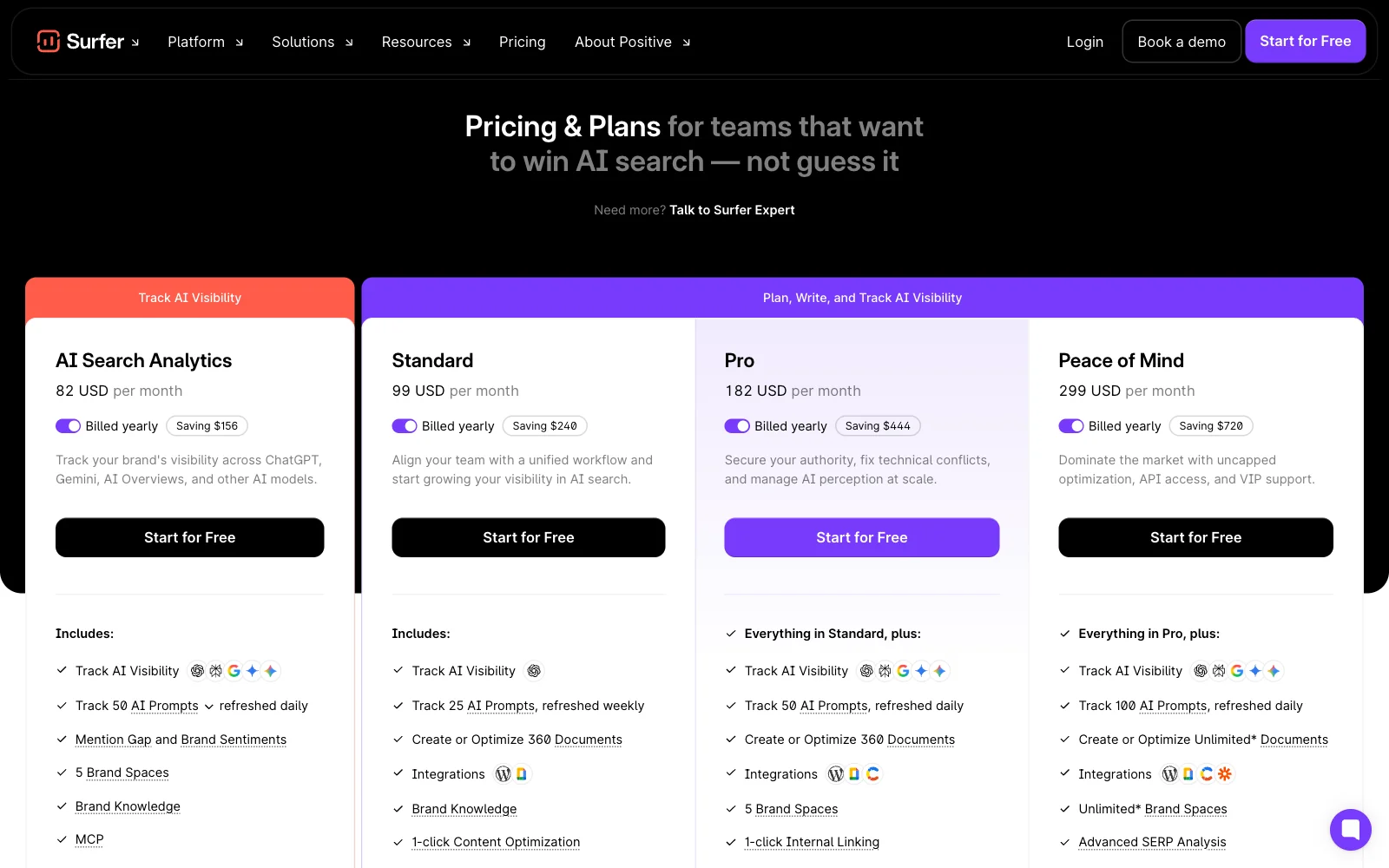
Surfer's Content Editor is the most widely used product in the content-optimization category. Discovery skips AI tracking entirely; real cross-engine coverage comes from the standalone AI Search Analytics tier, covering ChatGPT, Perplexity, Google AI Mode, AI Overviews, and Gemini.
There's no ChatGPT-only tier anymore, so AI Search Analytics is the only way in for AI tracking.
Pros:
- The AI Search Analytics tier covers five engines at once.
- Discovery still offers classic content scoring without the pricier AI tier.
Cons:
- Discovery, the base tier, has no AI-visibility tracking at all.
Price: $49/mo (Discovery); AI tracking from $82/mo
7. Clearscope
Best for: Content teams with many collaborators, since seats are never the constraint.
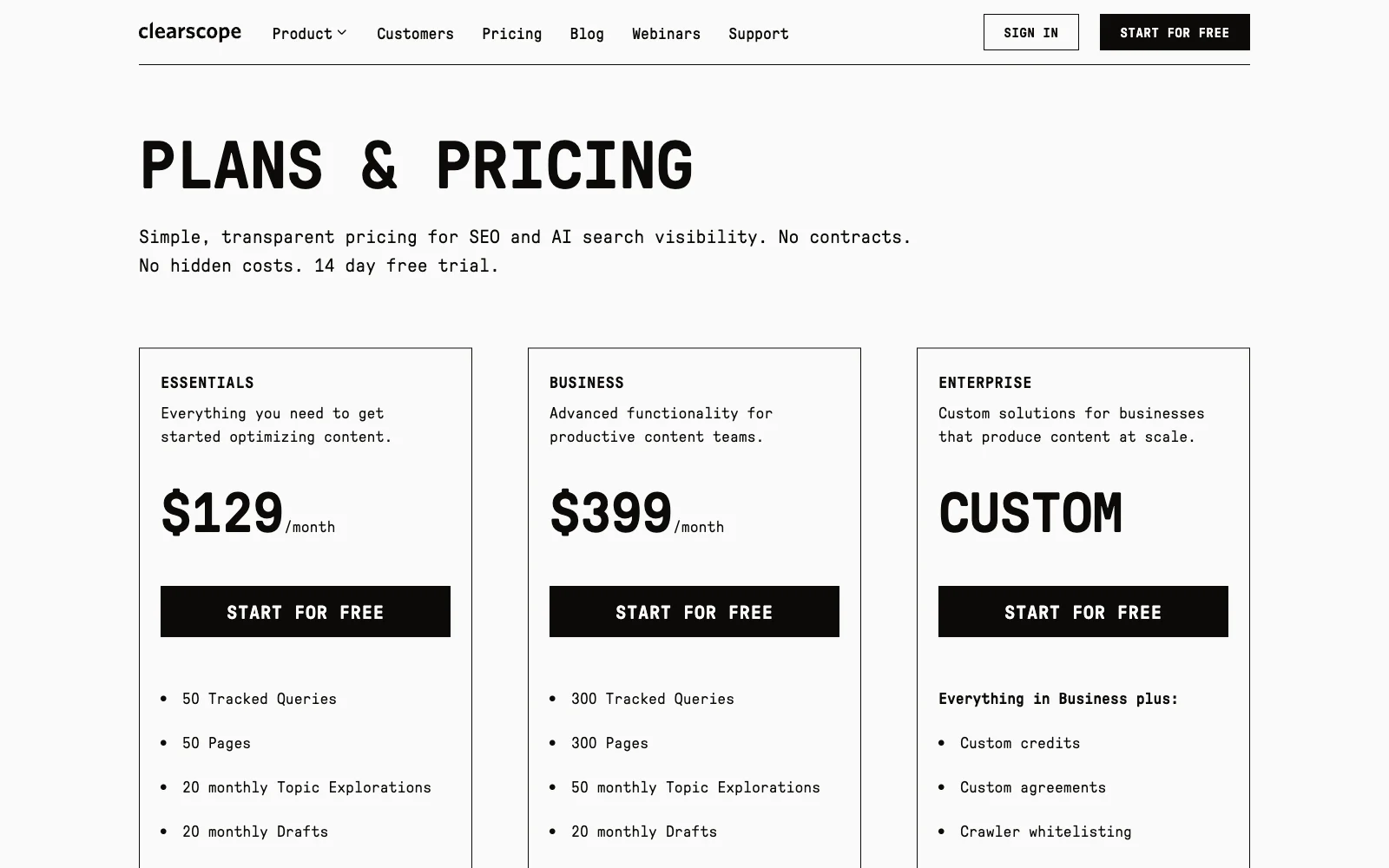
Clearscope bundles AI-visibility tracking (ChatGPT and Gemini mentions) into every tier, including the cheapest one, with unlimited seats across the board. Business raises the tracked-prompt and page ceiling and adds a dedicated account manager; Enterprise is fully custom.
Pros:
- AI-visibility tracking bundled into every tier, even the entry plan.
- Unlimited seats across every tier.
Cons:
- Essentials, the entry tier, costs more upfront than most other content tools.
Price: $129/mo (Essentials)
8. Frase
Best for: Solo founders who want scoring and tracking on one bill under $50.
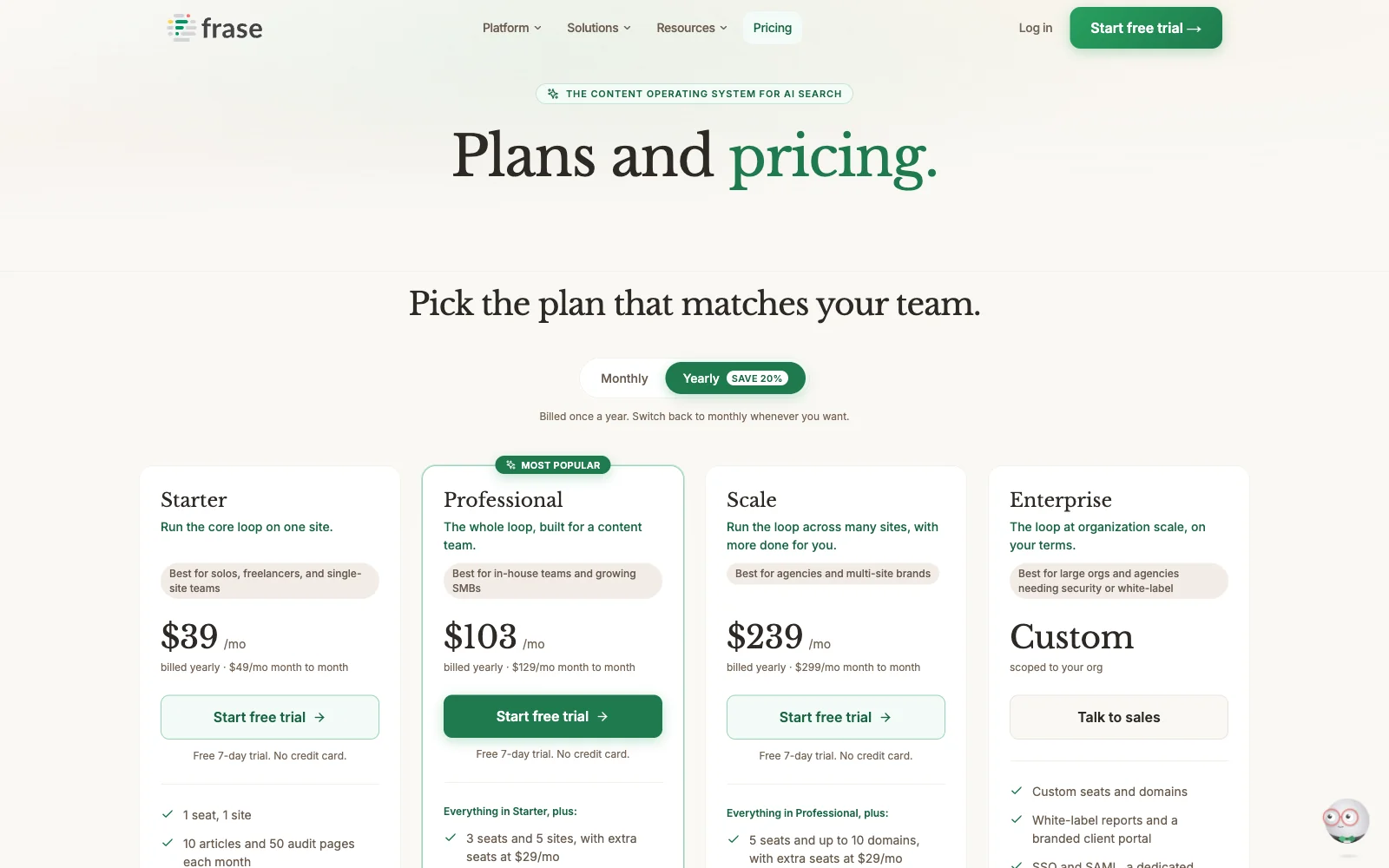
Frase is the only tool in this table that bundles AI-visibility tracking into its cheapest published tier, with no gating at all. Starter covers ChatGPT and Google AI; Professional adds Perplexity; Scale adds Claude and Gemini for full coverage.
Pros:
- AI-visibility tracking included from the Starter tier.
- The lowest all-in-one price in the content-optimization category.
Cons:
- Full five-engine coverage requires the Scale tier.
Price: $39/mo (Starter, billed yearly)
9. MarketMuse
Best for: Teams that want content-strategy depth and accept a sales conversation to get there.
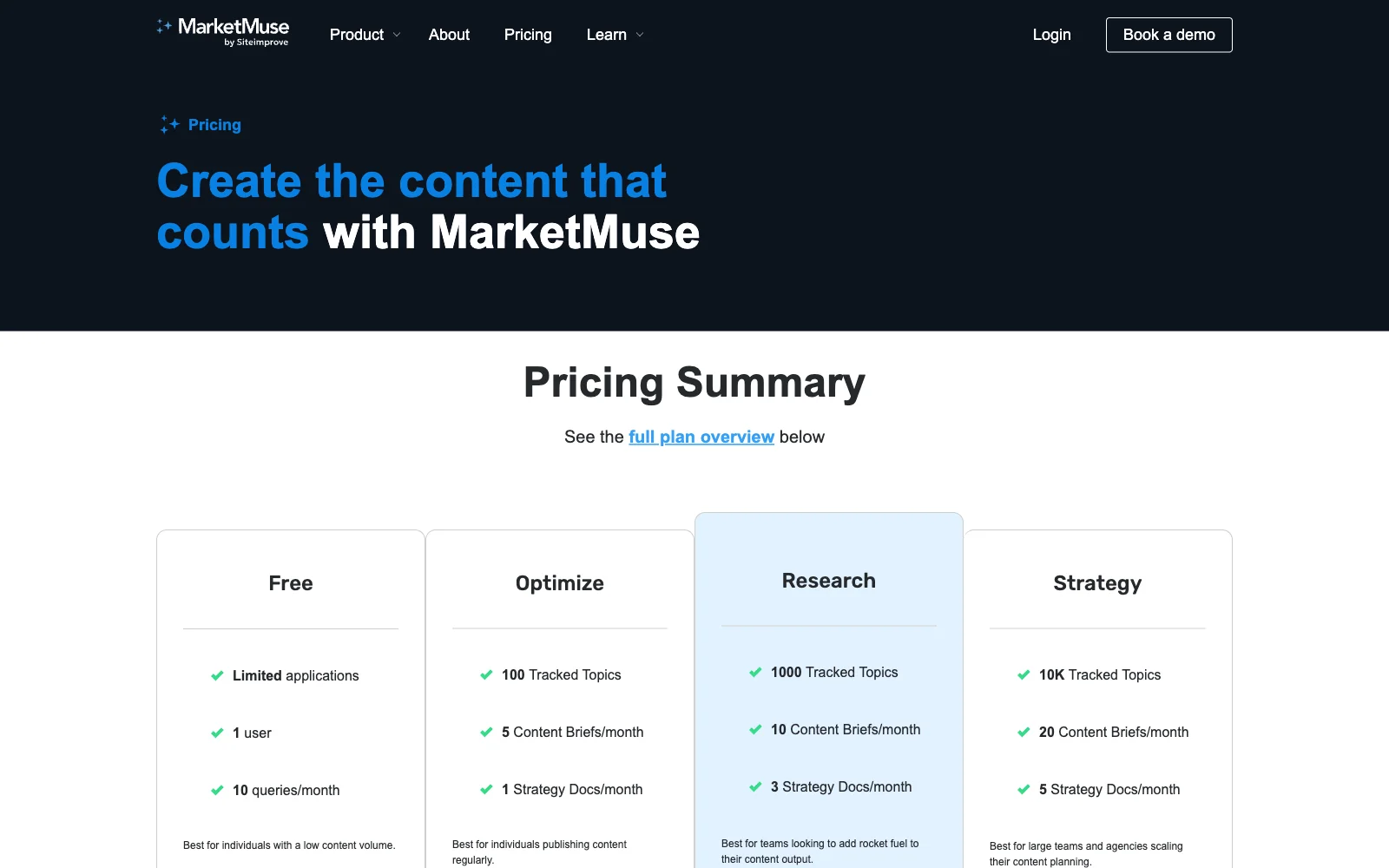
MarketMuse is the only content tool here with no AI-visibility feature at all: topic modeling, briefs, and classic scoring only. The free tier covers a single user and 10 queries a month; paid tiers scale tracked topics and briefs but publish no price.
Pros:
- A usable free tier with topic modeling and briefing for a single user.
Cons:
- No AI-visibility feature at all.
- Paid pricing isn't published; you book a demo to get a quote.
Price: Free tier; paid tiers unpublished
Category D: Technical llms.txt and AI crawlability tooling
10. LLMrefs
Best for: Dev-adjacent teams working through AI-crawlability readiness.
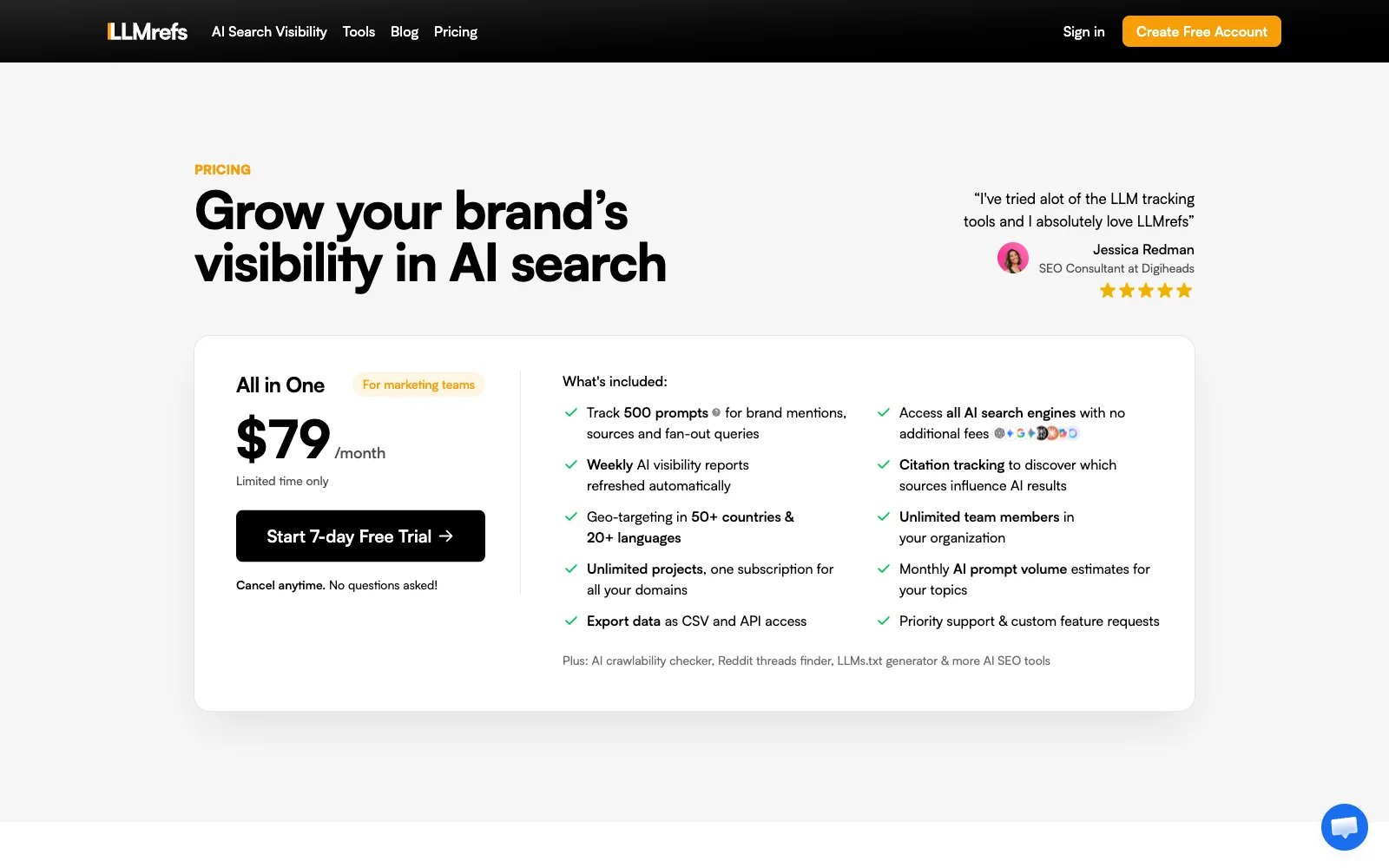
LLMrefs runs a single flat tier that bundles what most competitors sell separately: an llms.txt generator and an AI-crawlability checker, alongside prompt tracking across at least 10 AI platforms.
Whatever tool generates your llms.txt file, you can validate the result for free with our llms.txt checker; we built it for exactly that job.
Pros:
- One flat tier bundles an llms.txt generator, a crawlability checker, and prompt tracking across at least 10 platforms.
- A 7-day free trial before you commit.
Cons:
- The pricing page labels the $79 price "Limited time only", so check it before you budget.
Price: $79/mo (flat, single tier)
11. ZipTie
Best for: Teams that want spend to track actual prompt volume instead of buying a flat tier they might outgrow or overpay for.
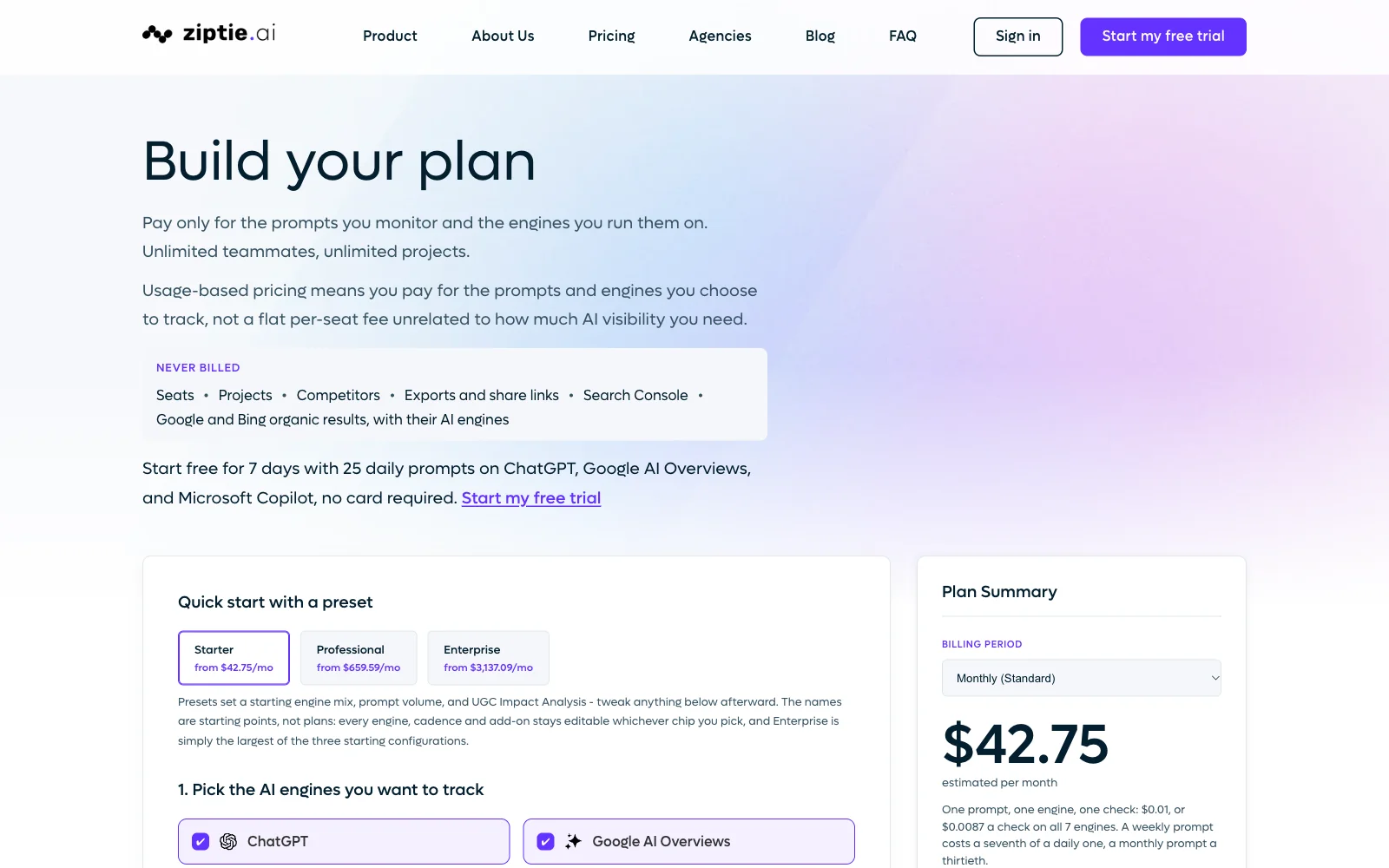
ZipTie prices by usage: you pay for the prompts you monitor and the engines you run them on. A Starter configuration starts around $42.75 a month; Professional and Enterprise configurations scale into the hundreds and low thousands as prompt volume grows.
The 7-day free trial covers 25 daily prompts across ChatGPT, Google AI Overviews, and Perplexity, enough to size real usage before committing.
Pros:
- You pay for the prompts and engines you actually use.
- A 7-day trial covering 25 daily prompts across three engines.
Cons:
- Costs scale into the hundreds or low thousands a month as prompt volume grows.
Price: From $42.75/mo (usage-based)
12. Mission Growth (our platform)
Best for: Teams that want monitoring bundled with expert execution rather than one more dashboard to check.
Mission Growth is an AI-led SEO and GEO growth service: AI catches the signal, our experts make the move, and you see the result. We built it for B2B SaaS, e-commerce, and consumer brands that want SEO and AI-search growth without building the team.
Our platform tracks AI citations and visibility for customers, and our experts act on what it finds. It isn't a self-serve tool in any single category above; engagements are scoped per customer.
Price: Monthly fee, quoted after an audit
AI visibility tracking is bleeding into every category
Three of the four AI content optimization tools in this table now ship some form of AI-visibility tracking, and MarketMuse is the lone holdout with classic scoring only.
That's 75 percent of the content category. Tool by tool:
- Clearscope includes tracked prompts at every published tier.
- Frase includes ChatGPT and Google AI tracking from its $39 Starter.
- Surfer sells it through its standalone AI Search Analytics tier.
The merger happened faster than the coverage: trackers are adding content features, content tools are adding trackers, and suites are bolting on both.
Two consequences follow. If your tracking needs are entry-level, a content tool you were buying anyway may already cover them, with Frase at $39 a month the extreme case. And category labels on pricing pages have become unreliable, so check the tier, not the homepage claim: Surfer "has" AI tracking, but Surfer's $49 tier has none of it.
Our read: within a couple of years, AI visibility becomes a feature checkbox rather than its own product category. Until then, the taxonomy above keeps vendor claims comparable.
How to choose based on team size and priority
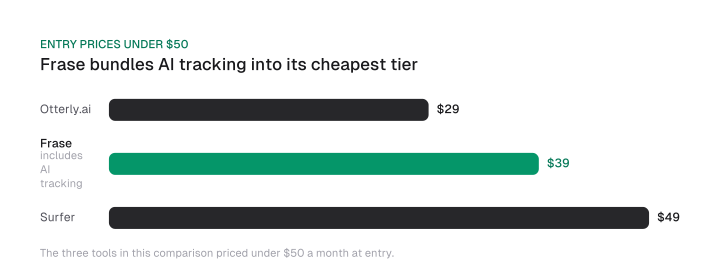
- Solo founder or startup that mostly needs content scoring, at the lowest price. Frase Starter at $39 a month or Surfer Discovery at $49. Only 3 of the 12 tools in our table (25 percent) have an entry price under $50: Otterly.ai at $29, Frase at $39, Surfer at $49. Of those three, Frase is the one that includes AI-visibility tracking at that price.
- Team already paying for Semrush, SE Ranking, or Ahrefs. Check whether the AI feature is bundled or a paid add-on before assuming you're covered: Semrush puts its 50 daily AI prompts in the Starter plan at $165.17 a month, SE Ranking's AI Search adds $71.20-$89 extra, and Ahrefs prices Brand Radar separately too (numbers in the LLM SEO tools guide).
- AI-referral traffic just showed up in your analytics and you need dedicated tracking. That's the dedicated AI visibility tools category. Otterly.ai is the budget entry and Profound the enterprise pick, but don't decide from two profiles: the full 11-tool comparison sits in our best LLM SEO tools roundup, and the ChatGPT-specific tier-gating breakdown sits in our ChatGPT SEO software comparison.
- Dev-heavy team focused on crawlability and llms.txt readiness. LLMrefs at $79 a month flat, or ZipTie from about $42.75 on its usage-based plan. Both treat the machine-readable surface as the product.
- Team that wants monitoring plus the execution handled. A dashboard tells you that you lost visibility; it doesn't write the content or fix the crawl. If you need both, the real decision is build versus buy versus hire. We wrote a full framework for that call in AI SEO agency vs software.
Pricing reality check: what "includes AI" actually costs
The median entry price across the nine tools with published self-serve pricing is $79 a month.
That figure excludes Mission Growth, a service model without self-serve pricing; MarketMuse, whose paid tiers are contact-sales-only; and Profound, whose only paid tier is custom-priced Enterprise. Sorted, the nine entry prices run $29, $39, $42.75, $49, $79, $79, $103.20, $129, and $165.17.
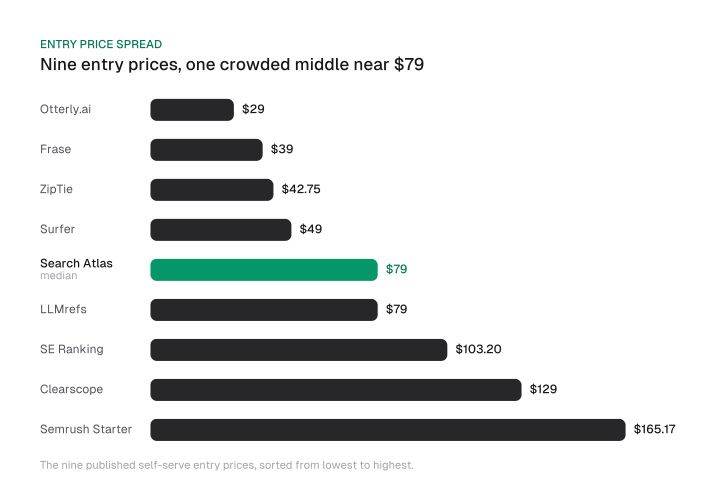
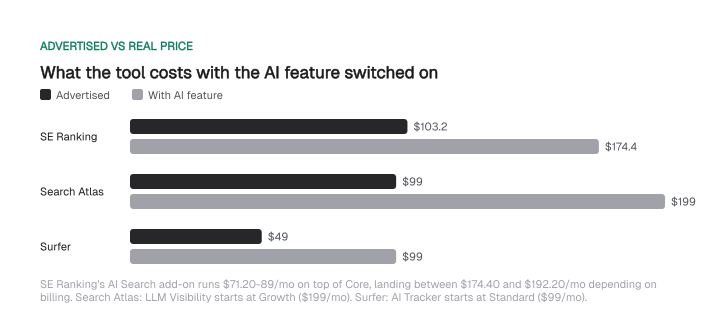
The median is the realistic number; the advertised price often isn't. With AI SEO software, the sticker price and the price with the AI feature switched on are frequently two different numbers.
Some tools gate their flagship AI-visibility feature behind a paid add-on or a pricier tier than the cheapest listed price. Here's where that happens:
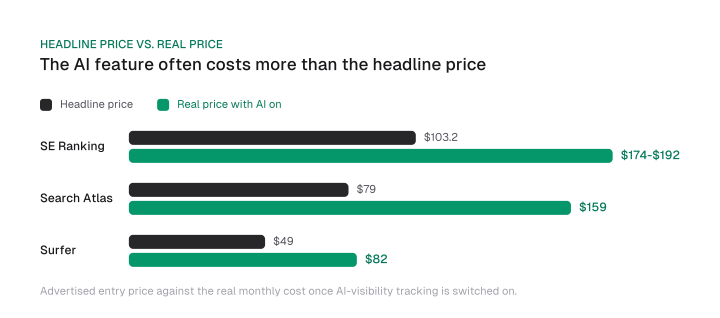
- SE Ranking: Core at $103.20 a month doesn't include AI Search; the add-on costs $71.20 to $89 on top.
- Search Atlas: Starter at $79 doesn't include AI Visibility; that starts at Growth, $159 a month.
- Surfer: Discovery at $49 doesn't include AI tracking; the cheapest way in is the $82 AI Search Analytics tier.
- Semrush: the first plan that states an AI prompt allowance is Starter at $165.17 a month, above the $117.33 SEO plan.
That's 4 of the 12 tools in the table, 33 percent of the lineup.
So the budgeting question is never "what does the tool cost" but "what does it cost with the AI feature switched on." For SE Ranking that lands between $174 and $192 a month, not $103.20. For Search Atlas it's $159 at Growth, not the $79 Starter headline. For Surfer, real cross-engine tracking is the $82 tier, not the $49 Discovery headline.
Ahrefs follows the same add-on pattern with Brand Radar; the current numbers live in our LLM SEO tools guide. None of this is hidden, but each gate sits one scroll below the headline number.
Price is only half the question. The other half is what to measure once the tool is live: citation share, prompt coverage, AI-referral sessions, and how those numbers tie back to revenue. We covered that measurement stack in AI search analytics.
Frequently asked questions
What are AI SEO tools?
AI SEO tools are software products that either use AI to do classic SEO work (briefs, content scoring, automation) or measure your brand's visibility inside AI-generated answers on ChatGPT and Perplexity, plus Google AI Overviews. In 2026 the label spans four distinct categories: AI-visibility trackers, AI-powered SEO suites, AI content optimization tools, and technical AI-crawlability tooling. Most products fit only one of the four categories well.
What are the different types of AI SEO tools?
Four types:
- AI visibility and GEO monitoring, such as Profound and Otterly.ai, tracks whether AI answers cite you.
- AI-powered suites, such as Semrush, SE Ranking and Search Atlas, add AI features to established rank-tracking platforms.
- AI content optimization, such as Surfer, Clearscope, Frase and MarketMuse, handles briefs, drafting and scoring.
- Technical tools, such as LLMrefs and ZipTie, audit llms.txt files and AI crawlability.
Match the category to your bottleneck before comparing prices.
How much do AI SEO tools cost in 2026?
Published entry prices in our 12-tool comparison run from $29 a month for Otterly.ai to $165.17 for Semrush's Starter plan, with a median of $79 across the nine tools that publish self-serve pricing. Budget past the headline number: the flagship AI feature costs extra in roughly a third of the lineup, either as a paid add-on or a tier upgrade that can double the monthly price.
Is an AI-powered SEO suite like Semrush or SE Ranking enough, or do I need a separate AI-visibility tracker?
Check what your tier includes first. Semrush's first plan with a stated AI prompt allowance is Starter at $165.17 a month, and SE Ranking's AI Search adds $71.20 to $89 a month extra, so "we already have a suite" often just means "we could pay extra to add tracking." Dedicated trackers go deeper on engine coverage and prompt volume; suites win when you want one vendor and consolidated billing.
Do AI SEO tools work for ChatGPT and Google AI Overviews, or just traditional Google rankings?
It depends on the category and the tier. Dedicated trackers cover multiple AI engines, but entry tiers often narrow the list: Profound's free Trial tracks ChatGPT only, while Otterly.ai's $29 Lite covers four engines. Content tools vary more; Surfer's AI tracking lives in a separate $82 tier covering five engines from day one; there's no cheaper single-engine option. Always verify per-tier engine coverage on the vendor's pricing page before you commit.
What's the difference between an "AI SEO tool" and an "LLM SEO tool"?
"AI SEO tool" is the broad label covering all four categories in this post, including AI-assisted classic work like briefs and audits. "LLM SEO tool" usually means the narrower visibility-tracking slice: software that measures whether large language models cite your brand in their answers. If that narrower job is yours, our LLM SEO tools comparison covers eleven of them with dated pricing.
Cite this page
Aktaş, F. (2026, October 4). Best AI SEO Tools in 2026. Mission Growth. https://missiongrowth.io/blog/best-ai-seo-tools
Download the data: 1 table as CSV (CC BY 4.0)
Figures we made for this post are free to reuse under CC BY 4.0 with credit to Mission Growth.
Get Mission Growth highlighted in your Google results.