AI Visibility Tool vs SEO Suite: 4 Tests and Real Prices
AI visibility tool vs SEO suite compared: four tests on engines, seats, volume and who acts, with plan prices checked October 2026, to pick suite, tool or both.
By Furkan AktaşPublished Updated
On this page
If you already pay for an SEO suite and someone asks whether you need an AI visibility tool too, the category label won't settle it. Four checks on the plan will: how many prompts it allows, which engines it names, what a second seat costs and who acts on the report.
The AI visibility tool vs SEO suite choice comes down to those four tests, because the AI tier of a suite is sold in units that hide what it samples. Semrush runs one engine per campaign, SE Ranking's page shows a plan quota and a separate add-on, and Ahrefs sells checks.
Here's the plan:
- What each side actually measures, and why that changes which number you trust.
- What each suite's AI tier includes, with current prices and engines.
- The four tests and a setup for each situation.
AI visibility tool vs SEO suite: what each one measures
An SEO suite measures a ranked list that stays put between checks; an AI visibility tool measures a generated answer that changes every time.
The unit of a suite is the ranked page. The unit of an AI visibility tool is the generated answer: whether your brand is named in it, and which sources it cites. That difference shows up in five places:
Suites now sample AI answers too, so the dividing line is the unit measured. Semrush's help center says its Prompt Tracking interface works the same as Position Tracking on traditional Google, with a few key differences, and it lists Average Position among the metrics. You also pick one engine per campaign: ChatGPT Search, Google AI Mode or Gemini.
So a prompt you want on three engines needs three campaigns. And that raises a question the pricing page doesn't answer: does a 50-prompt allowance count a prompt once, or once per engine? Put it to the vendor in writing.
Position is the shakier number to chase. SparkToro's January 2026 study had 600 volunteers run 12 prompts through ChatGPT, Claude and Google AI, 2,961 runs in all. For ChatGPT and Google AI, fewer than 1 in 100 pairs of responses gave the same brand list, and two lists came back in the same order only about 1 in 1,000 runs.
The data was collected in November and December 2025, so newer models may differ.
That study is about brand lists in recommendation answers. It says nothing about citation order. What it supports is reading the share of sampled answers that mention the brand instead of the position, and sizing runs with the prompt universe approach.
A rank view also covers only part of what an AI Overview cites. Ahrefs' March 2026 study of 863K keyword SERPs found 37.9% of cited URLs in the first 10 blocks. That leaves 62.1% outside the first 10 results (100 minus 37.9): 31.2% in positions 11 to 100 and 31.0% beyond the top 100 blocks.
Our own capture lands close:
Across 58 US Google results pages we captured between 22 September and 1 October 2026 (searches for the SEO, GEO and AI-marketing topics we research, not a random sample of US queries), 42 showed an AI Overview, which is 72.4%; the median Overview cited 7 sources, and 50.4% of the 268 cited sources were domains that also ranked in that page's organic results, or 40.7% when matched by exact URL.
Two samples of very different size agree within 3 points at page one depth. Two caveats apply. Ahrefs improved its parser since an earlier study that found roughly 76% in July 2025, so the two shares are not a trend. And our 58 pages cover topics we research, so read the 59.3% as a cross-check. The full set of AI Overview citations lives in our statistics hub.
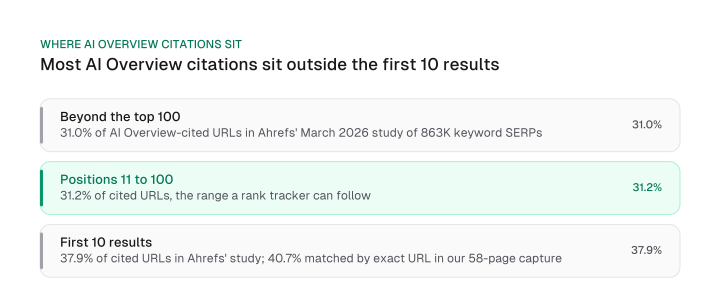
Keep one limit in mind. A rank tracker that follows positions 11 to 100 does reach 31.2% of those citations; what it can't show is the 31.0% beyond the top 100 blocks, or what the answer says about you.
Is this a separate cost, or just good SEO? Both. The work overlaps with good SEO, because crawl access, content and links feed both measurements. The measurement does not overlap.
The plan step is small. On Semrush it's $60 more a month to go from the SEO plan at $139 to Starter at $199, the first plan with a stated prompt allowance (50 daily prompts). That's one more line on a bill you already pay.
A monthly change in any of these numbers only counts once it clears the noise, and our AI search visibility KPIs guide defines which metrics are worth tracking.
How SEO software suites package AI tracking
An SEO software suite sells AI tracking inside a plan tier, as separate check packages, or as an add-on, so compare the engines, add-ons and seats each plan names.
The table puts each vendor's own plan, quota, engine list and seat price side by side. Semrush and SE Ranking amounts are monthly list prices; Nightwatch is in euros, isn't converted, and shows its per-month rate on yearly billing.
Download CSV (CC BY 4.0)
Semrush AI visibility pricing by plan
Semrush AI visibility pricing is a ladder of monthly plans: SEO at $139, Starter at $199, Pro+ at $299 and Advanced at $549 a month. Starter adds an AI-ready Site Audit and 50 daily prompts, Pro+ lifts the allowance to 100 and Advanced to 200.
Semrush's help center lists ChatGPT Search, Google AI Mode and Gemini for Prompt Tracking, while the AI Visibility part of its SEO + AI Search plans carries its own engine list, so check which module your plan includes before you count engines. A price table that shows Pro, Guru and Business plans, or the Semrush AI Visibility Toolkit as a separate purchase, is out of date.
SE Ranking AI tracking: plan quota or add-on
SE Ranking needs a careful read. Its subscription page lists Core at $129 a month at list price with 100 prompts to track daily and 1 manager seat, and Growth at $279 with 250 prompts and 3 manager seats.
The plan table also shows GEO limits of 100 and 250 daily prompts and 5 LLMs without naming them. Separately, an AI Search add-on costs $89.00 a month at monthly billing ($71.20 with annual billing), and its AI Results Tracker names AI Overviews, AI Mode, Perplexity and ChatGPT.
So "Core includes AI tracking" and "Core excludes it" are both readable from that page. Ask SE Ranking whether the quota runs without the add-on. If it needs it, Core plus the add-on is $218 a month at list prices ($129 for Core plus $89.00 for the add-on).
Ahrefs AI visibility: Brand Radar and Custom Prompts
Ahrefs sells AI visibility tracking differently. Every paid plan bundles a daily Custom Prompts quota (Lite 5, Standard 10, Advanced 20), but its AI visibility offer is Brand Radar, sold as check packages: Basic at $50, Growth at $100 and Scale at $250 a month. One check is 1 prompt on 1 platform in 1 location, and you can buy Brand Radar standalone, without the suite.
Dedicated AI visibility tools: engines, answers and seats
Counting the engines each vendor names on its own pages gives a spread: 3 on Semrush (one per campaign), 4 on the SE Ranking add-on, six AI platforms on every Nightwatch plan and up to 9 on Profound's Enterprise plan. Peec Starter lets you choose 3 models. So Claude is on Nightwatch's list, not on Semrush's Prompt Tracking or SE Ranking's add-on list; Semrush places it in Enterprise AIO.
Dedicated AI visibility tools price the unit differently again. Peec's own formula for monthly answers is tracked prompts times active models times tracking frequency, and its Starter plan has 50 prompts, 3 models and unlimited users. Otterly lists Lite at $29 for 15 prompts, Standard at $189 for 100 and Premium at $489 for 400, and sells extra engines as add-on packages.
Seats are where bundles and dedicated tools part ways. A second reader costs $40 a month on Ahrefs Lite (two more users at $40 each) and from $45 on Semrush. SE Ranking includes 1 manager seat on Core and 3 on Growth, with extra manager seats from $16. Peec Starter has unlimited users and Nightwatch charges no per-seat fees.
How the plans were compared
We compared the public pricing and help pages of each vendor. We ran no hands-on tests, and every plan fact comes from the vendor's own page. Semrush prices are monthly-billed, SE Ranking prices are list prices, and Nightwatch is in euros at its yearly-billing monthly rate. Prices and plans verified October 2026.
Four tests that decide between a suite, a dedicated tool or both
Stay in your SEO suite when your prompt count, engines, seats and fix workflow all fit its AI tier; add a dedicated tool when one test fails.
Run the four tests in this order:
- Volume. Multiply prompts by engines by days tracked, then compare that with the plan allowance, sized in our guides to the best AI rank tracking and the best LLM SEO tool.
- Engines. List the engines your buyers use, then check each against the engines the plan names. Claude is on Nightwatch's list and absent from the Semrush Prompt Tracking and SE Ranking add-on lists, so a Claude-heavy audience fails this test on a Semrush self-serve tier; Semrush's blog places Claude in Enterprise AIO. If you lean on SE Ranking, check the engines its AI Search add-on names before you count the plan's GEO quota.
- Seats. Count who needs to read the report and price the extra users. At $16 to $45 a seat, every extra reader adds a monthly line to a suite plan, while Peec and Nightwatch don't charge by seat.
- Who acts on the findings. If the person who reads the AI report also fixes crawl access, content and links, the suite's audit earns its place, and Starter's AI-ready Site Audit sits next to the tracker.
Volume is priced elsewhere, and the open question is whether a suite counts prompts once or per engine. Engines and seats you can settle from the plan pages today, and who fixes what you settle with your own team.
Published self-serve prompt plans top out at 200 on Semrush Advanced and 250 on SE Ranking Growth (its AI Search add-on lists tiers up to 1,000 prompts), against 350 on Peec Advanced, 400 on Otterly Premium and 500 on Nightwatch Agency; Otterly sells extra prompts as add-ons.
Before you read a monthly change as real, check it against the noise table in our AEO prompts guide.
Here's how the tests map to setups:
The best SEO suite for this job is the one you already pay for, when the four tests pass. If you use a suite for rank tracking and a dedicated tool for AI, keep one prompt panel in the tool that samples and leave the suite's tracker for classic positions.
Enterprise SEO suite or enterprise AI visibility platform
An enterprise SEO suite and an enterprise AI visibility platform both sell custom plans, so compare what each quotes in writing.
Semrush's Enterprise tier lists custom large-scale AI prompt tracking at a daily or weekly frequency, with custom limits. Profound's pricing page lists tailored prompt tracking and up to 9 answer engines. If you're weighing an enterprise SEO platform, ask both vendors for the same three things in writing: answers per month, engines and frequency.
Comparing an SEO tool suite and a dedicated tool on those three lines settles most of it. So the closing test is yours: if nobody on your team will act on what a report finds, skip both and fix the crawl, content and link work first. When the four tests pass, stay in the suite you pay for and ask your vendor for the answers-per-month number this week.
Frequently asked questions
How is AI visibility different from SEO?
SEO tracking shows where your pages rank in search results. AI visibility tracking shows whether AI answers mention or cite your brand for a prompt, which a rank view cannot see: by Ahrefs' count, 62.1% of AI Overview-cited URLs sit outside the first 10 results. That difference is why a suite's AI tier and a dedicated AI visibility tool are bought for different reports.
Do SEO suites track ChatGPT?
Yes, several do. Semrush's Prompt Tracking lists ChatGPT Search, SE Ranking's AI Search add-on names ChatGPT, and Nightwatch lists ChatGPT among its six platforms. On Semrush you pick one engine per campaign, so tracking ChatGPT and Gemini together means separate campaigns.
Can I use Semrush for SEO and Profound for AEO together?
Yes, you can pair Semrush for SEO with a dedicated tool such as Profound for AEO. Ahrefs sells Brand Radar standalone from $50 a month, so a split stack is a normal setup. Give each job one owner, so the suite and the tool don't report different numbers for the same prompt.
How much does it cost to add AI tracking to a suite I already pay for?
On Semrush it's $60 more a month from the SEO plan to Starter, which adds 50 daily prompts. SE Ranking's AI Search add-on is $89.00 a month at monthly billing. Ahrefs Brand Radar packages start at $50 a month. Prices were read from each vendor's page in October 2026.
What is LLM SEO, and which LLM is best for SEO?
LLM SEO means tracking how the models your buyers ask answer your category's prompts. No single LLM is best for SEO, so pick the engines your buyers use, check which plan includes each one, and write the prompts with our AEO prompts guide. The engine list per plan decides which tool you need.
Is an SEO suite's AI tier enough on its own?
Yes, while the four tests pass. Volume, engines, seats and who fixes what all have to fit. The engine list and the seat count are the two you can check from the plan pages today, and a failure on either is a reason to add a dedicated tool alongside the suite.
Do I need a tool at all if nobody will act on the report?
No. A report nobody acts on is a cost with no return, whatever it sits in. If you want the monitoring and the fixes handled together, an AI SEO agency is the other route. Mission Growth is an AI-led SEO and GEO growth service: AI catches the signal, our experts make the move, and you see the result. Mission Growth's platform tracks AI citations and visibility for customers.
Cite this page
Aktaş, F. (2026, October 9). AI Visibility Tool vs SEO Suite: 4 Tests and Real Prices. Mission Growth. https://missiongrowth.io/blog/ai-visibility-tool-vs-seo-suite
Download the data: 1 table as CSV (CC BY 4.0)
Figures we made for this post are free to reuse under CC BY 4.0 with credit to Mission Growth.
Get Mission Growth highlighted in your Google results.