AEO Prompts: How Many to Track, Plus 10 Patterns to Start
AEO prompts need a count you can defend. See what 8, 25 or more prompts can confirm each month, plus 10 fill-in patterns and where real wording comes from.
By Furkan AktaşPublished

On this page
AEO prompts are the test questions you send to AI answer engines to see whether your brand gets mentioned, cited or recommended. They matter for answer engine optimization because the prompts you pick decide what your numbers can tell you.
Treat the set like a sample. A handful of prompts read once a month gives you a number with a wide error bar,.
If you're about to fill the prompt slots in a tracker, this page gives you the wording sources, a starter set and the arithmetic for what a given count can confirm.
In this guide:
- Where real buyer wording comes from, including the one engine report that hands back phrases
- 10 prompt patterns with fill-in slots and a reading for every hit and miss
- A five-check test for which candidates earn a tracking slot
- How many prompts and runs you need, and what to score
AEO prompts: what they are and where to find real ones
AEO prompts are the test questions you send to AI answer engines on a schedule to see whether your brand is mentioned, cited or recommended, so each one is a measurement instrument that happens to look like a question.
That answers "what is an AEO prompt" for tracking purposes. One caution on the word: a working prompt, the kind in ChatGPT prompts for marketing, is an instruction you give a model to get marketing work done, and a tracked prompt is a question you ask an engine to measure a brand. This page is about the second kind.
A tracked prompt differs from a keyword in two ways. It carries constraints and context ("for a regulated team", "under a set budget") that a keyword drops. And it has no real volume behind it, so AI prompt volume figures are modeled guesses. With nothing to rank by, you source prompts from real wording instead.
Here's the order we'd trust, from most to least reliable. The order is our judgment, not a standard:
- Sales calls and support tickets. Buyers phrase the problem in their own words, with the constraints attached, which is exactly what a prompt needs.
- Community threads and review sites. People describe what they tried and what failed, and that wording transfers well to prompts.
- Your own search and site-search queries. They show what visitors already ask, though usually in shorter form than they'd type to an assistant.
- Engine-side data. Bing's report returns retrieval phrases; Google's report returns impressions without any wording.
- Tool-suggested prompts. Useful to fill gaps, but tag them "generated" so you can pull them out later.
What each engine hands back
Bing's report is the one that returns phrases, and those phrases are retrieval queries, which makes them a poor stand-in for buyer prompts. Grounding queries in Bing Webmaster Tools are, in Microsoft's February 2026 description, the key phrases the AI used when retrieving content that was referenced in AI-generated answers, shown as a sample of overall citation activity.
So a grounding query is what the engine searched to find your page. A buyer never typed it.
Google's side is different. Google's June 2026 announcement describes dedicated views of impressions in AI Overviews and AI Mode, broken down by pages, countries, devices and dates. It launched to a subset of websites first and lists no prompt phrases. For the wider tooling picture, see AI search analytics.
In practice, use Bing's phrases to seed wording and to group themes, and give them a "retrieval" source tag in your register. Never count one as a prompt a buyer asked, and never read the list as volume.
AEO prompts examples: 10 patterns to start with
Ten prompt patterns, each built on a constraint the buyer adds (segment, budget, stack, team, region, timeline, risk, switching, head-to-head and job to be done), give you a starter set where every row says what a hit means.
The constraint is the organising idea because a different use case returns a different list of brands. Fill the square-bracket slots with your own category and buyer, and read each row as a diagnostic.
Treat these AEO prompts examples as your starting set and swap in your own wording as it arrives.
The best AEO prompts at this stage are the ones whose miss column you can act on.
Copy the fill-in column as an AEO prompts template, swap the slots and keep the bucket.
Row 9 needs a use case. Without one, the engine tends to hedge and the answer tells you little.
Here are three rows filled for a made-up B2B brand, Northwind Ledger (illustrative only):
- Segment: "Best accounts payable software for mid-size manufacturers"
- Team and role: "Accounts payable software for a small finance team where the controller owns it"
- Timeline: "How long does it take to set up accounts payable software and what does it need from us?"
A word on wording. A definitional prompt ("what is X") is a poor test of whether you get recommended, because it asks for an explanation and not for options.
One tracker's documentation classifies Awareness-phase prompts as broad, unbranded and problem-based, with brand mentions typically lower. Keep those prompts, but read them as their own bucket.
That documentation assigns each prompt one of four phases (Awareness, Consideration, Evaluation, Decision). Keep that phase as a tag on every row, and keep branded and unbranded prompts in separate buckets.
Per-engine wording matters less than the constraint. Keep the same slot structure on every engine, and adjust only the phrasing an engine handles badly.
When you need to turn one buyer task into many prompt cells, prompt research for AI SEO shows the full build.
Which AEO prompts earn a tracking slot
An AEO prompt earns a tracking slot when it passes a repeat check (5 runs on one engine, with a brand named in every run and one brand in at least 3) plus four quick checks on source, bucket, wording and purpose.
This is the core of an AEO prompt strategy. Slots are limited, and adding or swapping prompts later resets the series, so refuse candidates by test before they cost you a slot.
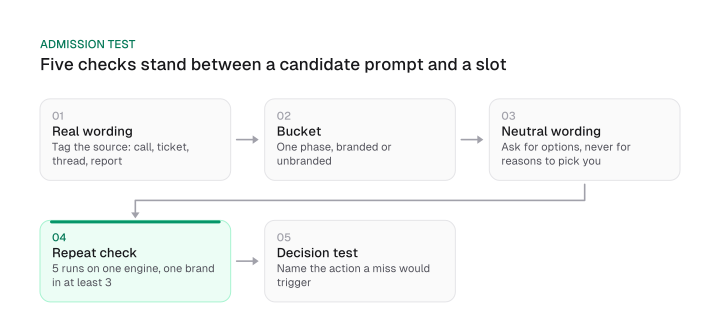
Here are the checks, in order:
- Real wording and a source tag. Name where the prompt came from (sales call, ticket, thread, engine report). Tag tool-written prompts "generated" and Bing grounding queries "retrieval", so the three stay separable.
- Bucket. Put the prompt in one of the four phases, branded or unbranded. The two never share a score.
- Neutral wording. The prompt asks for options and never for reasons to choose you. A leading prompt flatters your own number.
- Repeat check. Run the candidate 5 times on one engine. It passes if every run names at least one brand and the most frequent brand appears in at least 3 of the 5.
- Decision test. Write down the action a miss would trigger. No action, no slot.
The repeat check is the one that does the filtering. SparkToro's January 2026 study suggests that how often a brand shows up in a topic space may have much less to do with the brand's prominence than with how many potential recommendations the AI chooses from.
A prompt that fails the repeat check probably describes a scenario with too many candidates. Add a constraint (a segment, a budget, a stack) or drop it.
The 5 and the 3 are working numbers we picked; nobody has measured them as a threshold. Adjust them if your category is crowded, but write the rule down before you run it.
Then freeze the panel. Swapping prompts later starts a new series, so baseline resets are the real cost of a sloppy first set. Lock it for a quarter, and version any change.
How many AEO prompts and runs you need
Sampling error alone sets a floor: if each prompt returns one fresh answer per engine per day, a cluster of 8 prompts gives 224 answers in 4 weeks, a margin of about 7 points, and a month-on-month shift under about 9 points cannot be told from noise.
Start with the plan you probably have. One mainstream marketing suite's entry AEO plan covers ChatGPT, Perplexity and Gemini with 25 prompts for $50 a month, and its docs say tracked prompts run daily. The arithmetic assumes one fresh answer per prompt per engine per day. Here's the math:
- 25 prompts across 3 engines make 75 prompt-engine pairs.
- Over 30 days that is 2,250 answers a month.
- $50 divided by 2,250 is about 2 cents an answer, which is the price per answer you can compare across plans.
- 25 prompts fit 3 clusters of 8, with one slot spare.
If you're comparing plan caps across vendors, AI visibility tools lays out how the limits differ.
A cluster's mention rate is a proportion, so it has a margin of error. The table below uses a 95% confidence level, the worst case at a 50% mention rate, and treats answers as independent draws.
Download CSV (CC BY 4.0)
The table restated: 8 prompts read for 4 weeks carry about a 7-point margin, and the month-on-month change has to reach about 9 points before it clears noise. Going from 8 to 10 prompts buys you only 1 point of that threshold.
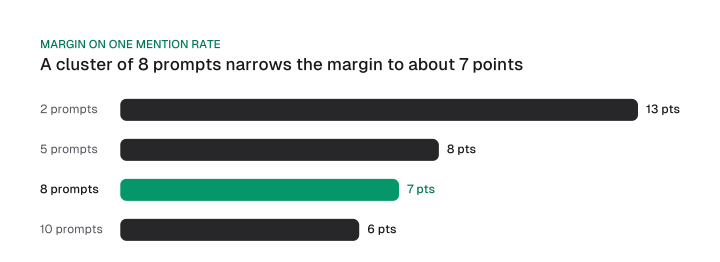
A single week is much weaker. An 8-prompt cluster read for 7 days yields 56 answers, a margin of 13 points and a smallest detectable change of 19 points, so weekly lines are direction only.
That is the same range ChatGPT SEO tools reaches when it works the margin for repeated runs of one prompt. Daily runs give you 7 answers per prompt per engine per week and 28 in 4 weeks, so cadence sets how fast the error bar closes.
Two caveats keep this honest. The 50% worst case is the ceiling on sampling noise, so a prompt that almost always or almost never names you is steadier than the table suggests.
But the table covers sampling error only. Engine churn between days and wording differences between prompts add noise it leaves out, so a shift above the threshold is necessary to call a change and not sufficient. And because it treats answers as independent, real margins are wider.
Use the table as a decision rule:
- Change under 9 points a month matters? Use 10 prompts, or add engines as separate clusters.
- Plan allows only 3 clusters of 8? Pick the three scenarios that decide revenue.
- Several engines? Never pool them into one rate, because rates differ by engine.
- Reading a week? Treat it as direction, and read the month as the result.
Score presence rate, not position in the answer
Presence rate is the number to score for each cluster, meaning the share of runs that name your brand, and branded and unbranded prompts need separate rates because a brand's place in the answer varies far more than whether it appears.
Some scorecards define share of answer as weighted by position. Scorecards that report presence are right, and a score weighted by position is the defect.
SparkToro's January 2026 study had 600 volunteers run 12 prompts through each of 3 tools, 2,961 runs in all. Two lists came back in the same order about 1 in 1,000 runs, while percent visibility is, in the study's words, "probably" a reasonable measure.
One prompt shows the gap. A cancer-hospital prompt on ChatGPT named one hospital in 69 of 71 answers, a 97% visibility rate. That same hospital was the top mention in only 25 responses, or 35%. Appearing is stable. Ranking first is not.
For what each KPI divides by, see AI search visibility KPIs.
So the thesis in one line: an AEO prompt is a measurement instrument, and a set of them is a sample with an error bar. Your next step is to write 8 prompts for the one scenario that decides most of your revenue, tag each with its source and bucket, and run them daily for 4 weeks. Then read the presence rate with its margin.
If you want a tracker to run that set, AEO tools compares the options. Mission Growth's platform tracks AI citations and visibility for customers.
Frequently asked questions
What are the top 10 AI prompts for AEO?
The 10 patterns in the table above are the starting set: segment, budget, stack, team and role, region, timeline, risk, switching, head-to-head and problem-first. They are tracking prompts that measure a brand. Generic prompts you give a model to do marketing work are a different thing.
How many AEO prompts should I track per topic?
Eight per cluster is a workable floor. It supports detecting about a 9-point monthly shift, and 25 prompts make three such clusters. If the change you care about is smaller, use 10 prompts or add engines as separate clusters rather than pooling them into one rate.
How often should I run AEO prompts?
Daily gives 7 answers per prompt per engine per week and 28 in 4 weeks. Read the weekly line as direction, because 8 prompts yield only 56 answers in a week. Read the monthly figure as the result, with its margin attached.
Is an AEO prompt the same as a ChatGPT prompt for marketing?
No. A tracked prompt is a question you ask engines to measure how a brand shows up. A working prompt is an instruction you give a model to produce marketing work. They share a word and nothing else, so keep the two lists apart in your register.
Should an AEO prompt name my brand?
Only in the branded bucket, such as head-to-head and switching prompts. Unbranded prompts leave your brand out so the engine has to choose. Report the two buckets apart, because one tracker's docs note brand mentions are typically lower in unbranded Awareness prompts.
Where do I find prompts if I have no sales calls yet?
Start with tool-suggested prompts tagged "generated", add Bing's grounding queries tagged "retrieval" if your site is indexed there, and fill gaps from community threads. Replace the generated ones with real buyer wording as soon as sales calls and tickets start arriving.
Cite this page
Aktaş, F. (2026, October 9). AEO Prompts: How Many to Track, Plus 10 Patterns to Start. Mission Growth. https://missiongrowth.io/blog/aeo-prompts
Download the data: 1 table as CSV (CC BY 4.0)
Figures we made for this post are free to reuse under CC BY 4.0 with credit to Mission Growth.
Get Mission Growth highlighted in your Google results.