
Enterprise SEO: What It Is, Strategy and Choosing a Platform
What enterprise SEO is, when crawl budget and team sign-off start to limit a site, and how to build a strategy for governance, migrations and platform choice.

On this page
Enterprise SEO starts at a threshold: a technical one Google documents with numbers, or an organizational one measured in how many people must approve one page change.
Most definitions stop at size: "thousands of pages," "a global brand." Size alone isn't a test you can run.
This guide builds a real test, then covers what breaks once you cross it: crawl budget, near duplicate templates, migrations, platform claims and the failure patterns that keep repeating.
In this guide:
- A test for whether you've actually crossed into enterprise SEO
- What crawl budget rations, and the size where it starts to matter
- A blast radius framework for scoring which changes need real safeguards
- Why some migrations recover in weeks and others take most of a year
- Three tiers of evidence for weighing an enterprise SEO platform's claims before you sign
What actually makes a site "enterprise" in enterprise SEO
Enterprise SEO starts the moment a site crosses either a technical threshold or an organizational one. You don't need both.
The technical threshold comes from Google's own guidance for large sites. The organizational threshold is procedural: how many teams must approve a routine page change before it ships.
Here's a test you can run against your own site instead of guessing from its size:
| Axis | You've crossed it when |
|---|---|
| Technical | Over roughly 1,000,000 pages that change about weekly, over 10,000 that change daily, or a large batch of URLs sitting in "Discovered - currently not indexed" in Search Console |
| Organizational | A single template or copy change needs more than one team to approve it before it ships |
Download CSV (CC BY 4.0)
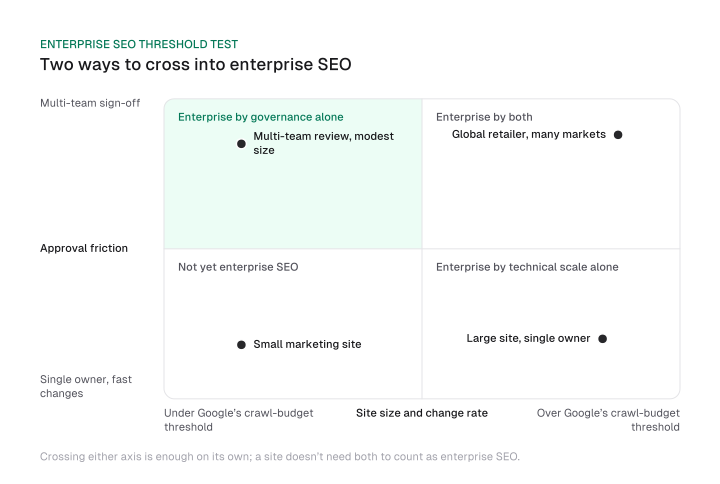
Cross either row and you're in enterprise SEO territory, at least for that mechanism:
- A large site with one owner and a fast deploy pipeline can skip most of what follows.
- A smaller site split across six regional teams, each holding veto power over a title tag, can't, even far below Google's size threshold.
The technical axis is well documented; the core technical checks every site needs covers it at the crawl and indexing layer. The organizational axis shows up nowhere in Search Console, only in how long a fix waits on legal and brand to sign off.
The difference from SEO at a smaller company isn't page count. A smaller team can ship a redirect the same day; a team past either threshold usually can't.
This guide sets aside the buyer journey and sales cycle content that shapes demand generation. That's covered in our B2B SEO guide; this one stays on scale and governance mechanics.
Two more layers sit on top of this system:
- AI Overviews and other AI search surfaces run on the same crawled, indexed pages; see our guide to AI search optimization services if you're building that layer specifically.
- Schema markup matters more at this size too, mostly because there's more of it to keep consistent; that's implementation depth for another guide.
Why a one-line fix takes months: the governance problem
Enterprise SEO changes stall because of blast radius and reversibility. The fix itself is rarely the hard part.
A title tag rewrite is trivial engineering. Roll it out across six markets and a mistake touches six markets at once.
That's what pulls legal and brand into review before a change that's one line long ships.
The fix is scoring the change first: every change type has a blast radius, how many pages and markets it touches, and a reversibility, how fast you can undo it if it's wrong.
Score both, then match the safeguard to the score instead of sending everything through the same chain.
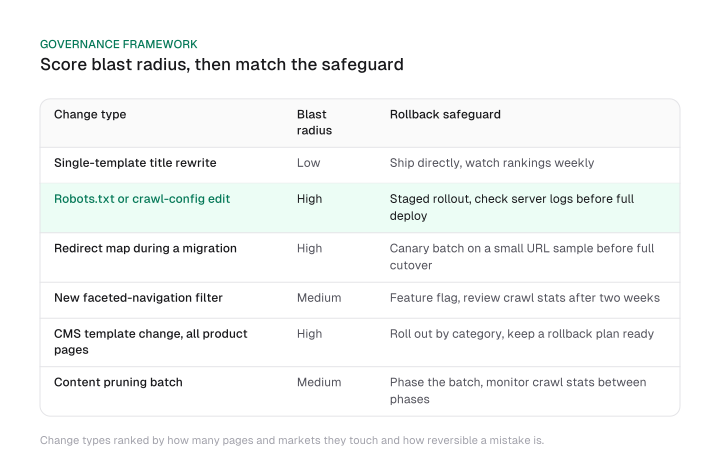
A robots.txt edit or a crawl configuration change belongs at the top of that list. It can quietly deindex a section within days, and few teams notice until traffic drops.
A title rewrite on one template sits near the bottom: low blast radius, easy to reverse, safe to ship without a committee.
Sort your own change types this way once. Most of what needs a meeting today won't need one tomorrow.
Setups spanning multiple domains raise the same question at a different layer. When three domains share a CMS but not a review process, a change scored "low risk" on one domain ships unreviewed to the other two.
Apply the same scoring rule to each domain individually; that alone closes the gap.
If you need a shared list that gets every reviewing team, from technical to legal, aligned, share this ai seo checklist with the teams that must sign off before your next migration or platform rollout.
What crawl budget actually rations at enterprise scale
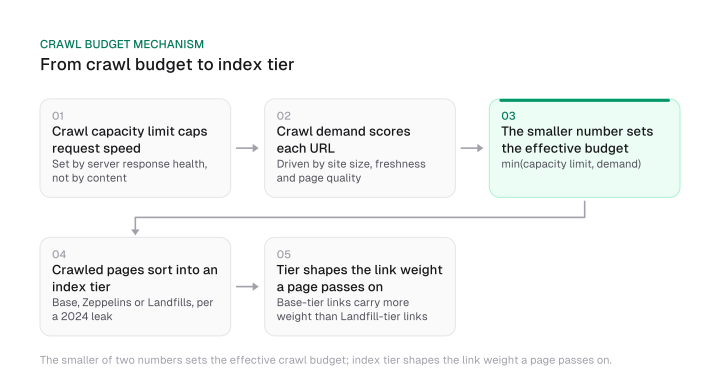
Crawl budget is the smaller of two numbers: a crawl capacity limit and a crawl demand score. Google uses whichever is lower.
The capacity limit is about server health: how fast your site can serve Googlebot's requests without breaking. Demand is about relevance.
Google names site size, update frequency, page quality and relevance to other sites as the demand drivers. A large site with weak pages still gets throttled on the demand side.
None of this matters much below Google's own threshold: roughly 1,000,000 pages that change about weekly, or 10,000 that change daily, or a large batch of URLs stuck in "Discovered - currently not indexed."
Below that line, content quality and internal linking are the bottleneck; crawl budget rarely is.
Here's the correction worth making: crawl budget isn't a fixed number Google allocates to your account.
Google's own team said as much on its Search Off the Record podcast, in an episode published back in August 2022. The term isn't an internal metric; it's external shorthand built to explain finite crawling resources.
It moves reactively as search demand for your pages moves, so treat it as a symptom rather than a spend you request more of.
A 2024 leak of Google's internal Content Warehouse API documentation showed a related mechanism: indexed pages sort into tiers named Base, Zeppelins and Landfills.
Which tier a page lands in shapes how much link weight it passes on to other pages; the duplicate-template section below covers that split.
Content pruning earns its place here for the same reason:
- A large mass of thin or duplicate pages depresses the demand signal for the rest of the site.
- Pruning isn't a project you run once. At this size it has to run on the same cadence as publishing, or the mass rebuilds itself.
Two more crawl and indexing checks worth running alongside it live in crawl and indexing checks.
Why duplicate templates get filtered, not just penalized
Google fingerprints and clusters near duplicate pages, then keeps one canonical page per cluster.
A Google patent on detecting near duplicate files describes the mechanism: documents get fingerprinted, near duplicates get grouped, and one representative survives per cluster based on signals like PageRank, recency and relevance.
That's why a templated page with thin unique content disappears instead of ranking lower. If your pages differ only in a swapped noun, the clustering step treats them as the same document, common cases:
- Product variant pages with identical spec text
- Location pages with only the city name swapped
- Filtered category pages with no unique copy
The rest are never a candidate for the index in the first place.
The fix follows straight from the mechanism. Adding more boilerplate variation, another paragraph of template copy, a different stock photo, doesn't change what the fingerprint sees.
What changes it is depth in the one slot that's actually unique per page: real spec differences, real local detail, real data users can see. That's the only lever the clustering step responds to.
The 2024 leak that names Google's index tiers is worth keeping separate from this patent. Losing the canonical slot in a cluster is a different claim from losing link weight; analysts inferred the weighting from the leak, and Google hasn't confirmed it separately.
Site migrations: where enterprise timelines actually come from
Get site migration SEO right by classifying the move first. A pure domain move recovers faster than a merge or a split, and the two aren't close.
Google's own site move documentation explains why. On a pure domain move, Google recognizes that everything is heading to one new domain and shuffles its existing signals over directly.
On a merge or a split, that shortcut doesn't exist. Google has to reassess the whole site from scratch, because by definition it's no longer the same site.
That difference is why identical redirect quality can still land on very different timelines. A few other patterns shift the timeline too:
- Domains for several countries. Consolidating them into one structure behaves like a merge, not a pure move, for each one folded in; rebuild hreflang alongside the redirect map.
- CMS replatforms. Swapping the underlying system changes rendering and often URL structure at once, stacking two signal changes into one.
- Redirect completeness. A missing mapping doesn't just lose that page. It can break the "pure move" signal for the whole batch.
A site of moderate size running a pure domain move can see recovery in a few weeks.
A Googler cited roughly a year, in a Search Off the Record episode published in February 2023, as a rough outer bound for large or complex migrations before it's worth reconsidering the strategy. That figure is worth planning around but not treating as a guarantee.
One guidance point holds regardless of migration type: keep the old domain redirecting for as long as you can, generally at least a year. Google's own site-move documentation sets that window for transferring ranking signals to the new domain.
Cut it short before Google finishes the transition, and you risk losing signals you already redirected once.
Once the new domains are live, confirm the traffic shift with ai search analytics rather than trusting the redirect report alone.
Choosing an enterprise SEO platform without buying the vendor's story
An enterprise SEO platform's own case studies are the weakest evidence you can act on. A third-party benchmark is stronger, and a scoped pilot on your own site is strongest.
Treat it as a hierarchy. A feature list alone won't tell you which tier to trust.
Most evaluations start with a feature list treated as a scorecard: crawl coverage, reporting depth, integrations.
Verify the list instead of scoring it. Every platform describes its features accurately in broad strokes and optimistically in the specifics, so use the list to decide what to test.
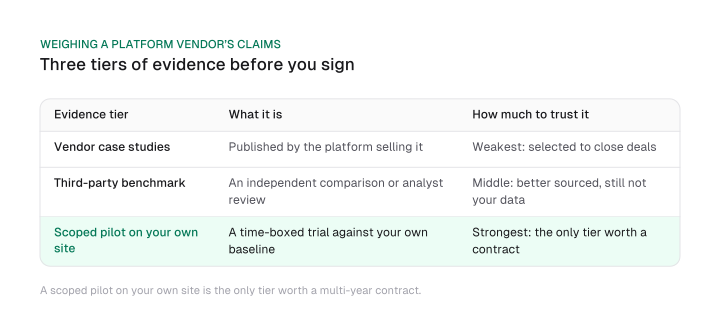
Vendor case studies sit at the bottom because they're picked to close deals, not to reflect your traffic, your CMS or your approval chain.
A third-party benchmark, run by someone with no stake in which platform wins, corrects for that bias but still isn't your data.
The only tier that resolves both problems is a scoped pilot: a trial with a fixed window, run against your own baseline, before signing.
Your enterprise SEO strategy should set the pilot's scope before you talk to a vendor: sites, markets, and the pass metric.
Pricing follows the model you choose more than the vendor you pick. Enterprise SEO cost breaks into two ranges worth knowing before a call:
- Platform contracts. One vendor's own published guidance puts annual pricing at $30,000 to $200,000-plus, driven by pages and domains tracked, feature tier, seat count and data volume.
- Agency retainers. One agency's stated rates commonly run $8,000 to $10,000 a month, with some engagements quoted above $21,000.
Neither range tells you which model fits your org, only what each one costs once you've decided.
Mission Growth is one option in that same decision, as a service rather than a platform: Mission Growth is an AI-led SEO and GEO growth service: AI catches the signal, our experts make the move, and you see the result. Mission Growth's platform tracks AI citations and visibility for customers.
Whichever model you're weighing, the same ai seo agency vs software decision applies to platform contracts: platform against retainer against in-house build.
The failure points that actually sink enterprise SEO
Enterprise SEO failures cluster into three root causes: governance, technical and content. Fix them in that order.
Governance failures carry the widest blast radius. Unclear ownership and siloed reporting let the other two categories recur unnoticed.
| Root cause | What shows up | Why it recurs |
|---|---|---|
| Governance | Unclear ownership between teams, siloed regional reporting, international rollouts with no shared review process | Nobody owns catching the other two categories before they ship |
| Technical | Faceted navigation exploding the URL count, hreflang gaps between markets, inconsistent HTTPS or redirect setup across domains | Crawl budget and index coverage absorb the damage silently |
| Content | Neglected title tags across thousands of pages, duplicate templates with no unique content slot, weak internal linking between hub pages | Reproduces the near duplicate clusters covered earlier |
Download CSV (CC BY 4.0)
Governance failures don't stay in their lane. Siloed reporting hides a crawl configuration mistake for weeks, because nobody outside one region's dashboard would see the drop.
Unclear ownership means the duplicate template problem from earlier gets rediscovered by three separate teams instead of fixed once.
Fix the governance root cause first. The other two categories don't disappear, they just get caught faster because someone's actually watching.
Before trusting one regional dashboard against another, check whether your own tracking setup is actually consistent across domains. A lot of "we're seeing conflicting numbers" turns out to be a tracking gap rather than an SEO problem.
Both thresholds from the first section point back to this list: a site that's crossed only the technical one mostly fights the technical row, a site that's crossed only the organizational one mostly fights the governance row, and most enterprise sites are fighting both at once.
That's why governance goes first. Two things to do next:
- Run the crossing test from the first section against your own site.
- Score your next change by blast radius before routing it through another meeting.
Frequently asked questions
There's no fixed number. Run the crossing test instead: you've passed Google's technical threshold around 1,000,000 pages updating about weekly or 10,000 updating daily, or you've passed the organizational threshold where a routine change needs more than one team to approve it.
Crawl budget is the smaller of two numbers Google sets for a site: a crawl capacity limit and a crawl demand score. It mainly matters above Google's own size threshold; below that, content quality and internal linking carry more weight.
It depends on the model. One agency's published rates commonly run $8,000 to $10,000 a month, with some engagements quoted above $21,000. One enterprise SEO platform vendor's own pricing guidance puts annual contracts at $30,000 to $200,000-plus, based on pages tracked, seat count and data volume.
A site of moderate size running a pure domain move can recover in a few weeks. A Googler cited roughly a year as a rough outer bound for large or complex migrations before it's worth reconsidering the strategy; treat that figure as a rough benchmark rather than a guarantee.
Ungoverned near duplicate templates and inconsistent hreflang across domains. Both trigger the same clustering mechanism: Google fingerprints near duplicate pages and keeps only one per cluster, so pages disappear from the index and rankings drop as a result.
It depends on which threshold you've actually crossed. A threshold crossed only on the technical side, high page count, frequent updates, can often be met with a standard tool's top plan. An organizational threshold, needing approval from several teams, usually calls for a platform or a built process; crawl coverage alone doesn't fix it.
Figures and images in this post are free to reuse under CC BY 4.0 with credit to Mission Growth.
Get Mission Growth highlighted in your Google results.