AI Search Optimization Services: What You're Paying For
AI search optimization services bundle 6 deliverables under different names, and one of them is oversold. See what to pay for and what to skip.

On this page
AI search optimization services all promise the same result: getting a brand cited or recommended inside ChatGPT, Google AI Overviews, or Perplexity. The invoices rarely agree on how you get there.
Vendors sell it under a dozen different names, but the work behind the invoice resolves into six recurring deliverables. One of the six, schema markup, has been tested for its effect on AI citations, and the test shows no meaningful lift on any platform.
If you're already comparing quotes for ai seo services, GEO, or AI search optimization, you've probably read why AI-generated answers are changing how people find brands. This guide skips that case and goes straight to what a vendor's line items actually buy.
If you haven't settled whether to hire an ai seo agency at all, that decision comes first.
In this guide:
- The six real deliverables behind every generative engine optimization services quote, whatever the invoice calls them
- Why schema markup, the most oversold of the AI SEO deliverables, doesn't move AI citations
- How multi-platform coverage differs by platform, with the correlation numbers behind it
- What one-time projects and monthly retainers actually cost, and where white label AI SEO pricing fits
- A scorecard to run your own quote through before you sign
What AI search optimization services actually include
AI search optimization services bundle six recurring deliverables: an audit, technical readiness, content, off-site authority, multi-platform tactics and tracking.
No matter what the invoice calls the package, you'll see them sold as "AI SEO," "GEO," or "AI search optimization," but the underlying work is the same six deliverables.
GEO, short for generative engine optimization, is the practice of getting a brand cited or recommended inside an AI-generated answer rather than ranked on a results page. That's a different job from classic SEO's; what generative engine optimization actually changes gets the full framework.
For this guide, the definition matters less than the deliverables it's sold as.
Here's the mapping, so you can hold any quote up against it:
| What the invoice calls it | The real deliverable | What it actually covers |
|---|---|---|
| "AI visibility audit," "GEO audit," "AI readiness assessment" | Audit and baseline assessment | A snapshot of where the brand currently appears, or doesn't, across AI Overviews, ChatGPT, Perplexity and Copilot before any work starts |
| "AI-ready schema," "structured data for AI," "technical AI SEO" | Technical readiness (schema markup) | JSON-LD and related structured data added to existing pages; see the correction below before paying extra for it |
| "GEO content," "answer engine content" | Content development and optimization | New or rewritten pages built to answer one query directly, structured so an assistant can extract the answer |
| "AI PR," "digital PR for AI search," "off-site authority building" | Off-site authority and digital PR | Placements and mentions on pages that already rank and get linked to; the correlation study later in this guide shows why that signal matters more on some platforms than others |
| "Multi-platform AI SEO," "omni-AI visibility" | Multi-platform coverage | Tactics tuned per engine instead of one blanket approach |
| "AI performance dashboard," "citation tracking," "visibility reporting" | Tracking and reporting | Recurring measurement against a defined baseline |
Download CSV (CC BY 4.0)
Two of those six show up on almost every quote you'll get: technical readiness and content. If you'd rather run the technical piece yourself, the ai seo checklist for do-it-yourself technical work walks through the same fixes a vendor would bill for.
Technical readiness and the schema markup problem
Schema markup, the most commonly sold "AI-ready" deliverable, has no measured causal lift on AI citations.
Google's guidance says no special schema.org markup is required for generative AI search, which directly contradicts how most vendors pitch this line item. Google is explicit about it in its guidance on optimizing for generative AI features:
"Structured data isn't required for generative AI search, and there's no special schema.org markup you need to add."
The causal evidence backs that up. A matched difference-in-differences test tracked 1,885 pages that added JSON-LD schema between August 2025 and March 2026 against 4,000 matched control pages that didn't add it. Here's what changed on each platform:
- Google AI Overviews. Citations fell 4.6%, a small but statistically significant decline.
- Google AI Mode. Citations moved 2.4%, indistinguishable from zero.
- ChatGPT. Citations moved 2.2%, indistinguishable from zero.
The study's own conclusion: adding schema produced no major uplift in citations on any platform.
One 2026 industry report found something that sounds like the opposite: pages using three or more schema types are 13% more likely to be cited, and FAQPage schema shows up on 10.5% of cited pages.
That's a correlation, and it doesn't cancel out the causal test above; the two measure different things. Sites that already run more schema tend to be careful sites generally, and careful sites earn citations for other reasons too.
So pay for schema because it protects rich result eligibility in normal Google search. A vendor's promise of more ChatGPT citations from the same line item is a different claim, and it's the one without evidence behind it.
Multi-platform coverage: what every AI engine actually requires
Multi-platform coverage isn't one skill, because the same off-page signal moves visibility on some AI engines and barely moves it on others.
A vendor selling "we optimize for every AI engine at once" is selling something less specific than it sounds.
Ahrefs' July 2025 study measured how brand mentions on highly linked pages tracked with AI assistant visibility across the top 50 domains per system. The relationship was strong for Google AI Overviews (rho=0.70), moderate for Perplexity (rho=0.40), and close to flat for ChatGPT (rho=0.12).
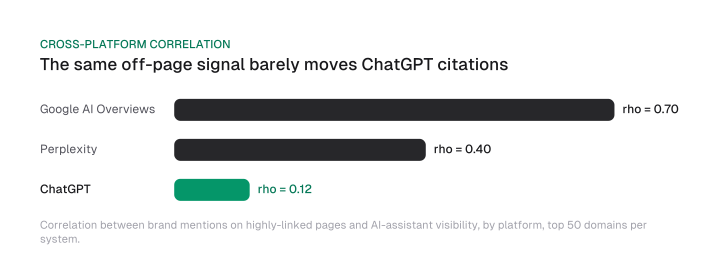
The same off-page signal that moves Google AI Overviews barely touches ChatGPT. That's why how geo vs seo tactics diverge by platform is worth reading before you sign off on a "we cover every platform" line item.
Ask the vendor which tactic is doing the work on which engine. If they can't answer, they're selling one tactic under three platform names.
Tracking and reporting: the metrics that actually prove visibility
A real AI SEO tracking deliverable reports a citation count against a defined baseline. A vague "visibility score" alone tells you nothing about what's being measured. Modeling what that visibility is worth in revenue is a separate job, covered in SEO ROI.
Even the industry's own official reporting tools are blunt about what a citation count can and can't prove.
Bing Webmaster Tools' AI Performance report puts it plainly: citation counts reflect "how often pages are cited, not page importance, ranking, or placement." Its Average Cited Pages metric, the report says, "does not indicate ranking, authority, or the role of any page within an individual answer." If Microsoft won't call its own citation metric a ranking signal, no vendor's dashboard should either.
Before you sign a tracking line item, get the vendor to define which of these it's actually counting:
- Mentions. The brand's name appears in an AI answer, with no link and no endorsement attached.
- Citations. The AI answer links to or names a specific page as its source.
- Recommendations. The AI answer actively suggests the brand as the answer to the reader's question, the strongest and rarest of the three.
- Baseline movement. Any of the above, tracked against where the brand started over time.
Mission Growth's platform tracks AI citations and visibility for customers. If you're evaluating a reporting deliverable, hold it to that same standard: a defined metric measured against a stated baseline.
For a lighter starting point that skips the retainer, how to track chatgpt mentions without a retainer covers the manual version of the same check.
Pricing: one-time projects vs. monthly retainers
AI search optimization pricing splits into two structurally different models: a one-time technical project and an ongoing monthly retainer.
Real published numbers for either are rare in this market, which is exactly why quotes are hard to verify. Where real numbers do exist, the pattern is consistent:
- One-time technical projects. $1,750 to $3,250 or more, scaling with the number of services covered.
- Monthly retainers. $3,500 to $30,000 or more a month, scaling from content and technical work up to full enterprise programs.
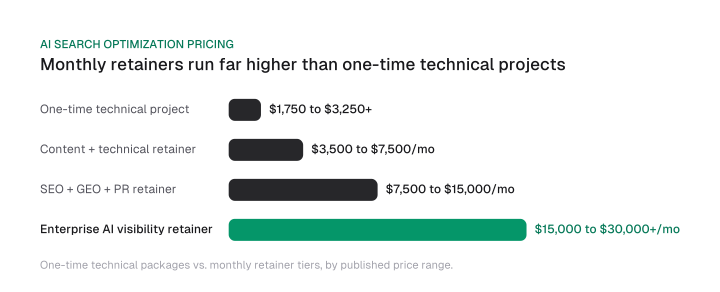
Line the two structures up and the gap is bigger than it looks month to month. A $3,500 monthly entry retainer costs $42,000 over twelve months, about 13 times the $3,250 top one-time tier.
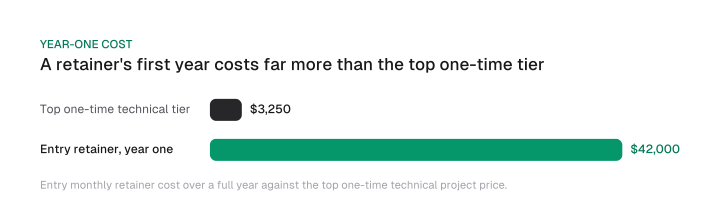
You're not comparing a cheap option to an expensive one; you're comparing a bounded project to a commitment with no end date.
Whether an engagement should be one-time or ongoing depends on which deliverable you're buying. The vendor's house style doesn't decide it.
Technical and schema work is naturally one-time, because once the markup is on the page, it's on the page. Content, off-page authority, and monitoring across engines are naturally ongoing work, because they decay the moment attention stops.
A third pricing model exists outside these two: Mission Growth's is a monthly service fee per project, quoted after an audit and discovery calls, with no public price list.
That's a model priced only once you're through the audit and discovery calls, distinct from a fixed retainer tier or a fixed project scope. Keep it in mind before you assume every quote fits the two models above.
Match the pricing model on your quote to the deliverable it's buying before you compare it to anyone else's number.
White label AI SEO: reselling these deliverables
White label AI SEO means an outside provider builds the same six deliverables described above, and an agency resells the finished work under its own brand.
It's a real, searched question with no standard market answer, so here's how to price it using the framework already built above.
The answer follows from the pricing structures already established. Price a white label engagement per client, at the same one-time or retainer bands covered in the pricing section, then add your own margin on top.
There's no separate "white label rate" floating in this market; there's the same $1,750 to $3,250+ one-time band and the same $3,500 to $30,000+ retainer bands, resold.
Two things do change when you're reselling instead of buying direct:
- Check rebranding first. Ask the provider whether the reporting deliverable can carry your brand instead of theirs.
- Set your margin on the right tier. Build it into the tier that matches what you're delivering; the smallest one-time tier is the wrong place to hide it.
How to evaluate a vendor before you sign
Evaluating an AI search optimization quote means checking it against the six deliverables and the schema correction above, not against the vendor's own case study percentages.
Here's how that check runs on two real shapes of quote.
| Deliverable | Quote A: one-time technical project | Quote B: monthly retainer |
|---|---|---|
| Audit and baseline | Covered once, at kickoff | Covered, refreshed on a schedule |
| Technical readiness (schema) | Priced by service count, $1,750 to $3,250 or more | Bundled into the content and technical tier |
| Content development | Outside this quote's scope | Starts in the content and technical tier |
| Off-page authority and PR | Outside this quote's scope | Starts in the SEO, GEO and PR tier |
| Multi-platform coverage | Outside this quote's scope | Named per platform in the enterprise tier; absent from the other two |
| Tracking and reporting | Ends when the project ends | Reports citations against a stated baseline instead of a single score |
Download CSV (CC BY 4.0)
Run your own quote against a short checklist before you sign:
- Find the six deliverables on the page. If a line item doesn't map to one of them, ask what it actually is.
- Ask what the schema line item is really buying. Rich result eligibility in Google Search is a real reason to pay for it; a promise of more ChatGPT citations isn't.
- Ask the vendor to define "visibility." Get them to say whether they mean mentions, citations, or recommendations, and against what baseline.
- Match the pricing model to the deliverable. A one-time quote for content or PR work, or a retainer for a pure technical cleanup, is a mismatch worth questioning.
- Check whether the case studies are comparable. A single client's percentage lift tells you about that client. It says nothing about whether the vendor's method works elsewhere.
If a quote survives all five checks, it's pricing real deliverables at a defensible model. If you're still not sure a paid engagement is the right call at all, revisit the ai seo agency vs. software decision first; and if you mainly need the numbers, not the labor, the best ai visibility tools for do-it-yourself tracking cover the reporting piece without a retainer attached.
Frequently asked questions
It depends on the deliverable. One-time technical work, like schema markup, stays on the page until the site changes, so its effect is durable. Content, off-page authority, and monitoring across engines decay once the work stops, because they depend on continued attention rather than a one-time fix.
No. Classic SEO targets ranking position on a results page; AI search optimization (GEO) targets whether an AI-generated answer cites or recommends the brand at all, which is a different outcome to optimize for even when some of the underlying work overlaps.
The deliverable decides the timeline; there's no fixed calendar across every quote. Technical fixes can show up once a page is re-crawled and indexed. Content, off-page authority, and continued work across engines compound gradually over months rather than producing a single visible jump.
Single-page or brochure sites with no distinct services usually don't need one, and neither does a business that only wants a one-time technical cleanup. Both are better matched to the one-time project band than to an ongoing retainer priced for content and off-page work they don't need.
White label AI SEO is an outside provider building the same six deliverables and an agency reselling that work under its own brand. It's priced at the same one-time and retainer bands as a direct engagement, with the agency's margin added on top.
AI search optimization services are sold under a dozen names, but only six deliverables are actually inside any of them. The one deliverable sold hardest across this market, schema markup, is the one with a measured causal test showing no meaningful citation lift on any platform.
Pull up your own quote next to the deliverable table and the scorecard above, and check which six boxes it actually fills before you sign it.
Figures and images in this post are free to reuse under CC BY 4.0 with credit to Mission Growth.
Get Mission Growth highlighted in your Google results.