AI in Marketing Statistics 2026: What Each Figure Counts
AI in marketing statistics from 2025 and 2026 surveys: adoption from 75% to 98%, AI share of budget, hours saved, results and which popular numbers fail.
By Furkan AktaşPublished
On this page
AI in marketing statistics from surveys fielded in 2025 and 2026 put AI use among marketers anywhere from 75% to 98%, because each survey counts a different thing: marketing organizations, marketing teams or B2B marketers' organizations. None of them is wrong for its own sample. Quoting one without saying what it counted is where the trouble starts.
This page holds the traced version of each AI marketing statistic and of AI marketing adoption 2026. Every figure below carries its survey, its base and the month it was fielded, so you can copy one of these AI marketing statistics into a deck, a budget case or an article without being caught out.
Key numbers, each with its scope and source:
- 75% of marketing organizations use AI, in Salesforce's tenth State of Marketing, fielded October to November 2025.
- 13% of marketers use agentic AI, in the same Salesforce report.
- 86.4% of marketing teams use AI in at least a few areas, in HubSpot's 2026 State of Marketing (page updated April 2026, fieldwork date not stated).
- 95% of B2B marketers say their organizations use AI-powered applications, in CMI's research of 1,015 B2B marketers (June to August 2025).
- 24.17% is the mean extent of AI and machine learning use in marketing, in The CMO Survey (January 2026).
- 15.3% of marketing budgets goes to AI on average, in Gartner's 2026 CMO Spend Survey (January to March 2026).
- 87% of B2B marketers using AI for content say productivity improved, but 39% say content performance did (CMI, June to August 2025).
- About one third of teams say AI saves their team 10 to 14 hours a week, per team and in bands (HubSpot, page updated April 2026).
- The 2025 market size is 32 billion dollars in Ken Research and 25.83 billion in Precedence Research.
The first section starts with the number everyone quotes first.
AI in marketing statistics: how many marketers use AI?
Marketer AI adoption sits between 75% and 98% in surveys fielded from mid-2025 to early 2026, because each one counts a different thing. The table sets the four any-AI figures beside what each survey counted, its sample and its fieldwork.
Download CSV (CC BY 4.0)
The 75% to 98% range is a 23-point spread across four denominators. Read it as what each survey counted.
Salesforce surveyed 4,450 marketers, HubSpot asked over 1,500 marketers about their teams, and CMI asked B2B marketers about their organizations in research sponsored by Storyblok. The 98% sits on a landing page that states no fieldwork date.
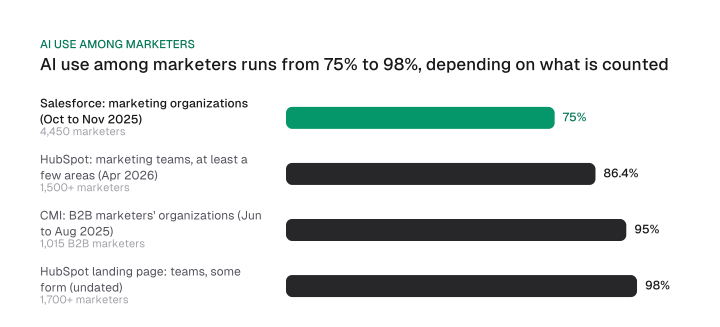
Wording alone moves a number even inside one survey. The CMO Survey asks the same marketing leaders how much of the time their company uses AI and machine learning (mean 24.17%) and generative AI (mean 22.42%). A separate use-case question counts only the 188 who named a use.
Population and wording differ across the four surveys at once, so the table shows what each counted without claiming the gap is only wording.
Few marketers sit out entirely: in HubSpot's 2026 State of Marketing survey, only 1.7% neither use nor plan to use AI. For marketers using AI in 2026, the open question is how deeply, which the next section measures.
Agentic AI is a separate, smaller count. Salesforce reports 13% of marketers using agentic AI, HubSpot's undated landing page says 86% of marketers use agents, and CMI says 28% of B2B marketers experiment with AI agents. Those are three different questions about three different groups. If you are deciding whether to buy one, the ai marketing agents guide covers that choice.
One more number needs a warning. One 2026 roundup writes:
87% of marketers now use generative AI in at least one recurring workflow
and credits it to Salesforce's State of Marketing. We did not find the 87% in the text of the tenth State of Marketing report, which gives 75% of marketing organizations. We did not open the report's chart appendix, so treat the attribution as unconfirmed and quote the 75%.
This table covers marketers using AI. For AI platforms sending visitors to sites, which is a different question, see our dated shares of site visits from AI platforms.
How much of their marketing do companies run on AI?
The CMO Survey 2026 puts the mean extent of AI and machine learning use in optimizing and automating marketing at 24.17% of the time, with a median of 20%. That is a far lower number than any adoption headline, and it is the one that tells you how much of the work runs on AI.
The question asks marketing leaders to rate the extent to which their company uses AI or machine learning, from 0% to 100% of the time. 191 leaders answered it. The survey was in the field from 7 to 29 January 2026, and the sample is 308 leaders at U.S. for-profit companies.
Generative AI looks similar. Across 187 companies the mean is 22.42%, and 11.8% of them use generative AI none of the time in marketing. For example, a company that runs one chatbot pilot counts as an adopter in the headline surveys but may sit near zero here.
The same leaders expect depth to grow. Their mean extent of use over the next three years is 55.91% with a median of 50%, which is 2.3 times today's mean and 2.5 times today's median. What is changing in AI marketing trends is depth: leaders expect AI to take a larger share of the marketing work inside their own companies.
CMI's stage question shows the same shape. Among B2B marketers, 68% describe their AI implementation as exploratory or developing, and 32% as established, advanced or leading. The contrast between breadth and depth has been drawn from the 2025 CMO Survey edition before, so this section reports the 2026 distribution: the mean, the median and the share at none of the time.
What do marketers use generative AI for?
Content creation is the most common AI use in the 2025 and 2026 surveys that ask: 89% of CMI's B2B marketers use AI content creation tools, and 73.9% of the 188 CMO Survey respondents who named a use use AI for content creation.
Personalization shows why the base matters. It appears as 14% (tools in use, CMI), as 65.4% (a use case among the 188 CMO Survey respondents who named a use) and as 89% (B2B marketers saying their organizations personalize content, CMI). Those are three different questions, and the 89% to 14% gap is a 6.4 times spread. A writer who picks the highest and lowest values can claim anything.
For generative AI in marketing statistics specifically, the 2026 figure lives in the extent-of-use section above. The widely repeated 2023 pair is older.
In the 18 to 25 May 2023 Salesforce and YouGov survey, 51% of marketers were using generative AI, and 76% of those generative AI users said they used it for content creation and 76% for writing copy. The Overview's longer task list matches an undated SurveyMonkey list, so we do not use it.
If you want to put these uses to work, our ai growth marketing guide covers the plays, and the ai content strategy workflow covers the content side. The dated tables here answer the "AI in digital marketing 2025" question for you: content first, ads and personalization far behind.
How many hours does AI save a marketing team?
HubSpot's 2026 survey asks how many hours AI saves the marketing team each week, in bands, and about two thirds of teams report 10 or more. That is a team-level, banded answer, and it should not be divided by headcount.
About one third say AI saves their team 10 to 14 hours per week, another third say over 15 hours, and just under a third say one to nine hours. Adding the first two groups gives about two thirds at 10 hours or more (our sum of the two bands).
Three different things get called "hours saved":
- Per team, in bands. HubSpot's question, above.
- High performers. Salesforce says marketers deploying AI successfully report a 20% ROI increase, and that high performers save an average of eight hours per week through automation. Both figures describe high performers, and the launch post words an expectation for all marketers.
- A 2023 estimate. Marketers in the May 2023 Salesforce survey estimated that generative AI would save them over five hours a week.
A fourth number circulates without a primary source. One roundup writes:
Daily AI Mail's synthesis of multiple surveys puts the range at 11–13 hours per week for heavy users.
That is a newsletter synthesis, untraceable (no primary found), so we leave it out.
Perceived productivity points the same way without a unit. In HubSpot's survey 26.5% say AI has significantly increased productivity and 66.2% say slightly or moderately. Before you quote an hours figure, check three things: the unit (person or team), the basis (measured, expected or high performers) and the band.
Does AI improve marketing results?
Among the 1,015 B2B marketers in CMI's 2026 research, 87% of those using AI for content say productivity improved and 39% say content performance improved, a 50-point gap in net improvement. The outcome ladder shows how far the claims fall as you move from effort to results.
Download CSV (CC BY 4.0)
We computed net improvement as the improved share minus the decreased share, both from CMI's page. Net improvement runs from 84 points for productivity to 34 points for content performance, so the gap between the top and bottom rows is 50 points. The base is marketers using AI for content creation, so do not read the shares as all marketers.
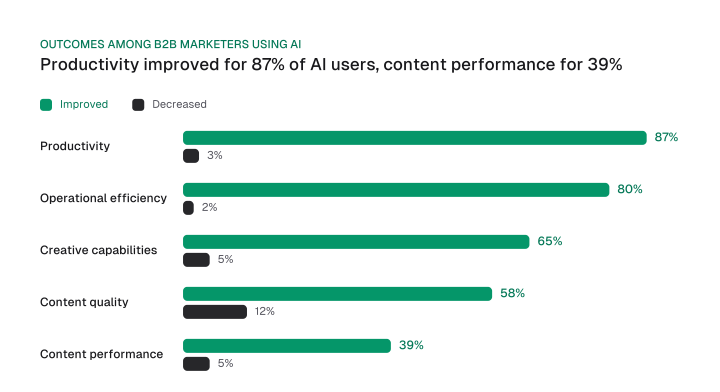
Two caveats sit under the ladder, and you should carry both if you quote it. 12% say content quality decreased, the highest decreased share of the five. And on content performance, 34% report no change and 15% say it is too soon to tell, so the 39% improved sits beside 15% still waiting for results.
Self-reported gains in The CMO Survey are modest and are means of respondents' own estimates: 14.06% for sales productivity, 14.64% for marketing overhead costs and 10.75% for customer satisfaction. Salesforce's 20% ROI is a figure for marketers deploying AI successfully, covered in the hours section. The circulating 68% and 86% ROI claims are traced in the claim-trace section below.
How much of the marketing budget goes to AI?
Gartner's 2026 CMO Spend Survey puts AI at an average 15.3% of marketing budgets, and 21.3% for AI-ready organizations, 1.4 times the average. The survey covered 401 CMOs and marketing leaders in North America, the UK and Europe, between January and March 2026.
Keep the two columns apart. They are survey averages and the survey gives no per-company figure, so multiplying them to get AI spend as a share of revenue would invent a number that Gartner does not publish. A share of revenue is not available from this source.
The readiness gap is the sharper finding. 70% of CMOs say becoming an AI leader is a critical goal for 2026, but only 30% report mature or fully developed AI readiness capabilities, a 40-point gap (our subtraction). Meanwhile 56% say their marketing organization lacks the budget to deliver the 2026 strategy.
Read the budget share as an intention that readiness has not caught up with. If you present it to a CFO, say the base: 401 leaders, one quarter of 2026.
How big is the AI in marketing market?
Forecasts of the AI in marketing market disagree widely even when they share a growth rate: Precedence Research and ResearchAndMarkets both use 26.7% a year, yet their 2030 values sit 2.6 times apart.
Download CSV (CC BY 4.0)
The same 26.7% rate on different bases produces very different markets. We grew Precedence's 2025 value at its own rate to 2030 and got about 84 billion dollars (25.83 grown at 26.7% for five years).
ResearchAndMarkets' 220.1 billion for 2030 is 2.6 times that. Going the other way, growing ResearchAndMarkets' 2023 value at its rate gives about 67 billion dollars for 2025, again 2.6 times Precedence's 2025 value. Ken Research's 2025 value is 1.2 times Precedence's.
Precedence also publishes free splits. North America was the largest market in 2024 and Asia Pacific is the fastest growing. By technology, machine learning is expected to dominate, by application content curation, and by end-user media and entertainment. It names NVIDIA, Salesforce, Google, Intel, IBM, Microsoft, Amazon, Oracle, Baidu and Twitter among the players, and lists machine learning use, social platforms, personalized experiences and e-commerce as growth factors.
The Google AI Overview for this query joins two of these worlds in one sentence:
The global AI marketing revenue is estimated to hit $47 billion and is projected to scale up to $217.33 billion by 2034.
The 47 billion figure appears on a Statista topic page whose model is not public and whose text we could not machine-verify. The 217.33 billion is Precedence Research's 2034 forecast from a 25.83 billion base for 2025. The two numbers have different bases, so do not compute with the 47 billion.
If you quote a forecast, compare it only within one publisher's base year and rate, and ask which market definition a figure uses. Date every value, as the table does.
Where are the skills, training and trust gaps?
Marketers' confidence in their AI skills rose by 21.2 points in a year in HubSpot's surveys, while the training and value figures roundups quote come from a May 2023 survey.
HubSpot's 2026 State of Marketing survey finds 68.2% of marketers understand how to use AI in marketing, up from 47% in 2025, a 21.2-point gain. And 67.5% know how to measure AI impact, up from 48%, a 19.5-point gain.
Now the old numbers. Salesforce and YouGov fielded their generative AI survey from 18 to 25 May 2023 among 1,029 marketers. In that May 2023 survey of 1,029 marketers:
- 70% said their employer does not yet provide generative AI training.
- 43% said they were unsure how to extract the most value from it.
- 39% said they don't know how to use generative AI safely.
The Overview's 43% "concerns" figure is a skills gap in that release. It describes marketers in 2023, and roundups present it as current. Pair it with the 2026 figures above and the direction is clear, even if the two surveys are not a clean comparison.
The 2026 trust evidence comes from two surveys. In CMI's research 12% say AI content quality decreased. In HubSpot's, 62.7% believe more unique, human-centered content is needed to compete with AI content.
If you're asked whether AI replaces marketers, 73.4% of HubSpot's marketers see AI working alongside marketers and assisting with most of their duties. That is the one jobs figure this page uses, because the others we found had no stated base.
Which AI marketing statistics don't hold up?
Google's AI Overview for this query packs twelve statistics, and a trace of each shows its survey date, population and what it counted, or that no primary source was found. One rule applies to every list alike: figures with no stated sample or fieldwork date, whether from a vendor survey or a SurveyMonkey list, are left out.
Download CSV (CC BY 4.0)
Two corrections are worth spelling out. The 65% better SEO figure comes from a January 2024 Semrush report on small business content marketing across over 2,600 businesses, not marketing teams. The 76% for content creation describes only generative AI users, and it dates to May 2023.
For the pay-per-click claim, we found no primary study and leave the numbers out. A primary study would have to say which campaigns were measured, over what period, against which baseline and with what sample.
An unverifiable figure may still be right for its own sample. We exclude it because you cannot check it. For AI search impact claims, which this page does not cover, see the ai seo impact ranking statistics page. For Overview claims in general, see google ai overviews statistics.
How to choose an AI marketing statistic to quote
Quote an AI marketing statistic with its denominator, sample size and fieldwork date, and choose the figure whose denominator matches your claim. To name the denominator, ask what the figure divides by: all marketers, teams, organizations or marketing work.
Download CSV (CC BY 4.0)
Then check the survey population. The next table gives sample and month for each source on this page.
Download CSV (CC BY 4.0)
The CMO Survey's response rate is 308 of 2,111 invited leaders, and CMI's survey was sponsored by Storyblok and reports on 1,015 of its 1,229 responses. Never use 1,229 as the base of a CMI percentage.
Method for this page: public surveys, read in October 2026, no original data, and surveys without a stated sample or fieldwork date excluded. For AI citation numbers, the same check applies, and our ai citation statistics page applies it.
Your next step is small. Pick the one figure that matches your claim, and write what it counted next to it, with the sample and month. The 75% to 98% range stops being a contradiction once each number carries its denominator.
Frequently asked questions
What percentage of marketers use AI?
It depends on what is counted. Salesforce found 75% of marketing organizations use AI (fielded October to November 2025), and HubSpot found 86.4% of marketing teams use AI in at least a few areas (page updated April 2026, fieldwork date not stated). Quote the figure with its denominator. The 75% to 98% range comes from different bases, so none is the single answer.
How much of the marketing budget goes to AI?
Gartner's 2026 CMO Spend Survey of 401 marketing leaders puts the average at 15.3% of marketing budgets. AI-ready organizations put in 21.3%. Both are survey averages, so you cannot multiply them by revenue to get a per-company figure. Fieldwork ran January to March 2026.
How many hours does AI save marketers?
HubSpot asks per team, in bands: about one third say AI saves their team 10 to 14 hours a week, and another third say over 15. It is a team-level answer, so do not divide it by headcount. The 11 to 13 hours quoted in some roundups has no primary source that we found.
Is AI in marketing worth it?
Among B2B marketers using AI for content, CMI finds 87% say productivity improved, but 39% say content performance improved, and 12% say content quality decreased. Productivity gains are common, while performance gains are far less certain.
How big is the AI in marketing market?
It depends on the publisher. For 2025, Ken Research gives 32 billion dollars and Precedence Research gives 25.83 billion. Even with the same 26.7% growth rate, publishers' bases differ, so 2030 values diverge by 2.6 times. Compare forecasts only within one publisher.
Are AI in marketing statistics reliable?
Only when the source states its denominator, sample and fieldwork date. Many circulating figures come from a May 2023 or January 2024 survey, or from pages with no stated method. Check the date and the population before you quote, and treat anything older than a year as history.
Cite this page
Aktaş, F. (2026, October 17). AI in Marketing Statistics 2026: What Each Figure Counts. Mission Growth. https://missiongrowth.io/blog/ai-marketing-statistics
Download the data: 8 tables as CSV (CC BY 4.0)
- AI use among marketers by survey, fielded 2025 to 2026
- What marketers use AI for, by survey and base, 2025 to 2026
- Outcomes among B2B marketers using AI for content creation, CMI, June to August 2025
- AI share of marketing budget and marketing budget share of revenue, Gartner 2026 CMO Spend Survey
- AI in marketing market forecasts by publisher, base year and growth rate
- Claim trace for statistics in Google's AI Overview on AI in marketing, October 2026
- Which AI marketing figure answers which claim, October 2026
- Survey population card for the sources used in this post
Figures we made for this post are free to reuse under CC BY 4.0 with credit to Mission Growth.
Get Mission Growth highlighted in your Google results.