AI Marketing Agents: 2026 Pricing and Autonomy Guide
What AI marketing agents actually do, how much autonomy each action has earned, and verified September 2026 pricing across Jasper, HubSpot and Salesforce.

On this page
AI marketing agents are software that decides its own next marketing action from live data instead of following a rule you wrote in advance.
Right now they run four jobs well: qualifying leads, personalizing content, generating campaigns and reallocating ad budget. What decides whether one is worth deploying isn't which vendor's demo looks the most autonomous. Two structural questions decide it instead: where the agent actually plugs into your stack, and whether the specific action you're about to hand it has earned that trust yet.
This guide answers both, with real September 2026 pricing across four vendors and a graduation rule for autonomy that doesn't rely on a vendor's own label for it.
What an AI marketing agent actually is
An AI marketing agent is software that decides its own next step toward a marketing goal from live data. Automation only runs a step you pre-programmed for it in advance, and ai agents in marketing exist precisely to close that gap.
That's the line that actually separates an agent from automation or a chatbot: not whether it uses AI, but whether it can choose an action for a situation you never wrote a rule for.
| Dimension | Marketing automation | Chatbot | AI marketing agent |
|---|---|---|---|
| Trigger | A fixed rule or schedule | A user's message | A live signal it's watching |
| Decides the next action | No, follows the rule | No, follows the conversation | Yes, within its scope |
| Adapts mid-task | No | Limited, inside the chat | Yes, reprioritizes as data changes |
| Typical output | Send an email at 9am | Answer a question | Score a lead, shift budget, draft and route content |
KPMG's Q2 2026 AI pulse survey found 53% of organizations using AI agents this quarter, compared to 55% last quarter. Adoption dipped slightly, but the same survey found the share orchestrating multiple AI agents across workflows doubled, from 9% to 18%. Fewer companies are experimenting, and the ones that stuck around are wiring agents together instead of running one in isolation.
Gartner's own October 2024 trends report backs that shift with a number. It expects at least 15% of daily work decisions to run through agentic AI without a human step by 2028, a jump from a 0% baseline in 2024.
But two buying guides now in circulation get that figure wrong, each in its own way.
One welds it to a separate Gartner metric about enterprise software adoption, producing a single incorrect combined claim that treats two different measurements as one number.
Another states the 15% figure correctly but gives it the wrong starting point, claiming it grew from under 1% in 2024. Gartner's own report baselines that figure at 0%.
That same page also cites an older, undated adoption figure that KPMG's Q2 2026 survey above has already superseded, a sign of how fast these numbers move.
What AI marketing agents actually do
AI agents for marketing run four jobs well today: qualifying leads, personalizing content, generating campaign content and reallocating ad budget.
- Qualifies leads from behavioral signals. The agent reads engagement data such as page visits, email opens and product usage, scores each lead against the pattern of ones that converted before, and reprioritizes the list a rep sees as new behavior comes in, instead of waiting for a scheduled re-score.
- Personalizes content per user. It swaps copy, offer or layout at send time or page-load time based on a visitor's segment and recent behavior, not a fixed template assigned once by list.
- Generates and localizes campaign content. It drafts copy in a defined brand voice and adapts it across languages and channels. This is the piece of the job that plugs into a broader ai content workflow most marketing teams already run.
- Reallocates ad budget inside a running campaign. It shifts spend between channels or audiences while the campaign is live, based on which segments are converting.
Two smaller categories of ai agents for marketing show up too: a handful handle customer service and support questions at the marketing-support boundary, and a few manage social media scheduling and replies. Neither runs as its own job the way the four above do.
"Autonomous budget optimization" runs on top of your ad platform's own bidding system, not as a mechanism of its own. Google's own Ads Help documentation describes Smart Bidding re-optimizing at every individual auction, weighing signals like device, physical location, weekday and time of day, remarketing list membership, interface language, browser and operating system.
An agent that "optimizes your budget" decides how much of your spend reaches that per-auction system, and when to shift it. It doesn't rerun the auction logic itself.
Ask a vendor directly which one their tool is actually doing: making the bid decision, or feeding a bidding system that already makes it.
Where an agent fits in your stack
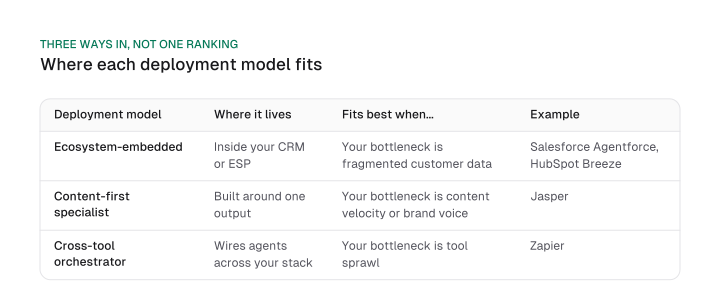
AI marketing agents split into three deployment models: ecosystem-embedded, content-first specialist and cross-tool orchestrator.
Ecosystem-embedded agents live inside your CRM or ESP. Content-first specialists are built around one output, like brand-voice content. Cross-tool orchestrators wire agents across your existing stack.
Match the model to where your actual bottleneck sits, not to which vendor's roundup you read last.
| Your bottleneck | Deployment model | Example |
|---|---|---|
| Data fragmented across your CRM or ESP | Ecosystem-embedded | Salesforce Agentforce, HubSpot Breeze, BrazeAI Agents |
| Content velocity or brand-voice consistency | Content-first specialist | Jasper |
| Tool sprawl, need triggers across apps | Cross-tool orchestrator | Zapier |
If your bottleneck is specifically SEO or AEO work rather than the broader marketing stack, this typology isn't the right lens. What you need instead is an ai agent seo setup built for search and AEO work specifically, a different buying decision than the one above.
No consensus "big 4" of AI marketing agents exists, whatever a quick search suggests. The phrase traces to one vendor. Braze's own April 2026 roundup names BrazeAI Agents, LangChain Agents, AutoGPT and CrewAI as its four "platforms worth knowing."
Three of those four are general-purpose developer frameworks. Only one is a packaged marketing product, and it belongs to the vendor publishing the list. LangChain and AutoGPT are toolkits a developer uses to assemble a custom tool from scratch; CrewAI coordinates several of them at once.
Pairing three frameworks with one company's own commercial product makes a single blog's list, not a market finding you can rely on.
How well a platform's own content shows up in AI-generated answers is becoming its own evaluation question, alongside organic search rankings.
Gartner's Peer Insights page for AI agent platforms has started asking reviewers about generative engine optimization next to the traditional autonomy question above. It's a newer axis, still without a hard, independently verified number attached to it.
Mission Growth's platform tracks AI citations and visibility for customers. That's the same category of tracking this newer axis is pointing at.
How much autonomy to give it
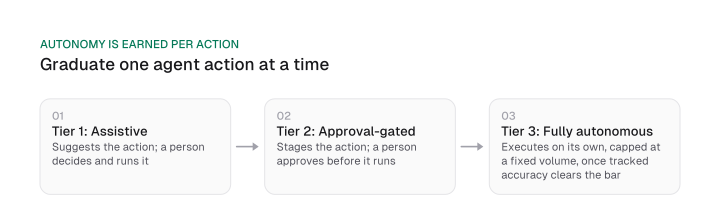
A marketing agent earns more autonomy only after it has a tracked record at a lower trust tier for that specific action, not because a vendor markets the whole platform as autonomous. Vendors pitching fully autonomous marketing agents skip that step; the ladder below doesn't.
| Tier | What it does | Graduates when... |
|---|---|---|
| 1. Assistive | Suggests the action; a person decides and runs it | Runs from day one, no graduation needed |
| 2. Approval-gated | Stages the action; a person approves before it runs | The assistive suggestion has a logged track record worth trusting |
| 3. Fully autonomous | Executes on its own, capped at a fixed volume or reach | That exact action has a tracked, acceptable error rate at Tier 2 |
Here's how the ladder plays out on a single action: lead scoring.
At Tier 1, the agent suggests a score and a rep decides whether to act on it. At Tier 2, it stages a scored list for a manager to approve before any lead gets routed.
At Tier 3, once its Tier 2 accuracy clears an acceptable bar, it routes leads above a fixed threshold on its own. A daily volume cap keeps one bad batch from flooding the pipeline.
This is an illustration of how the ladder applies to one action, not a documented deployment at a named company.
This graduation logic isn't new to marketing. Lee and See's 2004 review in Human Factors, built on decades of aviation and process-control research, found that trust guides reliance on automation, particularly where complexity and unanticipated situations make full understanding of the system impractical.
Whether that trust is appropriate depends on the context, the automation's own characteristics and the operator's own cognition. Applied to a marketing agent, the autonomy tier granted to one action should track that action's own demonstrated reliability, not how capable the platform looks in a demo.
The transfer is bounded. The original findings come from aviation and process control, not marketing, so it holds for repeated, measurable actions like budget shifts or lead routing, where an error rate can actually be tracked, not for one-off creative judgment calls. It would be disproven if tracking an action's own reliability turned out not to improve reliance decisions in a marketing-agent context specifically.
Multi-agent setups: when more agents beat one
A multi-agent marketing setup is only worth running when the task is parallel and valuable enough to absorb roughly 15 times the token cost of a single agent.
That "multi-agent beats single-agent" number every vendor borrows traces to one specific finding, and it comes with a caveat most of the pages repeating it drop.
Anthropic's own engineering writeup, published in June 2025, describes an internal research eval where a Claude Opus 4 lead agent with Claude Sonnet 4 subagents outperformed a single Claude Opus 4 agent by 90.2%. Treat that figure as directional, not a number you'll reproduce on a campaign task: it's Anthropic's internal research result, not a marketing benchmark.
The same writeup states multi-agent systems use about 15 times more tokens than a single chat call. The setup is only economically viable when the task's value clearly exceeds that added cost.
So the decision rule is short: run a multi-agent setup when a task splits cleanly into parallel pieces and the payoff clears roughly 15 times the token cost of doing it with one agent. A single blog post or a single lead score doesn't clear that bar. For example, a campaign brief that needs research pulled from a dozen sources at once might.
What AI marketing agents cost
AI marketing agent seat prices, as of September 2026, run from free to roughly $3,600 a month before one-time onboarding fees or metered usage credits.
That range depends mostly on which deployment model you pick, not on how "agentic" the vendor claims to be.
| Vendor | Deployment model | Entry price | Mid-tier price | Top tier price |
|---|---|---|---|---|
| Jasper | Content-first specialist | N/A | $59/seat/month, Pro, billed annually | N/A |
| Salesforce Agentforce | Ecosystem-embedded | Free, Salesforce Foundations | $5/user/month plus Flex Credits | $550/user/month, Agentforce 1 Editions |
| HubSpot Breeze (Marketing Hub) | Ecosystem-embedded | $20/seat/month, Starter (list price) | $800/month, Professional (promo) | $3,600/month, Enterprise |
| Zapier | Cross-tool orchestrator | N/A | $19.99/month, Professional, billed annually | N/A |
Download CSV (CC BY 4.0)
Group those four verified prices and a range falls out. At the entry end: free to about $20 a seat a month (Salesforce's Foundations tier, HubSpot's Starter plan).
In the middle: $59 to $800 a month (Jasper Pro, HubSpot Professional). At the top: $550 to $3,600 a month, or consumption-based (Salesforce's Agentforce 1 Editions or Flex Credits, HubSpot Enterprise).
That's a low-to-high grouping across the four vendors, not an average, since the models price on different units: seat, conversation and credit.
That range covers seat or license price only. HubSpot's headline Professional figure of $800 a month is itself a promotional rate. The standard price is $890 a month.
Professional and Enterprise also require a one-time onboarding fee: $3,000 and $7,000. HubSpot's AI agents draw from a separate metered credit pool too, priced at $9 per 1,000 credits beyond the 500/3,000/5,000 credits included by tier (Starter/Professional/Enterprise), paid annually.
Salesforce's cheaper entry points work the same way. The $5/user/month tier needs Flex Credits on top, priced at $500 per 100,000 credits.
Two of the most-repeated agent prices in current buying guides are each wrong, in different ways. Jasper's cited $39 seat price is stale: it runs roughly a third below the $59 Pro seat price on Jasper's own pricing page.
Salesforce's cited Agentforce 1 price of $550 per user is accurate, but incomplete. That $550/user/month tier is still live today, alongside the newer free and consumption-based pricing Salesforce added next to it, not instead of it.
What changed at Salesforce is the floor, not the ceiling. It added a $0 Foundations tier plus consumption-based Flex Credit and per-conversation pricing next to the existing $550 per user edition, so the entry price dropped to free while the $550 tier stayed exactly where it was.
Getting started without breaking anything
Your first marketing agent should go on the task with the most manual hours and the cleanest closed-loop outcome data.
Those two criteria point at the same tasks for a reason: the ones with the cleanest outcome data are also the ones where a mistake is cheapest to catch, because you see the result quickly and can correct course.
- List the marketing tasks eating the most manual hours right now, not the ones that sound impressive to automate.
- Cross that list against which tasks have closed-loop outcome data: a lead that did or didn't convert, an email that was or wasn't opened. Input signals alone don't count.
- Start the highest-overlap task at Tier 1 (assistive) from the autonomy ladder above, and log its suggestions against what actually happened.
- Graduate that one task through the ladder before adding a second agent on a different task.
Before switching any task to autonomous execution, confirm the agent:
- Reads closed-loop outcome data for that task, beyond the input signals that feed it.
- Produces a change log a person can audit after the fact, action by action.
- Operates under a hard cap on the size or reach of any single autonomous action.
You don't need a separate customer data platform before you start. What matters is that the task's outcome data already flows somewhere the agent can read it, not that you've bought a dedicated CDP first.
Deciding whether to build this in-house or hand it to a vendor is the same build-vs-buy tradeoff as picking an ai seo agency vs. software, just applied to marketing agents instead of SEO work. And if organic search is how most of your pipeline arrives in the first place, this decision sits inside your broader b2b seo strategy.
Marketing AI agents differ less by vendor brand than by two structural choices: where they plug into your stack, and whether the specific action you're handing them has actually earned autonomy yet. Pick the deployment model that matches your real bottleneck, start the highest-value task at the assistive tier, and let a tracked error rate, not a pricing page, decide when it graduates.
Frequently asked questions
No. The phrase traces to one vendor's own list pairing its product with three unrelated developer frameworks (LangChain, AutoGPT, CrewAI). No independent big four exists.
Start at the assistive tier for any action you haven't tracked yet, where it only suggests. Graduate it to approval-gated and then fully autonomous only after you've logged an acceptable error rate for that specific action.
No source backs that claim. Agents remove execution hours on specific tasks; they don't remove strategy, judgment or the review a new action needs before it earns autonomy.
Seat prices run free to roughly $3,600 a month depending on deployment model, before any one-time onboarding fee or metered usage credits some vendors add on top.
It depends on whether audit-trail and human-in-the-loop features exist at the autonomy tier you're actually running. Check that before you check the vendor's compliance page.
Compliance is a property of your configuration, not of the agent. The agent inherits whatever data your stack already lets it read, so the questions that decide it are which customer fields it can see, where that data is processed, and whether every autonomous action leaves an auditable record. An agent running at the assistive tier touches the same data as one running autonomously.
It depends on the deployment model. Ecosystem-embedded agents are configured inside a CRM or ESP you already administer, so the skill required is the one your team already has. Cross-tool orchestrators need someone who can reason about triggers and data flow between apps. The developer frameworks in circulation are not marketing products at all, and those do need an engineer.
No single platform wins a category, and the question hides the one that matters: where your bottleneck sits. An ecommerce team whose data is already in one suite and a B2B team stitching six tools together need different deployment models, not different rankings of the same list. Match the model to the bottleneck, then compare prices inside that model.
Paid media is the narrowest case of all, because the bid decision is not the agent's to make. Your ad platform's own bidding system already optimizes at auction time, so a paid-media agent is deciding how much spend reaches that system and when to move it. Judge it on the conversion data it reads back, not on how autonomous it claims to be.
Ecosystem-embedded agents ship inside one suite and work natively there; outside it they depend on that suite's own integrations. Cross-tool orchestrators exist precisely to reach across platforms you already run. Ask a vendor which of the two it is, and which direction the data flows, before assuming an integration is bidirectional.
Implementation time and time-to-results are different questions. Configuration on an ecosystem-embedded agent is short because the data is already there; the pacing constraint is the autonomy ladder, since a task only graduates once it has logged enough suggestions to judge an error rate. That tracking period, not setup, is what decides when you can trust the output.
Measure it against the task you gave it, not the platform. The seat price is one input; the others are the manual hours the task consumed before, the agent's error rate at its current tier, and the cost of catching those errors. A task without closed-loop outcome data cannot be measured this way, which is also why it should not be the first task you hand over.
Both happen, and the autonomy tier is what separates them. An agent pointed at a task with closed-loop outcome data gets measured and corrected, so it compounds. An agent generating output nobody scores against a result produces more of the same quality, faster. The deciding variable is whether the outcome comes back to the agent, not how capable the model is.
Yes, but it's only worth the added token cost on parallel, high-value tasks. A single agent handles most single tasks more economically.
Figures and images in this post are free to reuse under CC BY 4.0 with credit to Mission Growth.
Get Mission Growth highlighted in your Google results.