
B2B SEO: How to Rank for the Whole Buying Committee
B2B SEO strategy for a real buying committee: map content to every stakeholder, target bottom-funnel keywords, and prove the pipeline SEO creates.

On this page
B2B SEO works when your page set answers every buying committee member's question. It fails when you can't show the pipeline that work creates, because most of that committee's research never touches analytics.
That's the real fault line. It isn't word count. It isn't keyword volume.
Sound familiar? Rankings look fine. Traffic looks fine. Pipeline still gets credited to a demo request or a referral instead. The instinct is to write more, chase a bigger keyword, or add another channel. None of that closes the gap.
This guide treats B2B SEO as a buying committee problem first and a keyword problem second. It hands you the real committee size, a framework for keywords and content, a look at where AI chatbots already sit inside B2B research, and three proxies for proving the pipeline you create.
In this guide:
- What actually separates B2B SEO from B2C SEO
- Why a single page can't rank for a whole buying committee
- How to judge a small keyword that looks too weak to bother with
- A content matrix built around four buying committee roles
- Where AI Overviews and chatbots already sit inside B2B research
- The two technical fixes that cost B2B sites the most pipeline
- Three proxies for proving pipeline when most research is anonymous
What B2B SEO actually optimizes for: a buying committee, not a persona
B2B SEO is the practice of ranking for every question a buying committee asks before a purchase.
A buying committee is the full group of people, inside the company and out, who weigh in before a B2B deal closes.
You've got the economic buyer signing off on budget, the technical buyer testing the product, the end users who'll live with it, and outside advisors most vendors never see.
The number often quoted for that committee is smaller: 10 to 13 stakeholders. Forrester's January 2026 account is larger. Thirteen internal stakeholders plus nine external influencers, 22 in total, weigh in before a typical purchase closes.
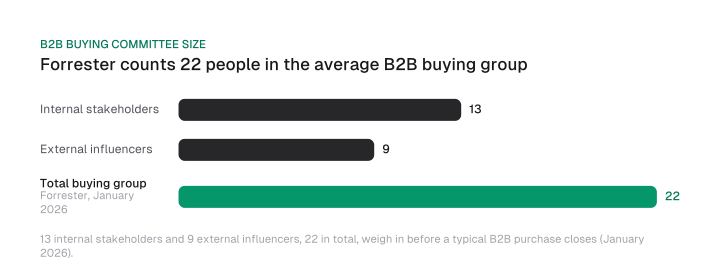
That's also the real answer to b2b seo vs b2c seo. It isn't lower search volume, even though volume usually is lower. A B2B sale has to satisfy roughly 22 people's search behavior across a single committee; a B2C sale satisfies one shopper.
Size isn't a burden this group tolerates. It's a factor buyers report as useful: Forrester's same report found that 94% of buyers in groups of six or more internal participants say the size itself helps, from more perspectives to easier budget approval.
None of that shows up in a single target keyword. It shows up in how many separate questions your page set answers before that group of 22 reaches agreement, which the next section explains.
A b2b seo strategy built around one persona's keyword will always undercount who's actually searching.
Why one page can't rank for the whole buying committee
One page can't rank for a whole buying committee because search and AI retrieval split a single topic into many separate questions, one per stakeholder concern.
Google has described its AI Mode in Search as using a technique it calls query fan-out. The mechanism behind that resembles what patent WO2024064249A1 describes: a query gets split into several synthetic sub-queries, each one retrieved in parallel, then the results get synthesized into a single response.
How Google AI Mode retrieves and synthesizes answers covers the mechanics in full.
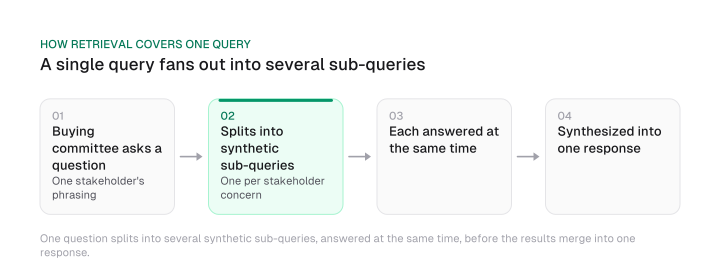
Here's what that looks like for two roles on the same committee:
- The technical buyer asks "does this integrate with our SSO provider": one retrieval event.
- Procurement asks "what does the data processing addendum cover": a different one entirely.
They aren't two readings of the same page. A page written only for the economic buyer, all ROI and pricing, answers exactly one of those questions. So it stays invisible for the rest, even when it ranks well on its own terms.
Coverage has to match the committee's questions, not because more content is generically better. It's because that's literally how retrieval finds and assembles an answer now.
A page set that never mentions integration security, procurement terms or onboarding time has holes retrieval can see. A technical buyer or a procurement reviewer can't fill those holes in from a page that was never written for them.
Finding bottom-funnel keywords that look too small to bother with
A bottom-funnel B2B keyword is worth targeting when its low volume reflects a small buying committee searching a specific situation. Good b2b keyword research starts from that distinction.
Here's why: the volume column in most keyword tools was built for consumer search patterns, and it punishes exactly the terms that convert best in B2B.
At any given moment, only a handful of companies are actively buying what you sell. Within each of those accounts, only a slice of a large committee ever types the exact phrase that describes their situation.
A thin volume number doesn't necessarily mean nobody wants the term. Often it means only a few accounts, each running their own search process involving several people, would ever type it.
Use this filter before you dismiss a keyword:
- Does it name a specific integration ("connects to [tool]")?
- Does it name a specific role's task ("how to configure [feature] for [role]")?
- Does it name a specific evaluation stage ("[category] pricing," "[product] vs [competitor]," "[product] for [use case]")?
If you answered yes to any of those, low volume is exactly what you'd expect from a targeted term. It isn't a reason to drop it.
For page type, keep the rule simple. A broad pillar topic gets a blog post. A term with a transactional modifier, comparison, pricing, integration or a named use case earns its own landing page built to convert.
That single split does more for a B2B content calendar than another round of keyword research sorted only by volume.
Mapping content to every role in the buying committee
A B2B content set should map four buying committee roles, economic buyer, technical buyer, end user, and procurement or legal, to distinct page types.
Skip a role and its concern goes unanswered, no matter how much you publish for the other three.
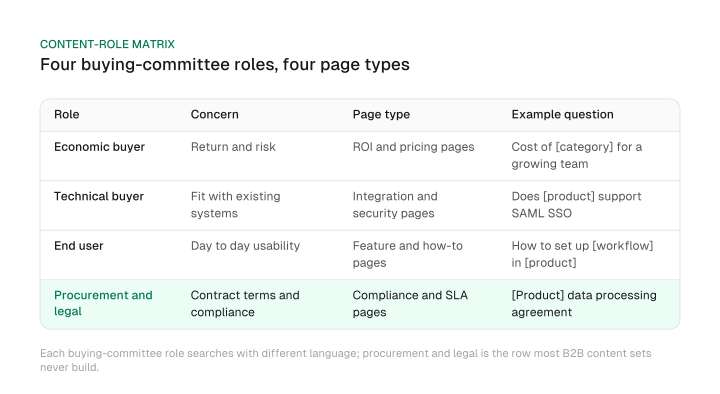
Here's how the four roles split, by concern and page type:
- Economic buyer. Return and risk drive this role. Build ROI and pricing pages; a typical search reads something like "cost of [category] for a mid-market team."
- Technical buyer. Fit with existing systems is the concern. Integration and security pages answer it, for a question like "does [product] support SAML SSO." For a SaaS product, SaaS SEO covers how integration pages earn that visit.
- End user. Day-to-day usability matters most here. Feature and how-to content covers it, in a form like "how to set up [workflow] in [product]."
- Procurement and legal. Contract terms and compliance exposure decide this one. A compliance and SLA page handles it, answering something like "[product] data processing agreement."
Procurement and legal is the role most content plans skip. It's also the one that stalls a deal after everyone else on the committee has already said yes. A single compliance page, built once and kept current, closes that gap without turning your site into a legal library.
AI Overviews and AI chatbots are already inside the committee's research
AI Overviews and AI chatbots already sit inside the buying committee's early research. That changes what "ranking" needs to cover before a click ever happens.
G2's 2026 Answer Economy report puts it at 51%: that share of B2B software buyers now turns to an AI chatbot more often than to Google when research begins, against 29% in its 2025 report.
That's a 22-point jump in a year (51 minus 29), happening before your page ever gets a click to measure.
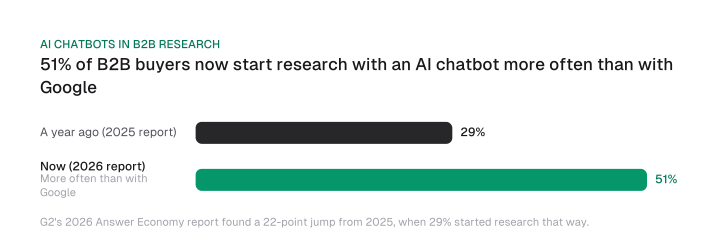
The click side is shrinking too. Ahrefs' April 2025 study found a 34.5% lower average click-through rate for the position-1 organic result once an AI Overview appears, comparing March 2024 to March 2025 data. Early-funnel B2B content now competes for a spot inside a generated answer as much as for a spot in the results.
Which means ranking for a technical buyer's early question isn't enough if the answer gets synthesized first. Optimizing directly for chatgpt seo citations covers the tactics for winning that spot.
Two more channels round out the picture:
- Analyst and community discussion, sometimes called the dark funnel because it leaves no tracking footprint.
- Social platforms, increasingly used as search engines in their own right.
Neither shows up in a keyword tool, and both deserve a presence.
How geo vs seo differs when buyers ask an ai covers the conceptual split between the two disciplines, and the full generative engine optimization framework goes deeper on the mechanics behind both. What ai overviews means for seo beyond this hub covers the CTR data in full; this section uses it only for the buying committee angle.
Whether any of this is landing for your own pages is at least measurable at the platform level: Mission Growth's platform tracks AI citations and visibility for customers.
Technical and on-page foundations B2B sites still get wrong
B2B sites lose the most ground on internal linking and architecture depth, more than on any exotic technical fix that usually gets top billing in a generic checklist.
Two things to fix here. Not twenty.
First, internal linking. Zyppy's February 2026 study found that pages with 40-44 incoming internal links are associated with roughly 4x the clicks of pages with 0-4. The reversal past 45-50 links traces mostly to sitewide navigation links rather than genuine topical linking.
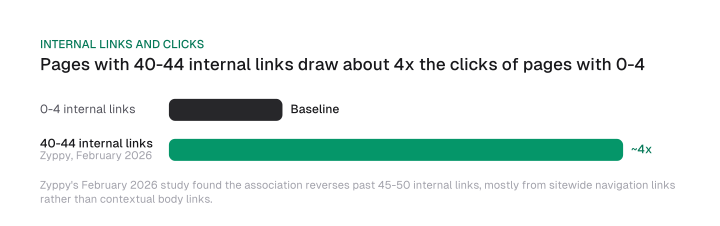
The association is correlational. It isn't proof that adding links causes clicks. But the pattern is consistent enough to act on: add contextual body links from genuinely related pages, each with a descriptive anchor that names what the linked page covers, rather than counting on a footer or nav menu to do the work.
Second, architecture depth. The four roles from the matrix above each need their own page type, and every one of those pages needs to sit within a click or two of the section a stakeholder actually browses. A compliance page buried three folders deep in a generic resources hub might as well not exist for the procurement reviewer looking for it.
This isn't a full b2b seo checklist. The full technical seo checklist covers crawlability, speed and the rest. These two items are the ones that specifically cost B2B sites pipeline.
Proving the pipeline B2B SEO creates when most of it is invisible
B2B SEO's pipeline contribution gets proven with three proxies used together, because most of a buying committee's research never touches a tracked channel. Turning that pipeline into a return figure finance accepts is a separate step, covered in SEO ROI.
Anonymous research, dark-funnel channels, chatbot sessions, colleague word of mouth, isn't a gap in your tracking setup. It's most of the journey, by design.
Three proxies, together, substitute for what analytics can't see:
- Branded search lift. Track branded query volume alongside your content calendar. A rise after a content push signals that your content reached people analytics never tagged as a session.
- A sales-assisted attribution override in the CRM. Give sales reps a simple field to flag "prospect mentioned reading [specific page]" during a call, then route that back into your attribution model by hand. It catches what no pixel can.
- A shortlist stage signal. In 6sense's 2025 Buyer Experience Report, 94% of buying groups had already put their shortlist in order of preference before a seller was ever contacted. If your SEO-sourced pages show up in that pre-contact research, the branded lift and the CRM flags above are how you'd see it.
None of these proxies proves causation alone. Together, they triangulate a pipeline contribution that a single last-click or first-click model understates by design: both assume the whole journey happened somewhere a script could see it.
The committee decides, not the keyword
B2B SEO succeeds when your page set answers every buying committee member's question.
It fails when you can't show the pipeline that work creates. It has never been about writing more or chasing a bigger keyword.
Every framework in this guide, the content matrix, the low-volume keyword filter, the two technical fixes, the three-proxy proof, exists to close one of those two gaps.
Start with the gap you can fix this week. Pull your current page set and check it against the four roles in the matrix above. If procurement and legal has no page, that's usually the fastest pipeline you're leaving on the table.
Frequently asked questions
Forrester's January 2026 data puts the average buying committee at 22: 13 internal stakeholders and 9 external influencers. That's higher than the 10-13 figure often quoted, and it's the number a b2b seo strategy should plan content around rather than a single buyer persona.
Yes. In G2's 2026 Answer Economy report, 51% of B2B software buyers turn to an AI chatbot more often than to Google when research begins, against 29% a year earlier. The practical implication: your content needs to be citable inside a chatbot's answer as well as rankable in a results page.
Mostly in who you're satisfying. B2B SEO answers roughly 22 people's search behavior across a single buying committee, each asking a different question. B2C SEO usually answers one shopper. That's a retrieval and content-coverage problem that search volume alone doesn't explain.
Combine three proxies: branded search lift after a content push, a sales-assisted attribution override recorded in the CRM, and a shortlist stage signal. 6sense's 2025 Buyer Experience Report found that 94% of buying groups rank a vendor shortlist before ever talking to a seller. No single attribution model catches research that never touches a tracked channel.
Yes, when the low volume reflects a specific buying committee role's language rather than weak demand. A term naming a specific integration, task or evaluation stage is usually worth targeting even at a thin volume, because only a slice of a small, active buying group would ever type that exact phrase.
That's a real, separate decision. Whether to build in-house or hire a b2b seo agency isn't something this guide resolves. Deciding on an ai seo agency instead of building in-house walks through that tradeoff directly, and the frameworks here apply whichever way you decide to staff it.
Figures and images in this post are free to reuse under CC BY 4.0 with credit to Mission Growth.
Get Mission Growth highlighted in your Google results.