
SaaS SEO: The Product-Led Playbook for B2B Pipeline
SaaS SEO means building the alternative, comparison and integration pages that convert trials, not just chasing more keywords. Here's the playbook.
On this page
Your SaaS SEO program ships content every week. Organic traffic keeps climbing, and trial signups aren't moving with it.
That gap isn't a volume problem. It's a page problem: a buyer decides on an alternative page, a comparison page, an integration page or a use case page long before a blog post reaches them, and most content calendars build those last, if they build them at all.
This guide gives you the build order for those four pages, the structure each one needs, and the technical and AI visibility mechanics that decide whether an answer engine ever cites them.
In this guide:
- Why the buyer journey isn't the straight line your funnel model assumes
- Which product-led page to build first, and how to structure it
- The one technical risk that makes a comparison page invisible to an AI crawler
- How AI answer engines pick which passage to cite
- When a SaaS SEO agency beats building in-house
What SaaS SEO actually optimizes for
SaaS SEO means ranking and getting cited for the pages a subscription buyer reads before they talk to sales. Traffic is a side effect; pipeline is the point.
Get that right and the rest of your SaaS SEO strategy follows: which pages come first, who owns them, and how you judge whether the program works.
Three things make a subscription product's SEO different from a services or hardware company's:
- Recurring revenue measurement. A single visit rarely closes a deal. A page earns credit when it shows up in the sessions before a trial or demo request, tracked as pipeline rather than pageviews.
- More than one buyer per deal. A practitioner who evaluates and a budget holder who signs off land on different pages of your site, often without ever seeing the same one.
- Product-led pages built for named competitors. Alternative, comparison, integration and use case pages exist because SaaS products compete against named alternatives, a fight most service businesses don't have.
Put those three together and you get product-led SEO: growth mapped to a buying decision instead of a content calendar chasing keywords.
Here's the reframe that carries the rest of this guide: the pipeline goal decides which pages matter first. Most buying groups have already picked a favorite before a salesperson ever hears from them.
6sense's 2025 Buyer Experience Report puts a number on that gap, and the next section walks through exactly how wide it is.
Map the buyer journey before you touch keywords
The buyer journey for a subscription product isn't a straight line from awareness to purchase. Building blog content before a comparison or alternative page exists is usually backwards.
6sense's 2025 Buyer Experience Report surveyed more than 4,000 B2B buyers. It found that 94% of buying groups rank a preferred vendor before first sales contact, and 77% end up buying from that pick.
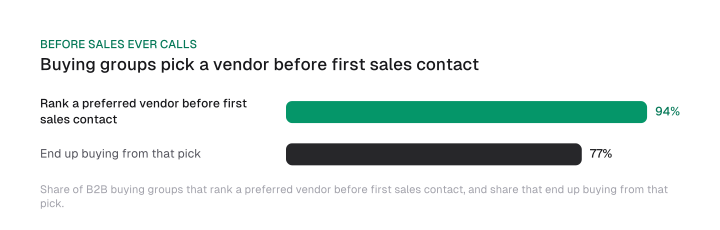
Sales enters after the decision is mostly made, so a page aimed at the awareness stage alone is competing for a decision that's often already settled by the time someone reads it. That's the correction the standard funnel checklist misses: it assumes buyers walk from top to bottom in order, so it schedules blog posts first and comparison pages last.
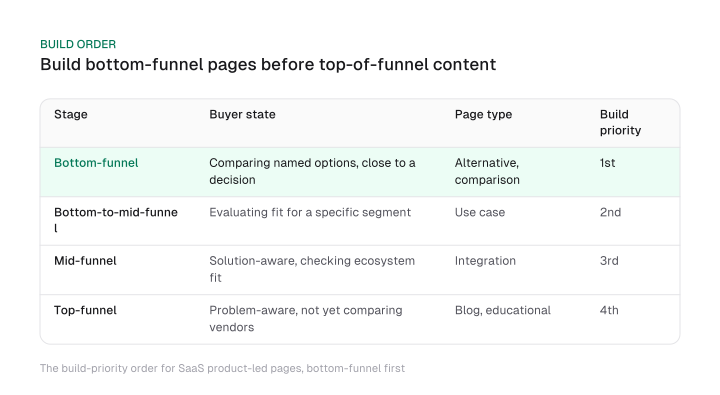
Here's the build order that matches how buyers actually decide, bottom of the funnel first:
| Stage | Buyer state | Page type | Build priority |
|---|---|---|---|
| Bottom-funnel | Comparing named options, close to a decision | Alternative, comparison | 1st |
| Bottom-to-mid-funnel | Evaluating fit for a specific segment | Use case | 2nd |
| Mid-funnel | Solution-aware, checking ecosystem fit | Integration | 3rd |
| Top-funnel | Problem-aware, not yet comparing vendors | Blog, educational | 4th |
Download CSV (CC BY 4.0)
The rule this table makes concrete: build alternative and comparison pages before another blog post, because that's where buyers who already have a favorite go to confirm or challenge it.
Build the four pages that actually convert a SaaS buyer
A SaaS site earns pipeline at the bottom of the funnel from four page types: alternative, comparison, integration and use case pages.
Each needs a different structure to do its job. A generic blog template does none of them well: each page displaces a competitor, wins a head-to-head, captures an ecosystem search or matches a segment, and the structure has to match the job.
One production note before the anatomy: these pages come from the same research, brief, publish, refresh process as any other page on your site. They just run against a fixed skeleton instead of a blank outline, which is what makes them repeatable across every comparison you need to build.
Alternative pages
An alternative page has to name the competitor's real strength before making its own case, or it reads as one-sided and both readers and AI answer engines discount it.
A reader searching "[competitor] alternative" already knows what the competitor does. Your job on this page is to state where you genuinely win, where the competitor still wins, and who should pick which. For example, if a competitor has a deeper integration marketplace, say so, then show the segment where your product wins anyway.
Comparison ("X vs Y") pages
A comparison page wins the "X vs Y" query with a structured feature table and FAQPage schema, built to be scanned rather than read top to bottom.
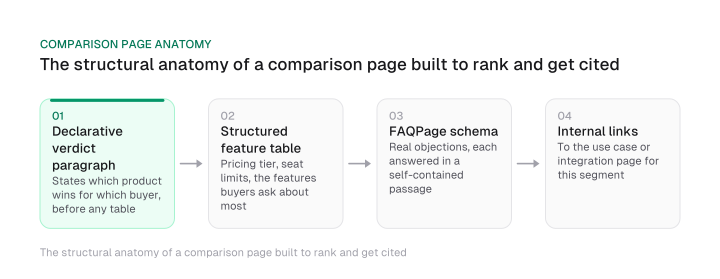
The anatomy that does this work, in order down the page:
- A declarative verdict paragraph near the top, stating which product wins for which buyer, in plain language, before any table.
- A structured feature table with the handful of attributes that actually decide the purchase: pricing tier, seat limits, the two or three features buyers ask about most.
- FAQPage schema wrapping the page's real objections, like whether the product is harder to set up than its rival, each answered in a self-contained passage.
- Internal links to the use case or integration page that matches the segment reading this comparison.
Integration pages
A dedicated integration page ranks for "[product] + [tool]" searches that a single combined integrations list never captures.
For example, a page titled "Notion integration," with its own URL, setup steps and use cases, ranks for that exact search. A generic integrations page listing fifty logos serves browsing; a dedicated page serves search.
Use case pages
A use case page earns its own URL when a buyer segment searches with language a general product page doesn't use.
"Project management for construction teams" and "project management for marketing teams" are different searches with different proof points. A single generic product page can't hold both without diluting either one. Build one when the segment's language is genuinely distinct, and skip it for personas that already fit the general page.
Keep the technical foundation from undoing the rest
A SaaS site's biggest technical risk is a marketing or comparison page built in the same JavaScript framework as the product, because crawlers that skip JavaScript never see it.
The basics matter the way they do for any site, and the full technical SEO checklist covers them in depth:
- Sitemaps that list every priority page
- Canonical tags on any duplicate or parameterized URL
- Redirects cleaned up after a URL changes
- Page speed fast enough that a crawler doesn't time out
The one risk specific to a SaaS site is rendering. Most SaaS marketing sites live in the same codebase as the product, so the alternative and comparison pages you just built often ship in the same framework, rendered in the browser, as the product itself.
An AI crawler that skips JavaScript requests that page and gets back an empty shell: no verdict paragraph, no feature table, nothing to cite.
We migrated our own React single-page app to prerendered static HTML for 20 marketing pages because AI crawlers do not execute JavaScript. It's the same failure mode this section describes, fixed at the source instead of patched afterward.
Link building still helps domain authority, but it can't rescue a page a crawler can't read. Fix rendering before you chase links.
Get bottom-funnel pages cited in AI answers
AI answer engines cite a page by pulling the single passage that best matches a query, sometimes just one row of a comparison table.
That row can win a citation even when the rest of the page wouldn't rank on its own. Patent US9940367B1 describes how an answer system scores a candidate passage, combining two kinds of signals:
- Query-dependent signals. Does the passage match the query's terms and answer terms.
- Query-independent signals. Position on the page, language coherence, and whether a section boundary marks a clean unit.
A page doesn't need to rank first for one of its passages to win that score. Structure a table row or a verdict sentence to stand on its own, and it can get picked even when the rest of the page wouldn't.
That mechanism matters more than chasing a "statistics" tactic in isolation.
A widely repeated claim overstates what adding statistics alone does for a page's visibility in AI answers. Aggarwal et al.'s 2024 GEO paper reports up to a 40% lift on one lab metric, Position-Adjusted Word Count, and each top individual method, citing sources, adding quotations or adding statistics, reaches that range on its own; the paper never tests the three combined. On its other metric, Subjective Impression, the same methods top out closer to 28%. That's a narrower result than a blanket lift in visibility or citation frequency from statistics alone.
Whether any of this moves the needle for your site is a separate, answerable question. Mission Growth's platform tracks AI citations and visibility for customers. For the full framework on what to measure, see the SEO KPIs guide.
For the mechanism behind all of this in more depth, see how generative engine optimization works. For tactics that apply beyond comparison pages specifically, see ai search optimization techniques.
Decide who builds it: in-house, agency or a hybrid
The SaaS SEO agency vs in-house decision comes down to two things: page output per quarter, and whether your team has the GEO, content and technical skills to build them.
Page count without skill produces pages that don't convert. Skill without output capacity produces a strategy nobody ships.
| Page output needed per quarter | Skill gap (technical, content, GEO) | Fit |
|---|---|---|
| 1-2 pages | None: team already ships and structures pages correctly | In-house |
| 3-6 pages | Partial: content is fine, technical or GEO structure is missing | Hybrid (in-house content, outside technical/GEO review) |
| 3-6 pages | Full: no in-house capacity for any of the three | Agency or full-service |
| Ongoing, plus monitoring | Team ships pages but lacks strategy and AI-visibility monitoring | A service like Mission Growth |
Download CSV (CC BY 4.0)
Cost scales with how many of these pages a team needs built and maintained per quarter; the full cost breakdown lives in the SEO cost guide, and the ROI math behind justifying the spend lives in the SEO ROI guide. Neither number changes the rule above: it comes down to output need and skill gap, more than any price tier.
A team that's already shipping pages but missing strategy and AI visibility monitoring fits a service, more than a full agency retainer.
Mission Growth (our platform) is an AI-led SEO and GEO growth service: AI catches the signal, our experts make the move, and you see the result. It's built for exactly that middle case, where the gap is monitoring and strategic direction rather than raw page production.
One proof point for that model: Pozitif Teknoloji's +225K organic clicks in six months, an organic-search result for a Turkish brand we work with.
Common SaaS SEO mistakes that stall pipeline
Most SaaS SEO mistakes don't come from a technical error. They come from skipping the four product-led page types and never assigning credit for a trial signup.
The costliest habits show up even on teams that otherwise run competent SEO:
- Measuring content by traffic instead of pipeline. A blog post that drives visits without a single trial signup looks like a win on a traffic dashboard and a loss on a pipeline one.
- Publishing blog content before any alternative or comparison page exists. This is the sequencing mistake from earlier in this guide, and it's the most common one.
- Treating the four page types as one-time projects. Competitors change pricing and features, and a comparison page built once and never refreshed goes stale exactly where a buyer would notice.
- Skipping attribution for signups that touch multiple pages. A buyer reads a blog post, then a comparison page, then signs up. Credit the wrong page, or none at all, and the program looks weaker than it is.
- Applying a generic B2B framework wholesale. The framework isn't wrong about technical SEO or link building. It's incomplete about the pages a subscription buyer needs before they'll trust a signup decision.
The costliest one is the first: measuring content by traffic when the real job was always pipeline.
SaaS SEO's job, restated
SaaS SEO's job is building the pages a buyer reads before ever contacting sales: alternative, comparison, integration, use case pages.
Each one has to be structurally legible to both Google and AI answer engines. Traffic follows from doing that well; it was never the goal.
If you're starting from zero, skip another blog post. Pick your strongest named competitor, build one comparison page using the anatomy above (verdict paragraph, feature table, FAQPage schema, internal links), and ship it before you add anything else to the calendar. If the whole domain is new, SEO for startups covers what to fix first with no authority.
Frequently asked questions
Credit the last product-led page, alternative, comparison or use case, that the buyer touched before signup. Track it as its own conversion event so a first-touch blog post doesn't take credit that belongs to the page that closed the decision.
Only where the product is subscription-based and self-serve or trial-driven. The four product-led page types (alternative, comparison, integration, use case) are the difference; the fundamentals of technical and content SEO underneath them are the same as any B2B site, and our B2B SEO strategy covers them.
Page type decides the timeline more than SEO as a discipline does. Pages that meet existing purchase intent, like a comparison or alternative page, tend to move faster than new content aimed at total newcomers. For the general timeline, see how long SEO takes.
SaaS SEO cost scales with how many product-led pages your team builds and maintains each quarter. For the full breakdown, see the SEO cost guide.
Yes, at the platform level. Mission Growth's platform tracks AI citations and visibility for customers. For a full KPI framework to build your own measurement around, see the SEO KPIs guide.
No, when the page names a real competitor strength alongside the product's own fit. A one-sided page that pretends the competitor has no advantages reads as thin to both readers and AI answer engines, which is the opposite of the trust an alternative page needs to build.
Figures and images in this post are free to reuse under CC BY 4.0 with credit to Mission Growth.
Get Mission Growth highlighted in your Google results.