How to Learn SEO for Free: 4 Paths and a Practice Loop
How to learn SEO: four starting points, four routes. Use free Google sources, practise with a change log, and see how 234 surveyed SEOs learned it.
By Furkan AktaşPublished Updated

On this page
Searches such as how can I learn SEO and learn seo from scratch all ask the same thing: where do I start? The short answer is to pick the route that fits your starting point, practise on a site you control and judge each change only after Google has recrawled it.
This guide lays out how to learn seo step by step on one route picked for your situation. It starts from free Google sources and answers "can I learn SEO on my own" with survey data.
Threads under how to learn seo reddit keep circling one decision, and the first table below settles it.
How to learn SEO: pick the path that fits your starting point
The right way to learn SEO depends on your starting point: a site owner, a career switcher, a marketer handed SEO and a writer or developer each need a different first project.
SEO stands for search engine optimization. That's all the definition you need here, so the table gives each starting point a first source and a first project.
Start with the row that matches you; that is how to learn seo for beginners without guessing. The first project decides what you can show, since every row ends in something a client or employer can check.
A site owner who wants the wider picture can read seo for startups after the Starter Guide. A career switcher should also check the skills named in job listings, which will ai replace seo breaks down.
A marketer handed SEO can follow an seo audit checklist for the audit project.
The writer or developer row packs two routes into one. Writers start from search intent and the query behind each page. Developers start from crawl and index behaviour, such as JavaScript rendering and redirects. Each borrows the other half later.
Do you need a course to learn SEO?
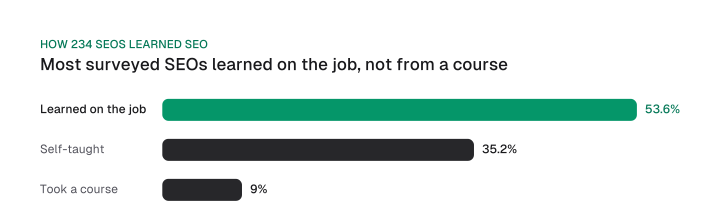
Most working SEOs did not learn from a course: in Ahrefs' 2024 survey of 234 SEOs, 53.6% learned SEO on the job, 35.2% were self-taught and 9% took a course.
Semrush's guide answers the same question with a line that has no source behind it:
No. Most SEO professionals are self-taught.
That is half right. Only 9% took a course, so formal education is plainly not required. But self-taught is the smaller group, 35.2% against 53.6% who learned SEO on the job.
Read those numbers with their limits. The respondents were 234 SEOs, and most responses were collected at Brighton SEO, so the sample is primarily UK. People chose to answer, and an SEO tool vendor ran the survey. It shows how these people say they learned. It cannot say which route works best.
So can you learn SEO on your own? Yes, 35.2% of these SEOs did. The largest group learned by doing the job, though, and a test site only approximates that. The survey can't show a test site substitutes for a job. Treat it as the nearest stand-in until you have one; that is our advice, and the data doesn't prove it.
A course earns its price when it gives you structure and feedback you lack. Buy one if you've no live site or employer to practise on and you'll do the practice part. For example, a structured course makes sense for a career switcher with nothing to test on.
Skip certificates as proof of skill: a certificate shows completion, while the proof note in the last section shows results. Google's own documentation is the free baseline either way. If you learn better from video, follow the same reading order and run the same checks.
What to read first, and how to tell you understood it
The best first reading is Google's own: the SEO Starter Guide, then How Search Works, then the Search Console start page, each followed by a check you can run on a real URL. All three are free, which also answers how to learn SEO for free.
The second row rests on two sentences from Google. Search works in three stages, and not all pages make it through each. Google also doesn't guarantee that it will crawl, index or serve your page, even if the page follows Search Essentials.
The Search Console page adds that the tool reports how Google crawls, indexes and serves a site. Its performance report breaks traffic down by queries, pages and countries. The Moz Beginner's Guide to SEO is another free route if you want a second voice.
The exit test is what makes the foundation finished. To run it, label three URLs of your own as not crawled, crawled but not indexed, or indexed, with the inspection result as evidence for each. If you cannot show the evidence, reread the stage you cannot name; what are seo services explains the three stages and which one a service acts on, so this page does not repeat it.
After the foundation, learn the skills one at a time, each as its own project:
- Keyword research: which keyword to write first covers picking the query before you write.
- On-page work, such as titles and headings, which each get one change in the sprint below.
- Technical checks, which the inspection tool already introduces.
- Link building, which comes last because it needs pages worth linking to.
Practice on a live site and judge each change after Google has seen it
The way to practise SEO is on a site you control, such as your own test site, with one logged change at a time that you read only after Google has recrawled the page. Learners on Reddit ask how to practice SEO, and this loop is the answer: a baseline, a change log and a recrawl gate.
Practice teaches SEO when you judge each change only after Google has recrawled the page. Crawling can take a few days to a few weeks.
Google gives two clocks. Its recrawl guidance says crawling can take anywhere from a few days to a few weeks. It tells you to monitor progress with the Index Status report or the URL Inspection tool.
The SEO Starter Guide runs the second clock: some changes take effect in a few hours, others could take several months. It suggests you wait a few weeks to assess whether your work helped.
A page Google hasn't seen yet can't have succeeded or failed. So judge a change after evidence of a recrawl, and ignore the fixed calendar window.
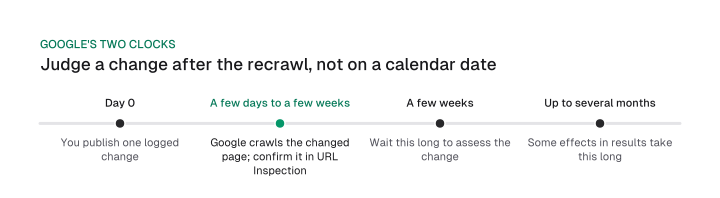
The timeline above puts it in order: you publish, Google crawls the changed page, you wait a few weeks to assess the change, and some effects take up to several months. The sprint that follows turns that rule into five steps:
- Verify the site in Search Console and run the baseline export: queries and pages from the performance report, saved with the date.
- Pick one change on one page: a title, a section that answers a query the page already shows impressions for, or an internal link.
- Write it in the change log before you publish: date, URL, what changed, what you expect, and which report you will read.
- Publish, then use the URL Inspection tool until it shows Google has crawled the new version. Expect a few days to a few weeks.
- Only then compare the same query and page against the baseline export. Google's guide says to wait a few weeks to assess; some effects take up to several months.
The change log is a small table you can copy:
One change at a time is the point. Two edits on the same page leave you unable to say which one moved the query. For a low-stakes experiment you can also put a made-up word on a throwaway page and watch how fast it is found. That is our suggestion for practice and has no source behind it.
Start with Search Console, because it is free and it is Google's own report. Add a third-party suite only after a specific question needs one.
Reading takes far less time than waiting, so expect most of your learning calendar to be waiting for Google. How long does seo take models that wait for a site owner.
The guide on how to write title tags includes a calendar window for judging a title edit. This sprint gates the judgement on the crawl instead, and it works for any change.
While you wait for Google, the 90 day seo plan gives you a week-by-week order of work.
Can you use ChatGPT to learn SEO, and do you need GEO first?
An AI chatbot can teach SEO if you treat every rule it gives as a claim to confirm in Google Search Central, and you don't need a separate GEO track first.
On the order of learning, Google says a page must be indexed and eligible to be shown in Google Search with a snippet to be a supporting link in AI Overviews or AI Mode. It lists no additional technical requirements. Specific optimization is optional for these features, and existing SEO fundamentals continue to be worthwhile.
That is Google's rule for Google's features; other engines differ. How to show up in ai overviews seo unpacks the eligibility rule, so here it only sets the order: foundations first. Whether AI makes the skill obsolete is a separate question that the will ai replace seo guide answers.
Treat the chatbot as an AI tutor, which is good at explaining and unreliable at citing. Use this verify rule on every answer:
- Ask the chatbot for the rule and for the source of the rule.
- Open Search Central and find the sentence that supports it.
- If you cannot find one, mark the rule a hypothesis.
- Test it with one logged change on your practice site.
If you are wondering whether to use AI to learn SEO, this rule is the answer we would give. If you want to see where the skills overlap, seo skills for ai search compares them with traditional SEO.
Show your work: how to prove SEO skill and what the job pays
SEO has no GitHub, so the proof of skill is a proof note: a dated baseline, the change log, and what Search Console showed afterwards. One page is enough, and it comes straight from the practice loop above. Write it in four parts:
- The starting state and the dates of your baseline export.
- The changes, copied from the change log.
- The signal you read and when you read it, including the date the inspection tool showed Google had crawled the new version.
- What you would do next.
An employer or client can check a proof note against your Search Console data, which a certificate cannot offer. The skills employers ask for in listings sit in the will ai replace seo guide, so this page does not restate them.
The work is worth the effort, within limits. Ahrefs' 2024 survey reported a median salary of $58,288 for SEOs, but its responses were mostly collected at Brighton SEO and are primarily UK.
SE Ranking's 2025 survey of 279 responses found a median salary of $51,680 globally, $66,000 in the US against $40,689 in the European region.
These are different samples with different methods, both self-selected. Read them side by side as a range of what two surveys found, and don't average them. The pay shows the job exists; it can't forecast what you will earn.
The proof note is the closing step of the whole route. Learning SEO works when the route fits your starting point and the practice is logged and judged only after Google has recrawled the page. This week, verify one site in Search Console, run the baseline export and write the first line of your change log.
Frequently asked questions
Can I learn SEO on my own?
Yes. In Ahrefs' 2024 survey, 35.2% of SEOs were self-taught and 53.6% learned on the job. A test site and the change log stand in for the job until you have one.
How long does it take to learn SEO?
Reading Google's sources is quick. Seeing whether a change worked takes longer: Google says effects can take a few hours to several months and suggests waiting a few weeks to assess. The phases an owner waits through are in the how long does seo take guide.
Is SEO hard to learn?
The concepts are small, since Google describes three stages. The hard part is patience and judging a change only after Google has seen it. You need no technical background to start; a developer helps with complex fixes.
Can I learn SEO for free?
Yes. Google's SEO Starter Guide, How Search Works and the Search Console start page cost nothing. A course adds structure; the sources themselves are free.
How do I show SEO skills without a portfolio?
Write a proof note from your practice loop: baseline, change log entries, the date the recrawl was confirmed and what you would do next. Search Console's performance report supplies the numbers.
Can I use ChatGPT to learn SEO?
Yes, for explanations. Confirm each rule against a sentence in Google Search Central, and test the rest on your practice site. Google lists no additional technical requirements for AI Overviews and AI Mode.
Can a beginner do SEO?
Yes. Start with one site and one change. If SEO is now your job, the marketer row in the first table covers the in-house case.
Cite this page
Aktaş, F. (2026, October 15). How to Learn SEO for Free: 4 Paths and a Practice Loop. Mission Growth. https://missiongrowth.io/blog/learn-seo
Figures we made for this post are free to reuse under CC BY 4.0 with credit to Mission Growth.
Get Mission Growth highlighted in your Google results.