The 90 Day SEO Plan: Week by Week, With a Checkpoint
A 90 day SEO plan, week by week, with a checkpoint before content starts and a plain note on which timeline claims are evidenced and which are a hedge.

On this page
You've read one or two other "90-day SEO plan" posts already, and the numbers didn't line up. One says your first lead lands in week 8. Another says meaningful movement starts in month 3. Neither says where the number comes from.
A 90 day SEO plan, sometimes labeled a 90 day SEO strategy or a 3 month SEO plan, works because of a dependency. Three phases, foundation, content and authority, run in that order, each one built on the last.
This guide runs the same three phases, and it does one thing those competing plans don't: it states, claim by claim, which of its own timing promises are evidenced and which are a calibrated hedge.
In this guide:
- The phase order behind the plan, and the one piece of Google's own leaked documentation that explains why no plan shows a real move overnight
- Which specific week and month claims other SEO roadmap guides make with no source behind them, and what's actually knowable instead
- Weeks 1-4: the foundation checklist and the checkpoint that proves it's actually done
- Weeks 5-8: one worked example, from a named competitive gap to a published page
- Weeks 9-13: a KPI matrix that separates leading indicators from lagging ones, plus a self-diagnostic for a plan that's quietly stalled
What a 90 day SEO plan actually does, and why the window is 90 days
An SEO plan works when its three phases run in the right order, each depending on the last: foundation, then content, then authority.
The window is sized to let each phase run and actually get checked. It isn't chosen for being a magic count of days.
What the three phases cover:
- Foundation, weeks 1-4. Technical audit, crawl access and a measurement baseline.
- Content, weeks 5-8. Pages built from named gaps, plus on-page differentiation.
- Authority, weeks 9-13. Link building and a KPI reading.
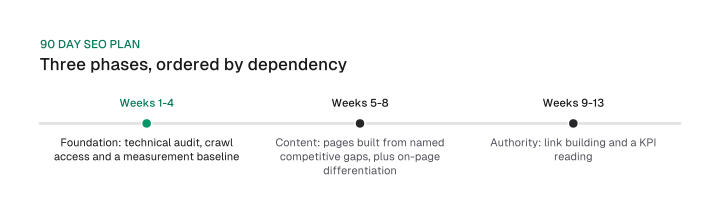
Content can't differentiate a site Google hasn't cleanly evaluated yet. Authority signals only compound on content that's already indexed. That's the real, checkable dependency behind the order, separate from any calendar convention.
A 2024 leak of Google's own Content Warehouse API documentation adds one supporting fact here. A URL retrieved as a qualifying result can still get held back from the results page purely because of its age in the index, logged as a distinct event separate from a real impression.
The same documentation shows a URL's coverage and click signal building up as a decayed, gradual total. It doesn't switch on all at once.
That's why no fixed short window ever shows a real ranking move immediately, whatever length you pick. The source names no half-life value or day count, so it explains the pattern behind the wait, and never a specific length for it. The fuller timeline mechanics live at how long does it take for seo to work.
If you're planning AI search visibility instead of classic rankings, a geo roadmap covers that version; this guide stays with organic rankings.
Which claims in this guide are evidenced, and which timelines elsewhere aren't
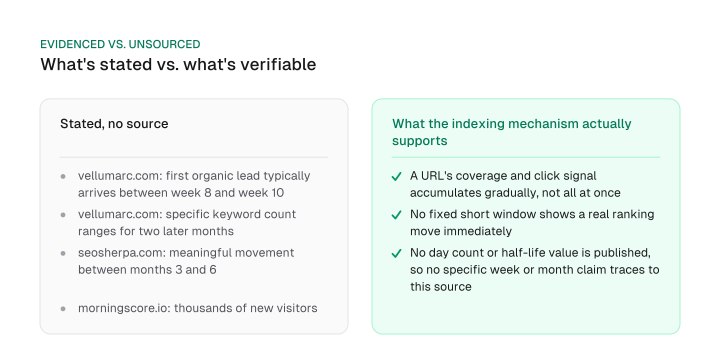
None of the four competitor plans that name a specific week or month for results cites a source for it.
This guide states plainly which of its own claims are evidenced, and which are a calibrated hedge instead of a finding.
A guide at vellumarc.com states, with no source given anywhere on the page:
"the first organic lead...typically arrives between week 8 and week 10 for service businesses that execute this plan without skipping phases"
The same page also gives specific keyword count ranges for two later months, again with no source behind either number.
seosherpa.com makes a similar claim, also unsourced:
"results typically start showing meaningful movement between months 3 and 6"
morningscore.io goes further, with no baseline or niche stated:
"thousands of new visitors"
None of these numbers traces to anything checkable. A specific week for "your first lead" isn't something a general plan can know. What's actually knowable is the mechanism above: a signal that builds up gradually, arriving on its own timeline.
Keep that rule past this page too: an evidenced claim comes with a mechanism or a source you can open yourself. A decorated one just comes with a specific number. Apply it to the next roadmap you read, including this one. The full breakdown lives at how long seo takes to actually show results.
Weeks 1-4: the foundation everything else depends on
Weeks 1-4 fix the technical, crawl and measurement baseline every later phase depends on.
A second Search Console reading, not the calendar, decides when the phase is actually done.
If you're wondering how to start an SEO plan from zero, this is that starting point.
Run through these in order:
- Confirm crawl access. Check robots.txt, the XML sitemap and any stray noindex tags so Googlebot can reach every priority page.
- Pull a baseline. Record indexed pages, crawl errors and average position from Search Console, by page group.
- Run the technical audit. Core Web Vitals, canonical tags and site architecture; the seo audit checklist walks through the full method.
- Check crawl budget, if it applies. On a large site, confirm Googlebot isn't wasting crawl requests on low-value URLs; crawl budget covers the mechanism behind that check.
- Map the gap list. This is what weeks 5-8 turns into briefs, separate from a plain keyword volume list.
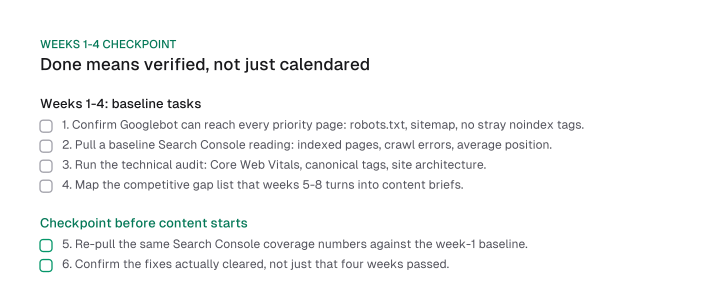
The foundation phase isn't done because four weeks passed. It's done when you re-pull the same Search Console coverage numbers from week 1 and confirm the fixes actually cleared.
A crawler tool, a keyword research tool and Search Console between them cover most of this phase. Which product you use matters less than whether each fix actually gets verified against that second reading.
Weeks 5-8: build the content that actually differentiates
Weeks 5-8 turn the gap research from the foundation phase into published pages.
The plan only compounds if each brief traces to a named competitive gap, separate from a keyword volume number.
Here's what that trace looks like end to end. Say the gap map from the foundation phase turns up one attribute every top ranking competitor covers only shallowly: a pricing page with a comparison table but no walk-through of the total cost over a year.
That gap becomes the brief: answer the question a reader has right after seeing that table, instead of another list restating the same prices.
The published page needs three things to actually close that gap: the calculation worked in full, a short line on how the number was derived, and a link back into the site's own pricing or product page. Skip any of the three and the page just repeats what the table already said.
That full trace, gap finding to brief to published page with nothing skipped, is the worked example this phase repeats on every priority page across the site.
A content phase built on gap research differs from a content calendar in exactly this way. A page briefed from keyword volume alone has nothing forcing it to say something the top 10 don't already say. A page briefed from a named gap does, by construction.
The same sequencing logic applies with no existing content to compare against yet. See startup seo strategy for how weeks 5-8 changes shape on a new site.
Weeks 9-13: build authority and read the KPIs that are actually telling you something
Weeks 9-13 shift into link building and a KPI reading that separates leading indicators from lagging ones.
Leading indicators move first, for the same accumulation reason explained in weeks 1-4; lagging indicators confirm the plan worked.
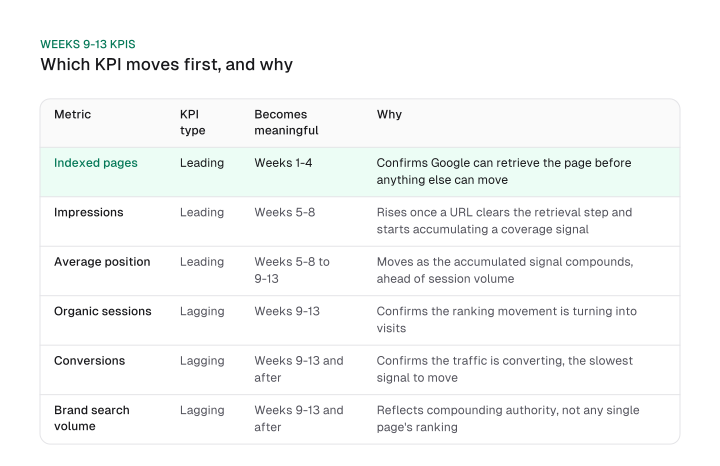
Here's why each metric moves when it does:
- Indexed pages (leading). Confirms Google can retrieve the page before anything else can move.
- Impressions (leading). Rises once a URL clears the retrieval step and starts accumulating a coverage signal.
- Average position (leading). Moves as the accumulated signal compounds, ahead of session volume.
- Organic sessions (lagging). Confirms the ranking movement is turning into visits.
- Conversions (lagging). Confirms the traffic is converting, the slowest signal to move.
- Brand search (lagging). Reflects compounding authority across the whole site, separate from any one page's ranking.
Reading a lagging metric early and calling the plan stalled means checking the wrong clock.
Copy the six rows above straight into your own tracker as a seo plan template: same columns, same order, checked against your own Search Console numbers instead of a generic list of metrics to watch.
A seo dashboard that pulls these numbers automatically each week beats a manual pull from Search Console once; the reading only means something as a trend.
This phase only tracks what already happened. seo roi covers whether the return justified the work, and seo forecasting picks up from these same KPIs to project the next quarter.
What actually derails a 90-day plan
A plan fails silently when a downstream task runs ahead of an unresolved upstream dependency.
Link building starting before the technical baseline actually cleared is the clearest example. No single task gets skipped outright; the sequence just breaks.
Every specific pitfall competitors list, an audit skipped, links bought too early, content briefed off keyword volume alone, is one pattern wearing different clothes: something downstream started before the thing it depends on actually finished.
A static list of pitfalls doesn't tell you which one is happening to your plan right now. This mid-quarter self-diagnostic does, checked against where the plan actually stands:
- Is link building running before the weeks 1-4 checkpoint confirmed the technical baseline actually cleared?
- Are new pages briefed from keyword volume alone, with no named competitive gap behind the brief?
- Has anyone re-pulled the Search Console coverage numbers since week 1, or is "foundation done" just an assumption because four weeks passed?
- Is a lagging KPI, organic sessions or conversions, being read for a signal before the accumulation mechanism above has had time to move it?
Answer yes to any of these and the fix is sequencing. More tasks won't fix a broken order. The enterprise seo strategy page covers the same dependency check at a larger scale, where more teams running in parallel makes the violation easier to miss.
Sequence an SEO plan by dependency, not by habit: measurement and crawl access first, content and differentiation second, authority and compounding signal third. Google's own leaked indexing documentation backs why no phase should be rushed. It doesn't back any specific day count over another, and this guide says so instead of borrowing an unsourced one from someone else's plan.
Pull your own Search Console coverage numbers this week. Those numbers are the actual baseline the weeks 1-4 checkpoint checks against, independent of any date on the calendar.
Frequently asked questions
Watch the leading indicators: indexed pages, impressions and average position move first, closest to the accumulation mechanism the checkpoint is built on. If weeks 1-4 confirmed the baseline cleared and those three are moving, week 9 will look different from week 1. Sessions and conversions come later.
Expect a gradually building signal instead of a promised date. Google's own leaked indexing documentation shows a URL's coverage and click signal accumulating over time rather than switching on at once, with no published day count attached to it. That's the honest ceiling on any timeline promise here.
An SEO plan is the sequenced, dated execution of an SEO strategy: which tasks happen when and in what order. The strategy is the higher-level set of priorities and goals the plan exists to carry out.
Three phases, ordered by dependency: a technical, crawl and measurement foundation in weeks 1-4, content built from named gaps in weeks 5-8, and link building plus a KPI reading in weeks 9-13, each with a checkpoint before the next one begins.
Nearly every specific pitfall reduces to one pattern: a downstream task, usually link building or a new content sprint, starting before the phase it depends on actually finished, rather than a step getting skipped outright.
Split them by type. Indexed pages, impressions and average position are leading indicators that move first; organic sessions, conversions and brand search are lagging indicators that confirm the plan worked, once the earlier signal has had time to compound.
Figures and images in this post are free to reuse under CC BY 4.0 with credit to Mission Growth.
Get Mission Growth highlighted in your Google results.