
How to Choose SEO Keywords: The Right Way to Sequence Them
How to choose SEO keywords means sequencing your whole candidate list by cluster size, not judging one best keyword at a time, with a worked example inside.

On this page
How to choose SEO keywords comes down to a sequencing problem across your whole candidate list, not a single-term judgment call.
Two checkable tests already exist for whether one keyword is winnable; what's missing from most advice is the rule for which winnable keyword to write first. This guide gives you that rule, then walks through building the list, reading the numbers correctly, and sequencing it end to end.
How to choose SEO keywords: start with your business, not a list
Choosing an SEO keyword starts from what the business can credibly serve and prove, not from a list a tool generated first. That's the real definition underneath every keyword checklist: a term earns a spot on the list when it's relevant to what you actually offer, searched by real buyers, and realistic enough to rank for.
Before you open Keyword Planner or Ahrefs, write down the specific problem your product or service solves, for which customer, and what proof you can show once they land on the page. A candidate list built from that starting point already drops half the noise a raw keyword export produces: terms your business can't credibly answer, and terms your actual buyers never search the way a suggestion engine phrases them.
From here on, how to choose the right keywords for SEO runs on one rule you can apply to that starting list right away: group the survivors into sets of searches a single page could answer, then start with the biggest set you can defend and let a candidate with nothing around it wait. How to prioritize keywords is that same question asked of the whole list at once.
That framing matters for a second reason: search behavior isn't neutral, and this is also where SEO and GEO, generative-engine optimization tuned for AI answer surfaces, start to diverge, even though the two get lumped together constantly; see GEO vs SEO for where the split actually falls.
Choosing the right keyword was never a single decision; it's a sequence of decisions across a whole list, which is what the rest of this guide walks through.
Build your candidate list: seeds, your own site, and your competitors
A usable candidate list combines your own seed terms, Google Keyword Planner's suggestions, and a look at what your top three competitors already rank for.
That's the practical version of how to pick keywords for a website, and it builds in three steps:
- Start with seed terms pulled from your own product pages, sales calls and support tickets, the words your actual buyers use, beyond whatever a tool suggests first.
- Run those seeds through Google Keyword Planner, plus Google Trends and other free, no-login tools for a directional read. Keyword Planner is free with a Google account and returns keyword suggestions without needing anything else set up first. Expect a range like "100-1K" for most terms outside your niche; that's normal, and Trends measures a different signal entirely.
- Look at what your three closest competitors already rank for. This is a lighter version of a full competitor keyword-gap analysis; here it's enough to note which of their covered terms your own list is still missing.
Once you have a working list, where each keyword goes on the page (title, H1, first paragraph) is a separate mechanical step, covered by how to rank higher on Google.
How long it typically takes before that placement shows up in rankings is a separate question too, one that how long does SEO take to show results walks through.
Read the numbers correctly: what your free tools actually measure
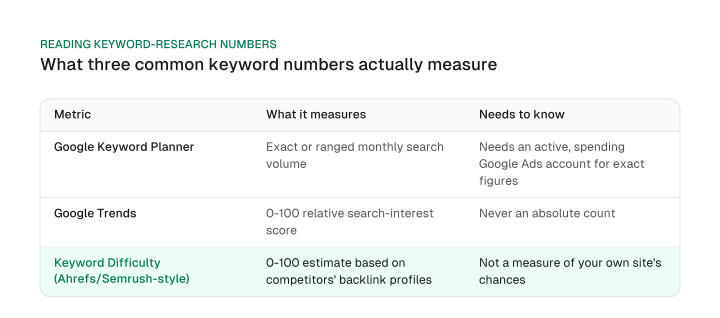
Google Trends and Google Keyword Planner report two different kinds of number, and treating them as interchangeable misjudges a keyword's real opportunity.
Keyword Planner is the closest thing to an absolute count on this list: a monthly search-volume figure, often shown as a range rather than an exact number. Google Trends never gives you a count at all.
Google's own Trends documentation describes the metric as a search-interest score, scaled from 0 to 100 relative to a topic's share of all searches in the region and time range you selected. The highest point in that range is set to 100, and every other point is adjusted against it, so a term's score reflects its own peak popularity, not any share of Keyword Planner's volume figure.
A third number you'll run into constantly, keyword difficulty, isn't a volume metric at all, it's an estimate built from competitor backlink strength, which the next section covers.
Don't stop at the score: check winnability with the right test for your situation
The keyword difficulty vs search volume tradeoff stops looking like a tradeoff once you separate what each number measures from how winnable a term actually is for your site.
A raw difficulty score is not a verdict on its own. Ahrefs' own Keyword Difficulty glossary calls the score "always only an estimation" because Google doesn't disclose all its ranking factors.
It recommends manual SERP analysis over the score alone for gauging your real chance of ranking for a particular keyword.
That caveat is worth holding onto: plenty of keyword advice presents a bare difficulty number and its color band as the final word, without ever passing along the limitation Ahrefs states about its own metric. Treat the number as a starting filter for which candidates deserve the real test below, not the verdict itself.
One more signal folds into the same read: if the SERP's dominant format doesn't match yours, a blog post competing against a page thick with video carousels or shopping results, that mismatch alone predicts a low chance, regardless of what the difficulty number says.
Your specific situation either clears a concrete bar or it doesn't, and which bar depends on where you're starting from. If you're running a new site with no backlink history, don't guess: check your own referring-domain count against the keyword's top-10 median, the way keyword research for new websites walks through.
If your site already has some authority, check whether your page type matches the query's intent and whether the top 10 leaves a real content gap, the check how to rank higher on Google's own keyword-selection section lays out. Neither test needs a difficulty score once you've run it; the score's only job is deciding which candidates are worth testing first.
Sequence your candidate list by cluster size, not one keyword at a time
A single well-matched page typically ends up ranking for about a thousand related keyword variants, so the choice that decides what to write first is which cluster a page can capture.
Ahrefs' own study of more than a billion pages in its Content Explorer index found that 90.63% of published pages get no organic traffic from Google at all. Among the pages that do rank, the average top performer ranks for roughly a thousand related keywords, not the handful anyone actually targeted when they wrote it.
The same study's own worked examples cite one page ranking for 406 variants and another for 55. That gap between the one term a writer aimed at and the thousand terms a good page actually earns is why picking single "best" keywords one at a time is the wrong unit of decision.
The unit that matters is the cluster. Group your candidate terms into sets of related searches: terms a reader would consider answered by the same page. Count how many candidates sit in each set, and write the page for the largest defensible cluster first.
A cluster with five related terms outranks a cluster of one on the sequencing question, regardless of which single candidate inside either group has the better individual volume or difficulty number.
Assign one clear primary term to that page and let the rest of the cluster, including the long-tail variants a dedicated guide covers in full, surface around it as subheadings rather than separate pages. Don't assign that same primary term to a second page too: two pages chasing one keyword split the cluster's ranking signal instead of adding to it, so the term stays with whichever page's cluster is largest.
An isolated candidate with no cluster around it waits: fold it into an existing page later instead of giving it a page of its own.
This is also the direct answer to "which keywords should I target." Once you've picked a cluster and sequenced it to the front of your list, actually ranking it is a separate job that the earlier winnability tests and placement mechanics already cover.
Worked example: sequencing three candidate keywords by cluster size
Sequencing three candidate keywords by cluster size sends a business selling accounting software to the "bookkeeping software" page first, not the narrower "bookkeeping software for landscaping contractors" variant.
The broader term already clusters with four related terms on the list. Take that same business with three candidates: "bookkeeping software," "invoicing software for small business," and "bookkeeping software for landscaping contractors."
Individually, the narrow, niche term might look like the safer bet: low competition, specific intent, easy to rank. Sequencing by cluster size says otherwise.
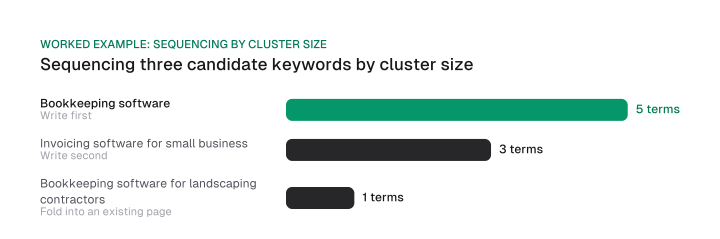
Say the seed-and-competitor research from earlier turns up 5 related terms clustering around "bookkeeping software" (general accounting-software searches), 3 clustering around the invoicing candidate, and just 1, the landscaping-contractor variant itself, with nothing else nearby. These are placeholder numbers for the example; run the same count on your own list.
The cluster-size rule writes "bookkeeping software" first: it's the page most likely to capture the largest set of related searches, beyond its own targeted term alone. The invoicing candidate goes second.
The landscaping-contractor term doesn't get its own page yet. It gets folded into the "bookkeeping software" page as a subheading once that page exists, where it can ride the larger page's authority instead of starting from zero on its own.
Prioritize and pick your tools
When volume, difficulty and intent signals disagree, cluster size settles it.
A modest-volume branded or transactional cluster that's large and winnable beats a broad informational term that isn't, and a free tool is enough for this until the check itself becomes the bottleneck. High search volume alone is never a reason to target a keyword if it fails the winnability check or sits outside any real cluster on your list.
Where a term falls in the buyer's journey, informational, commercial or transactional (a dedicated search-intent guide covers the full taxonomy), matters most as a tiebreaker between two otherwise close clusters: a smaller transactional cluster near a purchase decision often outweighs a larger informational one further from it.
Branded and non-branded candidates get the same test; branded terms usually clear the winnability check easily but rarely cluster with much else, so they sit low on the write-first list unless they're tied to a launch.
None of this requires a paid tool to start, and none of it changes for a first-timer: choosing SEO keywords for beginners follows the same sequencing rule as it does for an experienced team. A free plan builds the candidate list, reads Keyword Planner's numbers, and runs either winnability test.
Most free tiers exist to convert you into a paying customer of the same vendor: capped rows, capped daily searches, and, for Keyword Planner, a range instead of an exact number for many terms. Upgrade once the limit itself, not the score or the volume, slows the list down.
Choosing an SEO keyword was never about finding one perfect term. Two checkable tests already exist for whether a single keyword is winnable, the referring-domain gap for new sites and the intent-and-coverage-gap check for any site; cluster size decides which winnable keyword to write first.
If you already have a candidate list, count the clusters, sequence them largest to smallest, and start writing the top. If you don't have a list yet, build one from your own seed terms, Keyword Planner and a look at your top three competitors, then come back to this sequencing step.
Frequently asked questions
This is a common gap most keyword-research advice skips entirely. Treat the range as usable data, not a broken result: use the lower bound to size the opportunity conservatively, and cross-check the same term in a second free tool before deciding whether it's worth a candidate slot.
Match the tool's default country and geography to where the business actually sells. A US-default number silently overstates or understates a non-US business's real opportunity.
Informational, commercial and transactional. The full intent taxonomy and how to classify a given term is a separate topic; here it only matters as the tiebreaker in "Prioritize and pick your tools" above.
Most free tiers are built to convert you into a paying customer of the same vendor: capped rows, capped daily searches, and, for Google Keyword Planner, volume shown as a range rather than an exact number for many terms.
How to select keywords for SEO uses the same sequencing rule at either scale. The only difference is the candidate list's size, not the rule itself; one article still needs its own cluster check before you write it.
Figures and images in this post are free to reuse under CC BY 4.0 with credit to Mission Growth.
Get Mission Growth highlighted in your Google results.