
Question Keywords: How to Find Them, and Which Source to Use
Question keywords for SEO: where to source them (PAA, tools, Search Console), a modifier taxonomy, a worked example, and the mistake that wastes it.

On this page
Question keywords are one of the easiest SEO ideas to reduce to a trick: reformat an H2 as a question and hope for a featured snippet.
Question keywords for SEO reward something harder: knowing which source to pull from, and which modifiers go past the basic 5W1H set.
What question keywords are, not database research
A question keyword is a search query phrased as a direct question, interrogative or comparative.
Interrogative starters signal informational intent; comparative phrasing signals comparison intent instead of a plain lookup.
That search currently serves two different readers. The organic top ten is SEO and content-marketing pages, written for marketers who already do keyword research and want to add question-format terms to their process.
Google's AI Overview for the same search cites a university library-research guide instead, the kind that teaches a student to turn a research question into a database search string.
Stripping filler words and connecting what's left with Boolean AND or OR is a different skill for a different reader, and it stays out of scope from here on.
Two different readers, two different pages: SEO and content-marketing sites rank organically for "question keywords," while Google's AI Overview for the same search points to library research instead.
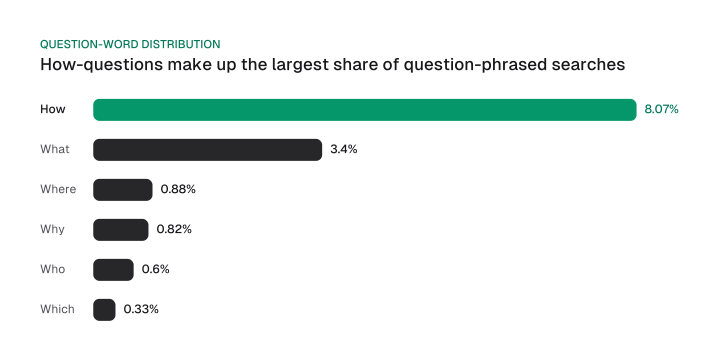
The clearest public breakdown of how question keywords split by type comes from a 2020 Backlinko analysis of Google search-query data.
Backlinko found 14.1% of all Google searches phrased as questions. Within that share:
- How: 8.07%
- What: 3.4%
- Where: 0.88%
- Why: 0.82%
- Who: 0.6%
- Which: 0.33%
Divide the "how" share by the total question share and "how" questions account for 57% of all question-phrased volume, the largest single category by a wide margin.
That distribution describes 2020 search behavior specifically. It isn't a claim about what AI Overviews changed, since the Backlinko study neither measures nor mentions them.
A page that wins organic rank for a question keyword but never appears in the AI Overview version of the same search is only answering half the visibility question.
That gap is exactly why tracking both surfaces matters, and it's also why how to get cited in Google AI Overviews is worth reading next.
Mission Growth's platform tracks AI citations and visibility for customers.
Where to find question keywords: PAA, tools, and Search Console
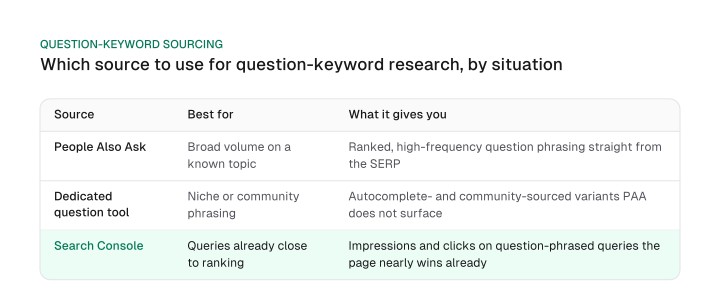
There are three answers to how to find question keywords: People Also Ask, a dedicated question tool, and Search Console. Each one fits a different situation.
People Also Ask keywords are ranked, high-frequency questions already surfaced for a topic you know. Pull from People Also Ask when you need volume across a broad subject.
A dedicated question-generation tool, the AnswerThePublic-style category built from autocomplete and community data, surfaces niche and community-sourced variants that PAA doesn't show. Reach for one when your audience's own phrasing matters more than raw frequency.
Search Console shows which queries, including ones phrased as a question, a page is already getting impressions and clicks for, through its Performance report. Check this source when you want questions a page is already close to ranking for, rather than starting from zero.
A 2020 Semrush study of US keywords found a PAA box on 49.37% of desktop SERPs and 52.27% of mobile SERPs, so for most searches a ranked list of related questions is already sitting in the results page.
No single source is enough by itself:
- PAA gives volume, but only for questions Google already ranks.
- A dedicated tool gives phrasing breadth, but not search volume by default.
- Search Console gives queries a page is already close to winning, but nothing the page hasn't touched yet.
For a deeper walkthrough of the Search Console side, read our AI search analytics guide, which covers Google Search Console's generative-AI performance report in more depth than fits here.
The question-keyword taxonomy: interrogative and comparative modifiers
Question keywords fall into two modifier families.
Six interrogative starters, who what when where why how, signal informational intent: the reader wants an explanation, a definition, or a process.
Comparative modifiers, which whose and versus-style phrasing, signal a reader closer to a decision. They already know the category and are choosing between named options inside it.
The table below gives question keyword examples for each modifier, mapped to funnel stage.
| Modifier | Example | Typical intent / funnel stage |
|---|---|---|
| What | What is a question keyword? | Definition, top of funnel |
| How | How do you find question keywords? | Process, top to mid funnel |
| Why | Why do question keywords matter? | Reasoning, top of funnel |
| When | When should you target a question keyword? | Timing, mid funnel |
| Where | Where do question keywords come from? | Sourcing, mid funnel |
| Who | Who searches with question keywords? | Audience framing, top of funnel |
| Which | Which keyword research tool finds question keywords? | Comparison, bottom of funnel |
| Whose / versus-style | Semrush versus a dedicated question tool | Direct comparison, bottom of funnel |
Download CSV (CC BY 4.0)
Comparative modifiers extend past the familiar 5W1H set, and they're the closest thing to a bottom-funnel signal the format has.
A reader typing "which" or a versus-style search already knows what they want and is choosing between named options, which is why the modifier earns its own section instead of folding into "how" or "what" coverage.
The funnel mapping holds for the interrogative starters too. "Why" and "who" sit at the top, "how" and "when" sit in the middle, and "which" sits at the bottom, closest to a decision.
Building, prioritizing, and implementing your question-keyword list
Turn a seed keyword into a working list by pulling candidates from all three sources, scoring them, then structuring the winners.
For example, take "email marketing software" as a seed you're already targeting:
- Pull People Also Ask questions for the seed, such as what it is and how much it costs.
- Run the same seed through a dedicated question tool for community phrasing, such as which option works with Shopify.
- Check Search Console for queries already phrased as a question that the page gets impressions on.
Some candidates will read more conversational than a typical head keyword, phrased the way someone would ask Gemini or a voice assistant.
Keep those rather than trimming them into shorter, terser phrasing. Conversational question keywords are the exact phrasing AI-search surfaces retrieve against, not an exception to filter out before scoring.
Score each candidate the way you'd score any keyword: volume, intent, keyword difficulty, and CPC, the same vocabulary as any other query. The scoring criteria here are the same ones behind broader b2b keyword research, just applied to queries that happen to be phrased as a question.
Add one question-specific factor: how many of the resulting questions cluster around the same seed.
If three or more cluster tightly around one seed and share a reader, structure them as a standalone FAQ block on the existing page for that seed. Building question-based content this way keeps a page focused instead of fragmenting it across near-duplicate posts.
If a single question stands apart with independent search interest and no natural home on an existing page, give it its own H2 instead. That's the prioritization call this format actually requires, past brainstorming what and how questions.
The question's own modifier then points to one of three featured-snippet types:
- A paragraph snippet fits definition and reasoning questions, what and why.
- A list snippet fits process and step queries, how.
- A table snippet fits comparison queries, which and versus-style.
Match the modifier to the snippet type before writing the answer. But formatting alone won't guarantee the result.
Common mistakes when targeting question keywords
The most common mistake is treating a question-phrased H2, paired with a short answer block of a fixed length, as a required prerequisite for winning a featured snippet.
Google's own documentation says that formula isn't how snippet selection works, and no fixed answer length is a prerequisite for eligibility.
Google Search Central's "Featured snippets and your website" page, updated in December 2025, states it plainly: you can't format or mark a page to become a featured snippet.
Google's systems decide whether a page would make a good featured snippet for a search, and surface it if so.
Formatting a heading as a question doesn't buy a guarantee. It only makes it easier for those systems to recognize a good answer once one already exists.
So the practical fix is to spend less time on structure and more on the answer itself.
A clear, direct, correctly-scoped answer in the right format, paragraph, list, or table, matched to the modifier it's answering, does the actual work. The heading question is just the label on top of it.
If the underlying answer is thin, generic, or padded to hit a word count, no amount of question-phrased heading recovers it.
Question keywords still matter.
They're still worth the source comparison and the modifier taxonomy: which source fits which situation, and which modifier signals which stage of intent, because sourcing and structuring are the parts of the format you actually control.
You can't format your way into a featured snippet Google hasn't decided to give. So target a question keyword because the reader's intent is a direct question, not because a question-phrased heading is treated as a shortcut to keywords that boost ranking.
Pull the next seed keyword through People Also Ask, a dedicated question tool, and Search Console before writing a single H2, and let those three answers decide which questions earn one.
Frequently asked questions
There's no verifiable fixed list of exactly twenty. What holds up is the modifier taxonomy above: six interrogative starters (who, what, when, where, why, how) plus comparative modifiers (which, whose, versus-style). Those families are the working list to use.
No canonical list of exactly seven question types exists either. Rather than a canonical count of seven, the categories that hold up are interrogative, comparative, and embedded or nested questions, a question folded inside a longer search. Category is the reliable way to group them.
Yes, and it's the clearest example of the comparative-modifier category. A "which" search signals a reader comparing named options, extending past the familiar 5W1H set and closer to bottom-funnel intent than most interrogative questions.
No. Formatting a heading as a question doesn't guarantee a featured snippet or an AI citation on its own, so target one where the reader's actual intent is a direct question, not by default, and not because the format is trendy.
Figures and images in this post are free to reuse under CC BY 4.0 with credit to Mission Growth.
Get Mission Growth highlighted in your Google results.