Startup SEO on Zero Budget: What to Do First, What to Skip
Startup SEO for zero authority and little budget: a go/wait test for your first keywords, the technical fixes to make first, and what to skip for six months.

On this page
Startup SEO in month one means picking the handful of moves a domain with zero track record can actually win.
Good SEO for startups looks different from SEO for an established brand, for exactly that reason. A generic checklist treats flat results in week one as failure. How long SEO takes on a new domain is a matter of months, so flat early weeks are expected.
It isn't failure. Your domain hasn't earned the credibility Google reserves for a site with a track record, and no tactic skips that step.
Here's the order this guide follows: what to fix first, which keywords you can win today, what to publish next, and what to deliberately skip.
In this guide:
- What actually limits early results, and why it isn't your task list
- Two numbers you can stop chasing, including the Domain Authority myth
- A go/wait test for picking keywords with zero backlink history
- The technical items that come before everything else
- What to skip while you're building trust
- How to judge ROI before you have organic traffic to measure
What "startup SEO" means before you have any authority
Startup SEO is standard SEO practiced against one real handicap: a new domain has no track record yet, and that gap limits results in months one through six.
Rand Fishkin read Google's leaked Search API documentation in May 2024 and drew one conclusion. For most small and newer sites, he found, "SEO is likely to show poor returns until you've established credibility, navigational demand, and a strong reputation among a sizable audience."
Every new domain starts under that floor, whatever it publishes next.
So when your first posts don't rank in week two, that's the credibility floor doing exactly what Fishkin's reading of the leak predicts.
Three things build the credibility Google is watching for, according to that reading:
- Credibility. A track record of accurate, useful content on your actual topic, sustained over months rather than a single post.
- Navigational demand. People searching for your brand by name, beyond the problem you solve.
- Reputation. Recognition among a sizable audience, beyond your immediate customer list.
None of those exist on day one. All three grow from the same few things: consistent publishing, traction with real customers, and enough time in front of real searchers.
This floor is the real subject of SEO for early-stage startups, more than any single tactic on the list. If you're building for a specific business model, the same limit still applies. B2B SEO and SaaS SEO both sit on top of it before any tactic specific to your business type matters.
Why domain authority and the "70% mobile" figure don't prove your SEO is working
Domain Authority and Domain Rating are third-party scores that Google has said directly it doesn't use to rank pages.
Global web traffic today also splits almost evenly between mobile and desktop, not the 70% figure that stuck around from an older mobile trend.
Two corrections carry into everything else here:
- A rising DA or DR score isn't SEO progress. Watch indexed pages and rankings in Search Console instead.
- "70% mobile" is outdated and measures the wrong thing. Design for mobile because Google's index runs on the mobile version of your pages, whatever the split shows.
John Mueller put it plainly for Google: "We don't use domain authority; that's a metric from an SEO company." Ahrefs' own help documentation says the same about its equivalent metric: "There's no evidence that search engines use Domain Rating (or similar scores such as Domain Authority...) as a ranking factor at all."
A rising score tells you a third-party tool likes your backlink profile. It tells you nothing Google itself is scoring.
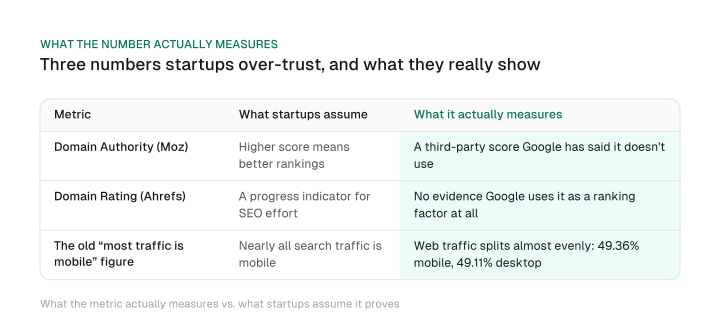
The mobile number is a different kind of correction. StatCounter's August 2026 data puts worldwide web traffic at 49.36% mobile and 49.11% desktop.
That's a page-view measurement across all web traffic. It isn't a search-specific number.
Google still indexes and ranks on the mobile version of a page regardless of the split, so a broken mobile layout costs you rankings either way.
A decision rule for choosing your first keywords with zero backlink history
A startup can test whether a keyword is winnable by comparing its own referring-domain count against the referring domains behind that keyword's current top 10.
That's exactly what Ahrefs' Keyword Difficulty (KD) score measures, and a KD number alone won't show you the gap. Keyword research for new websites needs one extra step most keyword tools skip: checking your own gap against the field instead of the term's difficulty alone.
Ahrefs' own methodology explains what KD actually counts. It's the number of referring domains linking to each page currently ranking on page one. Ahrefs states plainly that KD is "an absolute metric, not a relative one" that "doesn't account for your specific website's authority."
A KD score reads the same whether your own site has a couple of referring domains or a few hundred. A fixed KD threshold can't show you that gap.
Run the go/wait test instead:
- Pull your own site's total referring domains from your backlink tool.
- Pull the referring domains behind the keyword's current top 10 pages, and take the median.
- Compare the two counts: a close gap means go, a wide gap means wait.
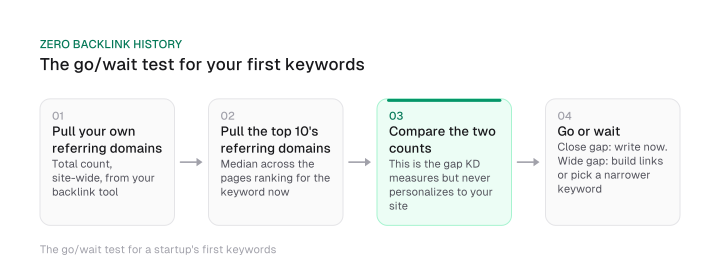
Here's what that looks like with placeholder numbers you'd replace with your own. Say you're weighing the keyword "project management software for startups." Your own site has 2 referring domains in this example. The current top 10 for that keyword has a median of 9, also just an example.
That's a real gap: wait on this exact keyword, or look for a narrower variant closer to your own count. A low KD score only tells you the average site could compete for the term. It never told you whether your specific, new domain could.
What to fix first: the technical foundation that gates everything else
A new startup site's first job is making sure Google can find, crawl and index it at all.
Page experience signals like Core Web Vitals sit after that step. They don't decide whether Google indexes a page in the first place.
Get found and indexed before anything else:
- Submit an XML sitemap in Search Console and confirm in the coverage report that pages are indexed.
- Check for an accidental noindex tag or a robots.txt line blocking your priority pages, a common launch-week mistake.
- Fix the crawl errors Search Console already flags before publishing more content on top of them.
Once indexing is solid, cover the basics: a unique, descriptive title tag and meta description on every page, and a main heading that says what the page covers. Then hit these documented thresholds next:
- Largest Contentful Paint (LCP): 2.5 seconds or less.
- Interaction to Next Paint (INP): 200 milliseconds or less.
- Cumulative Layout Shift (CLS): 0.1 or less.
These sit inside Google's page experience signals. A slow page can still get indexed, but it competes at a disadvantage once it's in the running.
Fix crawlability first and Core Web Vitals second. That sequencing question matters more before launch than a longer audit does. For the rest of the technical work, our full technical SEO checklist covers what comes next; these three come first for a domain with no track record yet.
What to do next: content built from founder and product experience
A founder's own first-hand product and customer conversations are exactly the experience signal Google's E-E-A-T guidance asks for.
A solo founder can produce credible content without hiring a writer first.
You don't need a content team to satisfy that signal in month one. You need to write down what you already know.
Start with what you already know:
- Why customers actually buy.
- Which objections come up on every sales call.
- What broke the week you shipped your last feature.
What a founder personally supplies:
- Real customer conversations, and the objections that came up in them.
- Product decisions and the reasoning behind them, well beyond the feature list.
- Specific numbers from your own funnel, whenever you can share them honestly.
What outside help adds later, once budget allows:
- Faster production, so publishing keeps pace once you have more to say than time to write it.
- Editing polish and SEO structure applied across a larger volume of pages.
Hire the writer for speed once you're ready to scale. Don't wait to publish until you can afford one.
The experience signal has to come from someone who actually talked to the customer. A hired writer can't supply that in your place.
What to skip in the first six months
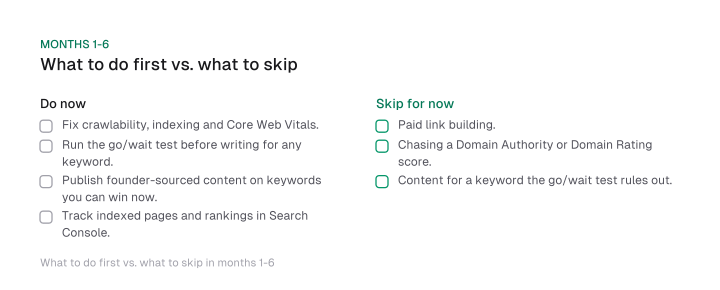
A startup should postpone paid link building, chasing a Domain Authority or Domain Rating number, and content built for a keyword it can't win yet.
None of those close the credibility gap that's actually holding results back. Spend the scarce first six months elsewhere: on signals Google actually uses.
Chasing a Domain Authority score is one of the most common startup SEO mistakes, since it isn't even a signal Google scores.
| Item | Skip or keep | Why |
|---|---|---|
| Paid link building | Skip for now | Doesn't build the credibility, navigational demand or reputation the early floor requires |
| Chasing a Domain Authority or Domain Rating number | Skip for now | Neither is a Google ranking factor, per Google and Ahrefs |
| Content for a keyword the go/wait test rules out | Skip for now | You'd be writing into a gap your own referring domains can't close yet |
| Crawlability, indexing, Core Web Vitals fixes | Keep, first | Decides whether Google can find and serve the page at all |
| Founder-sourced content on a keyword you can win now | Keep, ongoing | Builds the experience signal and the credibility floor at the same time |
| Indexed pages and rankings in Search Console | Keep, ongoing | The actual progress signal while you're building credibility |
Download CSV (CC BY 4.0)
Budget and links: judging ROI before you have organic traffic
A startup can judge SEO's early payoff against its own unit economics instead of waiting for organic sessions to show up.
Running out of capital, not a lack of visibility, is the reason most VC-backed startups actually shut down.
CB Insights' March 2026 analysis of 385 shut-down startups found "ran out of capital" cited in 70% of them, next to 19% for unsustainable unit economics, a gap of roughly 3.7x.
That's exactly why the skip list above matters: every dollar spent chasing a DA number or buying links is a dollar not protecting runway.
That's the core of SEO on a small budget: protect runway first, and let ROI decide where the scarce dollars go.
We built and ship free tools, including an SEO ROI calculator and an LTV:CAC calculator. Run both before committing budget:
Once you have traffic to measure, calculate SEO ROI against the full formula and published benchmarks. The same fixed-schedule discipline behind a growth experiment cadence applies to reviewing SEO spend against early traction.
Startup SEO in the first six months is a decision rule, not a longer to-do list: run the go/wait test on your first keywords, fix crawlability and Core Web Vitals in that order, publish what the founder actually knows, and skip the signals Google doesn't score while capital is still the bigger risk.
That sequencing, not a longer list, is the startup SEO strategy that works before you have any authority. Once these fundamentals are solid, the AI SEO checklist is the natural next step for AI-search visibility.
Run the go/wait test on the keyword you're about to write for next. If the gap is wide, it just told you what to do instead this week.
Frequently asked questions
Crawlability and indexing first: a submitted sitemap, no accidental noindex or robots.txt block, and clean Search Console crawl reports. Core Web Vitals (LCP, INP, CLS) come next as page experience targets. Content-heavy fixes can wait until those are clean.
Yes. The founder supplies the first-hand product and customer experience Google's E-E-A-T guidance actually asks for. A hired writer helps later with production speed and polish, but it isn't a prerequisite for credible content now.
No. Google has said it doesn't use either metric to rank pages. Watch indexed pages, impressions and rankings in Search Console instead of a third-party score.
Paid link building, chasing a Domain Authority or Domain Rating number, and content built for a keyword the go/wait test rules out. None of those close the credibility gap that's actually limiting early results.
Compare your own referring-domain count to the referring domains behind the keyword's current top 10 pages. A close gap means go; a wide gap means wait. A low KD score alone doesn't answer this.
Mobile and desktop web traffic are nearly even worldwide: 49.36% mobile versus 49.11% desktop in August 2026, per StatCounter, not the often-cited 70% mobile figure. Build for mobile anyway, since Google indexes the mobile version of your pages regardless of the split.
Figures and images in this post are free to reuse under CC BY 4.0 with credit to Mission Growth.
Get Mission Growth highlighted in your Google results.