SEO vs PPC: Which to Fund? Break-Even Math and Rules
SEO vs PPC: which should you fund? See what a click costs ($5.42 on average), how much paid spend duplicates free rankings, and a rule per situation.
By Furkan AktaşPublished Updated
On this page
SEO vs PPC looks like a choice between free and paid, but it is really a choice about overlap: which keywords you pay for even though you already rank for them. The answer changes by keyword, by industry and by how the page ranks.
If you run one marketing budget with no search team, you need three numbers before you move a dollar. What does a click cost? How many of your paid clicks would organic have delivered anyway? And what did AI Overviews do to each channel?
In this guide:
- A one-table comparison with a price on every row
- What a paid click costs by industry, and how many clicks an SEO retainer has to beat
- How much paid spend duplicates a ranking, and what AI Overviews changed
- A rule per situation, plus a pause test you can run in your own account
SEO vs PPC in one table: cost, speed, control and what stops when you pause
The difference between SEO and PPC is what you pay for: SEO pays people to earn rankings that cost nothing per click, while PPC pays a platform per click for placement that ends when the budget does.
Both halves of that sentence need a qualifier. "Free" organic clicks sit behind a monthly bill, and "immediate" paid clicks arrive at a price per lead.
Here's the comparison with a sourced number in each row:
The survey figures are averages that Ahrefs computed by assuming every respondent charges the top of their price band, so treat them as ceilings. The 1.74% is the odds for random crawled URLs, not for pages built to rank, which is why the filtered 6.11% leads the row.
The CPC and conversion benchmark behind the $5.42 comes from the customers of a local-business marketing platform, and its conversion rate counts leads. If you sell software, read it as a price anchor and measure your own.
In prose: SEO has no price per click but a monthly bill, PPC has a price per click and no bill after you stop, and the two overlap more than the table suggests. The rest of this guide prices that overlap. For the full SEO side of the bill, see our breakdown of seo cost.
What is SEO and PPC, and where SEM, paid search and Google Ads fit
SEO is the work of earning rankings in unpaid organic results, and PPC is paid search advertising billed per click, so an Ad Rank auction decides who appears and what each click costs. The short answer to "what is SEO and PPC" is earning rankings versus buying clicks.
CPC, cost per click, is the price of one paid click in digital marketing. PPC names the buying model and CPC names the price inside it, so "PPC vs CPC" sets a model beside its unit.
Ad Rank combines your bid with auction-time quality, which can include expected click-through rate, ad relevance and landing page experience. You set a maximum bid, and Google's Ads Help says what you actually pay is often less.
SEO can't be bought. Google says it doesn't accept payment to improve a site's ranking, so the cost of SEO is the people and time that make a page worth ranking. Keyword research, on-page work and links belong to what organic SEO is, which has its own guide.
The vocabulary overlaps, and that's where most confusion starts. This table pins each term to one level:
So SEO vs paid search is the same comparison as SEO vs PPC. "PPC" names how you're billed, "paid search" names the channel the ads run in, and SEM covers ads alone in some places and ads plus SEO in others. Pick one word and define it once.
Where PPC ads appear now
The top of the results page is no longer the only paid placement. At Google Marketing Live in May 2025, Google announced it was expanding ads in AI Overviews to desktop and bringing ads to AI Mode. In May 2026 it said it is testing two new Gemini-built ad types in AI Mode, labeled Sponsored.
Treat the AI Mode formats as tests, not as something you can buy in every market today. For planning, the paid slots are the classic results page top, priced by the Ad Rank auction, plus ads in AI Overviews and, in test only, ads in AI Mode.
What a click costs: PPC prices by industry against an SEO retainer
The average CPC across industries is $5.42, so a $3,209 monthly SEO retainer equals 592 ad clicks a month and a $1,348 freelancer retainer equals 249; the most common agency band of $500 to $1,000 equals 92 to 185. Those are the break-even clicks an SEO program has to beat.
The arithmetic is retainer divided by CPC. WordStream by LocaliQ's 2026 benchmark puts industry CPCs from $1.63 in Arts and Entertainment to $9.87 in Attorneys and Legal Services, a 6.1x spread ($9.87 divided by $1.63). Because the spread is that wide, the same retainer buys very different amounts of paid traffic:
Download CSV (CC BY 4.0)
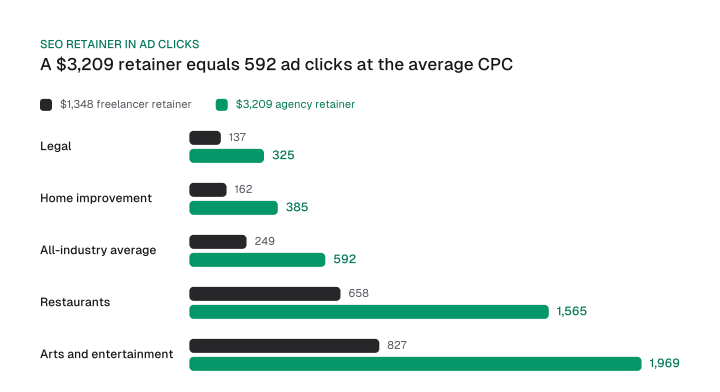
The cheaper the click in your industry, the harder SEO has to work to pay back. In legal, a $3,209 retainer needs about 325 extra monthly visits to break even. In restaurants it needs about 1,565.
If you sell to businesses, use the Business Services CPC of $5.87. The modal agency band then equals 85 to 170 clicks a month.
Here's a worked six-month outlay. A $1,348 retainer for six months is $8,088, which buys 1,492 clicks at $5.42. A $3,209 retainer is $19,254, or 3,552 clicks. Six months is a scenario input we chose to match the review point for a page outside the top 10.
Three caveats apply to this math:
- Traffic volume only. It ignores whether organic and paid visitors convert differently.
- A retainer isn't the whole SEO bill. Content and development can sit outside it, and the survey doesn't say what its averages include beyond provider fees.
- Averages hide spread. The survey ranges from $250 to $10,000 a month, so plug in your own quote.
To run your own retainer and traffic numbers, use the SEO ROI calculator. The full formula behind it is in our guide to seo roi.
When paid clicks duplicate organic ones: what ranking first changes
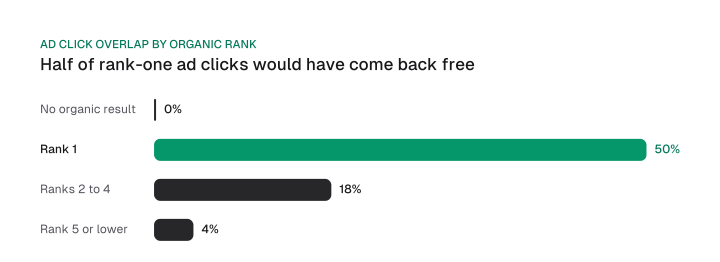
Paid clicks duplicate free ones when you already rank. Google's pause studies measured incremental ad clicks: 50% when the advertiser held the top organic result and 100% when none appeared. That makes organic vs PPC an overlap question.
An ad click is incremental if you wouldn't have received that visit without the ad. The rest would have come back through the organic listing.
What Google's pause studies measured
Google's Search Ads Pause studies switched ads off for advertisers and measured how much traffic returned through organic results. A paper dated March 2012 reports a meta-analysis of 390 of them. An earlier Google study found that on average 89% of visits from search ad clicks were incremental, so the remainder duplicated organic visits.
The share depends on where you rank. Google also found that 66% of ad clicks and 81% of ad impressions occurred with no associated organic result at all:
Two cautions. Google sells the ads, and the 50% is an average across advertisers that your account may beat or miss. The paper notes that some advertisers expect top-ranking keywords, typically branded terms, to add little or no incremental traffic, and it recommends geo experiments. So read this as direction: about half the clicks on terms where you rank first would have come back through organic.
What the overlap costs per 1,000 ad clicks
Duplication becomes money once you attach a price. As an illustration at the $5.42 all-industry CPC (an assumed figure, since no branded-term CPC exists), 1,000 ad clicks cost $5,420. With no organic result, $0 of that buys clicks you'd have had anyway. At rank 1, $2,710 does. At ranks 2 to 4 it's $976, and at rank 5 or lower it's $217.
Brand terms: the eBay experiment
A 2015 peer-reviewed field experiment at eBay (Blake, Nosko and Tadelis) found that brand-keyword ads had no measurable short-term benefit, which bears on whether to bid on your own brand name.
That brackets the rank-one case. Google's average says half of rank-one ad clicks come back free, and eBay's brand terms came back almost entirely.
Don't generalize it to every advertiser. For non-brand keywords, the same paper found that new and infrequent users were positively influenced by ads, but frequent users, who weren't influenced, accounted for most of the spend, so average returns were negative.
The practical rule: pause ads on keywords where you rank first, but test before you cut. Incrementality testing covers the designs, and the procedure below gives you one.
What AI Overviews did to organic and paid click-through
One April 2026 analysis of 53 brands found that paid click-through on AI Overview queries moved from 14.6% in January 2025 to 16.2% in February 2026, while organic click-through on those queries fell to a 1.3% floor in December 2025 and recovered to 2.4% by February 2026.
The analysis tracked 5.47M queries, 2.43B organic impressions and 296.9M paid impressions, from January 2025 to February 2026. Its authors call the data directional. Organic still sat below its 3.2% January 2025 level, so it recovered without returning.
Two studies, two answers
An earlier analysis from September 2025 read paid differently. The two cohorts disagree, and nothing proves why:
Download CSV (CC BY 4.0)
Cohort, intent mix, window and paid sample size can all explain a gap. The earlier study says its paid findings carry wider confidence intervals than its organic ones, and the later one keeps only search terms with complete data in every month, which favors steady series. We use the larger, newer cohort as the working answer and still call it directional.
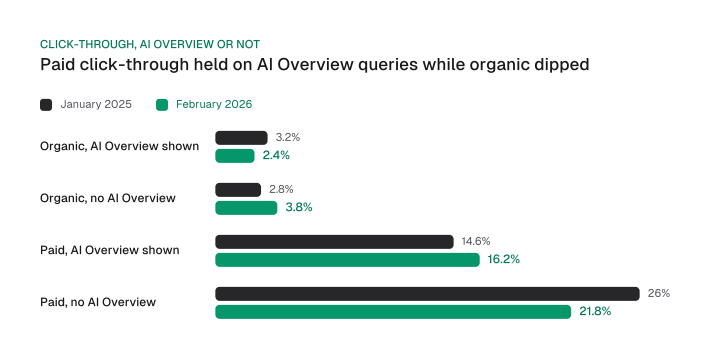
Paid is steadier, but steadier isn't cheaper. Paid click-through on queries without an AI Overview fell from 26% to 21.8%, and the 16.2% on AI Overview queries still sits below it. Organic without an AI Overview rose from 2.8% to 3.8%.
If your keyword is a comparison like "seo vs ppc", expect an AI Overview: across 30,842 tracked informational queries, comparison queries triggered one 95.4% of the time (267 of 280). The organic side of these studies is tabulated in ai overviews statistics, and whether the shift threatens SEO itself is the question will ai replace seo answers.
Is PPC the safer bet?
On click-through, yes, paid has been the steadier channel. The study's own projection model estimated paid click-through on informational queries with an AI Overview and a cited brand within 0.09 percentage points. It missed organic by 0.6 to 2.6 points across every segment, so paid is also the easier one to forecast.
But organic is where citations pay. The analysis reports that being cited in the AI Overview delivered 2 to 5 times the organic click-through of not being cited during 2025, though its monthly table for informational queries shows gaps below that range in some months. That's why geo vs seo matters here: the organic work that earns citations is the lever on this side.
Three rules follow:
- Plan paid budgets with steadier rates, but keep checking, because paid on AI Overview queries still runs below paid on queries without one.
- Treat organic on AI Overview queries as a citation game. The cited pages keep more of the clicks.
- Don't swap one for the other on this evidence alone. Paid clicks are rented and priced, and the overlap tables above still apply.
How long each takes: paid clicks today, ranking on a base rate
A PPC campaign can serve clicks within hours, while 6.11% of a filtered sample of non-empty English pages (and only 1.74% of random crawled URLs) reached the top 10 within a year in a 2025 crawl study, a base rate the common "3 to 6 months" range leaves out.
On the paid side, speed has a price. In the 2026 benchmark, Google Ads campaigns across industries average an 8.18% conversion rate and search advertising a $66.69 cost per lead, and part of that immediate traffic duplicates organic clicks you already hold.
On the SEO side, the base rate matters more than the range. Ahrefs' study counted 1M random URLs first seen in September 2023, then ran a second cut on 2M random URLs created in October 2023, non-empty English pages only, which the study calls possibly a fairer number.
The study also found that 40.82% of the pages that reached the top 10 did so within a month, so no single range fits every page, and none covers the pages that never arrive. The same study found 72.9% of top 10 pages are more than 3 years old, up from 59% in 2017, so a young page competes against old ones.
Use a three-step checkpoint:
- Month 1: buy clicks on terms you can't rank for and publish the pages you want to rank.
- Month 6: if a page isn't in the top 10, update it. The study says chances are pretty low after about 6 months unless you make changes.
- After a year: compare against the base rates above, and keep funding only the pages that moved.
So speed is real but conditional. PPC buys clicks the day you pay, SEO pays off only for pages that rank, and the six-month mark is where an unranked page needs changes instead of more waiting. For timelines by page type, see how long does seo take.
Control and targeting: what you can set in each channel
Google does not accept payment to improve organic ranking, so buying ads doesn't change your organic ranking and SEO control ends at the page, while PPC controls budget, bids, locations and audiences, and automated campaign types trade keyword-level control for reach.
Google's help documentation says it twice. Participation in an advertising program doesn't positively or negatively affect inclusion or ranking, and investment in paid search has no impact on organic ranking. Ads change clicks and leave rank alone.
Here is what you can set in each channel:
- SEO: page content, structure, internal and external links.
- PPC: budget, bid, location, audience and match type.
Control isn't free versus full. The lever SEO lacks is rank for money, and the lever PPC is losing is the exact keyword list. AI Max for Search expands your keywords with broad match and keywordless technology, so "full control over keywords" now depends on the campaign type you choose.
Keywords themselves differ across the two channels. An SEO keyword is a topic a page can satisfy, so one page can rank for many phrases. A PPC keyword is a query you win in an auction, priced separately each time. If you're choosing between them, how to choose seo keywords covers the SEO side.
PPC or SEO: which to fund, by situation
PPC or SEO depends on the keyword class: pause ads on brand terms where you rank first, buy clicks on commercial terms where you rank fifth or lower, and earn citations on informational queries where an AI Overview appears.
Prioritize PPC when the budget can't wait for rankings or you rank fifth or lower on a commercial term. Prioritize SEO when you already hold the top organic result, or when the query is informational and an AI Overview answers it.
Fund per keyword class. Each row below rests on numbers from the sections above:
Ask three questions in order:
- Do you hold a top organic result for this keyword? If yes, test before paying. If no, paid clicks are almost all new.
- How long can the budget wait? If the answer is under six months, you need paid clicks while pages build.
- Can you plan around variance? Paid click-through proved steadier than organic in the 2026 analysis; if your plan can't absorb swings, weigh that.
The next step: list your 20 highest-spend keywords and mark where you rank in the top 4. Those are your pause-test candidates.
Do the two channels help each other? The landing page signal
Quality Score is a diagnostic, not an input in the ad auction; Ad Rank uses bid plus auction-time quality including landing page experience, so a faster, more relevant page is the one change that serves both channels.
Three signals are shared between the channels:
- Landing page experience: it feeds Ad Rank for paid and is part of what a page offers an organic searcher.
- Search term data: the paid and organic report shows queries you hold in both places.
- Brand demand: the brand queries you pause or fund in a test are the same ones organic answers.
"Raise your Quality Score to cut your CPC" is half right. Google's Ads Help says higher quality ads can often lead to lower CPCs, so quality does move price. But the 1 to 10 score is a diagnostic that shows how ads for certain keywords affect the user experience, and it's not an input in the auction.
So improve the landing page and leave the number alone. It lowers what you pay and it helps the page that ranks, which means one fix pays twice.
How to run PPC and SEO together without paying twice
SEO and PPC work together through three shared assets: one landing page serving both channels, paid search terms that show which queries deserve an organic page, and a pause test that settles brand spend. If you sell to businesses, the same three assets serve B2B sales goals: the Business Services CPC of $5.87 is the nearest price anchor, and the same pause test applies.
Run PPC and SEO together by linking Search Console to Google Ads, using the paid and organic report to list queries where you rank with no ad as bid candidates and queries where you rank first with a low-value ad as cut candidates, then confirming each cut with a pause test.
Follow these steps:
- Link Search Console to your Google Ads account. The report needs both, and it counts text ads only.
- Open the paid and organic report. Find queries where you appear in organic search with no associated text ads. These are bid candidates.
- List queries where you rank first and run a low-value ad. These are cut candidates.
- Price the cut list. Multiply ad clicks by CPC by the 50% rank-one share to size the duplication.
- Confirm with a pause test before cutting anything.
Here's the worked example. Say 400 brand ad clicks a month cost $8.33 each, the Home and Home Improvement average (assumed, because no primary branded-CPC figure exists). That's $3,332 of spend, and at the 50% rank-one share, $1,666 of it duplicates organic clicks.
To test it, pause brand ads in half your regions for four weeks. Compare total brand clicks, paid plus organic, across the two halves. If the paused half loses few clicks, the ads were duplicating. If it loses many, keep them.
The overlap is measurable in your own account in a month, and the report Google ships for it is free. For other designs, read how to run an incrementality test that fits your traffic.
How the numbers were built, and how old they are
The figures here differ in age: the overlap shares come from studies behind a March 2012 paper and a 2015 experiment, while the 2026 benchmark and the 2025 to 2026 click-through analyses set today's prices and rates, so re-run a pause test before acting on those older shares.
The sources are as of October 2026, and the table below gives each one's age and sample. Derived numbers (break-even clicks, duplicated dollars) show their formula where they appear, and illustrations are labeled with their assumed inputs.
Download CSV (CC BY 4.0)
Old numbers set the direction: the studies behind the March 2012 paper show overlap is real and depends on rank. New numbers set the level: CPC and click-through. Your own account settles it.
So SEO vs PPC is a per-keyword call about overlap and predictability: pay where you can't rank, earn where you can, and test the overlap before assuming either. Start with the pause test on your brand terms this month.
Frequently asked questions
Should I keep bidding on my brand name if I already rank first?
Test it before you decide. In eBay's field experiment, brand-keyword ads had no measurable short-term benefit, and Google's pause studies found 50% of ad clicks were incremental at rank one on average. Pause brand ads in half your regions for four weeks and compare total clicks.
Does running Google Ads improve my organic rankings?
No. Google's FAQ says participation in an advertising program doesn't positively or negatively affect ranking, and Google Ads Help says paid search investment has no impact on organic ranking. Ads can change how many people click, and those clicks may help your business, but ranking stays separate.
Is PPC just Google Ads?
No. PPC is the billing model, where you pay per click, and Google Ads is one platform that uses it. Microsoft Ads is another, and the 2026 CPC benchmark behind our price figures covers campaigns on both. "Paid search" names the channel those ads run in.
What are the advantages and disadvantages of SEO compared to PPC?
SEO's advantage is clicks you don't pay for one by one, from pages that keep working after the spend stops; its disadvantage is time, since few new pages reach the top 10 within a year. PPC's advantage is clicks today on any keyword you can afford; its disadvantage is that traffic stops when you pause, and part of the spend buys clicks organic would deliver where you rank first.
Is SEO or PPC cheaper?
Per click, PPC has a price (about $5.42 on average) and SEO has none. Per month, compare the retainer with the clicks it equals: a $3,209 agency average equals 592 ad clicks at that CPC. Cheap-click industries favor PPC, and expensive ones, such as legal, favor SEO.
Can PPC replace SEO if AI Overviews cut organic clicks?
Not safely. One 2026 analysis found paid click-through on AI Overview queries steadier than organic, at 16.2% in February 2026 against 2.4%. But paid clicks are rented and priced, and part of them duplicates rankings you hold. Test the overlap before shifting budget.
Cite this page
Aktaş, F. (2026, October 10). SEO vs PPC: Which to Fund? Break-Even Math and Rules. Mission Growth. https://missiongrowth.io/blog/seo-vs-ppc
Download the data: 4 tables as CSV (CC BY 4.0)
- Ad clicks a month that equal one SEO retainer, by industry CPC (2026 benchmark)
- Share of ad clicks that are incremental, by organic rank (Google pause studies)
- Paid and organic click-through on AI Overview queries in two analyses (September 2025 and April 2026)
- Age, sample and weight of each source used in this guide
Figures we made for this post are free to reuse under CC BY 4.0 with credit to Mission Growth.
Get Mission Growth highlighted in your Google results.