
How Much Does SEO Cost in 2026? Survey Prices by Provider
How much does SEO cost in 2026? See real survey pricing by provider type, what actually drives the price, and how to set a budget you can defend.

On this page
A line repeated almost word for word across SEO pricing guides says it plainly: "SEO costs between $1,500 and $5,000 per month for most businesses." That figure is one agency's own price list, presented as the market rate. Ahrefs' 2024 survey of 439 providers puts the real average at $2,917 a month, with individual quotes ranging from $250 to $10,000.
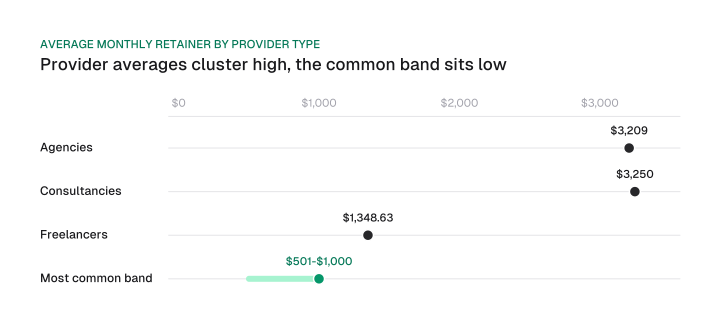
The average hides the more useful number. The single most common SEO cost per month, reported by 20.4% of respondents, is the $501 to $1,000 band, well below the figure most buyers walk in expecting.
This guide prices SEO by pricing model and provider type, using that same survey. It also prices the parts of SEO that never show up on an agency invoice: your own time, your tools, your content and your link building, using national wage data instead of a guess. By the end, you'll have a scope-based number of your own to check any quote against.
What SEO actually costs: retainers, hourly rates, and project fees
SEO pricing guides commonly quote a $1,500-$5,000 a month range that's anchored to what individual agencies charge themselves. The survey behind this guide reports what respondents actually pay, broken out by provider type and by the three SEO pricing models: retainer, hourly and per-project.
| Pricing model | Agencies | Consultancies | Freelancers |
|---|---|---|---|
| Monthly retainer (average) | $3,209 | $3,250 | $1,348.63 |
| Hourly rate (average) | $98.90/hour | $171.18/hour | $71.59/hour |
| Per-project fee (average) | $9,507.84 | $8,685.53 | $2,348.63 |
Three patterns show up once you compare the numbers side by side:
- Consultancies charge more per hour, not more per month. Their $171.18 hourly average is nearly double the agency rate of $98.90, even though the two provider types land close together on the monthly retainer.
- Freelancers run cheaper across every model. The agency average retainer runs about 138% above the freelancer average, computed from the survey's own agency and freelancer figures.
- The averages aren't what most people pay. The single most common monthly band, at 20.4% of respondents, is $501 to $1,000.
That band is roughly where cheap and professional tiers split: below it, you're usually buying a narrow task list; inside it, an entry-level ongoing program.
SEO cost per hour follows a similar pattern: the most common hourly rate overall is $75 to $100 an hour, reported by 24% of respondents, the same band agencies and freelancers report most often; consultants' most common band runs higher, at $100 to $150 an hour. For project-based work, the most common band is $2,501 to $5,000, at 21.2%.
Check any quote against its own model's actual common band instead of the overall average.
If you want to know whether that spend is worth it once you've settled on a number, calculate your SEO ROI against the return it's expected to generate.
What actually determines your SEO cost: size, industry, and technical condition
SEO cost can run higher for an older, established site than a newer, smaller one, because years of technical and link neglect have to be diagnosed and cleaned up before any growth work can start. That's a sharper predictor of price than company size or industry, and it's worth understanding before you assume a bigger, older business automatically pays a premium rate for a lighter workload.
The same survey's only business-segment breakout is local SEO, and it's the one place in this guide where local SEO pricing gets a real number instead of a guess.
| Local SEO segment | Average monthly cost |
|---|---|
| All local SEO providers | $1,557/month |
| Local SEO agencies | $1,819/month |
| Local SEO freelancers | ~$1,150/month |
The most common hourly rate for local SEO work is $75 to $100, the same band the wider market reports most often. Local SEO averages less than the general market because the work itself is narrower: a handful of location pages, review management and citation cleanup rather than a full content and link program.
The narrower scope buys the lower price, not the "local" label by itself.
Site condition works the other way. A site that's been live for years without technical maintenance can carry broken redirects, thin or duplicate pages and a backlink profile full of neglected or toxic links.
All of that has to get diagnosed and cleaned up before new content or links can compound. That's why an older site in poor shape can cost more to work on in its first months than a newer site with a clean foundation. Size and age buy domain trust; they don't pay for deferred cleanup.
No primary source in this guide breaks SEO cost out by company size or industry with real numbers. That's worth saying plainly rather than filling the gap with an invented table.
What business size changes in practice is which provider you can hire. A small business buying a freelancer's retainer pays $1,348.63 a month on average in the survey; a business that needs an agency's team pays $3,209.
Competition moves the price even without its own dollar figure in this data. When more providers chase the same keywords, every page needs deeper content, cleaner technical work and a stronger link profile to hold its place, and that extra work raises the price regardless of company size.
The same logic applies to industries like legal and healthcare, and to franchises or multi-location businesses competing inside the same crowded categories. It's why how much SaaS SEO costs or enterprise SEO cost can diverge from the general numbers here: the competitive and technical starting point differs, and there's no fixed per-vertical rate card.
AI search is moving the same bill in a new direction. Providers increasingly bundle AI Overview and AI-answer visibility work into the same retainer that used to cover classic search alone. So AI search tends to raise SEO costs through scope, as extra tracking and citation-focused content inside the quote, rather than as a separate line item.
Ask any provider which of those tasks the number covers. AI search optimization pricing covers that shift in depth.
In-house vs. agency vs. DIY: the real cost comparison
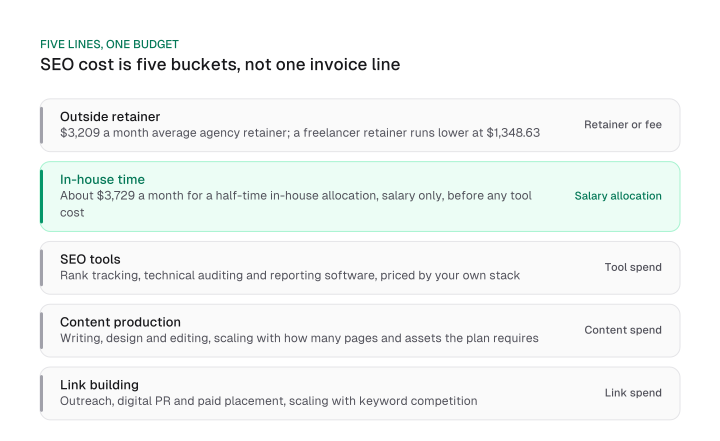
In-house SEO time carries a real, checkable price tag once it's run through national wage data, and that number alone can land above what an outside agency retainer averages, before a single tool subscription gets added. The SEO ROI guide already names these same cost categories and asks you to total whatever you're already paying; here's what each one actually costs in dollars:
- Outside retainer. $3,209 a month, the average agency retainer Ahrefs' survey reports; a consultancy retainer averages about the same at $3,250, a freelancer's runs lower at $1,348.63.
- In-house time. The U.S. Bureau of Labor Statistics reports a mean annual wage of $89,490 for marketing specialists as of May 2025, with a mean hourly wage of $43.03. The worked example below turns that into a monthly figure.
- SEO tools. Rank tracking, technical auditing and reporting software. The survey carries no dollar benchmark for this line, so price your own stack directly rather than guessing at a market average.
- Content production. Writing, design and editing for whatever the technical and content plan calls for. It scales with how many pages and assets the plan requires instead of a flat monthly fee.
- Link building. Outreach, digital PR and any paid placement. It scales with how competitive the target keywords are, which is the same driver that pushes local SEO pricing down and legal or healthcare pricing up.
One enterprise SEO platform's published in-house cost formula prices a hire at half their annual salary. Applying that same 50% allocation to the BLS wage gives $89,490 × 0.5 ÷ 12, about $3,729 a month in salary alone for a half-time SEO allocation, before any tool cost.
That number is the one that surprises people: $3,729 a month, for half of one person's time, already sits above the $3,209 average agency retainer. Add a tools budget on top of that, and in-house stops looking like the automatically cheaper option it's usually assumed to be.
Run the comparison in dollars instead of assuming it either way. If you're weighing whether to build this in-house or bring in outside help, whether to hire an AI SEO agency or build it yourself covers that qualitative decision on its own.
How to set and defend an SEO budget
A defensible SEO budget starts with your own scope-based number, built before you request a single quote, because the first price you see measurably biases how you judge every price after it. Tversky and Kahneman's 1974 research on judgment under uncertainty found that an initial reference point pulls later numeric estimates toward it, even when that starting point was arbitrary. They called it anchoring.
In SEO buying, the first quote you get plays the same role: it becomes the number every later quote gets measured against, whether or not it was ever a fair one.
That doesn't mean any specific quote is unfair, only that judging one price against another gets skewed by the order you see them in. If your own scope-based estimate always matched whatever quote you saw first, the bias wouldn't hold up here.
The fix is to build your own number first. Add up your own figures from the five buckets above (retainer or in-house time, tools, content, link building) before you read a single vendor's proposal. That gives you a reference point of your own, so a vendor's price anchors nothing.
Once you have that number, use it to check what a quote actually covers:
- Scope first. A retainer should name which of the five buckets above its price actually covers. If a proposal skips that, ask before you compare it to anything.
- Suspiciously cheap pricing. A quote well under the market's common $501 to $1,000 band usually means a narrower scope; find out what's missing before you sign.
- Performance-based pricing. It's rare in this market, and for good reason: it tends to create incentives that reward short-term ranking tricks over durable work, so we'd recommend against structuring a contract around it.
- Contract length. No reputable provider needs 12-18 months locked in before doing any work; that length can be reasonable for a full campaign once you can see progress, but it's a red flag when it's used to lock you in before results are visible. How long SEO takes to show results is worth reading before you sign anything long.
Pricing structures vary even among providers who quote after a proper scoping process. Mission Growth, for one, is a monthly fee quoted after an audit rather than a number pulled from a rate card, which is the kind of scoping a defensible quote should show regardless of which provider gives it to you.
How much does SEO cost, in the end? Less a matter of luck than of scope. Price your own program from the five buckets in this guide, check any quote's scope against that number, and treat the first price you see as one data point, not the anchor for every price that follows.
Frequently asked questions
How much would you charge for SEO, social media, and a website together?
A bundled quote for SEO, social media and a website varies far more than a single-service SEO quote, because you're really pricing three services under one number. Break it into its three components and check the SEO piece against the provider-type and pricing-model numbers in this guide before you compare it to anything else.
Do I need to sign a long-term SEO contract?
No reputable provider requires 12-18 months to start. That length can be reasonable once a full campaign is underway and showing progress, but it's a red flag when it's used to lock in a client before any results are visible.
What's the difference between a $2,000/month and a $4,000/month SEO plan?
The difference is usually scope and hours, rarely the hourly rate itself. The higher retainer typically buys more of the deliverables in the five-bucket list above (more content, more link building, more technical work), rather than the same work billed at double the rate.
Is there a quick way to estimate what SEO should cost for my business?
Start from the provider-type averages in this guide, then add your own numbers to the five-bucket checklist above. That produces a defensible range faster than a generic calculator, because it's built from your own scope instead of a generic input form.
How much does SEO cost for a high-competition industry like legal?
Higher than the general average, because competitive industries demand more content, more technical work and more link building to compete for the same keywords, not because "legal" itself commands a premium rate. Weigh that higher spend against SEO ROI benchmarks before you commit to it.
What is the average cost of SEO services in 2026?
The most recent large provider survey, Ahrefs' 2024 study of 439 SEO providers, puts the average monthly retainer at $2,917. The more useful number is the most common band: $501 to $1,000 a month, reported by 20.4% of respondents.
What's the minimum SEO budget to see results?
No survey sets a floor that guarantees results. The market's most common band, $501 to $1,000 a month, is where an entry-level ongoing program starts; below it you're usually buying a narrow task list rather than a program that can compound.
How much should a local service business invest in SEO?
Local SEO averages $1,557 a month across all providers in the same survey, $1,819 for agencies and about $1,150 for freelancers. Start from that band, then size it to your scope: how many locations, how much review and citation cleanup, and how many service pages you need.
Figures and images in this post are free to reuse under CC BY 4.0 with credit to Mission Growth.
Get Mission Growth highlighted in your Google results.