What is digital PR? Why it isn’t link building
Digital PR explained: how it differs from link building and paid press-release distribution, and what Google has actually said about link value.
On this page
Digital PR is often filed under link building, priced like it, and pitched like it, but the two aren’t the same discipline.
What is digital PR, exactly? It is the practice of earning coverage from journalists rather than buying or requesting it.
Digital PR vs link building comes down to who decides the outcome: an editor, not you. Google’s own John Mueller has said as much, on the record.
What digital PR is, and why it isn’t the same as link building
Digital PR is the practice of earning coverage and brand mentions from journalists rather than buying or requesting links, a distinction Google’s own John Mueller has drawn on record.
Traditional PR chases brand reputation across any media. Link building, in the general sense, covers any method of getting a link: outreach, directory listings, even a straightforward purchase.
Digital PR is narrower than both. It is specifically the earned-media slice, where a journalist or editor decides independently that a story, a dataset or an expert comment is worth running.
| What it optimizes for | Who decides the outcome | |
|---|---|---|
| Traditional PR | Brand reputation, any media | Journalists and editors, across all channels |
| Link building (general) | Any link, by any method | You: outreach, listings, or a purchase |
| Digital PR | Earned coverage that happens to carry a link or mention | Journalists and editors, in digital media specifically |
Digital PR gets waved off as a rebrand of link building fairly often, usually without any source behind the claim.
John Mueller settled it on Twitter, in January 2021:
“I love some of the things I see from digital pr, it’s a shame it often gets bucketed with the spammy kind of link building. It’s just as critical as tech SEO, probably more so in many cases.”
Coming from the person Google puts in front of the public for exactly this kind of question, that is close to an on-record classification.
Google's written policy backs half of that split with a mechanism: a paid or sponsored link has to carry a rel="nofollow" or rel="sponsored" tag so it doesn't pass ranking credit. The page stays silent on the reverse case, but the same mechanism implies it: a link a journalist grants without payment carries no such requirement, so it passes ranking credit by default.
That is what separates earned coverage from a bought or exchanged one, and the spam-policy page carrying it was last updated 2026-08-28. Digital PR is its own discipline, not a mass-link tactic wearing a press hat.
That same earned-mention mechanism carries into AI search, where a growing share of buying research now happens.
Which brand mentions actually move an AI-generated answer, and by how much, is a separate question with its own numbers, addressed in what AI Overviews means for SEO.
The short version for digital PR and SEO: coverage a journalist chooses to write doesn’t stop working at the backlink. It also puts a brand’s name in the kind of independent, editorial context an AI answer draws from.
How to tell whether a placement is actually worth the outreach
A digital PR placement is worth crediting only when the link has a story, a reason it exists in that specific piece.
Matching keywords across the page, folder and domain it sits on isn’t enough by itself.
That’s the test LinkResearchTools actually endorses: “a good sniff-test of whether a link is relevant or spammy is whether you’d feel comfortable showing it to a Google spam engineer,” and, more plainly, “a link can be considered relevant, if it has a story.” Two questions do the job:
- Does this link exist because the writer had a specific, on-topic reason to include it, or because it was slotted in?
- Would you be comfortable showing this exact link, in context, to someone at Google whose job is finding spam?
If either answer is no, the coverage might still be good PR, but don’t count it as SEO-grade.
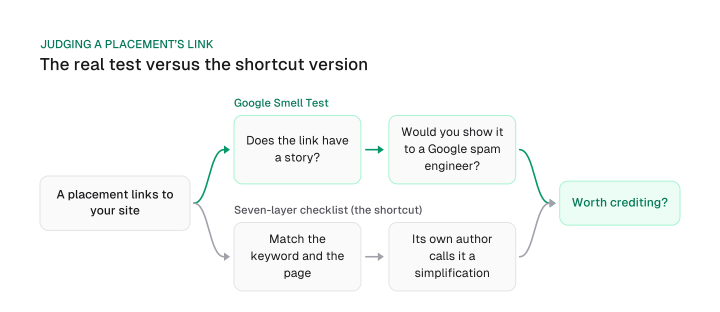
A longer checklist exists too: does the anchor keyword match, does the surrounding sentence match, the paragraph, the page, the folder, the domain, the root domain. Seven layers, scored like a rubric.
LinkResearchTools, the source that checklist traces back to, is explicit that it isn’t the real test, calling the seven-layer version a “simplification,” a “shortcut,” the kind of “simple checklist” low-cost outsourced link builders turn into standard operating procedure.
It’s useful for triage at volume, but it doesn’t decide whether a link is actually relevant. The story does that.
Treat the seven-layer version as a fast filter, not a verdict. The same discipline applies to any SEO ROI calculation.
Before crediting a placement, check what it actually contributes, rather than whether it technically exists.
Why a paid press release isn’t the same as earned digital PR
Digital PR sits in the “Earn” bucket of link acquisition, distinct from the “Ask” bucket (guest posting, blogger outreach, direct requests) and the “Buy” bucket (paid press-release distribution).
That is why an earned placement can never be guaranteed the way a paid one can.
The add, ask, earn, buy framework
The classification comes from Ahrefs’ Tim Soulo, who names four buckets. Add: links you place yourself, on directories or listings. Ask: you contact a site owner and request a link.
Earn: people link to you naturally, without being asked, “the best case scenario.” Buy: purchased directly or through a third party, which Soulo himself flags as “quite risky.”
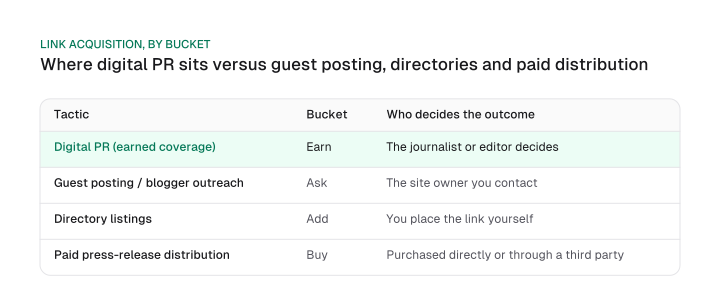
Guest posting and blogger outreach belong in the Ask bucket, not here. You are contacting a site owner and requesting inclusion, which carries its own selection, vetting and disclosure questions.
That is the real difference. Guest posting gets you a placement because you asked for it; the other kind arrives because a journalist decided your story was worth running on its own. Ahrefs calls earned links "the best case scenario" and treats asking as the fallback.
For a B2B SaaS site building its off-page profile as part of a broader SaaS SEO strategy or a dedicated link building for SaaS playbook, knowing which bucket a tactic sits in is what tells you what kind of promise is realistic for it.
Where paid and earned get conflated
PR Newswire sells paid press-release distribution, the “Buy” bucket by Ahrefs’ own framework.
Its own guide defines the practice as building reputation “primarily… through earned media,” then lists press-release distribution as one of its “types” in the same breath.
It also recommends “distribution services like PR Newswire” for “increasing the chances of pickup,” and at no point uses the word “paid” about its own service.
That’s the Buy bucket describing itself as though it were the Earn bucket. A press release paid for distribution is not earned coverage, no matter how the sentence selling it is framed. Among the distribution channels a campaign might use, that's the one distinction worth correcting: paid and earned are not interchangeable, whatever a distribution vendor's own guide calls itself.
The same conflation appears from the other direction, in guarantee language. One agency, digital.pr, advertises campaigns starting “from £900 per month,” next to this guarantee:
“100% Links Guarantee. We run unlimited stories until we get you the links that we promised, no exception.” “100% Earned Links. We never pay for links.”
An outcome that depends on an independent journalist’s decision cannot also be 100% guaranteed.
Treat that as one agency’s marketing copy, not proof that guarantees and earned coverage can coexist. Structurally, they can’t.
How to run a digital PR campaign, and measure whether it worked
Running a digital PR campaign means producing one pitchable asset, sending personalized pitches to a short list, and tracking coverage alongside the traffic and branded-search lift it produces.
Short-term coverage metrics and longer-term traffic metrics answer different questions, so track both.
Run the campaign
In practice, that breaks into six steps:
- Build one asset a journalist would actually want to cite. Original data, a survey, a tool, or a genuinely useful guide, not a generic blog post; nobody covers a listicle as news.
- Build a short, relevant target list. A handful of publications that plausibly cover this exact story beats a mass list of loosely related sites, and is where a digital PR strategy either holds together or turns into spray-and-pray outreach.
- Personalize every pitch. Fractl puts weekly pitch volume at 57% of journalists getting 50 to 500 pitches, and PR professionals meaningfully outnumber them; a pitch without a specific reason goes unread in that volume.
- Pick the campaign type that fits the asset. Digital PR examples split roughly into newsjacking (reactive commentary tied to a live news story), data-led or proactive campaigns (original research on a schedule you control), creative campaigns (a stunt or format built to be inherently coverable), and expert or tastemaker commentary (a named spokesperson for reactive quotes).
- Track coverage by tier, rather than by count alone. A trade-publication placement your buyers actually read outweighs a low-effort aggregator pickup, even at lower traffic.
- Split measurement into what to check now and what to check later.
Measure what it did
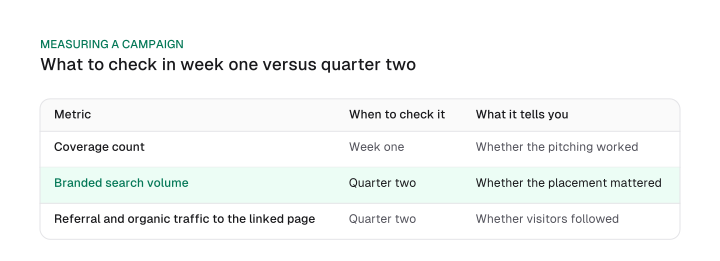
Coverage count, checked in week one, tells you whether the pitching worked. It says nothing about whether the placement actually mattered.
Branded search volume, checked by quarter two, tells you whether the placement mattered: it moved people to look for the brand by name. Referral and organic traffic to the linked page, over that same quarter, tells you whether visitors followed the coverage back to the site.
On the citation side, it’s also worth learning to track ChatGPT mentions a placement generates over the following weeks, since an earned mention doesn’t need a link to register there.
Sourcing pitches and prospects (HARO alternatives, broken-link building outreach, or building the linkable asset itself) is a deeper, separate topic. This section is about running and judging the campaign once the asset and the list already exist.
The challenges nobody puts in the pitch deck
Digital PR campaigns most often underperform when a team pitches generic, unpersonalized stories into an oversupplied inbox, or treats earned coverage as a bulk link-building tactic.
John Mueller, the Googler who put that classification on the record, has said it doesn’t work that way, the way marketers tend to assume.
The failure mode is specific:
- Journalists are already stretched thin under the pitch volume Fractl describes, and PR professionals meaningfully outnumber them, so a pitch without a specific reason goes unread.
- A campaign built to farm link volume, rather than earn a real story, runs into the wall Mueller named directly: “the spammy kind of link building” gets bucketed together, coverage or not.
The practical version of both failures looks the same from the outside: a press release blasted to a purchased media list, a pitch sent unchanged to a hundred other publications, a campaign measured only by placement count.
None of it is dishonest exactly. It’s PR built for a link-volume goal wearing an earned-media label, and it tends to underperform both as PR and as SEO.
For a new site with no link profile yet, this is also where SEO for startups programs tend to underinvest: chasing volume before the first genuinely pitchable asset even exists.
The corrective isn’t a bigger list or a louder pitch: digital PR is a discipline for earning coverage a journalist actually wants to run, not a link-volume channel with better branding.
Before you credit a placement, pay for a “links guarantee,” or judge a campaign by coverage count alone, run this check:
- Does the link have a story, and would it survive the Google Smell Test?
- Which bucket, add, ask, earn or buy, does this placement actually belong to?
That’s the test an agency pitch or a vendor claim should survive before it gets your budget.
Frequently asked questions
No. It’s the “Earn” bucket specifically, distinct from the outreach (“Ask”) and paid (“Buy”) buckets that make up the rest of link building. John Mueller, at Google, has distinguished it from spammy link building on the record.
Not for earned coverage. A guarantee can apply to paid distribution or to an unlimited-pitching promise, but not to what a journalist independently chooses to run. A placement guarantee and a claim of 100% earned links are structurally at odds with each other.
Digital PR cost varies by vendor and scope. One agency, digital.pr, advertises campaigns starting “from £900 per month” on its own homepage. Treat that as a single agency’s rate card, not a market average: pricing varies by target-list size and asset complexity too.
They’re different buckets. Paid distribution sits in “Buy,” earned coverage sits in “Earn.” Distribution can still be useful for visibility, but it isn’t the same signal as a journalist independently choosing to cover you, and it shouldn’t be reported as if it were.
Yes. The strategy scales down to a single well-targeted asset and a short, specific pitch list. It doesn’t require an enterprise budget, just a story worth a journalist’s time.
No. If anything, AI search raises the stakes for earning real coverage: the same independent, earned mentions that make a placement worth crediting also feed AI-citation signals. Mission Growth's platform tracks AI citations and visibility for customers.
Figures and images in this post are free to reuse under CC BY 4.0 with credit to Mission Growth.
Get Mission Growth highlighted in your Google results.