
SEO ROI: The Formula, Benchmarks, and What It Misses
See the SEO ROI formula, 19 industry benchmarks, and why attribution undercounts SEO today. Includes a worked example and a free ROI calculator.

On this page
SEO ROI answers a simple question with a number that's rarely as simple as it looks: did the SEO spend pay off. The formula itself is short.
(Revenue from SEO minus SEO cost) divided by SEO cost, times 100. Run it and you get a percentage.
That percentage alone won't tell a CFO much. In one SEO firm's own client benchmark, the same formula returns anywhere from 16% to 748% depending on what kind of campaign produced it.
The formula also misses revenue by design. Last-click reporting erases assists, and a falling click count can now mean an AI Overview answered the question on the results page instead of SEO failing.
In this guide:
- The SEO ROI formula and the four inputs it actually needs
- Why last-click GA4 reporting misses revenue SEO actually drove
- What counts as a good SEO ROI, by published benchmark
- How to defend a flat or negative number to finance, without leaning on the percentage alone
What SEO ROI actually measures (and why the formula alone can mislead you)
SEO ROI is the percentage return your SEO spend generates: (revenue from SEO minus SEO cost) divided by SEO cost, times 100.
In one SEO firm's own client benchmark, tracked from 2021 through the third quarter of 2025, that same formula returns 16% to 748% depending on campaign type. That's a spread wide enough that the percentage alone tells you almost nothing about program quality.
Basic content marketing landed at 16% ROI. Technical SEO work with no content or link building attached returned 117%. Thought-leadership content, the deepest tier in that dataset, returned 748%.
The widest and narrowest of those three sit nearly 47x apart. That gap reflects a correlation across campaign types in one dataset, not proof that campaign depth alone causes it.
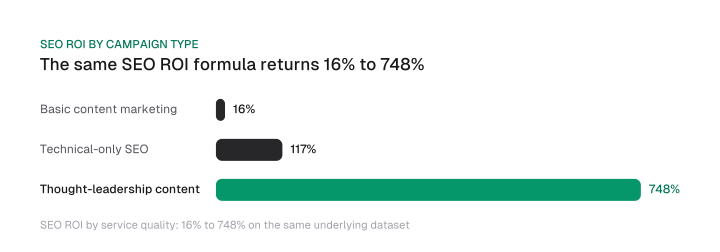
A positive ROI percentage alone tells you almost nothing about program quality until you know what kind of SEO work produced it. Before you compare your own number to anything you've read, know which tier you're actually being held against:
- Basic content marketing: 16% ROI
- Technical-only SEO: 117% ROI
- Thought-leadership content: 748% ROI
Ask which of those three describes your program. Then judge your own percentage against that row instead of the headline number.
How to calculate your SEO ROI in 4 steps
Calculating SEO ROI takes four inputs: total SEO cost, the revenue GA4 attributes to organic search, the formula itself, and a payback check against a real benchmark.
Skip that last step and a positive number tells you very little about whether the program is actually on track. Once you've got real figures for the four steps below, run your own numbers through our SEO ROI calculator instead of doing the arithmetic by hand every month.
Step 1: Total your SEO costs
Total SEO cost covers every dollar tied to the program, well beyond the retainer line. Add up:
- Agency or freelancer fees
- In-house time, valued at real hourly cost
- Content production
- Technical work
- Tools and software
- Link building spend
Leave one category out and the number looks better than it actually is. For what those costs should actually be for your situation, see our SEO cost guide; this step only asks you to total whatever you're already paying.
Step 2: Value your organic conversions
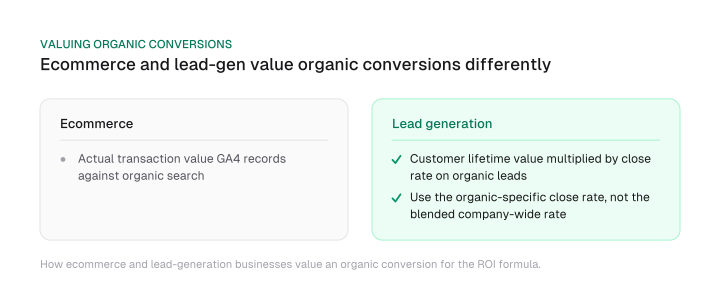
Organic conversions get valued differently depending on the business model. An ecommerce site uses the actual transaction value GA4 records against organic search.
A lead generation business has to build the number itself: customer lifetime value multiplied by the close rate on organic leads. GA4 only sees a form fill; it can't see whether that lead became a signed deal.
For example, if organic leads close at a lower rate than your paid leads, use that organic-specific close rate, not the blended company-wide one, or you'll overvalue the channel before you've even reached the formula.
Get this input wrong and every later number, including the ROI percentage, inherits the error.
Step 3: Apply the SEO ROI formula
The SEO ROI formula itself is short: (Revenue from SEO - SEO cost) / SEO cost x 100.
Plug in the totals from steps 1 and 2 and you have a percentage. That part is easy. Step 4 is the part that actually decides whether the number means anything.
Step 4: Check the result against a payback benchmark
A payback check turns a bare percentage into a judgment you can defend.
Say your SaaS spends $4,000 a month on SEO and, by month 9, organic search is driving $30,000 a month in attributed revenue. Run those two numbers through the formula from step 3, and the program is already returning several times its monthly cost.
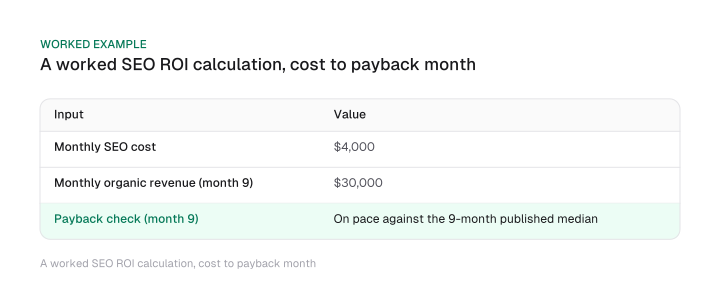
The number that actually matters here is the timing, and not the percentage on its own. Hitting a strong result by month 9 lines up with the published median breakeven across industries (more on that benchmark below), so this illustrative program is on pace, neither ahead nor behind. Why the early months are slow is its own question, covered in how long does SEO take.
Drop your own cost and revenue figures into the SEO ROI calculator to get your exact percentage and see how your own payback month compares.
Why last-click attribution undercounts what SEO actually did
Last-click attribution hands all the credit for a conversion to whichever channel closed it. So SEO gets erased whenever it opens or assists a journey another channel finishes.
Picture a visitor who finds your comparison page through organic search, leaves, comes back three days later through a branded ad, and converts. GA4's default view credits the ad. The search that started the whole thing gets nothing.
Google's own data-driven attribution model works differently. Here's what changes when you switch to it:
- Credit spreads across every touchpoint in the path, rather than only the last one.
- Counterfactual modeling compares exposed users against a control group to estimate what each touchpoint actually contributed.
- A conversion's credit can be reattributed for up to 7 days after it happens, as more of the path becomes visible.
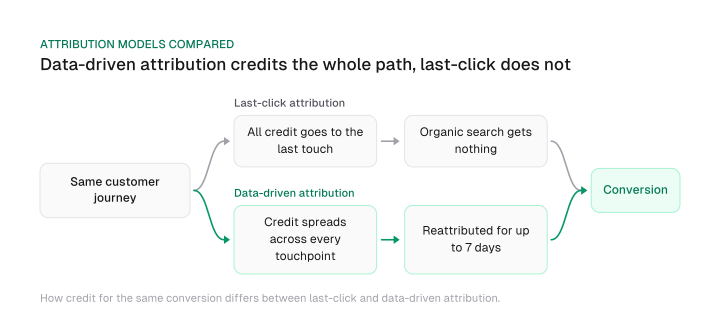
This is the real alternative to last-click: assists get counted instead of one channel taking everything. Switch your reporting to this model, and split brand search from non-brand search before you claim credit for either. That change recovers SEO attribution the classic formula assumes doesn't exist.
For the fuller measurement picture, including how citation tracking and AI referral data factor into the same blind spot, see our AI search analytics guide.
Why your ROI number looks worse than it should in the AI search era
A shrinking click count no longer proves SEO stopped working, because AI Overviews already answer a meaningful share of searches directly on the results page.
Ahrefs' June 2025 analysis found AI Overviews already show on 18.9% of US keywords, and can cut clicks by up to 34.5% on informational queries even when rankings hold steady. That's a real hit to the click side of the ROI formula.
But it has nothing to do with whether your content or technical work is any good.
Mission Growth's platform tracks AI citations and visibility for customers.
Judge SEO's revenue side by the rankings and visibility your pages hold, rather than only by the clicks they capture, because the click count is shrinking for reasons outside the program's control. The broader AI SEO statistics behind this shift cover how this plays out across query types.
What counts as a good SEO ROI
A good SEO ROI clears a median of 788% across 19 published industries in that same thought-leadership-tier client benchmark (Q1 2021 to Q3 2025), at a 9-month median breakeven.
The range runs from 317% to 1,389%, and ROI size doesn't track breakeven speed the way you'd expect.
We got that median by sorting all 19 industry ROI figures from the same benchmark report, then the 19 breakeven figures separately, and taking the middle value of each list.
Search for average SEO ROI and you'll usually land on one headline figure pulled from a single tier of a dataset like this one. The more useful frame is the full spread. These SEO ROI benchmarks use the report's own numbers, sorted and split at the middle, rather than one row picked because it looks good.
| Industry | SEO ROI | Breakeven |
|---|---|---|
| eCommerce | 317% | 9 months |
| Addiction Treatment | 736% | 8 months |
| Real Estate | 1,389% | 10 months |
| Median (19 industries) | 788% | 9 months |
Download CSV (CC BY 4.0)
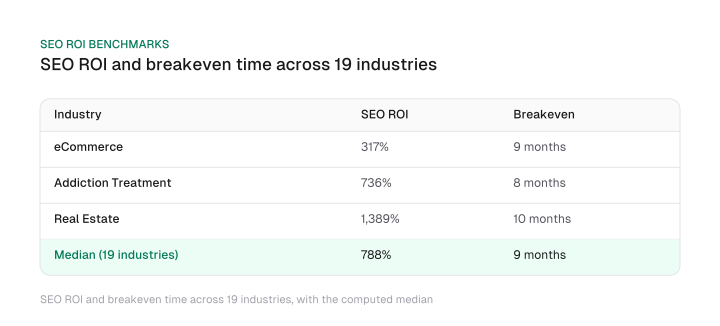
Read the table and the size of the ROI number stops predicting the speed of the payback. eCommerce sits at 317% ROI, with a 9-month breakeven right in the middle of the pack.
Real Estate sits at 1,389% ROI, at a 10-month breakeven. Addiction Treatment runs 736% ROI at an 8-month breakeven, close to the median on both counts.
Construction, elsewhere in the same report, breaks even faster than any of these rows, in 5 months, despite an ROI that lands well below the industry median, nowhere near the top. Compare your own number to the row that matches your industry and your breakeven timeline, and let the median be the bar.
How long SEO ROI takes, and why it doesn't just keep compounding
SEO ROI typically turns positive in 6-12 months, with peak results landing in year 2 or year 3, but that growth isn't automatic forever.
Ask how long does SEO ROI take to turn positive, and the published benchmark answer stays consistent: 6 to 12 months to positive, then a longer climb toward peak performance.
Google's patent US8832088B1 describes scoring a document by its age and by how strongly a query seeks fresh results, which is why a page that stops being updated can lose freshness-related benefit on those queries.
Backdating a publish date without a real content change doesn't reliably help either, since Google's ranking systems are built to weigh genuine content updates over a changed timestamp alone.
This isn't a universal claim that every page's ROI stops growing on its own. It's one specific mechanism that can flatten returns on pages your team stops maintaining.
Treat SEO ROI as an asset that needs upkeep, rather than a one-time build that grows by itself. Budget for maintenance the same way you budgeted for the initial build.
Projecting that number forward, before you've spent anything, is a separate question (see our SEO forecasting guide); this section is about what happens to a number you're already generating.
How to defend a flat or negative SEO ROI number to finance
A weak SEO ROI number gets defended with a payback timeline and a comparison against your hurdle rate, instead of the percentage alone.
Finance already judges every other line item this way: by when it pays back, and against what it's competing with for the same dollar.
Compare SEO's return against your hurdle rate, the return finance already expects from any use of that same budget, rather than against zero.
A program clearing a strong ROI on paper can still be the wrong call if that same budget would return more somewhere else. A program with a modest return can be the right one if the alternatives return less.
When you're presenting a flat or negative number to a CFO, lead with these three things instead of the percentage:
- The payback month. Saying you're on pace for month 9 against the industry benchmark reads as a program working as designed rather than one that's failing.
- The hurdle rate you're comparing against. State it explicitly, so the comparison isn't silently against zero.
- The campaign type behind the number. Technical-only work reads very differently from thought-leadership content at the same percentage, and finance should know which one it's looking at.
A positive SEO ROI percentage still proves nothing on its own until it's checked against that hurdle rate and the month it's tracking to pay back. The number matters less than what you compare it against.
Once your reporting answers those questions, work through the AI SEO checklist for the execution moves that actually change the number itself.
Frequently asked questions
Lead with the payback month and a comparison against your hurdle rate instead of the percentage. A program on pace against its payback benchmark isn't a failed one, even while the ROI percentage itself still reads flat or negative.
No. Pages that stop getting real content updates can lose the ranking benefit tied to freshness, per Google's timestamp-based freshness patent, so returns on those specific pages can flatten or reverse without upkeep. That's a page-level mechanism, not a rule that every program's ROI stops growing automatically.
The published median across 19 industries in that same thought-leadership-tier benchmark runs about 788%, at a 9-month median breakeven, but your own hurdle rate and payback timeline matter more than any headline average you've seen quoted elsewhere.
Only the share you can defend. Branded search is usually influenced by other channels a visitor saw first, so a credible SEO ROI number splits brand from non-brand traffic using Google's data-driven attribution model before claiming credit for either.
PPC ROI resets to zero the moment spend stops, while SEO ROI keeps returning from pages you've already built, at a falling marginal cost. That's also why SEO ROI needs ongoing upkeep, rather than one-time spend, to stay positive over time.
Figures and images in this post are free to reuse under CC BY 4.0 with credit to Mission Growth.
Get Mission Growth highlighted in your Google results.