How Long Does SEO Take? A Realistic Timeline, Phase by Phase
How long does SEO take? For a new site, about a year to settle, per Google's John Mueller. See the four phases, what sets your timeline and how to speed it up.
On this page
SEO's timeline isn't random.
It's set by documented mechanisms, some confirmed by Google and one that surfaced in a federal antitrust trial, and this post names them so you can estimate your own instead of borrowing someone else's range.
How long does SEO take to work?
SEO typically takes several months to about a year to show measurable ranking and traffic gains for most sites.
Google's own current guidance no longer states a specific number at all.
Google's "Do You Need an SEO?" guidance page never mentions a month count or a year figure anywhere on it. Instead, it tells you to ask a prospective SEO this:
"What kind of results do you expect to see, and in what timeframe?"
Search "how long for SEO to work" or "how long does it take for SEO to work," and you'll get the same generic range back every time, usually with no mechanism behind it. The "Google says four months to a year" line so many guides repeat isn't sitting on that guidance page anymore.
That gap matters more than it looks. If Google won't commit to a number, the honest range comes from what practitioners actually observe, gated by a specific set of factors:
- Domain authority. How much trust the domain has already built with Google.
- Keyword competition. How contested your target keywords already are.
- Technical readiness. Whether the site can be crawled and indexed cleanly.
- Content quality and volume. How much evidence Google actually has to evaluate.
- Budget and team. How fast the other four factors can move.
"How long does SEO take to show results" always comes back to those same five inputs. Each is a lever you can pull, and the next section explains the mechanism behind it.
Why SEO takes months, not days
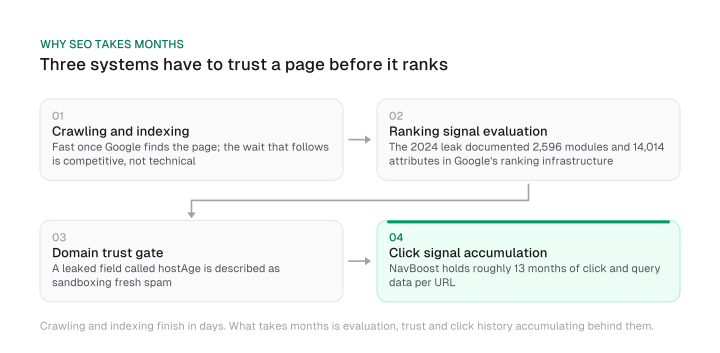
SEO takes months, not days, because three separate systems have to accumulate evidence about a page before Google trusts it.
None of the three is a single fixable setting you flip once. Crawling and indexing move fast. What takes months is ranking evaluation and domain trust maturing over time, and click history piling up behind both.
Crawling and indexing
Crawling and indexing are the fast part of the process.
Once Google's crawler finds a page, it's typically fetched and added to the index within days.
The wait that follows is competitive. It's not a technical bottleneck: an indexed page still has to earn its place against everything already ranking for that query.
If you want to confirm a page is actually indexed, Search Console's URL Inspection tool answers that in seconds. It won't tell you when you'll rank, only that you've cleared the first, easiest gate.
Ranking signal evaluation
Ranking signal evaluation covers far more ground than the old shorthand suggests.
SEO folklore still repeats a specific, much smaller ranking factor count. That figure is outdated.
The May 2024 Google Content Warehouse API leak documented 2,596 modules and 14,014 attributes across Google's ranking infrastructure. Those are documented API fields. They aren't a confirmed count of ranking factors, and Google has never said how many of them actually move a live ranking decision.
Here's what the scale does tell you: no single fix moves a page past evaluation on its own. A page earns its place across many systems working together, not one lever you can pull in an afternoon.
Domain trust and the click data window
Domain trust and accumulated click data are where new sites lose the most time.
Two separate signals point the same way, without confirming each other.
Google's leaked PerDocData module includes a field called hostAge. The leak's own description ties hostAge to sandboxing "fresh spam," though Google hasn't confirmed exactly how the field is used in ranking today.
Separately, John Mueller, a Google Search Advocate, said this in a June 2020 Search Central hangout:
"Over the course of a year, things settle down in kind of a stable state," Mueller said about new sites, with rankings fluctuating before that.
Those are two separate signals. Neither confirms the other as the mechanism behind it: nobody, including Google, has said hostAge explains Mueller's comment.
The other clock is click data. Pandu Nayak, Google's VP of Search, testified in the DOJ's antitrust trial that NavBoost (Google's click-based ranking system) "memorizes this information for all queries received in the past 13 months," down from an 18-month window before 2017.
A new URL starts that window at zero.
One plausible reason timelines for competitive keywords cluster near a year: a full click data window takes roughly that long to build. That connection is our own reading of the mechanism above; Google hasn't stated it as a rule.
What actually sets your timeline
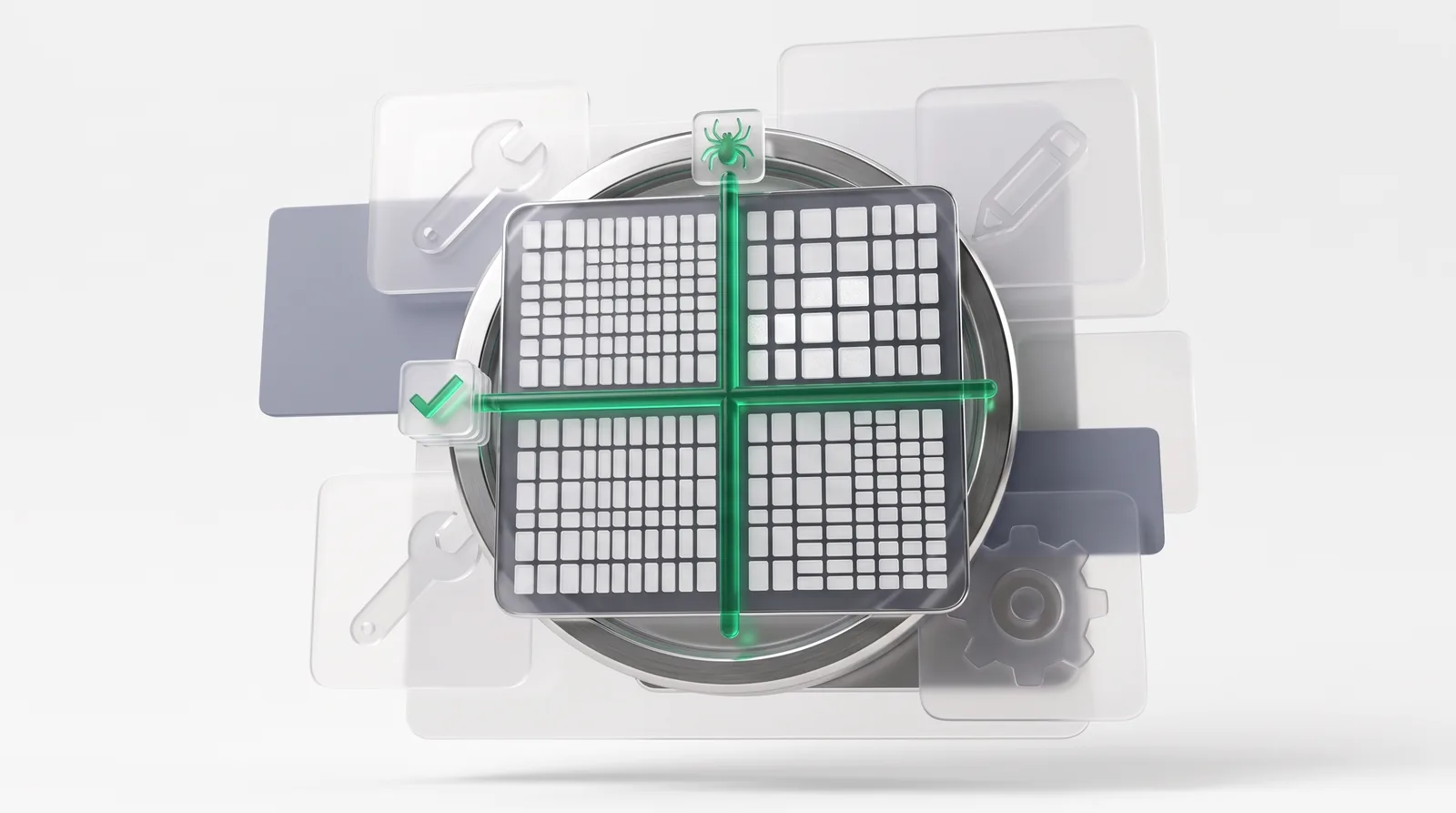
Your SEO timeline is set mainly by two things working together: how much authority your domain already has and how competitive your target keywords are.
Put a new domain up against a keyword that incumbents have owned for years, and every mechanism from the last section is waiting on you at once.
Put an established domain up against a low competition keyword, and you can see movement in weeks.
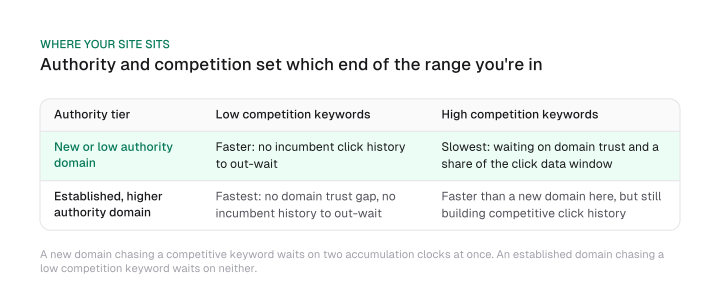
The two extremes on that grid explain most of the spread guides report.
An established domain chasing a low competition keyword isn't waiting on domain trust to build from zero, so initial movement can arrive quickly.
A new or low authority domain chasing a high competition keyword is the slowest combination. It's waiting on the trust signals described above and a meaningful share of NavBoost's click data window at the same time.
Which cell are you actually in? Most sites starting SEO for the first time land closer to the slow corner than they expect, regardless of how good the content is on day one.
Four more inputs shift the estimate without changing which cell you start in:
- Budget and resources. More budget buys more content and faster technical fixes in parallel.
- Technical readiness. A page Google can't crawl or index cleanly never reaches evaluation.
- Content quality and volume. Thin or repetitive pages give evaluation less to work with.
- Team expertise. Teams that understand the mechanism waste less time on fixes that don't move it.
None of the four replaces domain trust or click history; budget and expertise only compress the wait, and a technical SEO checklist is the fastest place to fix the crawl and index gate.
The real cost of waiting to start
Waiting to start SEO does cost you.
The disadvantage is bounded: it doesn't compound forever, because NavBoost's rolling click data window keeps advancing.
Nayak's testimony describes the window itself: roughly 13 months of accumulated click and query data per URL. It doesn't say how long a latecomer needs to catch up. What follows is our own reasoning built on that mechanism; Google hasn't made this specific claim.
A "competitor already has a head start" framing implies the gap only grows.
The window rolls forward. A competitor's clicks from well over a year ago have already aged out of the model, replaced by more recent data.
A latecomer who starts publishing and improving consistently today is filling the same kind of window an incumbent is also still filling, one month at a time.
That reframes the decision most founders actually face.
The cost of waiting another quarter is a few more months added to a wait that was already going to be months long.
Starting today doesn't erase the wait. Every day you delay adds a day to it directly; it doesn't multiply.
The four phases of a realistic SEO timeline
A realistic SEO timeline moves through four phases: discovery, initial signal, competitive stabilization and signal maturity.
Each phase ends when a specific signal finishes accumulating, not when a date arrives on a calendar.
That's why "month four" can mean something completely different for two different sites.
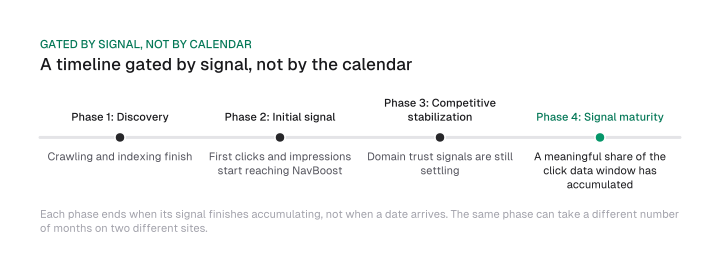
Here's what ends each phase:
- Discovery. Ends once crawling and indexing complete, typically the fastest phase.
- Initial signal. Begins once a page starts collecting real clicks and impressions, feeding directly into NavBoost.
- Competitive stabilization. The stretch where a new domain works through the trust gap described earlier, the same about-a-year window Mueller described.
- Signal maturity. Arrives once a meaningful share of the roughly 13-month click data window Nayak described has accumulated for that page.
Here's what that looks like for one hypothetical site: a new SaaS blog on a DR20 domain, publishing four posts a month and targeting KD20 keywords, not a head term but not trivial either.
How its first two phases play out:
-
Discovery: finishes within days of each post going live; crawling and indexing were never the bottleneck for this hypothetical blog.
-
Initial signal: starts arriving once a post has been live long enough to collect real search impressions and clicks, usually inside the first few weeks.
When will SEO start working for a page like this? Once it reaches initial signal and starts showing up in real search impressions.
Competitive stabilization is where this hypothetical blog spends most of its wait. It's a new domain, so its trust signals sit inside the same about-a-year window Mueller described.
Signal maturity, for the keywords published earliest, arrives once those posts have built a meaningful slice of the roughly 13-month window Nayak described. Posts published later in the campaign are still earlier in that same climb.
Track which phase a page has reached using impressions and clicks in Search Console, rather than final rankings alone. It's a more honest progress check than counting weeks on a calendar.
How to see results faster
You can shorten your timeline by skipping the parts of the wait that don't apply to you.
Mainly, that means targeting keywords where you don't have to wait out an incumbent's accumulated authority.
The mechanism from the sections above still applies. What changes is which part of it you're actually waiting on.
A few moves shorten the wait that's actually in your control:
- Size keywords to your current authority. Skip the click data race against an incumbent on a keyword you can't win yet.
- Fix technical readiness first. A crawl or index problem blocks evaluation entirely, and it's the fastest fix on this list.
- Publish for quality, not volume. Thin pages give evaluation less to work with.
For the tactical execution list, work through the AI SEO checklist. This section explains the reasoning behind it.
Two real results show what a fast timeline looks like in practice. MyPhotoStation's 5x organic revenue case study shows a US wall decor brand's organic revenue growing 5x in 5 months. Pozitif Teknoloji's organic case study shows a Turkish brand gaining +225K organic clicks in six months.
Both are organic search results, not AI citation measurements, and both landed inside a year.
SEO's cost is front loaded relative to when the traffic shows up. The SEO ROI payback math is where that tradeoff gets worked out in full.
A core update resets the clock in one specific way. Google's own core updates documentation says:
- Effects take time. A core update's effects can take several months to show.
- No change after a few months can mean waiting. That can mean waiting for the next core update, with no guarantee of full recovery either way.
If a core update just cost you traffic, resist the urge to rewrite everything overnight. That's a different clock from the growth timeline above: it doesn't reset to when you started or how much authority you'd built. It resets to Google's own recovery cycle.
Does AI search change the timeline?
Google's AI Overviews in Search partly inherit the classic ranking timeline.
Ahrefs' March 2026 analysis found that 37.1% of the URLs cited in Google's AI Overviews also rank in the organic top 10 among standard search listings for the same query.
That's a meaningful overlap. It doesn't prove that ranking causes citation, and the rest of AI Overview citations come from elsewhere in the index.
A page that hasn't cleared the mechanisms in the sections above can't assume AI visibility will arrive on a faster clock instead.
The two aren't fully decoupled. They're partly linked and correlational, not causal.
Mission Growth's platform tracks AI citations and visibility for customers.
For the fuller picture, see the AI Overviews impact on SEO; the mechanism above is only one piece of it.
None of this makes the wait arbitrary. It's set by crawling and indexing, by a documented but unconfirmed domain trust signal, and by a roughly 13-month click data window that came out on the record in a federal antitrust trial.
Place your site in the authority and competition grid above. Treat the gap you find honestly, and start on the parts of the mechanism that respond fastest today instead of waiting for a round number on a calendar.
Frequently asked questions
No. Google's current SEO hiring guidance page doesn't state a month or year figure anywhere; it asks you to define a timeframe with a prospective SEO instead, a change from the "four months to a year" line long repeated across the industry.
Only a domain change resets the clock behind the leaked hostAge field, which the leak describes as sandboxing fresh spam. A same-domain redesign with correct redirects keeps that clock running, since the domain and its history stay the same.
Google's own core updates documentation says effects can take several months to show, and if nothing has changed after a few months, that can mean waiting for the next core update. Google states there's no guarantee of full recovery.
It's a heuristic, useful as a prioritization habit. No one has published a measured split behind it, so put your effort into your best pages and keywords first rather than treating the ratio as literal.
Usually, yes, because local and long-tail keywords carry less accumulated competition than national head terms. That's the same competition mechanism that sets any timeline: less competition means less domain trust and click history to make up.
Figures and images in this post are free to reuse under CC BY 4.0 with credit to Mission Growth.
Get Mission Growth highlighted in your Google results.