SEO Lead Generation: How Many Searches You Need for Leads
SEO lead generation explained: work out how many searches you need, build pages that capture leads, and track which pages produce qualified ones.
By Furkan AktaşPublished Updated

On this page
SEO lead generation is the use of organic rankings to bring in visitors who become contacts your sales team accepts as qualified leads. Ten qualified leads a month takes about 690 clicks, at a 6.6% median landing-page conversion and a 22.1% lead-to-qualified-booking rate.
"Rank higher and leads follow" skips the arithmetic, and plans break on the arithmetic.
SEO (search engine optimization) is the work of earning visibility in unpaid search results. An SEO lead is a form fill, a call or a booking from an organic landing page that sales accepts as qualified. One note on wording: "lead generation for SEO" can also mean finding clients for an agency. You are reading the other meaning, where search brings you your own leads.
In this guide:
- How many monthly searches a lead target requires
- Which keywords deserve a lead target and which are feeders
- How to size the page pipeline from your own hit rate
- What a lead page must do, and how to track leads by page
- Four leaks that explain rankings without leads, plus AI and local search
SEO lead generation math: how many searches 10 qualified leads need
Ten qualified leads a month takes about 690 clicks, which means about 9,700 monthly searches at position 1 and about 345,000 at position 10.
The chain runs backwards from the target. Divide qualified leads by the lead-to-qualified-booking rate to get leads, divide leads by the visit-to-lead rate to get clicks, then divide clicks by the click share your position earns to get searches.
Here are the inputs:
- Click share: First Page Sage's 2026 panel puts blended position 1 at 7.1%, position 3 at 1.7% and position 10 at 0.2%; position 1 earns 3.6% on a page with an AI answer and 22.6% on one without.
- Visit-to-lead rate: one landing-page benchmark covering 41,000 pages reports a 6.6% median conversion across all industries.
- Lead quality: one scheduling vendor's analysis of 88,047 inbound B2B leads found 19,493 qualified bookings, which is 22.1% by our division.
Applied to 10 qualified leads, the chain gives about 45 leads, then about 690 clicks. The table shows what that means in searches, with a second case where the page converts at half the median (3.3%).
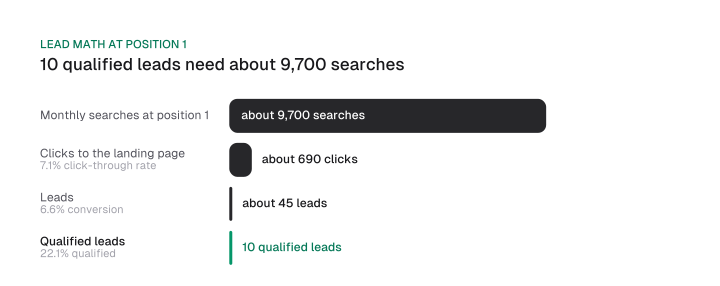
Read the table in prose before you trust it. At position 1 on a page that converts at the median, you need about 9,700 monthly searches covered. At position 3 it is about 40,600, and at position 10 about 345,000. Double each number if the page converts at 3.3%.
The AI answer matters most at the top: with no AI answer on the page, position 1 needs about 3,100 searches, and with one it needs about 19,200.
If your keywords average 100 searches a month each (an illustrative figure, so use your own), covering 9,700 searches at position 1 takes about 97 keywords. A handful of terms at position 5 will not carry a 10-lead target.
Treat the inputs as starting points. The 22.1% is lead-to-qualified-booking at one vendor's customers, so replace it with the share of leads your own sales team accepts. The 6.6% is a blend of all landing pages, not an organic-only rate, and the click shares mix branded and non-branded queries.
The click shares are a blended 2026 panel across pages with and without an AI answer; the seo forecasting guide covers how to discount them for your keywords.
Your first action: multiply your keyword set's monthly volume by your realistic click share and compare it with the table.
Choose keywords your page can close in one visit
A keyword deserves a lead target only if its page can finish the job in one visit, such as a quote request or a demo booking. A how-to page that cannot is a feeder page and is judged on assisted leads.
The lead math explains why this matters. A 10-lead target needs about 97 keywords at the illustrative 100 searches each, so check the volume of your own buying-intent keywords before you commit to a target. The lead-target set must come from pages that convert on the first visit, and informational content joins the plan as feeders with a separate metric.
This table pairs each keyword pattern with the one conversion event its page can ask for:
The one-visit test is a rule you can apply to any keyword:
- Name the single conversion event the page can ask for.
- Ask whether a stranger would take that step on a first visit.
- If yes, the keyword gets a lead target. If no, it is a feeder with its own metric.
Branded and non-branded leads need separate lines in your report. Position-1 click-through is significantly higher for branded terms, likely because they are mostly navigational queries, so a blended average flatters the quality of non-branded leads.
The same logic is why b2b seo can generate leads: buyers type "alternative" or "pricing" and self-qualify through the query itself.
How long until the first lead: plan pages, not hope
Only 1.74% of random URLs, drawn from 1 million that Ahrefs' crawler saw, reached Google's top 10 within a year, so a lead target needs a page pipeline sized from your own hit rate rather than from a month range.
Timeline ranges of several months describe programs with targeted pages. They leave out the odds that any single page gets there. A second Ahrefs cut, 2 million non-empty English URLs created in October 2023, put the share at 6.11%. Treat both as a floor for random pages; neither forecasts yours.
Here is how to size the pipeline:
- Measure your hit rate. About six months after publishing, count the share of pages that reached the top 10, by page type.
- Divide. Pages needed equals the number of pages your lead target implies divided by that hit rate.
- Update or drop. Ahrefs advises looking at updating content that is still outside the top 10 after about six months.
Start with lower-volume keywords. Ahrefs found it takes longer to rank for high-volume keywords than for low-volume ones, so early wins come from the smaller terms.
Rankings keep paying after a page lands, but the marginal cost is never zero. Cost per lead is program cost divided by leads. For the full month-by-month picture, see how long does seo take.
Build pages that capture the lead, not just the click
A lead page asks for one conversion event that matches its keyword, gates only what the visitor values more than their email, and passes Google's thresholds of 2.5 seconds for LCP and 200 milliseconds for INP at the 75th percentile.
Three rules cover most of it:
- One page, one conversion event. A service page asks for a quote. A comparison page asks for a demo. Adding a newsletter box beside a quote form splits the decision.
- Low-friction forms. Ask only for what sales needs to follow up.
- Gate only what they value. A calculator or a template is worth an email. The explanation of how to do the thing is not, because a visitor can get it elsewhere without paying.
An example of a tool a search can land on before any form: we built and ship free tools, including an SEO ROI calculator and an LTV:CAC calculator.
On speed, no source gives a fixed number of seconds after which visitors leave. Google publishes quality targets instead. Per Google's Core Web Vitals guidance, LCP should occur within 2.5 seconds of when the page starts loading, INP should be 200 milliseconds or less, and the measurement point is the 75th percentile of page loads, segmented across mobile and desktop.
INP matters most for a form. It observes the latency of all click, tap and keyboard interactions during a visit, which includes typing in a field. These thresholds are quality targets rather than abandonment data, so they neither confirm nor refute any cliff. Test the form on a mid-range phone before you tune the hero image.
Track SEO leads when Search Console hides the query
Search Console leaves anonymized queries out of its tables, so a lead can be tied to the landing page that earned it but not reliably to a query. Track leads per landing page and per 1,000 organic clicks.
Google defines anonymized queries as those not issued by more than a few dozen users over a two-to-three month period. They are omitted from the tables and included in chart totals unless you filter by query. A form submission records the landing page, so the page is the join key between your CRM and Search Console.
A page ledger shows why that join matters. These inputs are illustrative, not client data:
In this example the how-to guide holds 80% of the clicks (5,200 of 6,520) but 11% of the qualified leads (2 of 18). The service page converts 43% of its leads into qualified ones, the comparison page 39% and the guide 8%. Traffic share and lead share diverge here, and you should check whether they do on your own site.
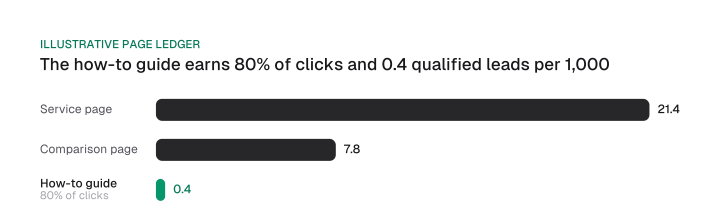
Sort your pages by qualified leads per 1,000 clicks and your content plan writes itself. Payback and attribution math sit in the seo roi guide.
SEO lead generation tools, by stage
SEO and lead generation share one toolset, and most of it is free or already in your stack. These SEO lead generation tools each answer one question in the chain:
Put the landing page and a source field on every CRM lead, and the ledger above becomes a monthly report.
Why rankings stall without leads: four leaks and their tells
Rankings stall without leads at one of four leaks (wrong-intent traffic, a page that cannot convert, junk leads, slow follow-up), and each shows in a different metric you can read today.
Read the tells in order, from the click to the CRM. Fix the first leak that shows, because a later fix cannot recover visitors an earlier leak never sent.
In the earlier example, the how-to guide shows the first leak: 5,200 clicks and 5 leads per 1,000 clicks, with an 8% qualified share. No form change rescues that page. It is a feeder, and it needs its own metric.
If the tell is a low visit-to-lead rate on the right keyword, the fix belongs to conversion work. The b2b conversion rate optimization guide covers form data, valid tests and speed to lead.
You are done with this section when you can name which of the four leaks your best-ranking page has.
AI search and local search as lead sources
AI search sent 0.5% of one site's visits but 12.1% of its signups. Because AI users click links 75% less, multiplying the 23x conversion advantage by the quarter of clicks that remain gives about 5.75 per searcher, close to the "more than 5x" Ahrefs expects if AI search scaled, a figure its author doubts.
AI search: few clicks, high conversion
Ahrefs measured this on its own site over 30 days. AI search visitors converted at 23x the rate of traditional organic search visitors, but Ahrefs' modeled data says AI users click links 75% less. Our multiplication, 23 x (1 - 0.75), gives about 5.75 as a ceiling on the net advantage per searcher.
Ahrefs expects more than 5x more conversions if AI search scaled, and its author's gut says it won't be quite that good. One site over 30 days is thin evidence.
So track AI referrals as their own lead source, and do not re-plan the program around them. Mission Growth's platform tracks AI citations and visibility for customers.
Local SEO lead generation: what Business Profile calls count
For local SEO lead generation, the Business Profile Performance report counts calls as clicks on the call button, and it includes actions from both organic search results and Google Ads.
Per Google's Business Profile performance help page, the Calls figure is the number of times a customer clicked the call button on your profile. A tap is not a conversation, and an Ads-driven tap is not an organic lead.
The decision rule: count local leads with a tracking number or a CRM source field, and treat the Calls figure as a directional signal. Account setup for AI search sits in the local seo for ai search guide, and the rates that follow a call live in call conversion optimization.
Pick one page this week, build its ledger row, and set the lead target from the table in the first section. That order (target, then keywords, then pages, then tracking) is the whole method.
Frequently asked questions
Is it legit when an SEO offers to sell me leads?
An SEO who offers to sell you leads is selling something you can verify. Check four things first: who owns the pages and the phone number, how a lead is defined, whether leads are exclusive to you, and what happens to the leads when you stop paying. Google says no one can guarantee a #1 ranking, and you are responsible for the actions of any company you hire.
Can SEO help in lead generation?
Yes, when your keywords map to pages that can close in one visit and the volume matches the lead math. A target of 10 qualified leads needs about 690 clicks, so SEO works as a lead channel once your pages hold positions on keywords with that much volume. It does not work from rankings alone.
What is the 80/20 rule in SEO?
The 80/20 rule is a heuristic that a minority of pages produce most of the results. In lead terms, check it on your own data: in the example ledger, one guide held 80% of the clicks but 11% of the qualified leads, so the shares can diverge. Measure leads per page.
How does lead-gen SEO differ from lead-gen PPC?
PPC leads stop when spend stops. SEO leads depend on pages that stay ranked, which takes upkeep but not a per-click bill. Cost per lead is still program cost divided by leads in both cases, so compare channels on qualified leads per page rather than clicks.
How long before SEO produces leads?
It depends on your page hit rate: only 1.74% of 1 million random URLs reached the top 10 within a year in Ahrefs' data. Measure your own after six months and size the pipeline from it.
Can a beginner do SEO for leads?
Yes, a beginner can do SEO: the basics (clear pages, relevant keywords, a site Google can crawl) are learnable without a specialist. For leads, start with one service page for one hire-intent keyword, add a single conversion event, and log leads per landing page in a spreadsheet from day one. Add feeder content after the first page converts.
Cite this page
Aktaş, F. (2026, October 10). SEO Lead Generation: How Many Searches You Need for Leads. Mission Growth. https://missiongrowth.io/blog/seo-lead-generation
Figures we made for this post are free to reuse under CC BY 4.0 with credit to Mission Growth.
Get Mission Growth highlighted in your Google results.