Call Conversion Optimization: A 2026 Benchmarks Guide
Call conversion optimization with the real 2026 benchmarks, a 3-stage diagnostic for answer, qualify, and close-on-call rate, and scripts that book more calls.
On this page
Your phone rings, someone picks up, and most of those calls still don't turn into revenue. Call conversion optimization fixes that gap by treating a single "conversion rate" as three separate numbers: how many calls get answered, how many of those become qualified leads, and how many of those leads close.
The benchmark usually quoted for this data is a garbled version of the one real dataset behind it, or an invented tier with no source at all.
Invoca's real, dated 2026 numbers replace both, alongside a three-stage scorecard, a script built for a B2B demo booking instead of another plumbing dispatch call, and a look at whether AI-referred calls convert differently.
In this guide:
- Invoca's real 2026 benchmarks for answer rate, lead rate and close rate
- How much of your total call volume should actually turn into a sale
- A three-stage scorecard for which stage to fix first
- A qualifying script for a B2B demo-booking call, not a home-services dispatch
What is call conversion optimization? (and what it isn't)
Call conversion optimization is the practice of increasing the share of inbound, marketing-generated phone calls that end in a booking, sale or qualified lead, measured as three separate rates instead of one blended number.
That definition draws a boundary, too. Outbound cold calling, where a sales rep dials a list of prospects, is a different practice with its own cadence and metrics.
So is "call to action" button copy on a landing page, and an agency's own "CRO strategy call," the consultation booking some CRO firms sell. Every one of those shares the word "call" with this exact search. None of them is the topic here.
The most commonly repeated version of this data is also wrong.
One widely cited breakdown states that Invoca's analysis of 60 million-plus calls found a 46% lead conversion rate, with 37% converting during the call and 61% speaking directly with a representative.
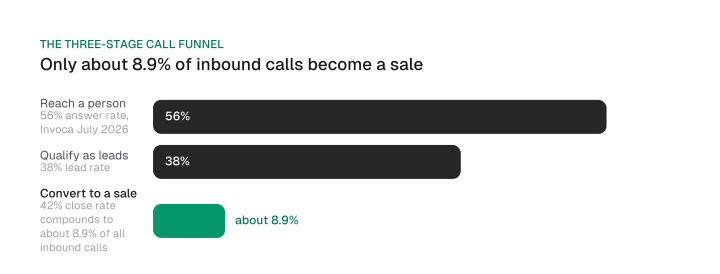
Invoca's own 2026 cross-industry report, drawn from 70M+ calls and 600M+ conversation minutes across 10 industries and published in July 2026, shows different numbers. 56% of callers speak with a person. 38% of calls from digital marketing are leads. 42% of those leads convert on the call.
The repeated version doesn't just round differently. It collapses three separate funnel stages, answered, qualified and closed, into one blended figure and assigns the wrong percentage to each.
Every benchmark here, the three corrected numbers above and the channel comparison later on, comes from that one Invoca report. It's the largest named report in this space, and still a single call-tracking vendor's own report.
Treat each number as the best available benchmark from one dated report rather than several vendors independently converging on the same figure.
How to calculate your call conversion rate (as three stages, not one)
Call conversion rate breaks into three multiplied factors: the calls answered, the calls that qualify as leads, and the leads that close on the call, all expressed as a percentage. Each factor isolates a different, separately fixable problem:
- Answer rate: calls answered divided by calls received.
- Lead rate: calls qualified as leads divided by calls answered.
- On-call close rate: calls that convert on the call divided by leads.
Multiply the three together with Invoca's July 2026 cross-industry numbers and about 8.9% of all inbound calls a business receives end in a sale: 56% get answered, 38% of those become leads, and 42% of those leads close on the call. That's a real, dated number, built from Invoca's own reported rates rather than an illustrative example.
That calculation rests on the base of each number. Invoca's 38% has to be a share of answered calls, and its 42% a share of those leads, for the three to compound into 8.9% of all calls.
Invoca's own chart labels confirm both bases: phone lead rate is the percentage of answered calls that are leads, and phone conversion is the percentage of leads that convert on the call. Treat 8.9% as a well-supported estimate, not an audited figure.
And note what those three numbers aren't: three independent studies agreeing with each other; they're three metrics pulled from the same dated Invoca report. That confirms the report is internally consistent, not that three separate vendors measured the same thing and landed in the same place.
Call-to-booking rate is the same formula under a different name. Appointment-based businesses, home services, medical practices, high-ticket sales, track it as the share of answered calls that end with a booked appointment instead of a closed sale. The math is identical to on-call close rate, just with "booking" as the finish line.
None of this three-stage math works without call tracking: assigning a unique, trackable number to each marketing channel or campaign so a call can be attributed back to the ad, keyword or page that generated it. Dynamic number insertion swaps the visible number per visitor, so even organic and paid traffic from the same page get separated.
Feed that attribution into your ad platform and CRM and the loop closes. Google Ads and Meta can optimize bidding toward calls that actually became leads instead of calls that merely connected. Your CRM can log a call's stage-by-stage path next to the deal record.
Once you can see conversion by channel, that number feeds straight into other calculations. Calculating SEO ROI for a channel starts with exactly this figure: multiply organic call volume by the on-call close rate for a realistic revenue estimate instead of a raw lead count.
SEO forecasting turns a conversion rate into a revenue range the same way, projecting future call volume through the same three-stage math to model what a traffic increase is actually worth.
Diagnosing your bottleneck: a three-stage scorecard
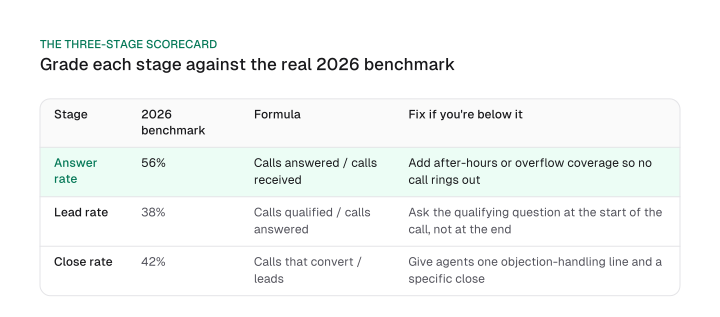
A call conversion diagnostic grades your answer rate, lead rate and on-call close rate against the corrected 2026 benchmarks, then names the one fix that moves the number most for whichever stage falls furthest below its benchmark:
- Answer rate, benchmark 56%. If yours is lower, add after-hours or overflow coverage, a live answering service or an AI receptionist, so a ringing phone never becomes a missed one. Missed-call text-back, the simplest form of missed call recovery, texts every caller nobody picked up for, right away, with a booking link or a number to call back. It recovers some of what a missed call would otherwise lose outright.
- Lead rate, benchmark 38%. If yours is lower, the start of the call is usually the problem. Agents spend it on pleasantries instead of asking the one qualifying question, budget, timeline, decision-maker, or whatever your business actually needs to know, that determines whether this caller is worth pursuing.
- On-call close rate, benchmark 42%. If yours is lower, agents are handling objections by deflecting them to a follow-up instead of closing on the spot. Give them one scripted objection-handling line and a specific ask; the next section shows what that looks like.
Fix the worst-graded stage first. Answer rate usually deserves the first look. It's the only one of the three where a miss is a guaranteed zero: a call that never gets answered can't become a lead no matter how good your close rate is.
getnextphone.com and kanect.in both make this same "find the biggest leak first" argument. What changes here is what you're grading against: Invoca's actual 2026 numbers, rather than either site's own unsourced tiers.
One more thing worth checking before you grade a call as "qualified" at all: very short calls, ones that end before an agent could realistically have qualified the caller, usually aren't real conversations.
Set that cutoff against your own agents' shortest genuine qualifying call. The right threshold varies by business, and a vendor default isn't tuned to it.
If the leak you're diagnosing isn't on the phone at all, a broken checkout or cart abandonment somewhere else in the funnel, that's a different diagnosis than this one.
Call scripts that qualify and close
A qualifying call script for a demo-booking business needs one opening line, one qualifying question, one objection-handling line and a specific, calendar-based ask, structured differently from a home-services dispatch call.
The common worked example for this kind of script is a home-services call, a plumber or an HVAC tech booking a same-day job. A B2B SaaS demo-booking call needs a different structure end to end:
- Opening line: "Thanks for calling [Company], this is [Name]. Are you looking into [product category] for your team, or did you have a specific question?"
- Qualifying question: "Before I get you booked in, can you tell me roughly how many people would be using this, and whether you're the one who'd sign off on it?" This replaces the "is this an emergency?" question a dispatch script asks. Budget, timeline and decision-maker are what actually predict whether a demo turns into a deal.
- Objection-handling line: if the caller says they're "just looking," respond with: "That's exactly what the demo is for. No pressure to buy, just a chance to see if it fits before you decide anything." Name the objection back to the caller, then remove the cost of finding out.
- The ask: "I've got a slot Thursday at 2pm or Friday at 10am, do either of those work?" A calendar link sent immediately after the call beats "I'll follow up," which is a same-day dispatch close borrowed into a script that doesn't need same-day urgency.
These call scripts generalize past this one example: build the qualifying question from what actually predicts a good deal for your business, budget and authority for B2B, urgency and property type for home services, rather than copying a generic "how can I help you today?"
Does the referral channel change how a call converts?
Calls referred by ChatGPT convert to leads at a measurably higher rate than the all-channel average, while call volume from AI answer engines is still small next to paid search and Google Business Profile.
Invoca's July 2026 report found that 49% of answered calls referred by ChatGPT are leads, roughly 10 percentage points above the 38% all-channel average. Calls referred by Google Business Profile convert to leads at 43%, also above average but by a smaller margin.
Treat the finding as an early signal on lead quality. Invoca's July 2026 report doesn't give an exact number for how much traffic ChatGPT sends, but it does say total call volume from generative AI search is still very low, with no measurable volume from LLMs other than ChatGPT.
The practical read: if a channel-level view shows AI-referred calls converting better, that's a reason to make sure your business is easy for an AI answer engine to find and cite, not only easy to find in a Google Ads auction.
Mission Growth's platform tracks AI citations and visibility for customers.
Tracking that split is worth doing on its own, before it shows up in your call data. AI search visibility KPIs covers what to track there beyond call conversion.
The stage-by-stage diagnosis holds regardless of channel: separate what gets answered, what qualifies, and what closes, then grade each against Invoca's 2026 numbers instead of an invented tier, and fix the worst one first. Pull your own three numbers this week, run them through the scorecard above, and fix whichever stage falls furthest below benchmark before spending another dollar on more traffic.
Frequently asked questions
What is the difference between call conversion rate and close rate?
Call conversion rate measures the full span from calls received to sales. Close rate measures a narrower slice: only the leads that already qualify. Using Invoca's 2026 figures, closing on the call converts 42% of those leads, while the roughly 8.9% cross-industry figure accounts for every inbound call, including the ones that never get answered.
Does call tracking actually improve conversion, or just measurement?
Call tracking alone doesn't move your conversion rate. It generates the attribution data, which channel and campaign a call came from, that makes the three-stage diagnostic above possible. The rate improves when you act on what tracking shows.
What is the difference between CVR and CTR?
They measure different things: CTR is the share of impressions that get clicked, and CVR is the share of visits or calls that convert. Our guide to SEO KPIs defines how each is calculated.
Is a certain call conversion rate good?
It depends which of the three stages that number describes. A figure near Invoca's 56% benchmark is healthy for calls answered, but the same number would be low for on-call close rate, where 42% is the 2026 benchmark. Run any single percentage through the three-stage breakdown above before you grade it.
Figures and images in this post are free to reuse under CC BY 4.0 with credit to Mission Growth.
Get Mission Growth highlighted in your Google results.