Lifecycle Email Marketing: A Guide With Benchmarks
Learn the lifecycle email marketing stages, triggers and metrics that actually move revenue, with a worked sequence template you can build from today.
On this page
You've read three guides to lifecycle email marketing this week, and they don't agree. One counts 4 stages, one counts 5, one counts 8. One says urgency converts; another says it backfires. None tells you which model to actually build against.
That disagreement isn't sloppiness. Guides disagree on customer lifecycle stages because each one is modeling something different: a generic marketing funnel, a detailed buying decision funnel, or the actual email sequence that fires on real triggers. Only one of those maps to a send you can build this week.
In this guide:
- The one stage model that maps to real triggers, not funnel theory
- Why triggered email earns a disproportionate share of revenue, and by how much
- A worked sequence of five emails you can copy into your own lifecycle email campaigns, trigger by trigger
- The single metric that proves each stage is working, with 2024-2025 benchmarks
What lifecycle email marketing is, and which stage model to use
Lifecycle email marketing is email triggered by where a specific customer sits in their relationship with your product: a signup, a first login, 30 days of silence. Guides disagree on how many stages that relationship has because each one is modeling something different.
The table below places the three models side by side.
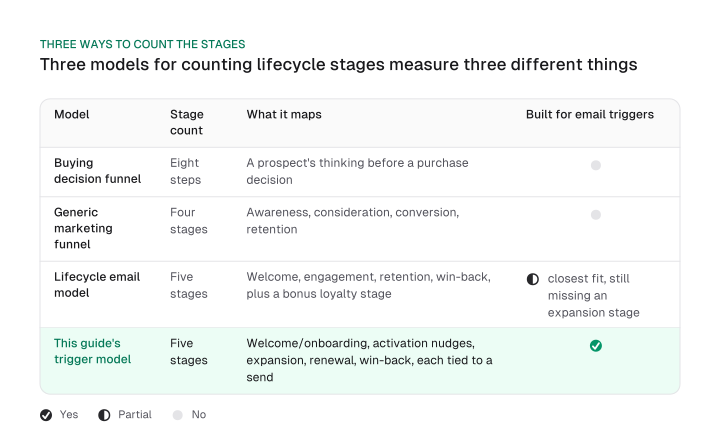
Only one of the three ties directly to a send.
The version with eight steps breaks the whole relationship, awareness through advocacy, into decision-stage granularity; the version with four stages (awareness, consideration, conversion, retention) is broad enough to fit a billboard campaign. Build against the fifth model instead: welcome and onboarding, activation nudges, expansion, renewal, and win-back, each one tied to a trigger you can point to in your product data.
Two of those stages hand off to other posts. Activation nudges line up with what user activation calls the activation event, the first action that predicts a paying customer; that post owns the metric, this one just names the emails that push a signup toward it. Expansion timing follows time to value: a slow time to value pushes back the first email that can credibly ask for an upgrade.
Why lifecycle email marketing outperforms broadcast sends
Lifecycle email marketing outperforms broadcast sends because a triggered email reaches someone the moment an action makes sense. The revenue data behind that edge is Omnisend's own, dated and specific.
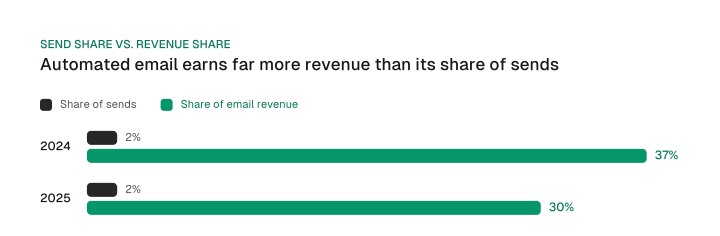
Full-year 2023 automated email already beat the average: a 42.1% open rate, a 5.4% click rate and a 1.9% conversion rate, per Omnisend's statistics report. By 2024, automated sends made up just 2% of total email volume but drove 37% of all email-generated sales, an 18.5x revenue-per-send multiple by our own math (37 divided by 2).
Omnisend's 2025 figures narrow that gap: 30% of revenue from the same 2% of sends, a multiple the company states directly as 16x more per send than a scheduled campaign.
Google's AI Overview for this search overstates the automated share of email revenue. Omnisend's own dated numbers land far lower, and moving lower still: 37% in 2024, 30% in 2025.
Automated email's edge shows up per message too. In 2025 it earned a 38% open rate and $2.87 per email sent, against $0.18 for a scheduled campaign, per Omnisend.
Segmentation decides who a trigger fires for: the same signup event means something different for a free-tier signup than an enterprise buyer, and sending the same email to both throws away the targeting a trigger is supposed to buy.
A lifecycle sequence's real payoff is the lifetime value it protects across a subscription. The LTV:CAC calculator turns your own retention numbers into that figure.
Building your first lifecycle sequence: triggers, timing and a worked example
A lifecycle sequence starts from one trigger: a signup, a first action, or a fixed number of inactive days. From there it maps 3 to 5 emails to that trigger, each with its own timing and one goal. The onboarding emails carry the most weight early, since a slow start costs every stage after it.
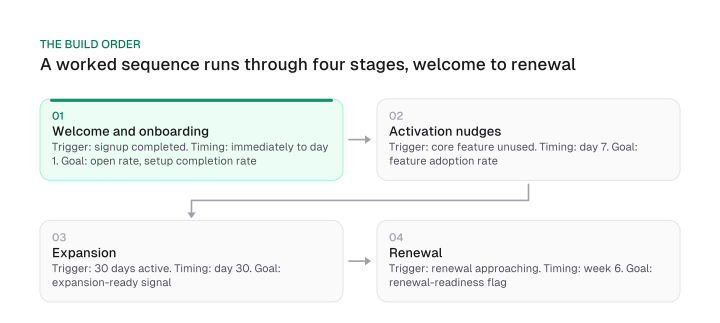
Klaviyo's own advice for building a single flow is to map the trigger, the timing and the message together, spacing each step further out than the last. That principle is right. It's also built for one flow. Here's the same discipline extended across a full B2B onboarding-to-expansion sequence, four stages deep, with one goal metric attached to each email.
This build order works on any ESP:
- Pick one trigger. A signup, a plan upgrade, an inactivity window. Not a calendar date.
- Set the timing. Hours for a purchase decision, days for a B2B evaluation.
- Write to one goal. Each email earns its place by moving one metric, never a general "stay in touch."
- Add the next email only when the first one is live. Five emails, built and shipped, beat eight emails still sitting in drafts.
The table below is a worked version of that order for a B2B SaaS signup.
| Trigger | Timing | Goal metric | Subject-line idea | |
|---|---|---|---|---|
| Welcome | Signup completed | Immediately | Open rate (proof the account is live) | "You're in. Here's your first move." |
| Setup nudge | Signup completed, key setup step still undone | Day 1 | Setup completion rate | "One thing left before this works for you" |
| Feature-adoption check | Setup complete, core feature unused | Day 7 | Feature adoption rate | "Most teams try this by day 7" |
| Value recap / expansion nudge | 30 days active | Day 30 | Expansion-ready signal (usage past plan limit) | "Your first month, by the numbers" |
| Renewal-readiness check | About six weeks active, renewal approaching | Week 6 | Renewal-readiness flag | "How's it going so far?" |
The trigger names for the expansion and renewal emails above are the same ones this guide defines in its stage model. User activation and time to value own the benchmarks behind those triggers; this table only tracks the goal metric.
Sequencing which email fires next is marketing automation: a fixed set of rules, decided in advance. That's a different problem from ai agents in marketing, software that chooses a novel action per customer in the moment. Once the trigger and timing are set, the copy still has to land with whoever's actually reading it; b2b copywriting covers the subject-line and body choices that make a buying committee open and act.
The lifecycle stages, stage by stage: what to send, when, and the urgency question
Each of the five stages needs a different email, a different trigger window, and its own answer on urgency. The guides that disagree on urgency are both right, just for a different deal size.
Here's what each stage sends, and why:
- Welcome and onboarding. Fires on signup. Job: first proof the account works, plus the one setup step that unblocks everything after it.
- Activation nudges. Fires when a key action is still undone days after signup. Job: get the account to the activation event before interest cools.
- Expansion. Fires on usage that crosses a plan limit or a feature gate. Job: put the upgrade in front of someone who's already hit the ceiling.
- Renewal. Fires as a contract or subscription date approaches. Job: surface a retention risk before it becomes a cancellation.
- Win-back. This stage sends the win back email once a customer has gone dormant or already churned, and it can lean into urgency the way a cart-abandonment reminder does, since the customer already showed intent once. Keep it distinct from two other emails: churn reduction's dunning email, which fires on a failed payment, and cancellation flow's in-flow save offer, which fires while someone is actively canceling.
Here's the rule that reconciles the urgency disagreement: Pipedrive warns against urgency broadly, calling it a technique to avoid because it risks buyer's remorse on considered, expensive purchases. Litmus takes the opposite stance, recommending urgency at the conversion stage because it "can work wonders."
The difference is deal size. If you're selling a cheap, fast purchase, urgency helps: a cart-abandonment reminder or an expiring trial nudges a decision the customer already made. If you're selling an annual B2B contract, the same countdown backfires. It reads as manipulative on a purchase this considered, exactly the case Pipedrive is warning about, and invites the second-guessing that kills the deal.
Measuring lifecycle email success: the one metric each stage needs
Lifecycle email success is measured stage by stage. A blended open rate hides exactly which stage is failing.
The gap is real: Litmus's 2024 survey of nearly 1,000 marketers found 44% already run triggered sends across the activation, engagement and retention stages, yet 34% say retention isn't treated as an important KPI, the exact metric a blended number hides.
| Stage | Primary metric | Benchmark for context | What a miss means |
|---|---|---|---|
| Welcome/onboarding | Onboarding completion rate | Welcome is one of the top three automation types by order share, per Omnisend, alongside abandoned cart and browse abandonment | A low completion rate points to a blocked setup step in the product itself |
| Activation nudges | Feature-adoption rate | See user activation for the activation-event benchmark this nudge is built to hit | A flat rate after the nudge means the trigger fired on the wrong signal |
| Expansion | Expansion-ready signal rate | See time to value for how fast an account should reach this point | A stalled rate usually traces back to a slow time to value |
| Renewal | Retention-risk flag rate | 34% of marketers say retention isn't treated as an important KPI, per Litmus's 2024 survey | An untracked flag rate here means renewal risk goes undetected until cancellation |
| Win-back | Reactivation rate | For context: back-in-stock, the single highest-converting automation type overall, runs at 6.46% per Omnisend; a dormant win-back account starts colder than that | A reactivation rate near zero for several cycles is a sign to move the account into a different program |
Download CSV (CC BY 4.0)
Put together, these five metrics replace one blended open rate with five decisions: which stage to fix, and how you'll know it's fixed. The renewal-readiness flag above measures whether a single account is on track; measuring whole signup cohorts against each other is a different exercise, covered in cohort analysis.
Three models for counting lifecycle stages disagree because they answer three different questions. Only the trigger model built around five stages answers the one that matters for email: what should send, and when.
If you build one thing this week, build the welcome email and day-1 setup nudge from the worked sequence above. It's the cheapest pair of the five to ship, and every later stage depends on it working.
Frequently asked questions
What's the difference between lifecycle marketing and growth marketing?
Growth marketing is the strategy layer spanning every channel and stage of a customer's life, from acquisition ads to pricing tests. Lifecycle email marketing is one execution channel inside it, specifically the retention and expansion stages. See growth marketing for the fuller definition.
Is CRM the same as lifecycle marketing?
No. A CRM stores the data a trigger needs, like a signup date or a plan tier. Lifecycle automation, often called lifecycle marketing, is the layer that reads that data and fires the email when a condition is met, for example when a plan-tier field changes from trial to paid.
Is email marketing still relevant in 2026?
Yes, specifically the automated share. Automated sends earned 30% of all email revenue in 2025 despite being just 2% of send volume, per Omnisend, down slightly from 37% in 2024 but still far ahead of their share of sends. Broadcast newsletters may be losing ground; lifecycle sends keep earning outsized revenue.
Can you give me an example of lifecycle marketing?
The clearest example is a full sequence: the five emails in the build section above run from a welcome message through a renewal readiness check around week 6, with a trigger, a timing and one goal metric for each step.
If you can only build one lifecycle email this quarter, which one?
Start with welcome. Abandoned cart, welcome and browse abandonment are the top three automation types by order share, 87% of all automated orders, per Omnisend. Build welcome first: every other lifecycle email in the worked sequence above assumes it already exists.
How many stages does the customer lifecycle actually have?
It depends which model you're reading. Buying-decision funnels count 8 steps, generic marketing funnels count 4, and lifecycle email guides land on 5. This guide uses 5, tied to actual send triggers: welcome/onboarding, activation nudges, expansion, renewal and win-back.
Figures and images in this post are free to reuse under CC BY 4.0 with credit to Mission Growth.
Get Mission Growth highlighted in your Google results.