
What Is Growth Marketing? Strategy, Team and Examples
Growth marketing is a full-funnel, experiment-driven discipline. See how it differs from performance marketing, and how to build a program that fits your team.

On this page
Growth marketing shows up in every job posting and every "what should we do next" meeting, and it rarely means the same thing twice. What it actually names is a full-funnel, experiment-driven operating model that a cross-functional team runs across acquisition, activation, retention, revenue and referral, not a single channel or a job description you hire for on its own.
People searching what is growth marketing are usually checking whether this is a rebrand of work they already do. The definition below settles that, and the sections after it cover whether your team is ready to run the model yet.
In this guide:
- The definition, including where the term's own history gets misquoted.
- How growth marketing differs from traditional, digital and performance marketing, in one table.
- The four growth-strategy pillars, and which two to build before the other two.
- What a growth marketing team looks like, and the one structural reason "embrace failure" actually works.
- A concrete readiness check before you build a team around any of it.
What is growth marketing?
Growth marketing is a full-funnel, experiment-driven discipline. It connects every marketing action to acquisition, activation, retention, revenue and referral outcomes.
It names an operating model that a cross-functional team runs, rather than a single channel or a job title you post on a hiring board.
A few reasons that distinction matters:
- Ties every dollar spent to the customer's lifetime value across the whole funnel, beyond the first click.
- Surfaces exactly where the funnel leaks. It reads real behavior data instead of relying on guesswork from top-line traffic.
- Builds an in-house testing habit that compounds release over release, rather than resetting with every new campaign.
The term has a contested history worth knowing before you adopt it.
Sean Ellis coined "growth hacker" in 2010, defining the role as "a person whose true north is growth. Everything they do is scrutinized by its potential impact on scalable growth."
A decade later, in 2020, Ellis drew a sharper line between the two terms he'd shaped: growth marketing "is a synonym for performance marketing" focused on the top of the funnel, while growth hacking "extends beyond the top of the funnel to include all of the levers of growth."
The common description turns growth marketing into growth hacking's more disciplined, matured successor.
Ellis's own words reverse that story: the term is the narrower one, confined to the top of the funnel, while growth hacking is the broader one that covers every lever.
Both readings can't be right at once. This guide uses the term the way most practitioners now apply it: the full-funnel operating model, whichever side of Ellis's own distinction it started on.
How growth marketing differs from traditional, digital and performance marketing
Growth marketing differs from traditional, digital and performance marketing by tracking a lead's full lifecycle value, instead of optimizing one channel or one campaign metric in isolation.
This shows up most as growth marketing vs performance marketing, since the two get used interchangeably far more than the others.
Traditional marketing runs mass-channel brand campaigns: TV, print, out-of-home. It's measured by reach and awareness over a long, campaign-based horizon, with work siloed by channel or agency.
Digital marketing keeps that same siloed, campaign-based structure, but moves it onto online channels: search, social, email and display. It's tracked by channel-level engagement over campaign or always-on time horizons.
Performance marketing narrows further to paid acquisition channels bought and optimized for a direct response. Specialists inside one paid channel drive toward cost per lead or cost per click in the near term.
Growth marketing spans every funnel stage, from acquisition to referral, on a continuous, compounding time horizon, run by a cross-functional, sprint-based team. It targets an evaluation criterion that weighs downstream signals, rather than a single local metric optimized on its own.
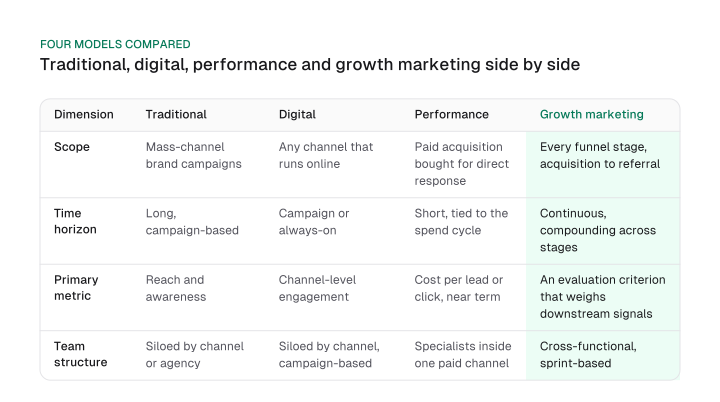
Scope and metric get compared often enough. Time horizon and team structure rarely do, and seeing all four together is what separates the terms cleanly.
The distinction from performance marketing has a concrete mechanism behind it. Ron Kohavi's 2017 presentation on controlled experiments describes a parallel case from experimentation practice, not a growth marketing one: at Bing, "queries per user" looks like a good engagement metric.
It can rise for the wrong reason: when search results get worse, people are forced to search again, and the count climbs without any real growth in demand.
That's why Bing's own evaluation is long-term query share and long-term revenue, tracked through "sessions per user" rather than that misleading count.
The same logic applies to Ellis's contested claim above: if growth marketing were only performance marketing under a new name, it would optimize the same near-term, channel-level numbers.
Judged by Kohavi's mechanism, the two point in different directions: one metric in isolation, versus a criterion built to catch when that metric is lying to you.
The four growth-strategy pillars, and which to build first
The four growth-strategy pillars are full-funnel optimization, high-tempo experimentation, product-led growth and a content-and-community engine.
A resource-constrained team should build the first two before the other two.
Full-funnel optimization and high-tempo experimentation both need only measurement across the funnel and a testing habit already in place.
So they come first. The four pillars are consulting firm Simon-Kucher's breakdown; the build order is ours, since Simon-Kucher lists them side by side.
Product-led growth "requires a deep organizational shift, demanding tight alignment between product, engineering, and marketing," so it waits until that alignment exists.
A content and community engine "can generate organic traffic for years, unlike an ad, which stops working the moment you stop paying for it." That payoff compounds across years rather than weeks, so it comes last for a team that needs traction now.
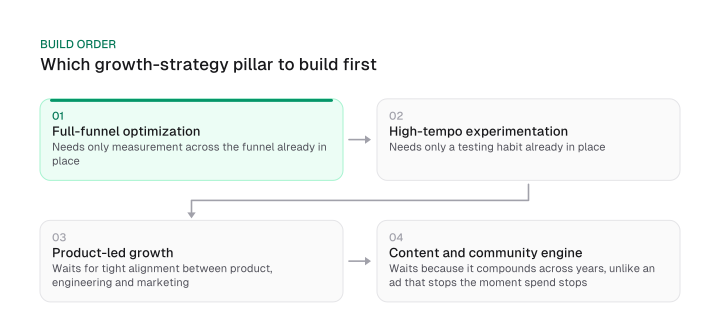
Full-funnel optimization runs on the AARRR framework, sequencing acquisition, activation, retention, revenue and referral.
Once it's running, automation decides what stays human in the review; the split is covered in growth experiment cadence.
High-tempo experimentation shows up as a few concrete practices:
- A/B testing across the funnel on a fixed cadence.
- Referral loops, measured by the viral coefficient and expanded in referral program.
- Cross-channel campaigns coordinated around one shared experiment backlog.
- Structured customer feedback that feeds the next round of hypotheses.
On the acquisition side specifically, growth teams run channels like B2B SEO alongside paid and lifecycle work, all measured against the same evaluation criterion described above.
On the revenue side, measuring content ROI ties that same funnel discipline to a dollar figure.
The metrics behind all of this are CAC, LTV, ARPU, churn rate and the K-factor. Picking the single number that guides the whole team is covered in choosing your north star metric, and growth loops covers how those loops compound.
What a growth marketing team does
A growth marketing team is cross-functional and sprint-based, and it runs prioritized experiments together.
It only compounds long-term when a failed test is structurally safe to report.
The roles are specific: a growth lead or product manager, T-shaped channel specialists, a data analyst, and embedded engineers and designers, working in two-to-four-week sprints.
That's a different structure from a traditional marketing team, which is typically organized by channel or campaign. It reports up through separate approval chains, rather than running as one sprint-based unit.
Growth teams hear "embrace failure as learning" as generic advice all the time. Few ever say why it actually works.
Amy Edmondson's 1999 study of 51 work teams at one manufacturing company found that team psychological safety was the strongest predictor of whether people reported errors and kept experimenting. It mattered more than team confidence or efficacy.
Learning behavior, meaning asking for help, discussing errors and experimenting, mediated the link to team performance.
Applied to a growth team, the implication is structural: separate the "this experiment failed" conversation from performance review.
Use a named, blame-free format for the weekly or monthly retro, or the hypothesis backlog quietly narrows to only the safe bets.
Some of that specialist capacity now runs through AI marketing agents embedded directly in the sprint.
They handle analysis or draft experiments, so human specialists spend their time on judgment calls instead.
Edmondson's finding is bounded: 51 teams, one manufacturing company, 1999, correlational, from a context that predates digital marketing entirely.
Treat it as the reason for the structure, rather than proof that any specific retro format works everywhere.
Once a growth team is running, most of its retention work routes through four specific practices. Reading retention curves over time is cohort analysis. Scoring which users are about to leave is predicting churn. Running the interventions that keep them is reducing churn. Defining the moment a new user gets real value is user activation.
How to build a growth marketing strategy
Building a growth marketing strategy means auditing the funnel, picking one metric, setting a cadence, and confirming readiness.
Four steps get you there:
- Audit the funnel stage by stage. Map acquisition, activation, retention, revenue and referral against real, measured numbers. SaaS SEO strategy is often the acquisition channel already producing traffic to test against.
- Pick one guiding metric. Choosing your north star metric decides which experiments get priority when two ideas compete for the same sprint.
- Set a fixed experiment cadence. Growth experiment cadence's own published traffic tiers apply here: fewer, longer tests under 10,000 monthly visits, a minimum detectable effect of 15% or more, and a 4-6 week minimum duration.
- Confirm the business is ready. Use the check below as the floor before building anything bigger.
If you'd rather have that audit and cadence run for you than build it in-house, Mission Growth is an AI-led SEO and GEO growth service: AI catches the signal, our experts make the move, and you see the result.
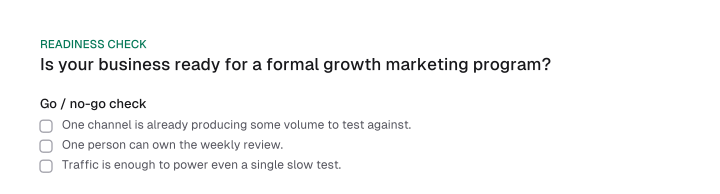
The rule is a go/no-go, not a maturity score: a small business is ready for a formal program only when all three hold at once. One channel already needs to produce some volume to test against. One person needs to own the weekly review. Traffic needs to be enough to power even a single slow test, per growth experiment cadence's own tiers for teams under 10,000 monthly visits.
Miss any one of the three, and growth marketing stays informal until that gap gets fixed.
Once the funnel audit is done, turning it into a full quantitative model is a separate step, covered in building a growth model.
Shortening time to value speeds up every stage downstream of activation.
Growth marketing in practice: real examples
Growth marketing in practice looks like a sustained, cadenced program, rather than a single campaign, shown by Mission Growth's own results across a 5-month and a 6-month client engagement.
For growth marketing examples that hold up under scrutiny, both are dated, checkable, and framed as organic-search results rather than an unattributed anecdote.
MyPhotoStation, a US wall-decor brand, grew organic revenue 5x in 5 months running a full-funnel growth marketing program.
Pozitif Teknoloji, a Turkish brand, gained +225,000 organic clicks in 6 months running the same kind of program.
Read that as a single total, and the obvious next step is to divide it out: 225,000 clicks over 6 months averages to about 37,500 clicks a month.
That average is useful for planning, but growth compounds instead of arriving in equal monthly slices. An early month in a run like this typically looks slower than a later one, even inside the same 6-month window.
Put together, these two engagements make the same point as the definition at the top of this guide.
Growth marketing pays off as a sustained operating model, run consistently across acquisition, activation, retention, revenue and referral, rather than as a single campaign or a job title on an org chart.
The next step is concrete: pick one guiding metric, run the readiness check above, and set your first experiment cadence before you hire anyone.
Frequently asked questions
How does growth marketing influence a brand, and does it dilute it?
Growth marketing measures trust the way it measures everything else: through actual customer behavior. Built on customer-obsessed, relevance-driven experiments rather than blanket campaigns, it builds brand trust incrementally, through the same tested, personalized experiences that drive the rest of the funnel.
How does growth marketing influence demand generation?
Growth marketing extends demand generation's job past the handoff to sales. It holds the program accountable for how many leads turn into real sales opportunities and how quickly deals move afterward, alongside raw top-of-funnel volume. A program judged only on lead count can still lose money right after that handoff.
What are the key metrics that matter most in growth marketing?
The core numbers are CAC, LTV, ARPU, churn rate, activation rate and the K-factor. Each maps to one funnel stage. Picking the single number that guides the whole team is a separate decision from simply tracking all of them at once.
Do I need a dedicated growth team to do growth marketing?
No. The readiness check above is the floor: a single owner and one channel already producing volume are enough to start running experiments. A full cross-functional team becomes worth building once that owner is managing more tests than one person can review in a week.
Figures and images in this post are free to reuse under CC BY 4.0 with credit to Mission Growth.
Get Mission Growth highlighted in your Google results.