
Local SEO for AI Search: How Google Ranks You Differently
Local SEO for AI search runs on off-site signals, not just Google's GBP-driven local pack. See Whitespark's 2026 factor rankings across your locations.

On this page
Your best-ranked location in Google's local pack can be invisible in an AI answer for the same search. Local SEO for AI search runs on a different set of signals entirely.
Whitespark's 2026 Local Search Ranking Factors survey measured that split directly. It scored Google's local pack and AI search visibility separately, and it used the same contributor panel for both.
How AI ranks local businesses differs sharply from Google's map pack, and that gap is the first budgeting decision for a brand running many locations.
A single Google Business Profile program was built to win the map pack. It was never built to win AI search visibility.
In this guide:
- How Google's local pack and AI search visibility rank the same location on different signals
- Which Google Business Profile work still earns its budget, and which doesn't
- The off-site program and technical fixes that earn AI visibility everywhere you operate
- How to write local pages AI systems can actually cite
- A manual way to check AI visibility across your markets before buying a tool
Local SEO for AI search: how Google ranks you differently
Google's local pack ranks each location almost entirely on that location's own Google Business Profile and proximity.
AI search visibility for the same location is decided mostly by independent sources outside your own site.
Whitespark's 2026 Local Search Ranking Factors survey found exactly that split, scoring both rankings with the same contributor panel.
Google's documentation names three local-pack factors: relevance, distance and prominence.
Relevance is how well a profile matches the search. Distance is how far away the business is. Prominence is how well-known it is.
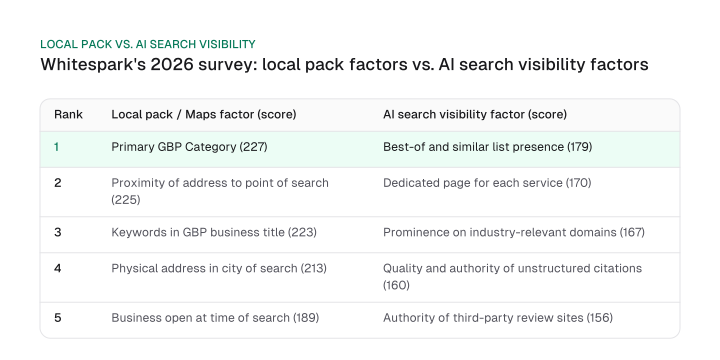
Whitespark's survey turns that framework into scored numbers. Primary GBP Category leads the entire local pack and Maps list at 227, the highest score on either list.
The AI search visibility list, scored by the same panel, looks nothing like it.
| Rank | Local pack / Maps factor (score) | AI search visibility factor (score) |
|---|---|---|
| 1 | Primary GBP Category (227) | Best-of and similar list presence (179) |
| 2 | Proximity of address to point of search (225) | Dedicated page for each service (170) |
| 3 | Keywords in GBP business title (223) | Prominence on industry-relevant domains (167) |
| 4 | Physical address in city of search (213) | Quality and authority of unstructured citations (160) |
| 5 | Business open at time of search (189) | Authority of third-party review sites (156) |
Download CSV (CC BY 4.0)
Primary GBP Category, the factor that tops the local-pack list, falls to rank 34 and a score of 112 on this one.
That's entity clarity local SEO in Semrush's own words: entity clarity, relevance and corroboration, credited to Semrush as an earlier, unquantified version of the same split.
For a brand running many locations, that's a budgeting decision. The GBP program that wins the map pack isn't funding AI visibility for the same location.
The off-site mechanics behind that gap, disambiguation, corroboration, knowledge graph presence, are entity-based SEO generally. Its local, multi-location form is the disambiguation problem below: keeping schema and citations consistent across every location's profile.
Get the per-location Google Business Profile work right, at scale
A location's Google Business Profile decides its local pack position almost by itself. A brand running many locations has to keep that profile correct at every one of them, flagship included.
The Google Business Profile AI search question that matters here is which fields still earn the same weight once AI visibility is the target. Four of the top five local-pack factors answer it, all address and profile mechanics you control directly, per location.
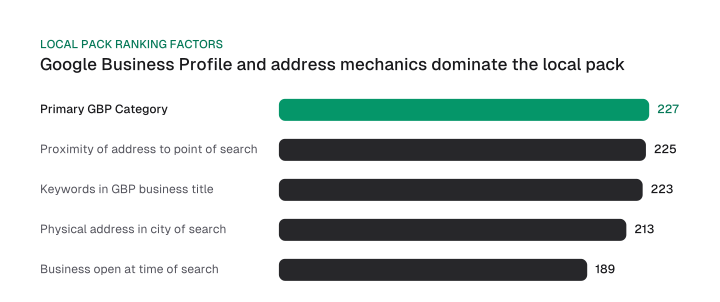
- Primary GBP category (227). Set it to the single most accurate category for what the location sells or does, not the closest match you find scrolling the list.
- Proximity of address to point of search (225). You don't control where a searcher stands, but you do control whether the address is correct down to the suite number, at every location.
- Keywords in the GBP business title (223). Use the location's real, registered name. Google penalizes keyword stuffing in the title field.
- Physical address in the city of search (213). A location's listed city has to match how customers actually search for it, which matters most near a metro boundary.
- Business open at time of search (189). Hours, including holiday hours, kept current across every location, including the ones a manager rarely checks.
One common assumption doesn't hold up against the same data: that posting to GBP frequently keeps a profile fresh and helps it rank. The survey ranks frequency of Google posts and updates 148th on the local pack and Maps list, with a score of 55, against 227 for the top factor.
If your team spends hours a week posting to dozens of GBP profiles for a ranking effect, that budget is better spent on category, address and hours accuracy, or shifted to the off-site program below.
These are Whitespark's contributor panel's scored rankings of perceived importance, a self-reported weight rather than a controlled before-and-after test. Read them as "the survey's contributors rank this factor near the top" rather than "doing this causes a specific gain."
Multi-location local SEO AI search work starts with this profile layer. Off-site proof needs its own budget line, which AI search optimization best practices covers at the platform level: crawlability, answer-first content and the schema decision.
Earn the off-site signals AI visibility rewards, location by location
AI search visibility rewards off-site proof that Google's local pack barely counts. None of it matters if a crawler can't reach the page or the page shows a stale address.
The survey's top AI-search factors are expert best-of-list placement, industry-domain citations and a dedicated page per service. A multi-location brand needs a second budget line for exactly that program, separate from the GBP program covered above.
Two failures silently zero out that work no matter how good it is:
- Crawler access. Darren Shaw, Whitespark's founder, told Search Engine Journal that Cloudflare "often blocks AI crawlers by default" in configurations he has audited. That's his own observation from client audits, not a documented Cloudflare policy, so check your own settings location by location instead of assuming a single default.
- Client-rendered content. Russ Jeffery, Duda's director of platform and product strategy, told Search Engine Journal that ChatGPT "doesn't have their own index" and reads pages at request time. If a location page loads its review carousel or opening hours with JavaScript in the browser, ChatGPT reads the page without them; render that content on the server and it is there on the first fetch.
Stale, duplicate location pages cause the same failure a different way: clones left behind after a redesign or a move, still indexed, still showing an old address. A citation from an industry domain does no good if the page it points to is wrong.
Schema markup's role here is narrower than a ranking lever. On the AI search visibility list, "website content marked up in schema" ranks 44th with a score of 103, a mid-tier practitioner-scored rank, distinct from a measured effect.
Shaw told Search Engine Journal he's never seen a study showing schema lifts rankings or AI visibility, citing a test that found nothing. His own view is that schema's job is disambiguation.
At the scale of many locations, that means keeping each location's LocalBusiness and Service schema synchronized with that location's own GBP fields: category, address, hours. Whether schema markup for AI search moves citations at all, in general, is answered with a causal study there.
Write local proof AI can attach to each location
An AI system can only cite proof it can read as plain text tied to one named location.
Reviews, credentials and pricing need to be written out, named per location, and organized around real customer sub-questions.
Semrush names reviews, alongside NAP and per-service descriptions, among the fields it treats as highest-impact for AI corroboration, and Whitespark's survey ranks review-site authority fifth on its AI search visibility list: a review counts less as a star rating than as text an AI system can read and cite.
Shaw described using Mark Williams-Cook's queryfan.com tool this way: a single customer prompt becomes roughly 10 sub-searches an AI system runs to answer it. Those sub-searches make the page's FAQ list.
Run the real question, does this location do same-day tank repair, through the tool. Build that location's FAQ from what it fans out into rather than from keyword guesses.
The second practice is naming the location instead of writing "we." Shaw called this "a hard yes" for the passages that matter most.
His example: "Johnson Plumbing Denver are experts at hot water tank repair," instead of "we are experts." Name each location by its full registered name in its pricing, differentiators and ratings copy.
Jeffery raised the readability cost of overdoing this. Reserve explicit naming for the passages an AI system needs to attribute correctly, and let ordinary sentences read normally.
An AI system also reads a page's numbers literally. A local business AI Overview citation will repeat an inflated review count exactly as written, so keep the real number and update it when it changes.
Check AI visibility across every location, not one
To track AI visibility for a local business, start with a manual spot-check before paying for a tool. Run the customer question a location actually gets through ChatGPT and through a Google AI Overview search, and note whether your brand, a competitor, or nobody gets named.
AI visibility for local business brands has to be checked market by market. A location's local-pack position doesn't predict what an AI answer names for that market, so headquarters alone tells you little.
Repeat that for a sample spread across your regions, beyond just your flagship city. Semrush's own tracking guidance walks through its paid tool but never suggests this manual check first.
Once the spot-check shows where the gaps are, a dedicated tool makes sense for tracking the full location list. Grid My Business launched a per-location AI visibility feature on September 23, 2026. It scans ChatGPT, Gemini, Google AI Mode and AI Overviews for each location.
That launch signals per-location AI tracking is becoming its own product category. It's not proof of how any one location performs.
Once you pick a tool, AI visibility KPIs covers the metrics worth tracking. For a comparison of the trackers themselves, see AI visibility tools.
What doesn't move the needle
Some claims about AI-era local SEO are unsourced predictions or the survey's own lowest-scored factors. Treating either as fact means spending on the wrong fixes.
A Forbes contributor's predictions of a neighborhood-level Google algorithm and a fixed timetable for AI overtaking Google for local discovery are examples of the first; geo-tagged photos as a ranking lever, one of the survey's own lowest-scored factors, is an example of the second.
Google's own documentation states plainly that no special optimizations exist for AI Overviews or AI Mode beyond standard SEO fundamentals. Its one local-specific line: keep Merchant Center and Business Profile information up to date.
That's a narrower, more useful claim than a prediction about when AI search will take share from Google's local pack. Build the program on that documentation and on Whitespark's own scored data instead.
The survey's own data works as a second correction. Tactics ranked near the bottom of its list, geo-tagged photos among them, separate real ranking weight from busywork.
Frequently asked questions
Can I do local SEO myself, or do I need an agency?
Whether to hire an agency or run this in-house is a resourcing decision. It isn't a ranking-mechanism question. Our separate guide on local SEO pricing across multiple locations covers investment bands to size it.
How much should local SEO cost across multiple locations?
Pricing scales with location count and scope. Our guide on local SEO pricing across multiple locations covers the bands, rather than restating them here.
Does schema markup help AI visibility for a local business?
Not as a documented ranking or citation factor in general. At the scale of many locations, schema's real job is keeping every location's data synchronized with its Google Business Profile fields.
Does this apply to a single-location business too?
Yes, the underlying mechanism is identical at one location: GBP and proximity for the local pack, off-site signals for AI visibility. What changes for a multi-location brand is scale: synchronizing many profiles and budgeting a separate off-site program instead of running it once.
Whitespark's 2026 survey draws a clear line: Google's local pack still runs on your GBP and your address, and AI search visibility for the same location runs on off-site proof the GBP program was never built to earn.
Pick five locations spread across your regions, run each one's real customer question through ChatGPT and an AI Overview search this week, and use what comes back to decide where the off-site program starts.
Figures and images in this post are free to reuse under CC BY 4.0 with credit to Mission Growth.
Get Mission Growth highlighted in your Google results.