
What Is Entity SEO, and How to Build Real Authority
Entity SEO explained: what an entity is, how Google links them, a stage-by-stage authority framework, a worked schema example, and how to report the results.

On this page
You've read a handful of entity SEO guides, and you still don't know what to build first. That's not on you.
Google doesn't rank strings of words anymore. It matches your page to a specific concept it already recognizes, and that concept has to be unambiguous before the match happens.
This guide skips the part you already believe. You'll get the actual disambiguation mechanism, one schema template you can copy today, a decision rule for which signal to build first given your stage, and a way to report the result to someone who only tracks keyword rankings.
In this guide:
- How Google actually recognizes and disambiguates an entity on your page
- Why entities matter more now that AI search reads for meaning, not keywords
- A complete Organization schema template with
@idandsameAs - A decision rule for which entity signal, and which schema type, to build first
- How to measure entity SEO and report it to a CMO who tracks rankings
What is entity SEO, and how is it different from keyword SEO?
Entity SEO makes the real things behind your content, your brand, people, products and topics, identifiable by machines.
That way, search and AI systems match your page to a concept instead of a string of words. So what is an entity in SEO? A specific, disambiguated thing a system can look up, distinct from a keyword you're targeting.
Keywords are still how people ask questions. Entities are how machines answer them, and neither replaces the other:
| Keywords | Entities | |
|---|---|---|
| What it is | A string of words someone types into a search box | A specific, identifiable thing: a brand, person, place or concept |
| What a system matches it to | Text patterns, word forms and close synonyms | A fixed record, ideally with an external identifier like a Wikidata ID |
| How you build the signal | Words in your content, headings and anchor text | Structured data, consistent naming and identifiers across the web |
| What it's good for | Matching how people phrase their questions | Matching what people mean, across phrasing, language and platform |
Entity-based SEO builds directly on keyword research. Once your content targets the right words, entity work makes sure it also identifies the real things those words point to, clearly and consistently.
You'll also see a large, oddly precise Knowledge Graph size figure repeated across many entity SEO guides, with no checkable Google source behind it. This guide uses the numbers Google actually published instead.
At its May 2012 launch, the Google Knowledge Graph described roughly 500 million real-world objects using about 3.5 billion facts. By its May 2020 disclosure, that had grown to roughly 500 billion facts about 5 billion entities, roughly 143x more facts and 10x more entities in eight years.
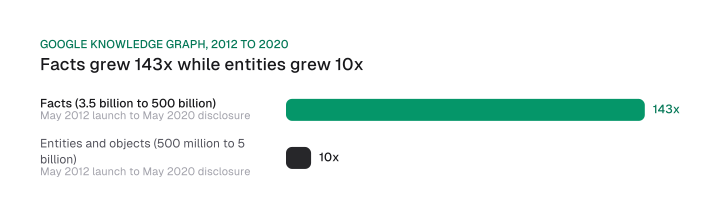
The growth matters less than what it implies. Google's own entity store grew both denser in facts per entity and larger overall between 2012 and 2020, so a page that supplies clean, structured facts about its entities has more to connect to now than it did in 2012.
Entity SEO is the implementable half of what people mean by "semantic SEO." Semantic SEO is the broader discipline of matching meaning rather than exact words; entity work is the concrete, structured-data half of that discipline you can actually build and test.
If you're deciding where AI Overviews fit into that shift, see what AI Overviews mean for SEO.
How Google recognizes and disambiguates an entity on your page
Google identifies an entity on a page through natural-language entity extraction, then disambiguates it by matching it to a known identifier, a Wikidata QID, a Wikipedia article, or your own schema, rather than by counting how often a word appears.
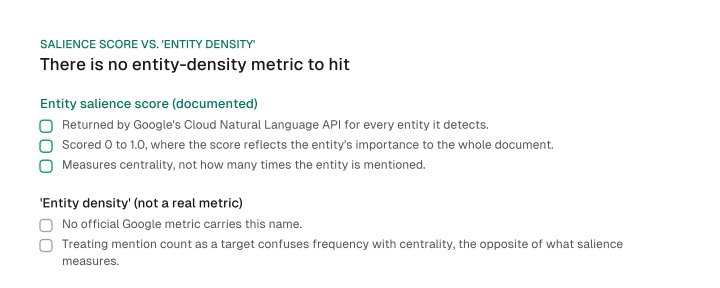
The mechanism is checkable. Google's Cloud Natural Language API returns an entity salience score for every entity it detects in a text: a score from 0 to 1.0 that measures how central that entity is to the whole document rather than how many times it's named.
A brand mentioned once in a page's opening sentence, tied to its category and location, can score higher than the same brand repeated ten times in passing.
Disambiguation itself works by narrowing candidates. A Google patent on contextualizing knowledge panels describes narrowing candidates a different way: it weighs how closely each candidate entity matches the surrounding context terms, how often that entity is searched, and its general importance or popularity, then selects the best-matching candidate.
That's why a page about Apple the company reads differently, and disambiguates differently, from a page about an apple the fruit. The co-occurring entities, products, executives, stock tickers, carry the disambiguating work, more than the word alone.
Once Google narrows to a candidate, the identifier you point to matters. Wikidata's own documentation states that when two items are merged, the retired ID becomes a redirect, not a deletion, and is never reassigned to a different entity: "Redirects are used to provide stable identifiers. They should not be deleted."
That's a concrete, checkable property. It's why a Wikidata QID is a safer target for schema.org's sameAs property than a page title alone: even through a merge, the identifier keeps pointing at the same thing.
A Wikipedia entry or Google Knowledge Panel helps this process along, though it isn't required: it raises the odds that Google resolves your entity correctly on the first pass. Without one, your page still gets a candidate score, just a weaker one, until other signals (schema, consistent naming, third-party mentions) fill the gap covered in the next section.
For how this same disambiguation logic extends to what an LLM associates with your brand, see our llm optimization guide.
Why entities matter more now that AI search reads for meaning, not keywords
AI answer engines assemble responses from entities they already trust, so a brand with clear, consistent entity signals gets pulled into more answers than one with the same content but an ambiguous identity.
An AI system building an answer picks which known entities to cite, not which keywords appear on the page; an entity it can't confidently identify gets skipped.
The urgency argument built into a lot of entity SEO advice, an AI takeover is coming so hurry, rests on stale sentiment data. Fractl surveyed consumers in 2025 and found 82% considered AI search more helpful than traditional search, with 66% expecting AI to replace traditional search within five years.
Fractl re-ran the identical questions in its Q2 2026 survey, 1,008 consumers plus 150 marketers: the helpfulness figure fell 28 points to 54%, while the replacement expectation barely moved, landing at 64%.
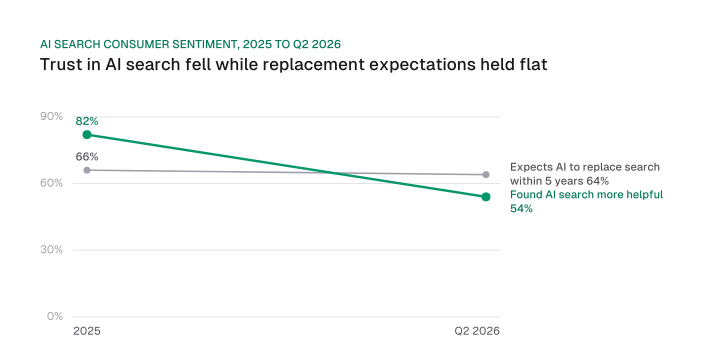
Consumer enthusiasm for AI search cooled within a year. The entities behind your brand didn't get any less real in the meantime. Build entity signals because they're durable infrastructure your content depends on regardless, not because of a sentiment number that already reversed.
Gemini reads the same entity signals when it decides what to cite, and knowing how to get cited by Gemini starts with the disambiguation work covered above.
How to build entity authority: schema markup and a template you can copy
Entity authority comes from schema markup entity SEO relies on: markup that names your entities explicitly, links them to a permanent external identifier, and stays consistent everywhere your brand appears.
Start with your Organization entity first, ahead of your products or people. Every other schema type on your site, Product, Person, LocalBusiness, disambiguates back to it, so an incomplete Organization block undermines everything built on top of it.
One of the clearest entity SEO examples you can build today is a complete Organization block that combines a self-hosted @id with a sameAs array pointing at more than one identifier type.
{
  "@context": "https://schema.org",
  "@type": "Organization",
  "@id": "https://example.com/#organization",
  "name": "Example Company",
  "url": "https://example.com",
  "sameAs": [
    "https://www.wikidata.org/wiki/Q00000000",
    "https://www.linkedin.com/company/example-company/",
    "https://opencorporates.com/companies/us_de/0000000"
  ]
}
The @id gives every other schema block on your site (Product, Person, Article) something stable to point back to. The sameAs array does the disambiguation work described above: a Wikidata QID, which survives a merge as a redirect rather than a deletion, a LinkedIn company page, and a business registry entry, so three independent sources corroborate the same entity.
To make this yours: swap example.com for your own domain in both the URL and the @id, search wikidata.org for your brand to find or request its QID, and replace the LinkedIn and registry links with your own.
Every field in that template does disambiguation work; none of it is optional filler. A version that skips the sameAs array, or points @id at a page instead of a permanent identifier, loses the guarantee the template is built on.
Consistency matters as much as the markup itself. If your business name, address or founding date reads differently across your site, your directory listings and your schema, you're feeding conflicting facts into the same disambiguation process, and Google has no reliable way to pick which version is correct. Keep the name, category and key facts identical across your site, your schema, your social profiles and any directories that list you.
Entity linking ties this together: point internal links that mention the same product, person or location back to one canonical page for that entity, using the entity's own name as anchor text rather than a generic "learn more."
Google reads consistent, name-anchored links as pages that belong to the same entity cluster. Reviewers weighing E-E-A-T credit a site whose internal links point at one clearly identified subject over scattered, ambiguous mentions.
For ecommerce specifically, this isn't a separate playbook. Build the Organization block first, then attach Product schema for each item, pointing its brand property at the same Organization @id rather than repeating brand details on every product page.
Your own machine-readable identity extends past schema. Run your llms.txt file through our free llms.txt checker to confirm AI crawlers can actually read it.
Choosing your first move: the entity and schema priority decision rule
Which entity signal to build first depends on your stage, and within schema implementation, Organization always goes first.
A brand that hasn't reached notability yet gets more from consistent citations and an Organization schema block than from chasing a Knowledge Panel it can't yet earn, or from Product or Person schema with no disambiguated Organization behind it.
| Your stage | Signal to build first | Schema to implement first |
|---|---|---|
| Pre-notability brand (no press, few backlinks) | Consistent name, category and facts across every directory and profile | Organization schema with @id and a minimal sameAs array |
| Small local business | Name, address and phone consistency across every listing | Organization or LocalBusiness schema, @id before location detail |
| Ecommerce store | Organization consistency first, then per-product consistency | Organization schema, then Product schema tied back to its @id |
| Funded, notable brand | A Wikidata entry or Knowledge Panel claim | Organization schema already in place; expand to Person and Product types |
There's a correct order on both axes. On signal priority: consistency and Organization schema come first, third-party citations second, and Wikidata or Knowledge Panel work only once you clear the notability bar those require.
On schema priority: Organization comes before Product, Person or any other type, because every other type disambiguates back to it. Skipping straight to the hardest signal, or shipping Product schema with no Organization @id behind it, is the most common wasted effort here.
A small business without backlinks or press mentions can still compete: it competes at the consistency layer, not the Knowledge Panel layer, until it earns that jump.
The same staged approach applies to chatgpt SEO: ChatGPT leans on the same entity consistency signals before it cites a source with confidence.
Measuring entity SEO, and reporting it to someone who tracks rankings
Entity SEO results show up first in entity-level signals (salience, Knowledge Panel presence, structured-data coverage), and those only become a CMO-readable report once you tie them to the downstream metric leadership already tracks.
| Entity-level signal | What it means | Pair it with this business metric |
|---|---|---|
| Salience score rising for brand or product entities | Google reads your content as more clearly about that entity | Branded and non-branded organic traffic to those pages |
| Knowledge Panel appears or gains detail | Your entity is confidently disambiguated in the Knowledge Graph | Branded search click-through rate and direct traffic |
Structured-data coverage across @id and sameAs | More of your site's identity is machine-readable | Rich-result impressions in Search Console |
| Consistent entity mentions across the web | Third parties reinforce the same facts you state | Referral traffic and mentions inside AI answers |
Report the entity metric and its downstream effect on the same slide, or the report reads as SEO jargon leadership discounts. "Salience improved" means nothing to someone who tracks rankings, or revenue. "Our brand entity is now clearly identified, branded search clicks are trending up because of it, and that traffic is what turns into revenue" does.
Mission Growth's platform tracks AI citations and visibility for customers. Pairing a tool like that with the downstream business metric above turns raw entity signals into a report leadership will actually read.
To connect this to your existing dashboards, see ai search analytics.
Entity SEO tools, entity stacking, and mistakes to avoid
Skip hunting for an "entities generator": the tools worth trusting surface the same signal Google itself exposes, entity presence and salience, rather than a proprietary score you can't verify against anything:
- Google's Rich Results Test. Confirms your JSON-LD actually parses the way you intended before you publish it.
- Search Console's Enhancement reports. Flags structured-data errors across your whole site, catching problems a single-page check would miss.
- The Cloud Natural Language API's entity-analysis demo. Paste in a page and read the real salience scores behind it, the same metric covered earlier in this guide.
- Wikidata's own item search. Confirms whether your brand's QID exists and matches the entity you intend.
For a broader comparison across categories, see AI visibility tools. Tools built around topical authority, Clearscope and similar content-breadth checkers, answer a different question: how thoroughly a topic is covered rather than whether the entities on the page are correctly identified. Useful, just not this guide's job.
"Entity stacking" isn't a separate Google program. It bundles legitimate consistency tactics, schema, citations, third-party mentions, under one label, with no evidence it outperforms doing that underlying work directly. If a tool or guide sells it as a shortcut, verify its claims against Google's own API output rather than the tool's own dashboard.
The most common mistake is building the wrong layer first: chasing a Knowledge Panel before the consistency work that earns one, or bolting Product schema onto a page with no Organization @id behind it.
You now have the actual mechanism, a schema template you can copy today, and a decision rule for what to build first at your stage. Start with your Organization schema, verify it against Google's own API output, and use the priority table above to pick your next move.
Frequently asked questions
No official one exists. The real, documented signal is the salience score, a range from 0 to 1.0 that measures how central an entity is to your content rather than how many times it appears. Optimizing for mention count confuses frequency with centrality.
Yes, at the consistency layer: schema, citations and structured data. The Knowledge Panel and Wikidata layer is the one that requires notability most small brands don't have yet. Start there, using the decision framework above to pick your first move.
Inconsistent descriptions of your entities create the real risk, whatever the source of the content. Keep names, categories and key facts identical across every page, regardless of who wrote the copy.
Nothing gets thrown out. Entity work adds structured identity on top of pages that already target the right topics, extending your existing keyword strategy with the schema, consistency and disambiguation signals covered in this guide.
No, it's the strongest signal but not a precondition. Consistency and schema work come first regardless of whether you qualify for a Knowledge Panel yet; see the decision framework above for what to build while you wait.
There's no published number specific to entity work, so don't expect a separate timeline. It strengthens signals your existing SEO already depends on, and moves at the same pace as your normal content and technical SEO work.
Figures and images in this post are free to reuse under CC BY 4.0 with credit to Mission Growth.
Get Mission Growth highlighted in your Google results.