Off page SEO: checklist, levers and who reads them
What off page SEO is, a beginner checklist, and which systems read links, mentions and reviews: Google ranking, local results and AI answers.
By Furkan AktaşPublished
On this page
Off page SEO is the work of earning trust for your site in places you do not own: other sites, review platforms, listings and the sources AI answers cite. This guide defines it, maps each lever to the system that reads it, flags three tactics Google names as link spam, and ends with a checklist for beginners.
Off page SEO defined: the scope test and the three readers
Off-page SEO is any signal about your site that other parties publish or control, such as links, mentions, reviews and listings, and three systems read it: Google's link systems, Google's local prominence and AI answers.
That is the whole definition, and it matters more than any list of tactics, because the useful question is never "which tactic?" but "who reads the result?".
For anyone asking what is off-page SEO in digital marketing, the scope test is the shortest answer. Ask whether you can change a factor by editing your own pages. If you can, it is on-page or technical SEO. If the signal sits outside your own pages and someone else decides whether it exists, it is off-page.
A backlink fails the test for you, since the linking site controls it. A title tag passes it. A Google review sits with the reviewer, so it is off-page even though you can ask for it.
That puts the topic next to two other branches. On-page SEO covers what you edit on a page, and technical work covers whether crawlers can reach, render and index it; the on-page branch has its own guide on this blog. The third branch is the evidence that you do not control.
Local SEO is sometimes counted as a fourth type. It is better read as a blend, since a Business Profile is a page you manage while the reviews and links that feed it are off-page. So the four types of SEO come down to on-page, off-page, technical and local, and only the first three are separate by the scope test.
Which systems read the evidence
Each of the three readers has its own description in Google's own documentation. Google's ranking-systems guide says it has "various systems that understand how pages link to each other as a way to determine what pages are about and which might be most helpful", and names PageRank among them as one of its core ranking systems.
In the same guide Google says it uses spam detection systems, including SpamBrain, to deal with content and behaviors that violate its spam policies. So links meet two kinds of system: link analysis systems that use them to work out what pages are about, and spam detection systems that deal with the manipulative ones.
Local results run on a different reader. Google's Business Profile help defines prominence as how well known a business is, and says it is partly based on how many websites link to your business and how many reviews you have.
A third reader, AI answers, appears in Google's AI features documentation: to be shown as a supporting link in AI Overviews or AI Mode, a page must be indexed and eligible to be shown with a snippet, and there are no additional technical requirements. A snippet-eligible page is the entire gate on Google's side; what lifts a brand into those answers is a separate question, covered below.
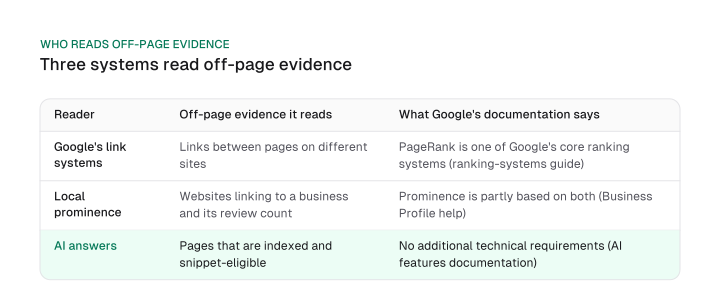
This split is why a single "backlinks versus mentions" argument goes nowhere. Links feed the first reader, links and reviews feed the second, and the third one reads brand visibility across sources. A related idea, how a brand becomes a recognised thing rather than a string of text, is the subject of entity seo.
How off-page SEO impacts rankings
Off-page SEO affects rankings through the first two readers: links through the link analysis systems, and links plus reviews through local prominence. That is as far as Google's documentation goes. It publishes no weight split between on-page and off-page factors, and no current source gives a defensible one. Reviews carry extra rules in finance, covered in SEC and FINRA rules on testimonials.
The percentages you see online are third-party estimates, some of them from expert-opinion surveys that ask practitioners what they believe, and Google has published none of them. Treat any "off-page is half of ranking" line as folklore and plan by reader instead.
Off-page SEO types and factors, lever by lever
The off-page SEO types and factors worth knowing are backlinks, brand mentions, reviews, local citations, social presence and digital PR, and each moves a different surface, so choose by the surface you need rather than by popularity. Off-page SEO factors differ in who reads them, so the table gives each lever a surface, a proof signal and a rule for when to leave it alone.
Read the table as step one of the off-page checklist further down, since it decides which two levers you run. The business-type starting points in the last column are our editorial judgment, and no source tested them. A local service business would begin with reviews and the profile, a B2B SaaS company with mentions and editorial links, and an online store with links and review sources.
Three rows deserve a closer note. Social presence is reach and discovery. Google's ranking-systems guide contains no social-signal system, and that is all this post claims; a post can still bring people to a page, and some of them link.
Local citations need care because Whitespark's survey, a weighting by 47 experts across 187 factors, is a panel estimate and not Google's published weights. In that survey citations lost about half a percentage point of weight, continuing a decade-long slide.
Whitespark also says 3 of the top 5 AI visibility factors are citation factors, and its ranked list puts expert curated best-of lists, prominence on industry-relevant domains and unstructured citations such as newspaper articles near the top, none of them a directory listing.
Do not read that as a return of NAP directory listings; the depth on that split lives in the local pack versus AI visibility comparison.
Digital PR is its own discipline with its own costs and examples, covered in digital pr.
One more distinction trips up beginners. A link you place on your own site to another site is not a backlink, and it is not off-page evidence about you either; how those links behave is in external links vs backlinks.
Where popular off-page tactics become link spam
Google's spam policy names low-quality directory or bookmark site links, a product sent in exchange for a link, and optimized-anchor links in guest posts or press releases, so these three popular off-page SEO techniques need a different method or a qualifier on the link. Google defines link spam as creating links to or from a site primarily to manipulate search rankings, and it lists those three among its examples.
A common rule tests a link by the quality of the site it comes from: get links from reputable sites, from relevant directories, with natural anchors. Google's wording tests something else, the exchange and the anchor. A reputable, relevant site can still carry all three forms below, so a reputable site test does not protect you.
The qualifier question (nofollow, sponsored, ugc) has its own treatment in the post linked in the lever section above. The policy covers links created primarily to manipulate rankings, so a guest article that earns readers is a different thing from one commissioned for its anchor.
Google's AI-based spam-prevention system, SpamBrain, can detect both sites buying links and sites used to pass them since its December 2022 link spam update, and you cannot see its verdict in advance.
Everything else about getting links, from outreach to prospecting to scaling, belongs to the dedicated guides. Finding dead resources on other sites and offering your page as the replacement is covered in broken link building. Pages built to attract links on their own are covered in linkable assets.
For a company selling software, link building for saas adapts the approach. Outreach, prospecting and scaling belong to the guide on link building itself, so this post keeps to the policy lines.
Is off-page SEO still worth it in AI search?
Google asks nothing extra of a page for AI Overviews beyond being indexed and snippet-eligible, and Ahrefs finds branded web mentions correlating far above link metrics among established brands, so off-page SEO still matters in AI search. That second part is a correlation on a stated sample, and a correlation is not a ranking weight.
Start with what is documented. Google lists no technical requirement for AI Overviews or AI Mode beyond that gate.
Nothing you edit on the page gets you into those answers beyond that gate. So the question of why some brands appear and others do not points to evidence outside the page.
Ahrefs studied that question in May 2025 across 75,000 brands, filtered to domains with Domain Rating above 40 and a top keyword of at least 800 monthly searches. Among those brands, link metrics showed moderate to weak correlations with brand visibility in AI Overviews: Domain Rating 0.326, referring domains 0.295 and backlinks 0.218.
Off-site brand factors ran higher: branded web mentions 0.664, branded anchors 0.527 and branded search volume 0.392. Ahrefs itself notes that all the factors showed moderate to very weak correlations on the Spearman scale, which it says does not necessarily mean they should be overlooked.
Its December 2025 follow-up, again across 75,000 brands but spanning ChatGPT, AI Mode and AI Overviews, found YouTube mentions the strongest at about 0.737. The two studies measure different things, so read them side by side and never average them. Our search everywhere optimization guide covers the December result in depth. For the video side, this YouTube SEO guide covers metadata, titles and retention.
Our own sample sits next to those numbers.
Across 58 US Google results pages we captured between 22 September and 1 October 2026 (searches for the SEO, GEO and AI-marketing topics we research, not a random sample of US queries), 42 showed an AI Overview, which is 72.4%; the median Overview cited 7 sources, and 50.4% of the 268 cited sources were domains that also ranked in that page's organic results, or 40.7% when matched by exact URL.
The sample behind these numbers is broken down in ai overviews statistics.
An evidence ladder for off-page levers
Evidence for off-page levers differs in strength, so we grade each lever on an evidence ladder and fund a lever only as far as its grade goes.
The rule is to fund a lever to the strength of its evidence, and to test the correlated and unmeasured rows against your own market rather than a study of other brands. If you want to see how those tests run in practice, how to track brand mentions in ai search engines walks through the tracking side.
Off-page SEO checklist for beginners: pick two levers, then audit sources
An off-page SEO checklist for beginners starts with two levers chosen from the lever table, then a source inventory: list the pages that answers cite for your five buyer questions and mark where your brand is missing. Off-page SEO for beginners works best with a deliberate limit of two levers, because anyone who starts six at once cannot tell which one moved anything.
- Pick two levers using the skip and start rules in the lever table, by your business type.
- Write five questions a buyer asks before choosing a product like yours, in their words.
- Run each question in Google and in the AI answer tools your buyers use, and list the cited sources, meaning the pages that appear as links or references.
- Mark for each source whether your brand appears, appears wrongly or is absent.
- Assign one off-page action per gap, and date the row.
- Check the same questions again after the actions are live and note what changed in the cited sources as well as in rankings.
- Run the spam-policy table against every tactic on the list before you start it.
The source inventory is the step that turns "get more mentions" into a dated list of named gaps. A template, filled with an illustrative structure (the sources below are invented placeholders for the layout, not findings):
Off-page SEO tools come in four categories, and the category matters more than the vendor. A backlink index shows who links to you and to competitors. Mention alerts surface new unlinked and linked references to your brand. Review monitoring tracks new reviews on the platforms you chose. AI answer tracking records which sources answers cite for your questions. Mission Growth's platform tracks AI citations and visibility for customers.
If you run a small business and need these steps weighed against a tight budget, the guide on SEO for small business covers priorities; this post gives the off-page part. Start the inventory with the five questions, finish it in a week, and let it tell you which two levers earn the next month.
Off-page SEO is the evidence other parties publish about your site, read by three different systems. Pick the two levers whose reader you need, drop the three tactics Google names, and run the inventory before spending on anything else.
Frequently asked questions
What is the difference between on-page and off-page SEO?
On-page SEO is what you edit on your own pages, and off-page SEO is the evidence others publish about you. Technical SEO is the remaining branch, covering whether crawlers can reach and index the site. The scope test decides: if editing your own pages can change it, it is not off-page. Google's ranking-systems guide describes the link systems that read the off-page part.
Do backlinks or brand mentions matter more?
They matter to different readers. Backlinks feed Google's link systems for web ranking, while Ahrefs finds branded web mentions at 0.664 against 0.218 to 0.326 for link metrics in its May 2025 study of 75,000 brands with Domain Rating above 40. That measures brand visibility in AI Overviews, and correlation is not causation.
Are directory submissions and guest posts safe?
Only in forms that do not trade on a ranking link. Google lists low-quality directory or bookmark site links and links with optimized anchor text in guest posts as link spam examples, so use a plain or brand anchor and a qualifier when anything of value changed hands.
Does off-page SEO still matter in AI search?
Yes. Google adds no requirement for AI Overviews beyond an indexed, snippet-eligible page, and branded web mentions correlate with AI Overview brand visibility in the Ahrefs sample. Read that as a correlation on established brands, not a promised result.
What are the best off-page SEO tools?
Choose by category: a backlink index, mention alerts, review monitoring and AI answer tracking. We rank no vendors, because the right pick depends on which two levers you chose.
How long does off-page SEO take?
This post's evidence does not support a number, so we state none. The general timeline for results is in how long does SEO take.
Cite this page
Aktaş, F. (2026, October 11). Off page SEO: checklist, levers and who reads them. Mission Growth. https://missiongrowth.io/blog/off-page-seo
Figures we made for this post are free to reuse under CC BY 4.0 with credit to Mission Growth.
Get Mission Growth highlighted in your Google results.