SEO for Small Business: Start With Your Customers’ Searches
SEO for small business starts with what your customers’ searches return: a map pack, an AI Overview or plain links. Then match your business type.
By Furkan AktaşPublished Updated

On this page
SEO for small business is the work of getting found by the people who search for what you sell. What that work looks like depends on what their searches return: a map with three businesses on it, an AI-written answer, or a list of plain links.
This guide gives you a check you can run today on your own searches, a table that tells you which Google assets your business can have, and an order of work you can read with a few dozen visits a month.
SEO for small business: what it is and what it pays
SEO for small business earns clicks without ad spend from the searches your customers run, and it pays when enough of those searches exist in your area or category. Check what the searcher actually wants by reading the results page before choosing which of those searches to target.
In business terms, SEO means being the result a customer finds when they search for what you sell, instead of paying for each visit. The letters stand for search engine optimisation. Owners who want to do it themselves can start with how to learn SEO on your own, which sorts paths by starting point.
It comes in three forms: a local pack (the map with three listings), a citation inside an AI Overview, or an ordinary blue link. Each is won with a different asset, so "do SEO" is three jobs instead of one skill. Is SEO worth it for a small business? That depends on how many of your customers' searches return each type, so the next section starts with a test.
Be careful with the payoff numbers you'll see quoted. A flat click-through rate for the first result is a common one, and Backlinko's version reads:
The #1 result in Google’s organic search results has an average CTR of 27.6%.
That figure comes from one dataset, and the study page states no AI summary split. It's a flat click-through rate that ignores what else sits on the results page.
Pew Research Center's March 2025 browsing data from 900 US adults shows the direction a flat figure misses. Users clicked a traditional result in 8% of visits when an AI summary showed and 15% when it didn't, about 47% fewer (our calculation: 15 minus 8, divided by 15).
Pew counts clicks on any traditional result per visit and Backlinko counts position-one clicks per impression, so the two figures don't subtract from each other. The full picture sits in our Google AI Overviews statistics post.
Search engines matter to a small business because that's where a customer with a need types it. The importance of search engine optimisation is that Google ranks local results on relevance, distance and popularity, so a position in the local pack comes from the work you do on those three, not from a budget.
The impact of SEO on a small business depends on which of the three results your searches return, so the check in the next section comes before any build. Timelines are a separate question, and how long does SEO take covers them.
Is SEO worth it for a small business? Run the three searches in the next section. If none of them shows a result type you could realistically enter, SEO is not the opening move for your business.
Check what your customers' searches return before you choose
A small business's searches return a local pack, an AI Overview or plain links, and Whitespark's 540-query study found those results split by query intent. Its researchers wrote the query lists for each intent, and real estate was the one industry outlier. Before you build anything, run this three-search check in your own town:
- Search your service plus your town, the way a customer would type it (for example "plumber Denver", with your own trade and place).
- Search the cost of your service in your town.
- Search a how-to question your customers ask before they buy.
Write down which of the three results came back for each. That's your first pass at keyword research in its simplest form. The wording of search one (service plus town) is the local keyword form you'll use on your pages, and the wider method belongs to a keyword research guide of its own.
Local SEO, in one sentence, is the work that earns the local pack for those service-plus-town searches. For a larger audit of your queries, see AI SEO trends 2026. If your searches return no local results, a national SEO strategy starts with a three-check test of each results page.
Here is what the Whitespark study found. It collected 540 queries in three US cities (Houston, Phoenix and Denver) across six industries, in a case study dated 12 May 2025, and sorted them into local, informational and hybrid intent. The industries were plumbers, personal injury lawyers, dentists, optometrists, medical clinics and real estate agents.
The source is Whitespark's case study on AI Overviews in local search. The lead column is our calculation: the larger share minus the smaller share.
Download CSV (CC BY 4.0)
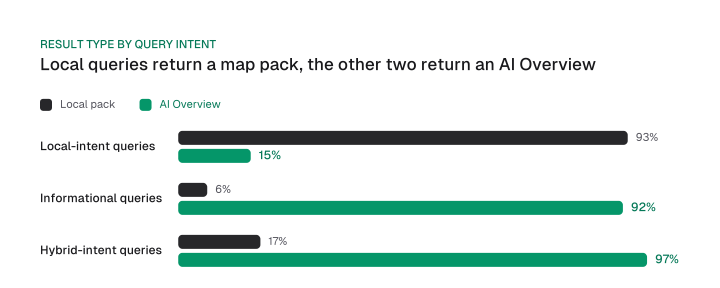
Read the limits before you lean on the numbers. The researchers wrote the query lists for each intent, and they say the nature of those queries affected how often a local pack appeared, so the shares describe those lists. The study page gives no per-intent query count.
Real estate agents were an outlier: AI Overviews appeared for as much as 50% of local-intent queries in that vertical. The study covers local-business query lists in three large cities, so don't stretch it to much smaller towns or other countries. For how Overviews behave on broader sets of queries, see AI Overviews impact on SEO.
Your own searches may also be coded differently than the study's. The study files "how much do personal injury lawyers charge in Phoenix" as informational and "cost of hiring a personal injury lawyer in Houston" as hybrid. Your cost search can land on either side, and it does not matter much: both sides lead with an AI Overview (92% and 97%) and show a small pack share (6% and 17%).
Now map the result to an asset. This mapping is ours, built from those figures, and not Google's:
You may have seen the 80/20 rule: that a small business should put most effort into local SEO and page structure. That is the Pareto principle applied to SEO, and we found no SEO study behind it. What the evidence supports is the split above: the local pack leads on local-intent queries, and an AI Overview leads on the other two.
Match your business shape to the profile and the page you can build
A business can create a Google Business Profile if it has a physical location customers can visit or travels to customers, so a virtual office or an online-only seller needs a different first asset.
The rule comes from Google's Business Profile guidelines. The table below turns it into seven SEO for small business examples, one per common shape. A service-area business hides its address, a storefront shows it, and a business that does both can show the storefront and set a service area.
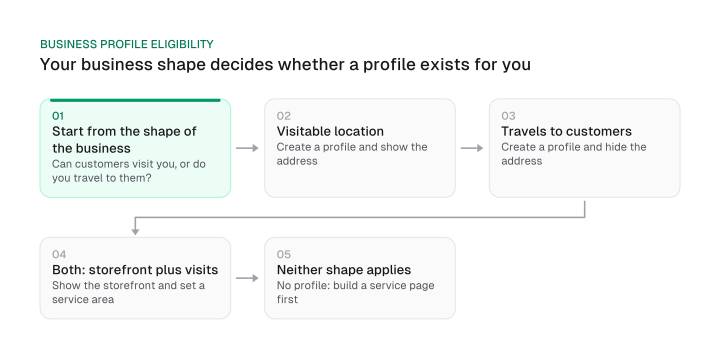
None of this means every business should rush to create a profile. If your row says no, the profile is closed to you, and the pages in the last column are where your effort goes. For multi-location businesses the picture changes, and local SEO for AI search covers it.
Three Google rules explain how a business that qualifies ranks. Distance is measured from the customer who is searching, or from what Google knows about where they are. That means a rank check from your own shop shows one point of view, and a customer across town may see a different map. This is our inference from Google's text, so check a few spots instead of trusting one.
Prominence is the second input. Google says it's based on information such as how many websites link to your business and how many reviews you have. The review count is therefore part of ranking, so asking real customers for reviews belongs in your routine.
Citations and link-building tactics sit in our off-page SEO guide. The third rule matters most for budget: Google says there's no way to request or pay for a better local ranking.
Build in this order, then read three numbers
A small-business SEO order starts with the asset your three searches pointed to, then service pages, then reviews, and you read the result in Business Profile numbers, a lead log and Search Console.
Calls, direction requests and website clicks, plus the lead log, read a pack or phone outcome. Search Console queries and clicks read the plain-links outcome. Skip any step your row in the shape table rules out.
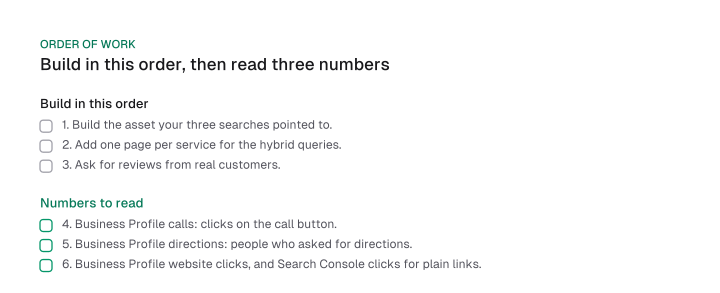
These SEO tips for small businesses work as a short small business SEO checklist, in this order:
- Build the asset from your check: the profile if your business qualifies, a service page written as an answer if your cost search returned an AI Overview, a how-to page if your how-to search did.
- Add one page per service where hybrid queries lead, so each cost-and-town question has a page that answers it. Titles, headings and internal links on those pages belong to an on-page SEO guide of their own.
- Ask for reviews from customers you've actually served.
- Check that pages load well on a phone. Speed and mobile have their own Core Web Vitals guide.
Reading the result takes three numbers and one habit. Google's Business Profile performance page defines the numbers:
- Calls: how many times a customer clicked the call button on your profile. Add your phone number to track it.
- Website clicks: how many times people clicked the website link on your profile.
- Directions: how many people asked for directions to your business.
Calls count button clicks and say nothing about answered calls, so they can't tell you who became a customer. The habit that closes that gap is a lead log. Copy this one, and ask every new customer "how did you find us" before you write the source:
At the end of the month, read the three Profile numbers beside the log. If calls rise and the log shows few customers, the profile is attracting calls that don't convert, so work on its services and description next. If the log names the profile as a source more often than before, the map pack is working.
For how leads and pages connect, our SEO lead generation guide goes deeper, and SEO reporting covers monthly habits.
Where plain links are the outcome, use Search Console. Its Performance report shows which queries bring traffic to your site and the number of clicks from Google Search results, so open it for the service page you built in step 2. Analytics can serve as an optional second view.
Rankings from a paid tool aren't on this list, because the searches and the log already read the outcome.
To track SEO performance over time, read the same numbers at the end of each month and compare them with the month before: Profile calls, directions and website clicks, the lead log, and Search Console clicks on the service page you built. Run the three searches again every few weeks to see whether the result type changed, then repeat the check each time you add a service.
Your next step is concrete: run the three searches today, write what each returned, find your row in the shape table and start the lead log. The opening move for a small business is whichever asset your own searches reward and your business shape allows, and the rest is the order above.
Frequently asked questions
Is SEO worth it for a small business?
It's worth it when at least one of your three searches returns a result type you can realistically enter. If none do, SEO is not the opening move. The Whitespark figures show how different the result types are: local packs on 93% of local-intent queries against 6% of informational ones. For the market-level answer, read will AI replace SEO.
Can I do my own SEO for my business?
Yes, for the opening move: the three-search check, the asset in your shape row and the lead log need no agency. For the stage at which paid help starts to make sense, see what are SEO services. Financial firms face extra rules on what pages may claim, covered in this guide to SEO for financial services firms.
How much should SEO cost for a small business?
It depends on scope and stage, and the full breakdown sits in how much does SEO cost. If you decide to hire, our best SEO agencies list compares providers.
Does SEO really help small businesses?
It helps in the way your searches allow. On local-intent queries a local pack appears 93% of the time and an AI Overview 15%; on informational ones an AI Overview leads at 92%. Pew found users clicked a traditional result in 8% of visits with an AI summary and 15% without, so expect fewer clicks where an Overview leads.
What is the 80/20 rule of SEO?
It's the Pareto principle applied to SEO, with no SEO study behind it that we found: a small share of effort supposedly produces most of the result. What can be stated with evidence is the split by query type, where the local pack leads by 78 points on local-intent queries and an AI Overview leads by 86 on informational and by 80 on hybrid ones.
Which SEO tools does a small business need?
The opening move needs no paid tool. Search Console shows the queries and clicks for plain-link results, Business Profile performance shows calls, directions and website clicks, and the lead log records who became a customer. Those three read the outcomes described above.
How do I track and improve SEO performance over time?
Compare one month with the last on four numbers: Business Profile calls, direction requests and website clicks, new customers in your lead log, and Search Console clicks on your service page. To improve them, fix the step whose number stalled, and rerun your three customer searches every few weeks, because a changed result type means the asset you build next changes too.
Cite this page
Aktaş, F. (2026, October 15). SEO for Small Business: Start With Your Customers’ Searches. Mission Growth. https://missiongrowth.io/blog/seo-for-small-business
Download the data: 1 table as CSV (CC BY 4.0)
Figures we made for this post are free to reuse under CC BY 4.0 with credit to Mission Growth.
Get Mission Growth highlighted in your Google results.