National SEO Strategy: Test Keywords, Then Build the Plan
National SEO is decided per query by the results page. Run a three-check SERP test, split national clicks in Search Console, then plan the work.
By Furkan AktaşPublished Updated

On this page
National SEO is the work of earning organic visibility across a whole country, and whether a keyword belongs to it is something you can check. Below you get a three-check test for every target query, a rule for brands with physical locations, a Search Console view that measures national work honestly, and questions to put to a provider. Run the test first; everything else follows from its result.
National SEO is a property of the results page
Google decides whether a query is national by the results page, not the keyword, so national SEO is scored query by query.
Google says it uses location to judge relevance. Its How Search Works page gives a football example: someone searching football in Chicago will likely see results about American football and the Chicago Bears, while in London the same search might turn up results about soccer and the Premier League.
The Business Profile help makes the local half of the point. Google writes that a customer might find local places near them if they search for "Italian restaurant" on their phone, and that it tries to show the kind of nearby business the customer would like to visit.
The query names no city, yet the results are local. So a keyword is never national or local by its words alone, and one site always holds both kinds. The first job in a national plan is to look at the results page for each keyword, which the next section turns into a test.
The three scopes differ in what they target and where the work lives:
National SEO vs local SEO is therefore a choice made per query, and a multi-location brand sits in two columns at once. The local column, including the ranking factors behind map results, lives in local seo for ai search and the map pack; here the focus is the national column and the line between the two.
The three-check SERP test for any keyword
The three-check SERP test counts how many of three local signals a query's results page shows (a map pack, city-named organic results, city names in related searches), and zero signals means the query is national. The test is our own scoring rule, built on Google's documented use of location. It is not a Google metric, and we weight the three signals equally by choice.
Open the results page for each keyword and ask three questions:
- Check 1: does a map or local pack take space on the first screen?
- Check 2: do the organic results include city-named pages or place directories?
- Check 3: do the related searches or autocomplete add city names to the query?
Count the checks that say yes. No location tool is needed, because each check reads one page.
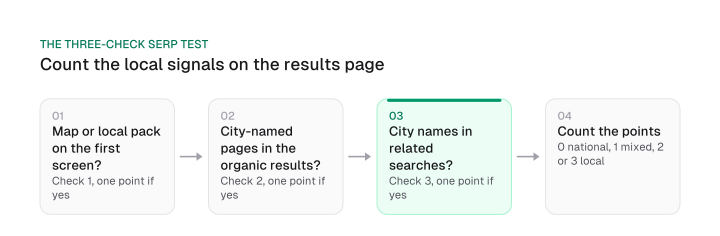
The score picks the campaign, which answers the question of what kind of SEO campaign your business requires:
Treat the score as a routing rule for budget. A zero is where national investment pays its way, and a three belongs to the local playbook even if your business ships everywhere. Intent type is a separate classification; search intent walks through it. This test only decides geographic scope and which workstream gets the money.
For example, a broad category term for software or a product line tends to score low, while a service plus "near me" or a city name tends to score high (illustrative query types, not observed results). Run the real check on your own list: the results page is the evidence, and a guess from the words proves nothing.
Which businesses need national SEO, and where the hybrid line sits
A business needs national SEO when its buyers sit beyond one service area and it can fulfill an order or a client there; a brand with stores adds city pages only where a staffed location or service area backs them. Fulfillment reach sets the scope.
Who should invest in national SEO? Invest if your buyers live beyond one service area, you can fulfill an order or serve a client in the farthest region at the margin you need, and your keyword list scores mostly zeros and ones on the three-check test. Nationwide e-commerce and SaaS or B2B companies usually meet all three; a service-radius business should hold off.
Start with the fulfillment radius: can you deliver or serve a buyer in the farthest target region at the margin you need? If not, expansion is premature, and teams end up chasing national keywords they cannot profitably serve. If yes, the business model sets the first workstream, as these national SEO examples show.
For e-commerce stores that ship nationwide, ecommerce seo covers category structure in depth, and b2b seo does the same for software and service buyers.
The hybrid rule is ours, derived from Google's Business Profile guidelines. They allow one profile for each location when a service business has separate service areas and separate staff at each location, and they say a profile's service area shouldn't extend farther than about 2 hours of driving time from where the business is based.
The page-level translation: build a city page only where a staffed location or service area exists, and answer every other city from the national page set. That rule settles when a city earns a page of its own.
The middle case needs its own answer. Is a multi-state brand that sells in three or four states doing national SEO? It is the hybrid: a national page set for category queries plus state pages built where service exists.
Measuring it has a catch. Search Console's Countries dimension groups data by the country where the search originated, so a state split has to come from another source. Control the scope of the work through the page set you build.
Run national SEO as four workstreams ordered by the test
Four workstreams make up a national SEO strategy (keyword tiers and topical authority, content, links and digital PR, technical foundation), and the SERP test result sets which one goes first. Authority work leads on score-zero keywords; everything else follows from what those pages need.
Keyword tiers and topical authority
Group the score-zero keywords into tiers: head terms that name the category, mid-tier problem and comparison terms, and long-tail questions. Build the tiers as connected hubs so the site shows depth on the whole subject. Topical authority SEO explains how that depth is built and read by search engines.
Content
Content follows the tiers. Each score-zero keyword gets one page that answers it better than the pages already ranking, and score-one keywords get a page that also shows service proof. Skip content for keywords that score two or three unless you have the location behind them.
Links and digital PR
National rankings need national links, and earning press coverage is the usual route: a coverage-worthy asset earns links from outlets that no local directory can match. Point those links at the hubs, and the homepage gets its share anyway.
Technical foundation
The technical foundation is a pointer here: pages must be crawlable, indexable and fast enough to render, and a national site with thousands of URLs magnifies any defect. Fix the template once and the benefit repeats across the page set.
Location pages: the doorway guardrail
Creating one page per city or state for a national site risks doorway abuse. Google's spam policies list, as an example, having multiple domain names or pages targeted at specific regions or cities that funnel users to one page.
A state or city page needs a unique reason to exist, and the staffed-location rule above is the test. The case differs from programmatic seo at scale, which covers generated pages in general: these are hand-built state and city variants, one way a national plan can drift into spam.
Measure national SEO in Search Console, and say what the filters cannot separate
Search Console separates national from local performance only in part. Filter Countries to your market, set the branded filter to non-branded, drop explicit place terms with a Doesn't match regex query filter, then score what is left.
The filters remove brand queries and queries that name a place. A localized query with no place name survives them, which is why the last step is scoring.
Follow these steps in the Performance report, Search results view, using Google's Search Console help for the filters:
- Add a Countries filter set to your market. Google defines the country dimension as grouping data by the country where the search originated, and the report's geographic grouping stops there.
- Apply the branded and non-branded queries filter and set it to non-branded. Google describes it as a way to separate data by whether the search term included your brand name. It isn't available for sites with a low number of impressions, and some queries might be incorrectly identified, so use the regex fallback below when it is missing.
- Add a Queries filter, choose Custom (regex), and select Doesn't match regex. Regex search lets you filter for, or exclude, multiple queries. Matching is a partial match anywhere in the string by default, and it is not case-sensitive by default.
- Export the remaining queries, sort them by clicks and score the biggest ones with the three checks.
- Report the share of clicks from queries that score zero, month over month.
The patterns below are illustrative, with a made-up brand (Acme Cloud) and made-up cities. Separate values with a vertical bar and wrap the whole expression in parentheses, as Google's help page describes.
Brand fallback (Queries, Doesn't match regex):
(acme cloud|acmecloud|acme)

Explicit place terms (Queries, Doesn't match regex):
(near me|nearby|austin|dallas|denver)
Name the limit in the report. Until the remaining queries are scored, call the remainder "non-branded, non-place-term clicks" and never "national clicks". The score-zero share of that remainder is the metric to track, and it moves when you publish authority content for the right keywords. For the wider reporting setup, see seo reporting.
Timeline and cost: what changes at national scale
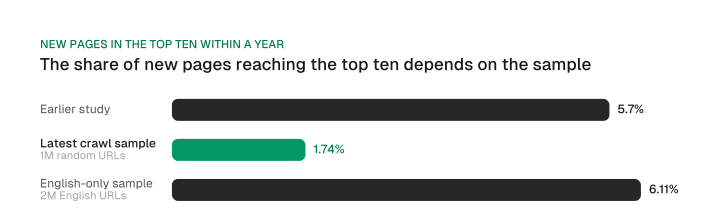
A national plan needs a year-scale view because Ahrefs finds between 1.74% and 6.11% of new pages reach the top ten within a year, depending on the sample, and the average number one page is now five years old.
No primary source gives a national-specific month count or compares national and local speed, so this guide states neither. The general range and its drivers are in how long does seo take.
An earlier Ahrefs study put the average top-ranking page at 2 years old and the share of new pages ranking in a year at 5.7%. Both figures have since moved.
Ahrefs's update puts the average number one page at 5 years old, three years older (5 minus 2). It also reports two new-page rates. Of 1M random URLs seen by its crawler in September 2023, 1.74% made the top ten within a year. Of 2M random URLs created in October 2023, filtered to non-empty English content, 6.11% did.
Ahrefs warns that some of the difference could just be due to the sampled data, so treat the share as a range and not a fixed rate.
One more Ahrefs figure shapes the plan. Of the pages that ranked in the top ten, 40.82% did so within 1 month. That leaves most ranking pages arriving later, so a quiet first month is no verdict on a page, and a long flat stretch after launch is a prompt to review the page rather than simply wait.
What a year-one plan can rely on:
With the average leader five years old, budget for refreshing and linking existing pages and not only for publishing new ones.
Cost follows the same logic. National work scales with per-keyword competition (how many strong sites hold each query), the number of pages the plan needs and the link acquisition behind them, which is why national scopes usually cost more than local ones. This guide gives no prices; seo cost covers the pricing models and what drives them.
What to ask a national SEO agency before you sign
Before you sign, a national SEO agency should show you each keyword's test result, the number of planned city pages with the reason for each, and a report that states which queries were scored national and separates branded, explicit-place and localized clicks.
These five questions turn this page's tests into a vetting checklist. For the general process of choosing a provider, see how to hire an SEO consultant; the questions below are specific to national scope, and the same list works for any national SEO services you shortlist.
- Can you show the test result for every target keyword? Look for a score or an equivalent classification per query, checked on the live results page. Red flag: a keyword list sorted by search volume only.
- How many city or state pages are planned, and why does each exist? Look for a staffed location or service area behind every one. Red flag: a page per city with the same template.
- How will you report national results? Look for a report that says which queries were scored national and separates branded, explicit-place and localized clicks. Red flag: a single "organic traffic" line.
- What do you expect from new pages in the first year? Look for an answer that cites measured rates and avoids a promised month. Red flag: a guaranteed ranking date.
- What is the refresh plan for pages that exist already? Look for a schedule for updating and linking current pages. Red flag: a plan made only of new content.
If you are weighing a national SEO company that sells scope as a package, what are seo services shows what the labels usually include. The agency page is a sales page, and the questions above are how you read it.
The results page is what makes a query national, so test each target query before funding national work, measure it query by query in Search Console, and add city pages only where a real location backs them. Next step: export your keyword list, run the three checks on each term, and bring the scored list to your next provider call.
Frequently asked questions
Does national SEO help me rank on Google outside my city?
Yes, where the keyword scores zero on the test. Google adjusts results to the searcher's place, as its football example shows, so a query that returns local places will keep favoring businesses near the searcher. Run the three-check test on the keyword before you invest.
Is a three or four state business doing national SEO?
No, it is the hybrid middle: one national page set plus state pages where service exists. Search Console's geographic dimension is country, so state-level spread has to come from another source. Avoid state pages with no real service behind them, since pages targeted at specific regions that funnel users to one page are an example in Google's spam policies on doorway abuse.
What is the difference between national and international SEO?
The national version targets searchers in one country, while the international one targets several countries or languages. International work adds language and country targeting, using hreflang for language versions of a page.
Do national brands still need local SEO?
Yes, for each staffed location. The national page set serves category queries, and Google shows nearby places for queries such as "Italian restaurant" with no place name, so each location needs its own local presence.
Can a small company start with national SEO?
Yes, with the keywords that test zero and a narrow set of them. Authority is the constraint: Ahrefs finds between 1.74% and 6.11% of new pages reach the top ten within a year, so a small site should expect to concentrate its effort.
Cite this page
Aktaş, F. (2026, October 15). National SEO Strategy: Test Keywords, Then Build the Plan. Mission Growth. https://missiongrowth.io/blog/national-seo
Figures we made for this post are free to reuse under CC BY 4.0 with credit to Mission Growth.
Get Mission Growth highlighted in your Google results.